Franz Liszt was born in Raiding, near Ödenburg, October 22, 1811 and died in Bayreuth, July 31, 1886. He was a Hungarian composer and pianist who was a major influence during the romantic period. Liszt was an outstanding pianist at seven, composed at eight and made concert appearances at nine. In addition to being a piano virtuoso, he was also a critic, conductor, city music director, literary writer and transcriber of the works of other composers. He transcribed Beethoven’s Symphonies for the piano.
Franz Liszt began his career as the outstanding concert pianist of the century, who, along with the prodigious violinist Niccoló Paganini (1782-1840), created the cult of the modern instrumental virtuoso. To show off his phenomenal and unprecedented technique, Liszt composed a great deal of music designed specifically for this purpose, resulting in a vast amount of piano literature laden with dazzling, and other technical marvels. In this vein, Liszt composed a series of virtuosic rhapsodies on Hungarian gypsy melodies, the best-known being the all too familiar Hungarian Rhapsody no. 2. Liszt developed the rhapsody as a form of serious music. This kind of music is worlds apart from the generally more introspective, poetic music of pianist-composer Frédéric Chopin.
Liszt was wildly handsome and hugely talented. He was extremely popular in Paris during the 1830’s. It is said that women actually fainted at his piano recitals. He was the first to position the piano so that its lid reflected the sound and the audience could see his profile as he performed.
Liszt was the first to write a tone poem, which is an extended, single-movement work for orchestra, inspired by paintings, plays, poems or other literary or visual works, and attempting to convey the ideas expressed in those media through music. Such a work is Les Préludes, based on a poem in which life is expressed as a series of struggles, passions, and mysteries, all serving as a mere prelude to . . .what? The Romantic genre of the symphonic poem, as well as its cousin the concert overture, became very attractive to many later composers, including Saint-Saëns, Tchaikovsky, Dvorák, Sibelius, and Richard Strauss.
Listen to Liszt’s transcription of Meyerbeer’s Hellish Waltz from Robert du Diable, which probably caused more public commotion than any other piano piece in history.
Mr. Takács is widely admired for his command of the instrument and his intelligent and communicative musical interpretations. His complete set of Beethoven’s sonatas, which was released in 2011, was acclaimed internationally.
For this concert, he will play an All-Beethoven-Program including the Tempest, Pathetique and Waldstein Sonatas.
Do not miss his piano masterclass on Saturday, October 24 from 2 p.m. to 4 p.m. (free event) Mr. Takács has been a cherished piano professor at Oberlin Conservatory of Music since 1976. You will be amazed to see him take piano students to another level of accomplishment.
1813 ~ Giuseppe Verdi, Italian composer
Read quotes by and about Verdi More information about Verdi
1835 ~ Camille Saint-Saëns, French composer, organist and conductor Saint-Saëns’ Carnival of the Animals is featured in Disney’s Fantasia and Fantasia 2000.
Read quotes by and about Saint-Saëns
More information about Saint-Saëns
• 1931 ~ Russ Columbo’s Prisoner of Love was recorded on Victor Records.
1940 ~ John Lennon, British rock singer, songwriter and guitarist
More information about Lennon
• 1935 ~ Cavalcade of America was first broadcast on radio this very day. The CBS show featured some of Hollywood and Broadway’s most famous stars in leading roles in the half hour radio dramas. Thomas Chalmers narrated the stories about obscure incidents and people in American history. The orchestra (yes, radio shows had live orchestras back then) was led by Donald Voorhees. The show aired from 1935 to 1953, changing from CBS to NBC in 1939; with one sponsor for its entire duration. The DuPont Company introduced its slogan on Cavalcade of America …”Better things for better living through chemistry…”
• 1947 ~ “High Button Shoes”, opened on Broadway in New York City with an entertainer named Phil Silvers in the lead. The popular show ran for 727 performances.
• 1948 ~ Jackson Browne, Songwriter, singer
• 1967 ~ “And now…heeeeeeeeerrrree’s the Doctor!” Coming out of the NBC Tonight Show Orchestra to become musical director of The Tonight Show Starring Johnny Carson, Doc Severinsen replaced Skitch Henderson on this night. Doc became famous for an eccentric wardrobe, quick wit, great trumpet solos and fabulous charts.Tommy Newsome became Doc’s backup arranger for many of the tunes the band played. Later, Doc and the band would move to solo albums, group CDs and incredibly successful concert tours. Doc went on to play with various symphony orchestras and even became the owner of a custom trumpet company in the San Francisco Bay Area.
• 1973 ~ Priscilla Presley, was divorced from Elvis in Santa Monica, CA. Ms. Presley got $1.5 million in cash, $4,200 per month in alimony, half interest in a $750,000 home plus about 5% interest in two of Elvis’ publishing companies.
• 1973 ~ Paul Simon got a gold record this day for his hit, Loves Me like a Rock.
• 1975 ~ John Lennon turned 35. To celebrate, Yoko Ono Ono presented John with a newborn son, Sean Ono Lennon.
• 1976 ~ Ludwig van Beethoven’s “Symphony number 5 in c minor” landed for a twenty-two-week stop in the first spot on the Top 5. Beethoven is dead and this isn’t a ghost story. It’s simply a case of Beethoven being updated with a disco rock beat and a catchy new title: A Fifth of Beethoven.
• 1985 ~ A 2½ acre garden memorial was dedicated to John Lennon by his widow,Yoko Ono, this day. The memorial in New York City’s Central Park is named Strawberry Fields.
• 2001 ~ Herbert Ross died at the age of 76. He was a director and choreographer whose credits include the hit movies “The Goodbye Girl,” “The Sunshine Boys” and “The Turning Point.”
• 2003 ~ Don Lanphere, a saxophone player who came on strong at the dawn of bebop, nearly succumbed to drugs and drinking, then recovered to become the city’s jazz “grandpop,” died of hepatitis C. He was 75. As lead tenor in the Seattle Repertory Jazz Orchestra and in smaller groups, Lanphere’s versatility and virtuosity ranged from blazing riffs on the tenor to a solo jazz rendition of the Lord’s Prayer on the soprano sax. Many who were born long after Lanphere’s boyhood gigs with such legends as Charlie Parker, Fats Navarro and Max Roach hailed him as a jazz patriarch or, as his Web site proclaimed, “Seattle jazz grandpop.” Born in the apple country of central Washington about 95 miles east of Seattle, Lanphere played as a teenager with touring bands in Seattle, then studied music briefly at Northwestern University in Evanston, Ill. By the time he got to New York, captivated by the post-World War II bebop revolution, he was hooked on heroin. By his early 20s he had recorded with Navarro and Roach and played gigs with Parker, Woody Herman and top big bands, including one led by Artie Shaw. He could write a chart, the chord arrangement on which jazz improvisation is based, from the sound of water dripping in a tub. Battling alcohol and narcotics addictions that resulted in at least one arrest, he was back at his father’s store in Wenatchee – “from the Big Apple to the little apple,” he once said – by 1960. Only after he and his wife Midge became born-again Christians in 1969 did he dust off his horn. In an interview in 1998, he said that without the conversion, “I would be dead by now.”
Sibelius: Valse Triste and Scene with Cranes Beethoven: Piano Concerto No. 2
-Sean Chen, piano Sibelius: Symphony No. 2
Hailed as a charismatic rising star, pianist Sean Chen won over fans and critics at the 2013 Van Cliburn Piano Competition as the Crystal Award winner with “an exceptional ability to connect with an audience combined with an easy virtuosity” (Huffington Post). Chen is the first American to earn a Cliburn award since 1997, just months after being named the 2013 Christel DeHaan Classical Fellow of the American Pianists Association.
“It was a muscular, impassioned performance, and you felt that he is an artist with something to say.” – Cincinnati Enquirer
$58, $46, $34. 1 Free Student Ticket Available with Mason ID on October 13, 2015
JoyTunes (Piano Maestro) just released one of the most beautiful pearls of classical piano music, Bach’s Prelude in C major.
As a bonus, they also released the original version of Für Elise (till now we had the simplified version). You can find them in the Classical & Opera section.
Piano Maestro is available to students of the O’Connor Music Studio for no extra charge.
A concert pianist is someone who plays the piano in concerts. So far so good, although it may be worth adding the adverb ‘regularly’ to that description. Someone did once tell me that his Aunt Ada was a concert pianist. “She had a lovely touch and played to great acclaim in a concert in our church hall – ‘Rustle of Spring’ I think.”
To avoid any confusion the clip above was played by Semprini, not Aunt Ada.
I’ve written before on this blog about how much more time is spent practising secretly at home or backstage than in front of an audience. It’s the training leading up to the Wimbledon Final, the solitary punchbag months before the blood flies into the roaring crowds at the World Heavyweight Boxing Championship.
But between home and the stage there are many hours when I want to work and I can’t. It’s one of the greatest frustrations of my touring life that, unlike other instrumentalists, I arrive at a hotel without my instrument. There’s that hour before dinner or the time spent twiddling thumbs before doing an interview when I would love to twiddle all ten fingers and check through a passage in my concerto or just get loosened up after a long flight … and I can’t.
Or at least the effort involved in doing so can be enormous. A piano somewhere in the hotel is the best solution, as long as it’s far away from prying ears. It has been suggested to me in the past that I play in the atrium lobby, amidst the mingling guests, the palm trees, the pile-up of Samsonite suitcases. Not even ‘Rustle of Spring’ is thinkable in those circumstances, I’m afraid. If the hotel is a mere walk from the hall then that’s the next best scenario although, later in the evening, there’s unlikely to be someone waiting just for me at the stage door. It has to be planned in advance and it’s often hard to know my plans in advance.
Then the options start to get worse, a taxi ride to a distant hall in heavy traffic, for instance. Finding the venue itself is the first hurdle but then, how to find the stage door? I’ve spent many occasions circling the building, rattling rusty handles, banging my fists against flaking doors, pressing antique buzzers, shouting through glass walls, leaving voicemail messages … to no avail.
Sometimes a generous patron will invite me to use his or her piano. Now I don’t want to sound like I don’t appreciate such kind offers (and sometimes it’s been the beginning of a wonderful friendship) but in my experience pianos in strange homes often come with cats … or rattling photo frames perilously balanced on piano lids, or a vase of trembling flowers on the same, or an impossibly high bench, or a squeaky pedal. And worst of all is the person who, leaving the door open, says to me: “Oh, I love the piano. Don’t mind me. I’ll just be in the next room if you need anything. What are you going to practise?” Then I freeze. I simply can’t work if I know someone is listening to me. It’s a bit like writing when someone is looking over your shoulder. Self-consciousness makes self-expression (and self-criticism) impossible.
So for a long time I oscillated between these various unsatisfactory formats until in more recent years I just stopped trying to practise on the road at all. But then a few seasons ago I started renting an electric keyboard if I was going to stay in a city for more than a couple of days. It was wonderful, saving time and making time so much more fruitful. I’d turn the volume down very low and work away at any time of the day or night.
I’m just beginning a two-month tour, starting in Hobart this week with the Tasmanian Symphony Orchestra and Marko Letonja, playing all five Beethoven concertos for the first time. And, also for the first time, I’ve brought along my own electric piano. It’s an experiment and so far (during a short stop at a beach in Thailand last week) it’s been invaluable. A full length keyboard of 88 keys is no good because, as well as being just that bit too heavy to maneuver, it won’t fit into a regular taxi.
But then I discovered the Nord 76-key Piano 2 with Hammer Action. Hand-made in Sweden (yes, I did a second take too) it’s the perfect tool for the job. There are lots of pieces of course which you can’t play from start to finish with a reduced keyboard (although only one note, occurring just three times, in all five Beethoven concertos is missing) but, like a ballet dancer at the barre, in just thirty minutes I can warm up, stretch the muscles, work at a few problem passages here and there and generally keep in shape without having to leave my room. Now when I don’t play the piano I don’t want to.
By Stephen Hough
Concert pianist, writer of words and music, governor of royal ballet companies, theology, art, poetry, perfume, puddings. Website: www.stephenhough.com Twitter: @houghhough
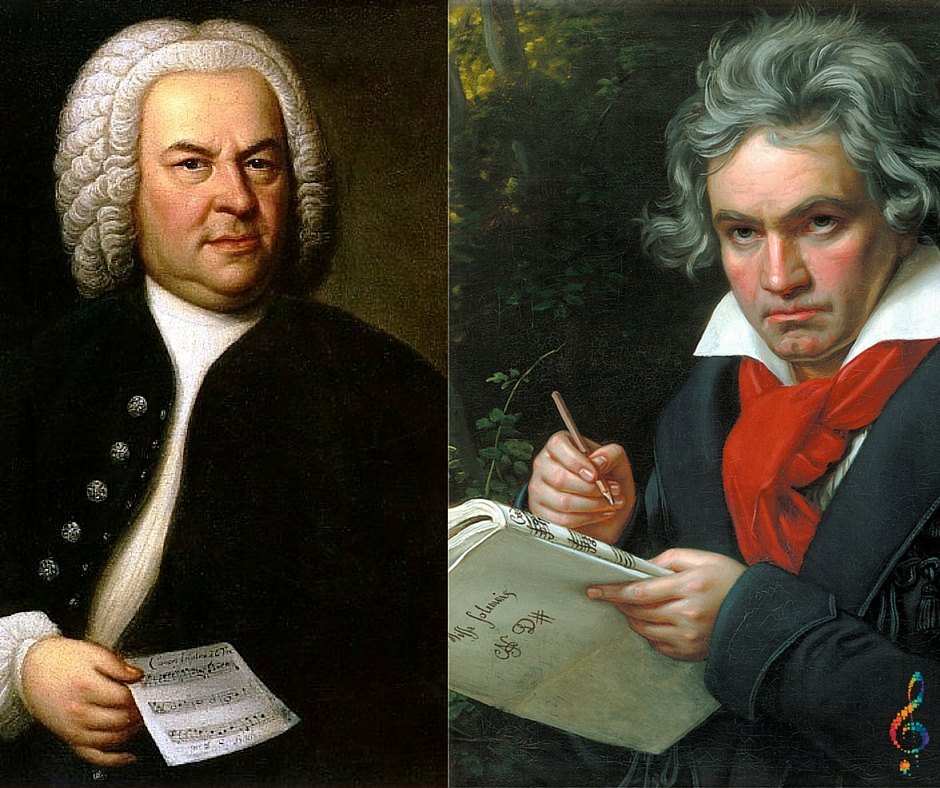
Beethoven’s first published works—his Opus No.1—were three trios for piano, violin and cello and already they show a marked advance on Haydn’s trios in the comparative interdependence of the three parts. Their freedom from Haydn’s oppressive formality looks forward to the first mature trios, the pair that comprises Opus 70, displaying all sorts of harmonic twists, thematic innovations and structural idiosyncrasies, these trios make much of the piano part and contain plenty of dramatic outbursts that are typical of Beethoven’s middle period.
Even more arresting is the first of the Opus 70 trios (1808) nicknamed ”The Ghost” because of its mysterious and haunting Largo. Its sibling boasts a cheerful bombastic finale that is the most entertaining music that Beethoven composed for this combination of instruments.
The “Archduke” Trio Opus 97 (1811) was Beethoven’s last full – scale work for piano trio and is typically conclusive. The third movement is its centre of gravity, a highly moving set of variations with the cello dominating the thematic content. It opens with a hymn-like theme and progresses to a coda which magnificently sums up the movements ideas. The finale might be less powerful than that of Opus 70 No. 2, but it nevertheless has a sweeping rhythmic power. Again, it is beyond the shadow of a doubt that Beethoven defined the piano trio form that it retained throughout the 19th century by allowing the string instruments the status of genuinely equal partners in this superlative performance.
The Piano Puzzlers book is available in the O’Connor Music Studio library if you’d like to give any a try. Piano Puzzlers as heard on American Public Media’s “Performance Today.” Includes 32 tunes with songs by Gershwin, Berlin, Arlen, Porter, Rodgers, Fats Waller, Lennon & McCartney, and others disguised in the styles of Bach, Handel, Haydn, Mozart, Beethoven, Brahms, Schubert, Schumann, Chopin, Janacek, Debussy, Ravel, Rachmaninoff, Stravinsky, Prokofiev, Bartok, and Copland.
Includes an introduction by Fred Child, host of “Performance Today” as well as background info by Bruce Adolphe. “Bruce Adolphe has taken a common musician’s party game and elevated it to high art and truly funny musical slapsticks. The Piano Puzzlers are a unique combination of extraordinary insight into the styles of many composers subtle, expert workmanship and great, great fun!”
If you’re a music geek (like me), I have a program for you. Now, let me be clear, to fully qualify as a music geek…you must have a fond appreciation for classical music (no, Poison, Quiet Riot, and Zepplin do not count as classical music). So, if you’re a “music geek” without an appreciation for classical music…well, I hate to burst your bubble…but, you’re not truly a music geek. Instead, you’re a music appreciator, but not a geek. So, if you just listen to indie music and scowl at anything on a label larger than Matador…don’t bother following the link I’ll provide…the fun will be lost on you…And, you probably won’t have a chance.
Every Wednesday night, on my way home from WNL, I turn on my local NPR station to listen to Piano Puzzlers on Performance Today. It’s absolutely incredible. A pianist/composer (Bruce Adolphe) takes a familiar folk or pop tune and sets it inside a classical masterpiece (or in the style of a particular composer). Sometimes it’s easy…sometimes it’s ridiculously difficult. There are days when I say, “got it” on the first pass. Then there are days when I say, “what the heck?” And, more often than not, I’m able to get either the popular/folk tune or the composer.
This is sad to admit, but there are nights when I’ll slow down on the drive home or sit in the car in the driveway to finish an episode. In fact, I get a little worked up if someone stops me after WNL…as I might miss the beginning of Piano Puzzlers (it usually hits around 8:20pm on our local station).
Take a listen to some of the archives and see if you can figure it out! It’s really cool…but probably only appreciated by music geeks (the kind of people that listen to NPR for their musical programs and not just the snipets of cool indie rock between segments on All Things Considered…which is a great show too).
American pianist Edmund Battersby, who gave the opening concert of the Dublin International Piano Festival at the Hugh Lane Gallery on Saturday, may well have felt at times that he was in some sort of movie scene rather than in a regular concert.
While he was playing, the piano began to move away from him. It wasn’t a full concert grand, and didn’t have lockable castors. The gallery has a shiny floor, and the instrument didn’t always manage to stay in its place. Battersby coped masterfully, making the necessary adjustments as if he were merely fixing his jacket or making himself more comfortable on the piano stool.
His savoir faire was all the more remarkable given that he was playing one of the most daunting works in the repertoire, Beethoven’s Diabelli Variations.
The story of these variations is well known. The composer and publisher Anton Diabelli decided to create a “patriotic anthology” by sending all the important Austrian composers of the day a simple waltz theme of his own for each to write a variation on.
Beethoven rejected Diabelli’s original idea, and described the theme as a “cobbler’s patch”. But he changed his mind and wrote a set of 33 variations, which Diabelli proudly published as a companion piece to the 50 variations he had received from other hands.
Classical piano pieces by such composers as Beethoven, Mozart and Chopin likely sounded much different when the masters first performed those works than they do today. Pianos themselves have changed considerably — but so, too, has technique.
Over the past decade, a growing number of musicologists have begun to take a closer look at how technique shapes not just the sound of music, but also the audience’s emotional response to it.
“Music has one foot in physics and one foot in aesthetics,” said Rolf Inge Godoy, a professor of musicology at the University of Oslo. “Body motion is essential for shaping the outcome of the sound, both in terms of what you actually hear and in terms of the visual impact on an audience.”
Dr. Godoy uses optical motion capture — also employed by the animation industry — to study the physics of musical movement. Infrared cameras capture light from reflective markers placed on a cellist’s hands or a percussionist’s body, recording the performer’s motion at up to 500 frames per second and at an accuracy to one-third of a millimeter.
Computer algorithms then make associations between the motion data, what is heard and what listeners say they felt.
Recently Dr. Godoy turned the technology on a fascinating question: How were such classical pieces as Mozart’s Variation K. 500 and Hummel’s Etudes, Opus 125, originally played, and how might that have made a difference in sound and in audience reaction?
To find out, Dr. Godoy struck up a collaboration with Christina Kobb, a doctoral candidate at the Norwegian Academy of Music and head of theory at Barratt Due Institute of Music in Oslo. Ms. Kobb has developed an unusual expertise: She has learned how to play the piano according to techniques described nearly 200 years ago.
As a visiting student at Cornell University in 2010, she researched 19th-century pedagogical piano treatises — essentially, instruction manuals for piano playing. The techniques that they described, she realized, differed drastically from those she had been taught.
“I was not following even the most basic instructions given to beginners at the time,” Ms. Kobb said. “I wondered, ‘Would this make a difference in my playing?’ ”
For the next three years, she gradually replaced her modern way of playing with 19th-century technique, gleaned from around 20 treatises. Most were written in Vienna in the 1820s, while a few were published in France and England. Her primary source, however, was “A Complete Theoretical and Practical Course of Instructions on the Art of Playing the Piano Forte,” the seminal 465-page treatise published in 1827 by Johann Nepomuk Hummel, one of Mozart’s students.
“It’s hard enough learning how to play once,” she said. “I had to become conscious of every motion in my hands and fingers, things that normally I would do automatically, by habit.”
While modern players tend to hunch over the keys and hold their forearms nearly perpendicular to the keyboard, 19th-century style dictated that pianists sit bolt upright. The posture prevented players from bringing their weight to bear on the keyboard, instead forcing them to rely on smaller finger movements. The elbows were held firmly against the body, with forearms sloping down and hands askew.
As Ms. Kobb became more fluent in this approach, she found that certain movements — jumping quickly between disparate chords, for example — became swifter and more fluid. “The elbow against your body serves as a sort of GPS, so you always know where you are,” she said.
Chords and scales sound smoother and can be played faster, Ms. Kobb also found, and dramatic pauses between notes — often a matter of physical necessity rather than of style — are lessened. The old style also allows the performer to be more discriminatory and subtle in choosing which notes to stress, Ms. Kobb learned, producing a performance that is subdued by today’s standards.
“There’s a different physical feeling to playing, as well as a different outcome,” she said.
To identify the sources of those differences, Dr. Godoy and his colleagues recently attached 46 pieces of reflective material to Ms. Kobb’s fingers and arms, and then filmed her playing on an electric piano. After analyzing her movements, the researchers will be able to tell precisely which differences in technique account for each variation in the music as it is played in the old and modern styles.
“The correlation between bodily effort and sound output is really what we’re aiming to find out, but in order to do that we need to perform extensive statistical analysis, which is tremendously time-consuming,” Dr. Godoy said. He expects the results of the data analysis in three to four months.
“We are exploring those connections to get a better understanding of what music is,” Dr. Godoy added. “What is its power, and why do people respond so strongly to it?”
For her part, Ms. Kobb now plans to delve deeper into the repertoire of Romantic composers. “It’s time to restore the early techniques to try to bring us even closer to the way music sounded at the time of Beethoven,” she said.

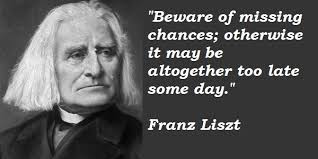

 Listen to Liszt’s transcription of Meyerbeer’s Hellish Waltz from Robert du Diable, which probably caused more public commotion than any other piano piece in history.
 Read quotes by and about Liszt
 Liszt was the first recitalist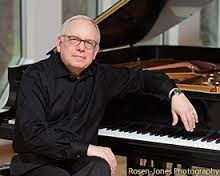

 1813 ~ Giuseppe Verdi, Italian composer


 MaryO'Studio