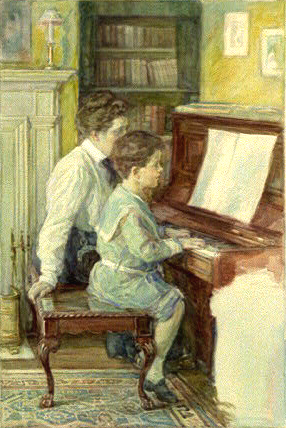
Today is National Buy a Musical Instrument Day

Piano 8


Each year on May 22 we observe National Buy a Musical Instrument Day.  The day is all about playing music.  If you are a musician, it might be time for a new instrument.  Maybe you can learn to play a second or third one.  If you have never played an instrument before, National Buy A Musical Instrument Day might be the motivation you need to start.

Naturally, here at the O’Connor Music Studio, a piano, keyboard with weighted keys (and 88 of them!) or organ is recommended but this day is for all types of instruments and is for people of all ages.  Grandpa can play his ukulele while the grandkids play the drums, trombone, and flute. Together they can all make terrific music!

Adapted from http://www.nationaldaycalendar.com/national-buy-a-musical-instrument-day-may-22/


National Buy a Musical Instrument Day

Piano 8


Each year on May 22 we observe National Buy a Musical Instrument Day.  The day is all about playing music.  If you are a musician, it might be time for a new instrument.  Maybe you can learn to play a second or third one.  If you have never played an instrument before, National Buy A Musical Instrument Day might be the motivation you need to start.

Naturally, here at the O’Connor Music Studio, a piano, keyboard or organ is recommended but this day is for all types of instruments and is for people of all ages.  Grandpa can play his ukulele while the grandkids play the drums, trombone, and flute. Together they can all make terrific music!

Adapted from http://www.nationaldaycalendar.com/national-buy-a-musical-instrument-day-may-22/


From TED-Ed: How Playing An Instrument Benefits Your Brain

When you listen to music, multiple areas of your brain become engaged and active. But when you actually play an instrument, that activity becomes more like a full-body brain workout.

What’s going on? Anita Collins explains the fireworks that go off in musicians’ brains when they play, and examines some of the long-term positive effects of this mental workout.

via How playing an instrument benefits your brain – Anita Collins | TED-Ed.

Are You Moving this Summer?

Many homeowners don’t realize that there are movers available to them who specialize in the transportation and storage of pianos. A piano is a delicate instrument and not something you want to take risks with. By trusting this major job to a piano mover, you can rest easy knowing that one of the most valuable items in your home is being transported with the care it deserves.

But It Weighs 1500 Pounds. How Delicate Can It Be? 

pianomovingThis is exactly where many homeowners go wrong. Sure, that piano in your living room is heavy enough to throw out the backs of four or five of your best buddies as you wrestle it out the door and up into the truck, but don’t let that fool you. Despite its bulky appearance, it is also a precision musical instrument with over 1000 moving parts and 200 finely-tuned strings, any number of which can be damaged and require repair if your piano isn’t handled properly in a move.

Your Piano Mover Understands Pianos

These intricate inner workings of a piano are exactly why hiring an expert in piano moving is so important. These professionals understand pianos and moving them, from the safest way to lift and twist a standard upright piano to get it out the door, to how to properly disassemble a grand piano and transport it without causing any damage. And even more importantly, a piano mover understands that when your piano is delivered to your new home, you expect to be able to sit down and play it right away. It’s why many piano movers keep tuners and repairmen on staff, and why the rest will have a trusted list of professionals available on request if you need it.

From: http://www.homeadvisor.com/article.show.Don-t-Take-Risks-Moving-Your-Piano-Hire-an-Expert.14222.html#ixzz39Gny25qc

Why Students Really Quit Their Musical Instrument (and How Parents Can Prevent It) – National Association for Music Education (NAfME)

piano-teacher
A great article from the National Association for Music Education (NAfME)

The real reasons that students quit is often beyond their own understanding.  It is up to teachers and parents to create moments for students to want to continue on their instrument during the early years of study in order for the child to be successful and stay with the craft.

Here are reasons students quit, and ways to combat them:

Parents need to find music just as important as other subjects.  The sad truth is that many non-music teachers and administrators do not find music equally as important as math or English language-arts, but parents need to.  Besides, you wouldn’t let your child quit math, would you?  Many kids would jump at that opportunity.  Music is a core subject…period.  The more parents treat it as such, the less students will quit.

Students don’t know how to get better.  Without the proper tools and practice habits to get better at anything, students will become frustrated and want to quit.  It is the role of the music educator and the parents to give students ownership over their learning.  Teachers must teach students why, how, where, and when to practice, and parents must obtain minimal knowledge about how students learn music in order to properly support them at home.

Parents and students think they aren’t musically talented.  Sure, there are some kids who pick up an instrument and sound decent immediately, but they will hit a wall later and have to work hard to overcome it.  Most everyone else won’t sound that great at first.  Playing a musical instrument is a craft that, if practiced correctly, is something that all children can find success in.  As long as students know how to practice and that it needs to be done regularly, they will get better.

Students discontinue playing over the summer.  Statistics show that students who do not read over the summer find themselves extremely behind once school starts.  The same goes for playing an instrument.  A year of musical instruction can quickly go down the tubes over the summer vacation if students do not find small ways to play once in a while.  Picking up an instrument for the first time after a long layoff can be so frustrating that a student will not want to continue into the next school year.

The instrument is in disrepair.  A worn down cork, poor working reed, or small dent can wreak havoc on a child’s playing ability.  Sometimes the malfunction is so subtle that the student thinks they are doing something wrong, and frustration mounts.  Students, parents and teachers need to be aware of the basics of instrument maintenance and be on top of repairs when needed.

Teachers don’t create enough performing opportunities during the year.  The best way to motivate students musically is through performance.  Weeks or even months on end of practicing without performing for an audience gets old very quick, and student will definitely quit.  Teachers should schedule performances every six weeks or so in order for students to stay engaged and practicing.  Parents can help by creating small performance opportunities at home — a Friday night dinner concert or a planned performance for visiting family members are great ideas.

There is not enough “fun”music to practice.  It’s very important for parents to be aware of music that interests their child, because it exists in sheet music form for download or purchase.  It’s important that all students play music that is aligned to their interests in addition to other pieces that are worked on in school.

Other activities are pulling at the child.  Between art lessons, sports, karate, and other activities, parents grow weary of having “one more thing” to be on top of schedule-wise.  Parents need to understand that the enduring social and psychological benefits of music are as enormous as those of sports — in the same and different ways.  Budget time accordingly and children will have 10 minutes a day to practice an instrument, for sure.

Much like any worthwhile venture, practicing a musical instrument has its ups and downs.  Kids need to be reminded to practice, of course — but they should not be constantly pushed, and they should not be completely left alone.  It’s a balancing act where sometimes the parents will need to give their child a break for a few days and other times will need to bribe them to practice.  Either way, all children are capable of thriving with a musical education, and students will indeed thank their parents for not letting them quit.

via Why Students Really Quit Their Musical Instrument (and How Parents Can Prevent It) – National Association for Music Education (NAfME).

How Playing An Instrument Benefits Your Brain – Anita Collins | TED-Ed

When you listen to music, multiple areas of your brain become engaged and active. But when you actually play an instrument, that activity becomes more like a full-body brain workout.

What’s going on? Anita Collins explains the fireworks that go off in musicians’ brains when they play, and examines some of the long-term positive effects of this mental workout.

via How playing an instrument benefits your brain – Anita Collins | TED-Ed.

How Playing An Instrument Benefits Your Brain

When you listen to music, multiple areas of your brain become engaged and active. But when you actually play an instrument, that activity becomes more like a full-body brain workout.

What’s going on? Anita Collins explains the fireworks that go off in musicians’ brains when they play, and examines some of the long-term positive effects of this mental workout.


Read the entire article at http://ed.ted.com/lessons/how-playing-an-instrument-benefits-your-brain-anita-collins

Music lessons spur emotional and behavioral growth in children, new study says – The Washington Post

From the Washington Post, but we knew this already, right?

http://youtu.be/TlBmdNm3uhc

Music training not only helps children develop fine motor skills, but aids emotional and behavioral maturation as well, according to a new study, one of the largest to investigate the effects of playing an instrument on brain development.

Using a database produced by the National Institutes of Health Magnetic Resonance (MRI) Study of Normal Brain Development, researchers at the University of Vermont College of Medicine analyzed the brain scans of 232 healthy children ages six to 18 specifically looking at brain development in children who play a musical instrument. (The original study did not indicate specific instruments.)

“What we found was the more a child trained on an instrument,” said James Hudziak, a professor of psychiatry at the University of Vermont and director of the Vermont Center for Children, Youth and Families, “it accelerated cortical organization in attention skill, anxiety management and emotional control.”

Read the entire article at Music lessons spur emotional and behavioral growth in children, new study says – The Washington Post.

What Instrument Should You Learn to Play in 2015?


Picking which instrument to learn can be a challenge within itself which is exactly why we created this fun quiz!

Just answer 10 questions and we’ll recommend an instrument for you to learn. Happy New Year and Happy Playing!

Take the test here: What Instrument Should You Learn to Play in 2015 | JoyTunes.