. 1760 ~ Jan Ladislav Dussek, Czech composer and pianist. Along with his friend, famed piano maker John Broadwood, Dussek made important design improvements to the piano, allowing for the more dynamic style of playing that his highly original compositions required. Beethoven himself later used a Broadwood piano with Dussek’s innovations. This helped pave the way for Romanticism and Dussek’s influence on Beethoven’s piano writing has been well documented.
Dussek’s Piano Sonata Op. 77 in F minor (“L’invocation”), from 1812, is the last work he ever composed, and he saved the best for last. This is a neglected masterpiece that foreshadows Schubert, Chopin, Schumann, and Brahms.
. 1881 ~ Anna (Pavlovna) Pavlova, Russia’s premier ballerina
. 1894 ~ Hans von Bülow, German pianist and composer died (b. 1830)
More about von Bulow
. 1898 ~ Roy Harris, American composer
. 1904 ~ Ted Mack (William Maguiness), TV host of The Original Amateur Hour, The Ted Mack Family Hour
. 1914 ~ (Gordon) Tex Beneke, Bandleader, singer, tenor sax in the Glenn Miller Orchestra
, 1915 ~ Charles Emile Waldteufel, composer, died at the age of 77
. 1918 ~ All theatres in New York City were shut down in an effort to conserve coal.
. 1923 ~ Mel Powell, American jazz pianist and composer. One of his works is Mission to Moscow for Benny Goodman. He was also Dean of Music at California Institute of Arts.
. 1923 ~ Franco Zeffirelli, Italian director and producer of opera, theatre, film and television
. 1924 ~ Bandleader Paul Whiteman presented his unique symphonic jazz at the Aeolian Hall in New York City. The concert marked the first public performance of George Gershwin’sRhapsody in Blue. The composer, himself, was at the piano this night. Distinguished guests included John Philip Sousa and Jascha Heifetz.
. 1942 ~ Mildred Bailey recorded More Than You Know on Decca Records.
. 1948 ~ Joe Schermie, Bass with Three Dog Night
. 1949 ~ “Annie Get Your Gun” closed at the Imperial Theater in New York City after 1147 performances
. 1964 ~ The Beatles played two concerts at Carnegie Hall in New York City, concluding a very successful American tour.
. 1968 ~ Singer and famed guitarist, Jimi Hendrix, received an honorary high school diploma from Garfield High School in Seattle, WA, where he had dropped out at the age of 14.
. 1972 ~ Al Green’s Let’s Stay Together knocked American Pie out of the top spot on the music charts. The record stayed at the top for one week, before giving way to Nilsson’s Without You. Green returned to his gospel roots in 1980 and is a minister in Memphis, TN. Green recorded 14 hit songs with six of them making it to the Top 10.
. 1976 ~ Sal Mineo, singer, died
. 1983 ~ Eubie Blake, US ragtime-composer/pianist (Memories of You), died at the age of 96
. 2011 ~ Elizabeth “Betty” Garrett, American actress, comedian, singer and dancer (All in the Family), died of an aortic aneurysm at the age of 91
. 1759 ~ François Devienne, French composer and professor of flute
. 1797 ~ Franz Peter Schubert, Austrian composer Read quotes by and about Schubert More information about Schubert
. 1798 ~ Carl Gottlieb Reissiger, German Kapellmeister and composer
. 1882 ~ Anna Pavlova, Russian ballerina and choreographer
. 1892 ~ Eddie Cantor (Iskowitz), Entertainer, ‘banjo eyes’ Some of his hits were: If You Knew Susie like I Know Susie, Alabamy Bound, Dinah, Ida, Makin’ Whoopee and Ma He’s Makin’ Eyes at Me
. 1906 ~ Benjamin Frankel, British composer
. 1921 ~ Mario Lanza, Opera singer. Some of his non-operatic songs were Be My Love, The Loveliest Night of the Year and Because You’re Mine
. 1923 ~ Carol Channing, Broadway entertainer and Tony Award-winning actress in shows such as Hello, Dolly! (1964) and Thoroughly Modern Millie
. 1934 ~ Ron Weatherburn, jazz pianist
. 1936 ~ “The Green Hornet” was introduced by its famous theme song, The Flight of the Bumble Bee, originally by Rachmaninoff. The radio show was first heard on WXYZ radio in Detroit, MI on this day. The show stayed on the air for 16 years. “The Green Hornet” originated from the same radio station where “The Lone Ranger” was performed.
. 1937 ~ Phillip Glass, American composer of minimalist music More information about Glass
. 1946 ~ Terry Kath, Guitarist with Chicago
. 1951 ~ Harry Wayne Casey, Keyboards, singer with KC and the Sunshine Band
. 1951 ~ Phil Collins, British rock drummer, songwriter and singer
. 1951 ~ Phil Manzanera (Targett-Adams), Guitarist with Roxy Music
. 1955 ~ Electronics pioneer RCA demonstrated the first music synthesizer that could electronically play musical sounds.
. 1960 ~ Julie Andrews, Henry Fonda, Rex Harrison and Jackie Gleason, appeared in a two-hour TV special titled, The Fabulous ’50s. 1961 ~ Lloyd Cole, Guitarist, singer with Lloyd Cole and The Commotions Dial Records founder Ross Russell died. He released 78-rpm recordings of Charlie Parker on his small jazz label and wrote a biography of Parker in 1973 called “Bird Lives! The High Life and Hard Times of Charlie (Yardbird) Parker”.
. 1976 ~ ABBA knocked Queen from the UK No.1 position on the UK singles chart with ‘Mamma Mia.’ Queen’s single ‘Bohemian Rhapsody’ had enjoyed a nine-week run at the top of the charts, by coincidence, Queen’s single contains the famous “mamma mia, mamma mia, mamma mia let me go” line.
. 1981~ Justin Timberlake, singer with *NSYNC who had the 2000 US No.1 single ‘It’s Gonna Be Me’ and the 1999 UK No.5 single ‘I Want You Back’. As a solo artist scored the 2003 UK No.2 & US No.3 single ‘Cry Me A River’. His second solo album ‘FutureSex/LoveSounds’ was released in 2006 with the US No.1 hit singles ‘SexyBack’, ‘My Love’ and ‘What Goes Around… Comes Around.’ With his first two albums, Timberlake has sold over fourteen million albums worldwide. Timberlake has his own record label called Tennman Records. He also has an acting career, having starred in films such as The Social Network, Bad Teacher and Friends with Benefits.
. 1982 ~ Sandy Duncan of Tyler, Texas gave her final performance as Peter Pan in Los Angeles, CA. The actress completed 956 performances without missing a show. She flew a total of 261.5 miles while on stage.
. 1985 ~ John Fogerty, former leader of Creedence Clearwater Revival, returned to the A&M recording studios in Hollywood, CA to give his first ‘live’ performance in 14 years. Actually, Fogerty performed in a video called Rock and Roll Girls.
. 1987 ~ Madonna’s record, Open Your Heart, moved to the #2 spot on the pop charts (right behind At This Moment by Billy Vera and The Beaters). A week later, Open Your Heart became Madonna’s fifth #1 hit since 1983. She had 11 consecutive singles in the Top 10, the most for any female artist of the rock era.
. 1995 ~ George Abbott, Director, passed away.
. 2002 ~ Evelyn Scott, the city’s first female disc jockey who later played a tough-talking tavern keeper on the television soap opera “Peyton Place,” died at the age of 86. Born in Brockton, Mass., Scott moved to Los Angeles and landed a job as a disc jockey on radio station KMPC. She later was hired as a singing DJ on KHJ’s “Rise and Shine” morning show. She began acting in theater companies and eventually landed small roles in films such as “Wicked Woman,” “The Green-Eyed Blonde” and “I Want to Live.” She may be best remembered as saloon keeper Ada Jacks in the soap “Peyton Place,” which showed the extramarital affairs and other dark secrets of the residents of a small New England town. Scott played the role from 1965 to 1969, and then reprised the role on “Return to Peyton Place” from 1972 to 1974. She also came back for the 1985 television movie “Peyton Place: The Next Generation.” Scott appeared in episodes of other TV shows including “Bonanza,” “Gunsmoke” and “Perry Mason.” After she retired from acting, she dedicated her time to helping the homeless and served as a board member of Portals House Inc., a center for mentally ill people.
. 2004 ~ Roberto Ocasio, a versatile musician and bandleader of Latin Jazz Project, died in a car accident. He was 49. Ocasio performed more than 250 times last year, mostly in Cleveland. He has shared stages with such other Latino musicians as Eddie Palmieri and NestorTorres. His band played venues from street festivals to Cleveland’s Severance Hall. Ocasio played the piano and six other instruments. He earned a degree in composition and arranging from the Berklee College of Music in Boston. He formed Latin Jazz Project in 1997. Ocasio composed and arranged the band’s music, a repertoire ranging from original pieces to rock tunes and American standards with his own twist. He performed songs in Spanish and English.
Camille Saint-Saëns’ Carnival of the Animals is featured in Disney’s Fantasia and the newly released Fantasia 2000.
Salieri
Antonio Salieri lived from 1750 until 1825. Born in Legnago, he was brought as a boy to Vienna by Florian Gassmann, his predecessor as court Kapellmeister who supervised his musical training and education. He owed much to the influence and patronage of Gluck, to whom he seemed a natural successor in the field of opera. He won similar success to the latter also in Paris with his operas for the French stage. His pupils included Beethoven and Schubert, Czerny, Hummel, Moscheles and one of Mozart’s sons. He was a prolific composer, principally in vocal music of all kinds.
Thanks to Pushkin and Rimsky-Korsakov, as well as Shaffer and the film Amadeus, Salieri has been cast as the villain in the tragedy of Mozart’s early death. Antonio Salieri occupied a position of great importance in the music of Vienna. From 1774 he was court composer and conductor of the Italian opera, serving as court Kapellmeister from 1788 until 1824.
Salieri wrote some 45 operas, ranging from Tarare, with a libretto by Beaumarchais, for Paris and settings of libretti by Lorenzo da Ponte for Vienna to the Shakespearean comedy Falstaff and the operetta Prima la musica poi le parole (First the Music then the Words), staged at the imperial palace of Sch?nbrunn in 1786 on the same evening as Mozart’s German Singspiel Der Schauspieldirektor (The Impresario).
Salieri wrote a quantity of church music, as well as oratorios. He left still more secular vocal music, ranging from cantatas and choruses to duets and solo arias.
Rather less instrumental music by Salieri survives. This includes music for the ballet, sinfonias, concertos and music for various smaller ensembles.
As well as a significant quantity of ballet music, Salieri wrote concertos, including an organ concerto and a piano concerto, a Birthday Symphony and a set of variations on La folia di Spagna, (The Folly of Spain) the dance tune used by Corelli and many other Baroque composers.
Salieri’s chamber music consists principally of serenades, cassations and marches.
Satie
Erik Satie lived from 1866 until 1925 and was a French composer whose spare, unconventional, often witty music represents a first break with 19th century French Romanticism.
Scarlatti, Alessandro
(Pietro) Alessandro (Gaspare) Scarlatti lived from 1660 until 1725 and was the father of Domenico Scarlatti. Allessandro was a leading composer of early Italian opera and one of the most important figures in developing classical harmony.
Scarlatti, Domenico
Domenico Scarlatti (1685-1757) is an important Baroque composer from Italy. He composed more than 500 keyboard sonatas, many of which are in one movement. Occasionally, he wrote them in pairs of similar or contrasting mood. Scarlatti used interesting melodies and combined them with a rhythmic vitality.
Scharwenka
Franz Xaver Scharwenka was born near Posen, Germany. He lived from 1850 until 1924 and was a pianist and composer. In 1881 he started a music school in Berlin, and spent the years from 1891 until 1898 in New York City directing the Scharwenka Music School. He composed symphonies, piano concertos, and Polish dances.
Schickele
Peter Schickele is a composer in his own right, in addition to “discovering” P.D.Q. Bach He recently arranged Elgar’s Pomp and Circumstance for the new Disney movie Fantasia 2000.
Schoenberg
Arnold Schoenberg lived from 1874 until 1951. He was a German composer whose revolutionary method of composition (based on a series of 12 tones called 12-Tone Music) influenced many later composers.
Schubert
Franz Peter Schubert lived between 1797 and 1828. He is considered to be a romantic composer. He was an Austrian composer who was one of the greatest creators of melody and foremost writer of ‘lieder’ (German songs).
Although he only lived for 31 years, Schubert composed more than 600 songs, 22 piano sonatas and many short piano pieces. This melodic output has never been equaled either in quantity of quality. He was one of the first musicians to earn a living from the sale of his music.
Schubert’s Ave Maria was featured in the Walt Disney movie Fantasia.
Schumann, Clara Wieck
Clara Wieck Schumann was a fine pianist and composer. She married Robert Schumann.
Schumann, Robert
Robert Schumann was born in Zwickau, June 8, 1810 and died in Endenich, near Bonn, July 29, 1856. He was a German composer and pianist. With Chopin and Liszt he developed much of the technique of Romantic piano music.
He was a child prodigy, but his parents wanted him to become a lawyer. He did attend law school for a while but soon left to become a musician.
His earliest compositions were piano pieces, but he also wrote a popular piano concerto, several symphonies, and chamber music.
A master of the more intimate forms of musical compositions, Schumann is unique in music history as being one of the great composers who concentrated on one musical genre at a time, with the bulk of his earliest compositions being for the piano. Schumann’s piano music (and later his songs) remain supreme examples of the Romantic style of the second quarter of the nineteenth-century. Immensely influenced by literature and poetry, it is the dreamy nature of his music which most affects the listener, as can be heard in the fifth movement from the piano suite entitled Carnaval. Aside from three piano sonatas, most of his work for the instrument is in the form of suites comprising short, poetic pieces, each expressing a different mood.
Schumann composed his 13-piece collection Scenes from Childhood in 1838, shortly after he became engaged to Clara Wieck, who also was a fine musician and the most celebrated woman pianist of her time. Clara Wieck was the daughter of his first music teacher, who had opposed their union.
In 1840, Schumann was finally able to marry Clara Wieck. Schumann’s happiness found an outlet in the great number of Lieder he wrote during that year. The first number from his song cycle Dichterliebe, Im wundersch?nen Monat mai (A Poet’s Love: “In the beautiful month of May” ) is another example of the composer’s harmonic and melodic style.
In order to publicize his own music and to stimulate and improve the musical tastes of the burgeoning concert-going public, Schumann founded Die Neue Zeitschrift f?r Musik (The New Journal for Music) in 1834, and remained active as its editor for ten years. In the pages of this publication, Schumann considerably raised the standards of music criticism and did much to promote the careers of young composers such as Fr?d?ric Chopin, Hector Berlioz, and especially Johannes Brahms, who was to become a very close friend of Schumann. Throughout his life, Schumann felt himself divided by two contrasting natures: the gentle, poetic, Apollonian side, which he called “Eusebius”; and the more forthright, dramatic and stormy side he named “Florestan”. Because of this rift in his personality, he feared insanity for much of his life, and eventually did spend his last years in an asylum.
Scott, Cyril
Cyril Meir Scott lived from 1879 until 1970. He was a composer, born in Oxton, Cheshire, NWC England, UK. As a child he studied the piano in Frankfurt, later returning there to study composition. His works won a hearing in London at the turn of the century, and in 1913 he was able to introduce his music to Vienna. His opera, The Alchemist, had its first performance in Essen in 1925. He composed three symphonies, piano, violin, and cello concertos, and numerous choral and orchestral works, but is best known for his piano pieces and songs.
Scott, James
James Scott (1886 to 1938) was a Ragtime composer along with Scott Joplin and Joseph Lamb.
Although an extremely important figure in ragtime, Scott was always viewed as second to Scott Joplin in terms of musical expertise and prowess. However, Scott developed a very unique sound within the form of ragtime. He received lessons as a boy from John Coleman, a Missouri pianist, who recognized the boy’s genius. Soon after, he gained the attention of both the respected composer Charles Dumars, and the ragtime master himself, Scott Joplin, and the rest is history.
Seals, Son
Born in Osceola, Ark., Son Seals learned guitar from his father, a former minstrel show performer and juke joint operator. He initially established himself professionally as a drummer, working with guitarist Earl Hooker and appearing behind Albert King on the 1968 Stax album “Live Wire/Blues Power.”
Seals moved to Chicago in 1971 and began fronting his own groups on the city’s South Side.
Seals helped establish Chicago-based Alligator Records as the era’s premier blues label with a run of albums featuring his tough songs, brooding vocals and spikey guitar work. Signed to Alligator, he made an immediate impression with his impassioned 1973 debut “The Son Seals Blues Band.” After the release of its 1977 sequel “Midnight Son,” the New York Times called Seals “the most exciting young blues guitarist and singer in years.”
He won three W.C. Handy Blues Awards, and received a Grammy Award nomination in 1980 for his work on the live compilation “Blues Deluxe.”
Seals had a tempestuous relationship with Alligator and its founder-owner Bruce Iglauer, who also managed him; he departed the label in the mid-’80s, but returned to the fold in the ’90s. His last album “Lettin’ Go” was cut for Telarc in 2000.
He toured widely, despite the loss of a leg to diabetes. Late in his career he opened several shows for the jam band Phish, who covered his song “Funky Bitch.”
Seals had 14 children.
Segovia
Andrés Segovia lived from 1894 until 1987. He was a guitarist who was born in Linares, Spain. Largely self-taught, he gave his first concert in 1909, and quickly gained an international reputation. Influenced by the Spanish nationalist composers, he evolved a revolutionary guitar technique permitting the performance of a wide range of music, and many modern composers wrote works for him. He was created Marquis of Salobrena by royal decree in 1981
Shaw, Artie
Artie Shaw was born Arnold Jacob Arshawsky to a seamstress mother and photographer father in New York City on May 23, 1910, Shaw was about as restless a jazz star as one could find.
He formed and reformed bands, married and divorced eight times, gave up music for more than 30 years and put down his clarinet in 1954 never to play it in public again, quitting at age 44.
Critics dismissed his work at first. But soon they hailed him as a unique voice in swing-era jazz, especially for his beautiful tone and control of his instrument’s top register.
The Down Beat critic Howard Mandel once wrote: “In Shaw’s lips and hands the clarinet bent as pliantly as a blade of grass; it thrilled him to make glissandi, fast or sad melodies, and wonderful virtuosic turns.”
Among his famous songs were a 1938 rendition of “Begin the Beguine,” which made him a national star and chief rival to legendary clarinetist Benny Goodman, “Oh, Lady Be Good,” “Stardust,” “Indian Love Call” and “Frenesi.”
He once said the success of “Begin the Beguine” was like an anchor around his neck.
As smooth as his tone was, Shaw was a man at war with himself. A crusty, self-declared perfectionist, Shaw gave up the clarinet because he said could not reach the level of artistry he desired.
In 1981, he ended a long musical intermission by reorganizing a band that bore his name and played his music — but with another clarinetist, Dick Johnson, leading the orchestra and playing the solos Shaw made famous.
Shaw traveled with the orchestra as a guest host and sometime conductor of the band’s signature opening number, “Nightmare.”
Shaw’s bands in the 1930s and 1940s featured a who’s who of jazz greats including Billie Holiday, Buddy Rich, Roy Eldridge and “Hot Lips” Page. At the height of his popularity, he earned $30,000 a week, a huge sum for the Depression Era.
He was one of the few white bandleaders who sought out black talent. Decades after Billie Holiday sang with him, Shaw still marveled at the sound of her voice.
“When she sang something, it came alive. I mean that is what jazz is all about,” he once said.
Shaw called himself a difficult man, a view his eight former wives, including novelist Kathleen Winsor and actresses Evelyn Keyes, Ava Gardner and Lana Turner might have agreed with. He recalled once almost erupting when a woman asked if he could play something with a Latin beat.
Of Shaw’s string of former wives, manager Curtis recalled, “He said he never had to pay any alimony because they were all as rich as he was.”
It was once a national joke to have as many wives as Artie Shaw had.
In a 1985 interview with Reuters, Shaw said he gave up playing when he decided he was aiming for a perfection that could kill him.
“I am compulsive. I sought perfection. I was constantly miserable. I was seeking a constantly receding horizon. So I quit,” he said.
“It was like cutting off an arm that had gangrene. I had to cut it off to live. I’d be dead if I didn’t stop. The better I got, the higher I aimed. People loved what I did, but I had grown past it. I got to the point where I was walking in my own footsteps,” he said in that interview.
Shaw spent his time as a guest on television game shows, writing an autobiography and a novel, traveling and lecturing.
But starting in the 1980s, Shaw returned to the road with his revived band as its host and sometime conductor of its opening number before turning over to Johnson.
Sibelius
Jean Sibelius (1865 until 1957) was the most famous composer in Finland. He is the best known of the Finnish composers chiefly remembered for his seven symphonies (Finlandia). In 1897, at the age of 32, Sibelius was awarded a lifelong pension by the Finnish government so that he could devote all his time to composing.
Shostakovich
Dmitri Shostakovich (1906 to 1975) was a Russian composer renowned for his brilliant symphonies. His daring and experimental style brought him often in conflict with authorities.
Shostakovich’s Piano Concerto number 2 is featured in Disney’s newly released Fantasia 2000.
Schuetz
Heinrich Schuetz (1585- 1672) was a German composer who was born in Koestritz, Germany. Schuetz travelled to Italy to study in Venice. After his return he played an important role in bringing the Italian baroque style of music to Germany.
His compositions include church music, psalms, motets, passions, a German requiem, and the first German opera, Dafne, produced in Torgau in 1627. As a German Protestant Schuetz contributed greatly to German cultural unity after the 30-year war.
Smetana
Bedřich Smetana lived from 1824 until 1884. He wrote national music based on Bohemian folk tunes. Smetana was a child prodigy, playing is a string quartet by the age of 5 and composing by the age of 8.
He had to teach to support himself, but he maintained his Like Beethoven, Smetana did not allow his loss of hearing to stop him from composing. One of his greatest works was composed after his hearing was gone.
In The Bartered Bride he produced one of the greatest of all comic operas.
Smith
Bessie Smith (1894 to 1937) was perhaps the most influential female blues singer to ever live, so much so that she was given the nickname “the Empress of the Blues”. She was born into poverty in the 1890s, and started her singing career young. She was blessed with a deep, expansive voice that was powerful yet still had a very expressive quality to it. She rose to fame in the 1920s during the Depression, after she moved to New York City and began recording with jazz greats such as Louis Armstrong and Benny Goodman. Sadly, she was killed in a tragic automobile accident in 1937, after her career was in shambles, and she had began turning to alcohol.
Sondheim
(Joshua) Stephen Sondheim was born in 1930 in New York City. Is is a composer, lyricist who received tutoring from family friend Oscar Hammerstein II and at age 17 was a production assistant for Richard Rodgers and Hammerstein. He wrote some music for television shows and for the play Girls of Summer (1956) before making his debut on Broadway by writing lyrics for Leonard Bernstein’s West Side Story (1957) and Jule Styne’s Gypsy (1959). He first wrote music as well as words for the successful farce, A Funny Thing Happened on the Way to the Forum (1962). With producer-director Harold Prince he wrote both words and music for a string of innovative works, including A Little Night Music (1973) – which contained his best-known song, “Send in the Clowns” – and Pacific Overtures (1976), which combined elements of the Broadway musical with Japanese Kabuki theater. He won the 1985 Pulitzer Prize in drama for Sunday in the Park with George (1984).
Known for their often complex wordplay, evocative music, and unconventional subject matter, his works for stage, screen, and television mark him as one of the true artists of modern musical theater, one of the few who could inspire fans to wait overnight in freezing weather for tickets to merely a revue featuring his songs. He himself remains a private person, never courting publicity, and about all the public knows of him is that he enjoys word-based puzzles and party games.
Sor
Fernando Sor lived from 1778 until 1839. He is a Catalan composer chiefly known for his many compositions for guitar, his own instrument. Although originally opposed to the Napoleonic invasion of Spain, he later accepted a position under the French government and was, in consequence, obliged to seek refuge abroad, in London, and in Paris, where he established himself as a successful performer, teacher and composer.
Sor published a quantity of music for guitar, some of it pedagogical in purpose and some of it for concert performance. His Methode pour la guitarre, published in 1830, is among the most important books on guitar technique.
Sor wrote a number of boleros and seguidillas for voices and guitar, in addition to Spanish, Italian and English songs and duets for voice and piano.
Sor’s opera Telemaco nell’isola de Calipso (Telemachus on the Island of Calypso) was staged in Barcelona in 1797. Sor’s other theatre music was principally for the ballet, including a successful Cendrillon (Cinderella), a march from which he arranged for guitar.
SPEBSQSA
The SPEBSQSA (Society for the Preservation and Encouragement of Barber Shop Quartet Singing in America) was founded April 11, 1938 by 26 singing, striped-shirted gentlemen. Now we know that’s 6 quartets worth, but that?s what it took to get the organization humming. So, let?s head for the barbershop and ask for a “shave & a haircut, two bits!” or a refrain of Sweet Adeline.
By the way, Sweet Adeline, the love song that became a favorite of barbershop quartets, was written in 1903 by Richard Gerard and Henry Armstrong and there really was a sweet Adeline. She was opera singer Adelina Patti.
Today, female barbershop quartets are called Sweet Adelines.
Stern
Isaac Stern is a violinist who was born in Kremenets, Russia in 1920. Brought in infancy to the U.S.A. by his family, he grew up in San Francisco and took up the violin at age eight, later studying at the city’s conservatory from 1928 until 1931 and debuting with the orchestra at age 11. After years of further study and growth, he achieved an outstanding success at his Carnegie Hall debut in 1943. He went on to a career in the highest rank of international violinists – the only one to have been entirely trained in America. From 1961 he often played chamber music with pianist Eugene Istomin and cellist Leonard Rose; for many years he was president of New York’s Carnegie Hall, which he helped save from demolition. An intense and individual player, he both mastered the standard repertoire and introduced many new works. As a cultural ambassador he made tours of Russia in 1956 and of China in 1979.
Still
William Grant Still lived from 1895 until 1978. He was a composer who was born in Woodville, Miss. He has been called “the dean of Afro-American composers”. Still worked with W. C. Handy and graduated from Oberlin College. His music, while classical in technique, grew out of black life; his works include the Afro-American Symphony (1931).
Stockhausen
Karlheinz Stockhausen was born in 1928 and has been among the leading avant-garde figures in German music since the 1950s. In spite of material difficulties, he studied in Cologne with Frank Martin and was subsequently strongly influenced by attendance at Darmstadt, where summer sessions contributed largely to the development of new music. He went on to study with Messiaen in Paris. Parallel to his work in electronic music, he explored the human element in performance, moving from total serialism, in which every aspect of a piece is controlled by a predetermined serial pattern, to a more flexible approach.
The numbering of Stockhausen’s works allows his earlier compositions the numbering of fractions, with his Kontre-Punkte of 1952 as the first whole number, No. 1. A varied and fascinating series of compositions includes Stimmung for electronically treated voices, Mantra, for two pianos, woodblocks and crotales, the result of a visit to the Osaka World Fair, at which his music was featured. Zyklus has an important part in modern percussion repertoire, while work continues on Licht, a project divided into seven days and involving dramatic use of instrumental performance. The size of this work, calculated to reach completion in 2002, is characteristic of the composer’s Wagnerian tendencies.
Of particular interest in the development of Stockhausen’s ideas is Gruppen, first performed in 1958, and using three orchestras surrounding the audience. Use of short-wave radio occurs in Hymnen, Spiral and his celebration of the bicentenary of Beethoven’s birth, Kurzwellen mit Beethoven (Short-Wave with Beethoven). Aus den sieben Tagen (From the Seven Days), a series of fifteen compositions, is written without notes but with verbal directions to performers, on whose particular imagination and ability he as so often relies. His continuing work Licht (Light) allows a significant dramatic element for solo trumpet in Donnerstag (Thursday), but all in all the comprehensive nature of Stockhausen’s work and its development over the last forty years defy succinct summary.
Stokowski
Leopold (b. Antoni Stanislaw Boleslawowicz) Stokowski lived from 1882 until 1977. He was a conductor who born in London, England. After musical studies in London, Paris, and Germany, Stokowski came to America in 1905 and four years later was named conductor of the Cincinnati Symphony. He left that post in 1912 for a long and celebrated tenure as conductor of the Philadelphia Orchestra, in which he cultivated a popular but later dated creaminess of sound. Stokowski became the great matinee idol of conductors – that despite his bold championing of advanced composers including Varese, Berg, and Schoenberg – and was for awhile linked with Greta Garbo. Resigning from Philadelphia in 1938, he went on to conduct for shorter periods orchestras including the NBC Symphony, Hollywood Bowl Symphony, New York Philharmonic, Houston Symphony (1955 to 1962), and American Symphony (1962 to 1973), the latter of which he founded. His popularity is reflected in the fact that he appeared in several movies, notably One Hundred Men and a Girl (1937), Fantasia (1940) and Disney’s newly released Fantasia 2000.
Strauss, Johann Jr.
Johann Strauss Jr. (1825 – 1899) was the most famous of a musical family. He formed his own orchestra in Vienna and became known as The Waltz King.
Although his father wanted him to become a bank clerk, the supremely talented and devastatingly handsome Johann Strauss, Jr, was drawn to music. At the age of 19 he started his own orchestra, eventually providing orchestras for 14 of Austria’s ballrooms.
The Blue Danube was one of the more than 500 waltzes he composed and it became his “theme song”.
When Strauss visited the United States in 1872, he conducted 20,000 musicians and singers in a huge performance of The Blue Danube at the Boston Peace Jubilee.
Strauss, Johann Sr.
Johann Strauss, Sr. was an Austrian composer, best known for his “Radetzky March.”
Strauss, Richard
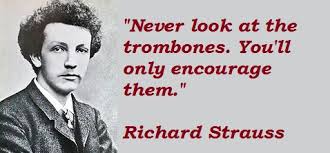
Richard Strauss was born June 11, 1864 in Munich, Germany. He died on September 8, 1949 in Garmisch-Partenkirchen, Germany. He was a German composer and conductor known for his intense emotionalism in his symphonic poems. He characterized himself as ‘composer of expression’ which is born out in his colorful orchestration. In his operas he employed Wagnerian principles of music drama, but in a more compact form.
Strauss was composing by the age of six, having received basic instruction from his father, a virtuoso horn player. This was, however, his only formal training. The elder Strauss instilled in his son a love of the classical composers, and his early works follow in their path. Strauss’ first symphony premiered when he was seventeen, his second (in New York) when he was twenty. By that time, Strauss had directed his energies toward conducting, and in 1885 he succeeded Hans von B?low as conductor of the orchestra in Meiningen. For the next forty years, he conducted orchestras in Munich, Weimar, Berlin and Vienna.
As a conductor, Strauss had a unique vantage point from which to study the workings of the orchestra. From this vantage point he developed a sense for orchestration that was unrivaled. He immediately put this sense to use in a series of orchestral pieces that he called “tone poems”, including Macbeth, Don Juan, Tod und Verklärung, Till Eulenspeigels lustige Streiche and Don Quixote. These works are intensely programmatic, and in the last two, Strauss elevated descriptive music to a level not approached since the techniques of text painting during the Renaissance. He also used his knowledge of orchestral techniques to produce a revised version of Hector Berlioz’s important orchestration treatise; this edition remains a standard to this day.
After the turn of the century, Strauss began to shift his focus to opera. With his principal librettist Hugo von Hofmannsthal, he created two forward-looking and shocking works: Salome, based on Oscar Wilde’s controversial play, and Elektra, Hoffmannsthal’s version of the classical Greek tragedy. In these works, the intense emotions and often lurid narrative elicited a more daring and demanding musical language full of extreme chromaticism and harsh timbres. But with his next opera, Der Rosenkavalier, Strauss seems to have left this aside, turning to a more focused, almost neoclassical approach in his later works. With this, Strauss settled into a comfortable place in German musical society, perhaps too comfortable, given his willingness to acquiesce to the artistic maneuverings of the rising Nazi regime. In the end, he broke with the Nazis on moral grounds, and died virtually penniless in the aftermath of the Second World War.
Musical Examples:
Don Quixote
Suite from Le Bourgoise gentilhomme, Op.60, Prelude
Also Sprach Zarathustra
One of Richard Strauss’ most popular works is Also Sprach Zarathustra since it was made popular in the 1968 Stanley Kubrick science-fiction movie 2001: A Space Odyssey.
Also sprach Zarathustra, Op. 30 (Thus Spoke Zarathustra or Thus Spake Zarathustra) is a tone poem by Richard Strauss, composed in 1896 and inspired by Friedrich Nietzsche’s philosophical treatise of the same name. The composer conducted its first performance on 27 November 1896 in Frankfurt. A typical performance lasts half an hour.
The work has been part of the classical repertoire since its first performance in 1896. The initial fanfare — entitled “Sunrise” in the composer’s program notes — became particularly well known to the general public due to its use in Stanley Kubrick’s 1968 film 2001: A Space Odyssey, and as the theme music of the Apollo program. The fanfare has also been used in many other productions.
The piece starts with a sustained double low C on the double basses, contrabassoon and organ. This transforms into the brass fanfare of the Introduction and introduces the “dawn” motif (from “Zarathustra’s Prologue”, the text of which is included in the printed score) that is common throughout the work: the motif includes three notes, in intervals of a fifth and octave, as C–G–C (known also as the Nature-motif). On its first appearance, the motif is a part of the first five notes of the natural overtone series: octave, octave and fifth, two octaves, two octaves and major third (played as part of a C major chord with the third doubled). The major third is immediately changed to a minor third, which is the first note played in the work (E flat) that is not part of the overtone series.
“Of Those in Backwaters” (or “Of the Forest Dwellers”) begins with cellos, double-basses and organ pedal before changing into a lyrical passage for the entire section. The next two sections, “Of the Great Yearning” and “Of Joys and Passions”, both introduce motifs that are more chromatic in nature.
“Of Science” features an unusual fugue beginning in the double-basses and cellos, which consists of all twelve notes of the chromatic scale. It is one of the very few sections in the orchestral literature where the basses must play a contra-b (lowest b on a piano). “The Convalescent” acts as a reprise of the original motif, and ends with the entire orchestra climaxing on a massive chord. “The Dance Song” features a very prominent violin solo throughout the section. The end of the “Song of the Night Wanderer” leaves the piece half resolved, with high flutes, piccolos and violins playing a B major chord, while the lower strings pluck a C.
One of the major compositional themes of the piece is the contrast between the keys of B major, representing humanity, and C major, representing the universe. Because B and C are adjacent notes, these keys are tonally dissimilar: B major uses five sharps, while C major has none.
Works:
Orchestral music, including symphonic poems: Macbeth (1888), Don Juan (1888-1889), Tod und Verklärung (Death and Transfiguration, 1889), Till Eulenspiegels lustige Streiche (Till Eulenspiegel’s Merry Pranks, 1895), Also sprach Zarathustra (Thus Spake Zarathustra, 1896), Don Quixote (1897) and Ein Heldenleben (A Hero’s Life, 1898); 2 symphonies (Domestic, 1903 and Alpine, 1915); 3 concertos (2 for horn, 1 for oboe)
15 operas, including Salome (1905), Elektra (1909), Der Rosenkavalier (The Cavalier of the Rose, 1911), Ariadne auf Naxos (1912) and Die schweigsame Frau (The Silent Woman, 1935)
Choral works (with and without orchestra), chamber works
Stravinsky
Igor Stravinsky lived between 1882 and 1971. He is considered to be a twentieth century composer. Both Stravinsky and Prokofiev were students of Rimsky-Korsakov. Stravinsky is a Russian composer renowned for his ballet scores beginning with Firebird, and Petrushka for the Ballets Russes in Paris.
Rite of Spring created a scandal because of its complex rhythms and polytonal harmonies. Despite this, Stravinsky’s music greatly influenced contemporary music. After residing in France he moved in 1939 to the U.S. where he continued writing music for the stage.
His most famous works are for the ballet. His two most popular are The Firebird (featured in Fantasia 2000), based on a legend of a prince capturing a Firebird and receiving a magic feather, and Petrushka, in which a lovable doll is brought to life.
Stravinsky’s The Rite of Spring was featured in the Walt Disney movie Fantasia.
Suk
Joseph Suk lived from 1875 until 1935. He was born in Krhaechaovice, Czech Republic and was a composer and violinist. He studied in Prague under Dvorák, whose daughter he married, and carried on the master’s Romantic tradition by his violin Fantaisie (1903), the symphonic poem Prague, and particularly by his deeply felt second symphony, Asrael (1905), in which he mourned the deaths of his master and of his wife. He was for 40 years a member of the Czech Quartet, and in 1922 became professor of composition in the Prague Conservatory.
Sullivan
Arthur (Seymour) Sullivan was an operetta composer. He teamed up with Sir William Gilbert to write H.M.S. Pinafore, The Mikado, Pirates of Penzance and others. A recent movie about Gilbert and Sullivan, Topsy-Turvey, won an Oscar in 2000.
von Suppé
Franz von Suppé was an Austrian composer of light operas, notably “Poet and Peasant”. He lived from 1819 until 1895.
Suzuki
Shin’ichi Suzuki was born in 1898 in Nagoya, Japan and is a very famous music teacher. He studied in Tokyo and Berlin, and with three of his brothers founded the Suzuki Quartet. His mass instruction methods of teaching young children to play the violin have been adopted in many countries, and adapted to other instruments.
Alfred Brendel was born in 1931 in Wiesenberg, Czech Republic.
After World War II, Brendel composed music, as well as continuing to play the piano, to write and to paint. However, he never had more formal piano lessons and, although he attended master classes with Edwin Fischer and Eduard Steuermann, he was largely self-taught after the age of six.
He made his debut in Graz (1948), and has since performed widely throughout Austria, where he lives.
He is known for his interpretations of Mozart, Beethoven, Schubert, Liszt, and Schoenberg. He tours internationally, and has written many essays on music.
A short insight from Alfred Brendel on his recording career:
• 1813 ~ Franz Schubert, age 12, finished his first symphony, The Symphony in D Major
• 1896 ~ Howard Hanson, American composer, educator and conductor
More information about Hanson
• 1909 ~ Josef Gingold, Russian-born American violinist
• 1936 ~ Charlie Daniels, American CMA Award-winning musician (1979), guitar, fiddle, singer with Charlie Daniels Band
• 1941 ~ Curtis Lee, Singer
• 1941 ~ Hank Marvin (Brian Rankin), Guitarist with The Shadows
• 1945 ~ Wayne Fontana (Glyn Ellis), Singer with The Mindbenders
• 1948 ~ Telma Hopkins, Singer with Dawn
• 1955 ~ A local kid from Lubbock, TX opened a concert for Marty Robbins and Elvis Presley. In the audience was a youngster by the name of Scott Davis. He would later become a superstar. We know him as Mac Davis. The kid who opened the concert was Buddy Holly.
• 1957 ~ After a show at the Pan Pacific Auditorium in Los Angeles, local police told Elvis Presley that he was not allowed to wiggle his hips onstage, the local press also ran headlines saying Elvis would have to clean up his act. The next night, the Los Angeles Vice Squad filmed his entire concert, to study his performance.
• 1961 ~ Brian Epstein, a record store owner in London, was asked by a customer for a copy of the record, My Bonnie, by a group known as The Silver Beatles. He didn’t have it in stock so he went to the Cavern Club to check out the group. He signed to manage them in a matter of days and renamed them The Beatles.
• 1965 ~ Earl Bostic, American jazz alto saxophonist and a pioneer of the post-war American rhythm and blues style, passed away
• 1980 ~ Annette Funicello, Cubby O’Brien, Tommy Cole, Sherry Alberoni and Dickie Dodd joined other Mouseketeers wearing black ears and white shirts on a sound stage in Burbank, CA. They were celebrating the 25th anniversary of the Mickey Mouse Club. The five special events each week were:
Fun with Music Day on Monday
Guest Star Day on Tuesday
Anything Can Happen Day on Wednesday
Circus Day on Thursday
Talent Roundup Day on Friday
• 2003 ~ Oliver Sain, a saxophonist whose work was later recorded by artists from Loretta Lynn to Sean “P. Diddy” Combs, died of bone cancer. He was 71. Sain was a musician, songwriter and producer, known for his performances on songs like Bus Stop and Feel Like Dancing in the 1970s. He performed as recently as the previous night, his wife said. Sain’s work was sampled by Combs on his “No Way Out” CD and recorded by artists including the Allman Brothers Band, Chaka Khan and Ry Cooder. Sain grew up in Dundee, Miss., where he became known for his saxophone playing. He moved to St. Louis in 1959 and opened a recording studio in the city in the next decade.
• 2008 ~ A statue honoring AC/DC’s Bon Scott was unveiled at the Fremantle Fishing Boat Harbour in Western Australia. Although born in Scotland, Scott grew up in Fremantle after his family emigrated to Australia in 1952. Bon started out his newfound Australian life in Melbourne, his family lived in the suburb of Sunshine for 4 years before moving to Fremantle. Scott was born in 1946 died on 20th February 1980. He is buried in Fremantle Cemetery.
• 2018 ~ Richard Gill died at the age of 76. He was an Australian conductor of choral, orchestral and operatic works, who has been involved in music training and education.
• 1782 ~ Niccolò Paganini, Italian violin virtuoso and composer
Read quotes by and about Paganini
More information about Paganini
• 1796 ~ Anton Thadäus Johann Nepomuk Stamitz, German composer
• 1908 ~ George Feyer, Pianist and entertainer, born in Budapest
• 1917 ~ Jascha Heifetz made his debut at Carnegie Hall in New York City. Heifetz was a 16-year-old sensation who had played the violin since age 5.
• 1927 ~ Dominick Argento, American composer
• 1933 ~ Floyd Cramer, Pianist
• 1941 ~ Edda Moser, German soprano
• 1941 ~ Everything I Love, by Buddy Clark, was recorded this day, number 6469 on the Okeh label.
• 1943 ~ Lee (Melvin) Greenwood, CMA Male Vocalist of the Year, 1983 and 1984, sax, piano, bandleader
• 1957 ~ The Crickets started a three-week run at No.1 on the UK singles chart with ‘That’ll Be The Day’. It was also a No.3 hit in the US where it went on to sell over a million. The song was inspired by a trip to the movies by Holly, Jerry Allison and Sonny Curtis in June 1956. The John Wayne film The Searchers was playing and Wayne’s frequently-used, world-weary catchphrase, “that’ll be the day” inspired the young musicians.
• 1958 ~ Simon LeBon, Singer with Duran Duran
• 1960 ~ Singer Ben E. King recorded “Spanish Harlem” & “Stand By Me”
• 1975 ~ Rocker Bruce Springsteen appeared on the cover of both TIME and Newsweek. Things were certainly going well for ‘The Boss’ that week.
• 2000 ~ Walter Berry, a bass-baritone who won acclaim for his interpretations of Mozart and Strauss and was beloved by Austrians for his renditions of Schubert, died of a heart attack at the age of 71. Known for the powerful timbre of his voice, Berry was a prolific performer who sang 100 different roles in more than 1,280 appearances at the Vienna State Opera. His U.S. debut was a 1963 performance with the Metropolitan Opera in New York. His interpretations of classical lieder by fellow Austrian Franz Schubert won him his most loyal following. Austrians who rarely went to the opera loved Berry for his renditions of popular Viennese songs performed as they believed only a native- born son could. In 1989, he became a professor at the Vienna University for Music and Performing Arts.
• 2001 ~ John Roberts, a promoter of the Woodstock Music and Art Fair in 1969, died of cancer. He was 56. Roberts produced the festival concert with three others, almost by accident. The idea originally was a pitch for a television comedy show about two young venture capitalists with money but no business plans. Roberts and his partners funded the festival with Roberts’ inheritance and ticket sales. They lost $2.3 million but recovered their loss with royalties from film and album spinoffs, and held on to the profitable name and trademark symbol of a dove on the neck of a guitar. A graduate of the University of Pennsylvania, Roberts later invested in other companies, avoiding the music business. Roberts also was a championship bridge player.
• 2006 ~ Amy Winehouse released her second and final studio album Back to Black. The album spawned five singles: ‘Rehab’, ‘You Know I’m No Good’, ‘Back to Black’, ‘Tears Dry on Their Own’ and ‘Love Is a Losing Game’ and won Best Pop Vocal Album at the 50th Annual Grammy Awards. Back to Black sold 3.58 million copies in the UK alone, becoming the UK’s second best-selling album of the 21st century. Worldwide, the album has sold over 20 million copies.
The Piano Puzzlers book is available in the O’Connor Music Studio library if you’d like to give any a try. Piano Puzzlers as heard on American Public Media’s “Performance Today.” Includes 32 tunes with songs by Gershwin, Berlin, Arlen, Porter, Rodgers, Fats Waller, Lennon & McCartney, and others disguised in the styles of Bach, Handel, Haydn, Mozart, Beethoven, Brahms, Schubert, Schumann, Chopin, Janacek, Debussy, Ravel, Rachmaninoff, Stravinsky, Prokofiev, Bartok, and Copland.
Includes an introduction by Fred Child, host of “Performance Today” as well as background info by Bruce Adolphe. “Bruce Adolphe has taken a common musician’s party game and elevated it to high art and truly funny musical slapsticks. The Piano Puzzlers are a unique combination of extraordinary insight into the styles of many composers subtle, expert workmanship and great, great fun!”
If you’re a music geek (like me), I have a program for you. Now, let me be clear, to fully qualify as a music geek…you must have a fond appreciation for classical music (no, Poison, Quiet Riot, and Zepplin do not count as classical music). So, if you’re a “music geek” without an appreciation for classical music…well, I hate to burst your bubble…but, you’re not truly a music geek. Instead, you’re a music appreciator, but not a geek. So, if you just listen to indie music and scowl at anything on a label larger than Matador…don’t bother following the link I’ll provide…the fun will be lost on you…And, you probably won’t have a chance.
Every Wednesday night, on my way home from WNL, I turn on my local NPR station to listen to Piano Puzzlers on Performance Today. It’s absolutely incredible. A pianist/composer (Bruce Adolphe) takes a familiar folk or pop tune and sets it inside a classical masterpiece (or in the style of a particular composer). Sometimes it’s easy…sometimes it’s ridiculously difficult. There are days when I say, “got it” on the first pass. Then there are days when I say, “what the heck?” And, more often than not, I’m able to get either the popular/folk tune or the composer.
This is sad to admit, but there are nights when I’ll slow down on the drive home or sit in the car in the driveway to finish an episode. In fact, I get a little worked up if someone stops me after WNL…as I might miss the beginning of Piano Puzzlers (it usually hits around 8:20pm on our local station).
Take a listen to some of the archives and see if you can figure it out! It’s really cool…but probably only appreciated by music geeks (the kind of people that listen to NPR for their musical programs and not just the snipets of cool indie rock between segments on All Things Considered…which is a great show too).
The Piano Puzzlers book is available in the O’Connor Music Studio library if you’d like to give any a try. Piano Puzzlers as heard on American Public Media’s “Performance Today.” Includes 32 tunes with songs by Gershwin, Berlin, Arlen, Porter, Rodgers, Fats Waller, Lennon & McCartney, and others disguised in the styles of Bach, Handel, Haydn, Mozart, Beethoven, Brahms, Schubert, Schumann, Chopin, Janacek, Debussy, Ravel, Rachmaninoff, Stravinsky, Prokofiev, Bartok, and Copland.
Includes an introduction by Fred Child, host of “Performance Today” as well as background info by Bruce Adolphe. “Bruce Adolphe has taken a common musician’s party game and elevated it to high art and truly funny musical slapsticks. The Piano Puzzlers are a unique combination of extraordinary insight into the styles of many composers subtle, expert workmanship and great, great fun!”
If you’re a music geek (like me), I have a program for you. Now, let me be clear, to fully qualify as a music geek…you must have a fond appreciation for classical music (no, Poison, Quiet Riot, and Zepplin do not count as classical music). So, if you’re a “music geek” without an appreciation for classical music…well, I hate to burst your bubble…but, you’re not truly a music geek. Instead, you’re a music appreciator, but not a geek. So, if you just listen to indie music and scowl at anything on a label larger than Matador…don’t bother following the link I’ll provide…the fun will be lost on you…And, you probably won’t have a chance.
Every Wednesday night, on my way home from WNL, I turn on my local NPR station to listen to Piano Puzzlers on Performance Today. It’s absolutely incredible. A pianist/composer (Bruce Adolphe) takes a familiar folk or pop tune and sets it inside a classical masterpiece (or in the style of a particular composer). Sometimes it’s easy…sometimes it’s ridiculously difficult. There are days when I say, “got it” on the first pass. Then there are days when I say, “what the heck?” And, more often than not, I’m able to get either the popular/folk tune or the composer.
This is sad to admit, but there are nights when I’ll slow down on the drive home or sit in the car in the driveway to finish an episode. In fact, I get a little worked up if someone stops me after WNL…as I might miss the beginning of Piano Puzzlers (it usually hits around 8:20pm on our local station).
Take a listen to some of the archives and see if you can figure it out! It’s really cool…but probably only appreciated by music geeks (the kind of people that listen to NPR for their musical programs and not just the snipets of cool indie rock between segments on All Things Considered…which is a great show too).
. 1760 ~ Jan Ladislav Dussek, Czech composer and pianist. Along with his friend, famed piano maker John Broadwood, Dussek made important design improvements to the piano, allowing for the more dynamic style of playing that his highly original compositions required. Beethoven himself later used a Broadwood piano with Dussek’s innovations. This helped pave the way for Romanticism and Dussek’s influence on Beethoven’s piano writing has been well documented.
Dussek’s Piano Sonata Op. 77 in F minor (“L’invocation”), from 1812, is the last work he ever composed, and he saved the best for last. This is a neglected masterpiece that foreshadows Schubert, Chopin, Schumann, and Brahms.
. 1881 ~ Anna (Pavlovna) Pavlova, Russia’s premier ballerina
. 1894 ~ Hans von Bülow, German pianist and composer died (b. 1830)
More about von Bulow
. 1898 ~ Roy Harris, American composer
. 1904 ~ Ted Mack (William Maguiness), TV host of The Original Amateur Hour, The Ted Mack Family Hour
. 1914 ~ (Gordon) Tex Beneke, Bandleader, singer, tenor sax in the Glenn Miller Orchestra
, 1915 ~ Charles Emile Waldteufel, composer, died at the age of 77
. 1918 ~ All theatres in New York City were shut down in an effort to conserve coal.
. 1923 ~ Mel Powell, American jazz pianist and composer. One of his works is Mission to Moscow for Benny Goodman. He was also Dean of Music at California Institute of Arts.
. 1923 ~ Franco Zeffirelli, Italian director and producer of opera, theatre, film and television
. 1924 ~ Bandleader Paul Whiteman presented his unique symphonic jazz at the Aeolian Hall in New York City. The concert marked the first public performance of George Gershwin’sRhapsody in Blue. The composer, himself, was at the piano this night. Distinguished guests included John Philip Sousa and Jascha Heifetz.
. 1942 ~ Mildred Bailey recorded More Than You Know on Decca Records.
. 1948 ~ Joe Schermie, Bass with Three Dog Night
. 1949 ~ “Annie Get Your Gun” closed at the Imperial Theater in New York City after 1147 performances
. 1964 ~ The Beatles played two concerts at Carnegie Hall in New York City, concluding a very successful American tour.
. 1968 ~ Singer and famed guitarist, Jimi Hendrix, received an honorary high school diploma from Garfield High School in Seattle, WA, where he had dropped out at the age of 14.
. 1972 ~ Al Green’s Let’s Stay Together knocked American Pie out of the top spot on the music charts. The record stayed at the top for one week, before giving way to Nilsson’s Without You. Green returned to his gospel roots in 1980 and is a minister in Memphis, TN. Green recorded 14 hit songs with six of them making it to the Top 10.
. 1976 ~ Sal Mineo, singer, died
. 1983 ~ Eubie Blake, US ragtime-composer/pianist (Memories of You), died at the age of 96
. 2011 ~ Elizabeth “Betty” Garrett, American actress, comedian, singer and dancer (All in the Family), died of an aortic aneurysm at the age of 91




 MaryO'Studio