My son was at this Opening Concert and found it very interesting.
Math and music join forces for the Harmonic Series, an exciting quarterly program presented by MoMath, hosted by public radio’s “Piano Puzzler” Bruce Adolphe, each event will bring together different musicians, composers, and mathematicians — and some who are all three at once — in conversation and performance. Enjoy the best of both worlds as these talented minds play live music and participate in an ongoing discussion about the artistic and logical intersections of these two disciplines.
Opening Concert – December 16, 2015 7:00 PM “All Things Equal: Music and Math at the Piano”
Featuring performances by Noam Elkies & Orli Shaham
Noam Elkies is a mathematician, composer, and the youngest ever tenured professor at Harvard. Orli Shaham is an acclaimed pianist and the host of “Dial-A-Musician.” Celebrate Beethoven’s birthday on December 16 with this eagerly anticipated debut! Noam and Orli will display their performance talents and discuss with host Bruce Adolphe the subtle and splendid ways that mathematics weaves into their artistry.
The National Museum of Mathematics (MoMath) is located at 11 East 26th Street in Manhattan and is open from 10:00 am to 5:00 pm, seven days a week, 364 days a year (MoMath is closed on Thanksgiving Day). Special note: MoMath closes early the first Wednesday of every month, at 2:30 PM.
• 1726 ~ The first performance of J. S. Bach‘s Sacred Cantata No. 55 Ich armer Mensch, ich Sündenknecht on the 22nd Sunday following Trinity. Was part of Bach’s third annual Sacred Cantata cycle in Leipzig 1725-27
• 1848 ~ Frederic Chopin played his final piano concert at a Polish benefit ball at Guildhall in London.
• 1850 ~ Giuseppe Verdi‘s opera Stifellio was first performed at the Teatro Grande in Trieste despite difficulties with the censors which resulted in cuts and changes.
• 1861 ~ First Performance of Johannes Brahms‘ Piano Quintet No. 1 in g, Op. 25, at a rehearsal in Hamburg, with pianist Clara Schumann.
• 1862 ~ The work noted above received its official premiere with members of the Hellmesberger Quartet; Brahms at the piano, in Vienna.
• 1870 ~ Birth of Australian composer Alfred Hill in Melbourne. d-Sydney, 30 OCT 1960.
• 1876~ The first performance of Peter Ilyich Tchaikovsky‘s March Slav in Moscow.
• 1877 ~ The first production of Gilbert and Sullivan’s opera, The Sorcerer, was presented, in London.
• 1888~ The first production of Tchaikovsky‘s Fifth Symphony in St. Petersburg.
• 1891 ~ Poland’s premier and premier ivory tickler, Ignace Jan Paderewski, made his American debut at Carnegie Hall in New York City. In later years, Paderewski, who suffered from arthritis, settled in Paso Robles, CA. The hot mineral baths located there eased his pain. He played only Steinway grand pianos custom-built to his specifications. In fact, five were made just for his use.
• 1925 ~ Sir Charles Mackerras, Australian conductor
• 1930 ~ David Amram, American composer and French-horn player
• 1938 ~ Gordon Lightfoot, Canadian folk singer, songwriter and guitarist
• 1938 ~ Orchestra leader Kay Kyser, speaking to an audience at the College of the City of New York (CCNY) told of the “inner workings and artistic features of swing music.” It marked the first of a series of lectures on swing music presented by Kyser, who went on to presentThe Kollege of Musical Knowledge on radio.
• 1941 ~ Gene Clark, Singer, guitar with The Byrds
• 1942 ~ Bob Gaudio, Singer with The Royal Teens; The Four Seasons
• 1946 ~ Martin Barre, Guitarist with Jethro Tull
• 1950 ~ Roberta Peters filled in for the lead in Mozart’s Don Giovanni, making her debut at the Metropolitan Opera in New York City. She would become one of the Met’s most famous stars.
• 1962 ~ The 4 Seasons, with Frankie Valli as lead singer, began a five-week run at the top of the tunedex with Big Girls Don’t Cry.
• 1967 ~ Ronald DeVoe, Singer with New Edition
• 1970 ~ Elton John recorded an album live, on what was WABC-FM in New York City. It marked the first time that a concert was aired live and recorded for release as aired. The LP was titled, 11/17/70.
• 2001 ~ Jerry Jerome, a tenor sax player who was a featured soloist with the bands of Glenn Miller and Benny Goodman, died of leukemia. He was 89. One of the big names in the Big Band era, Jerome was a featured soloist with the Glenn Miller, Benny Goodman, Red Norvo and Artie Shaw orchestras. He then became a successful musical director and conductor on radio and television. Jerome also established a music business, scoring and arranging commercial jingles. Three years ago, Arbors Records released Jerome’s “Something Old, Something New.” The sequel recording, “Something Borrowed, Something Blue,” will be released in December. Born in Brooklyn, N.Y., Jerome started playing the sax while in high school. He attended the University of Alabama and went on the medical school, playing gigs at jazz clubs to earn tuition money. He joined Goodman’s orchestra at the height of its popularity in 1938. When Goodman broke up his band in 1940, Jerome joined Shaw. While with Shaw, he appeared in the film “Second Chorus,” with Fred Astaire and Burgess Meredith.
• 2003 ~ Arthur Conley, a 1960s soul singer and protege of Otis Redding’s, died at his home in the town of Ruurlo, in the eastern Netherlands. He was 57. Conley was born in Atlanta and started his recording career in 1959 as leader of the group Arthur and the Corvets. He was best known for his 1967 hit, Sweet Soul Music, which he co-wrote with Redding based on a number by Sam Cooke. Conley had several minor hits in the following two years. He moved to Europe in the early 1970s after several tours of the continent, deciding that he was “fed up with the pressure” in the United States, said Giesen. In the Netherlands, Conley appeared on television and radio, and ran an independent record label. In the last five years he was an adviser to The Original Sixties R&B and Soul Show, which sought to reproduce the sound and look of the heyday of soul.
.1817 ~ Louis Lefébure-Wély, French organist and composer
.1854 ~ George Whitefield Chadwick, American composer and conductor
.1921 ~ Loonas Kokkonen, Finnish composer
.1943 ~ Leonard Bernstein replaced an indisposed Bruno Walter as conductor of the NewYork Philharmonic Orchestra. Thus began a legendary career and worldwide appreciation for Bernstein’s many compositions with the orchestra.
.1965 ~ Julie Harris starred in “Skyscraper”, which opened on Broadway in New York City. The musical ran for seven months.
.1968 ~ This was a good day for The Beatles. Their movie, “Yellow Submarine”, premiered in the U.S. and the single, Hey Jude, topped the pop music charts (it was in its 7th of 9 weeks at #1).
.1975 ~ Whoa Whoa Whoa, Feeeelings. One of the great lounge-lizard songs of all time, Feelings by Morris Albert, went gold.
.1999 ~ Donald Mills passed away. He had been one of the Mills Brothers.
.2000 ~ Cecil Blackwood, a gospel singer who was a member of the Blackwood Brothers and crooned with Elvis Presley, of cancer at the age of 66. The Blackwood Brothers, who have won nine Grammys and 20 Dove awards, were a favorite of Elvis Presley, who briefly sang with Cecil Blackwood in a group named the Songfellows. The Blackwood Brothers were formed in 1934, the same year Blackwood was born in Ackerman, Miss. He became the group’s baritone in 1954. The Blackwood Brothers have recorded 300 albums, backed country stars PorterWagoner and Barbara Mandrell, and are members of the Southern Gospel Music Hall of Fame.
.2000 ~ Jimmy Payne Sr., a tap dancer whose rhythm and technique as well as a mastery of precise steps attracted Bob Fosse, June Allyson, Gregory Hines, Lena Horne and others to his Chicago studio, died Nov. 13 at the age of 95. The son of a Cuban mother and Barbadian father, Payne grew up in the Panama Canal Zone before moving to New York in 1917. After traveling from New York to Chicago in 1947, Payne helped introduce African and Afro-Cuban rhythms to the dance scene. He taught in a number of Chicago dance studios from the 1950s into the 1970s. He continued to teach some of the city’s top dancers until his regimen was slowed by a number of strokes in his early 90s.
.2000 ~ New York entertainment lawyer and tax expert Joseph Taubman, who wrote how- to books for people working in the business side of show business, died at the age of 81. Taubman’s clients included Lionel Richie, Pete Seeger, Joan Baez and Arlo Guthrie. He also served as counsel to the National Film Board of Canada. Taubman wrote “Financing a Theatrical Production,” and his treatises on various aspects of the entertainment business published in the 1970s remain in print.
.2000 ~ The site, thebeatles.com, went live and is the band’s only official presence on the Internet among a flood of unofficial fan sites.
.2002 ~ Mieke van Hoek, a dance choreographer and teacher, died. She was 56. The Dutch-born van Hoek taught modern-dance choreography and dance improvisation at the Rotterdamse Dansacademie. After emigrating to the United States in 1977, van Hoek worked as a teaching assistant at the American Dance Festival in Durham, N.C., and studied at the Laban/Bartenieff Institute in New York. She founded a center for meditation, healing and the arts in Canones in 2000.
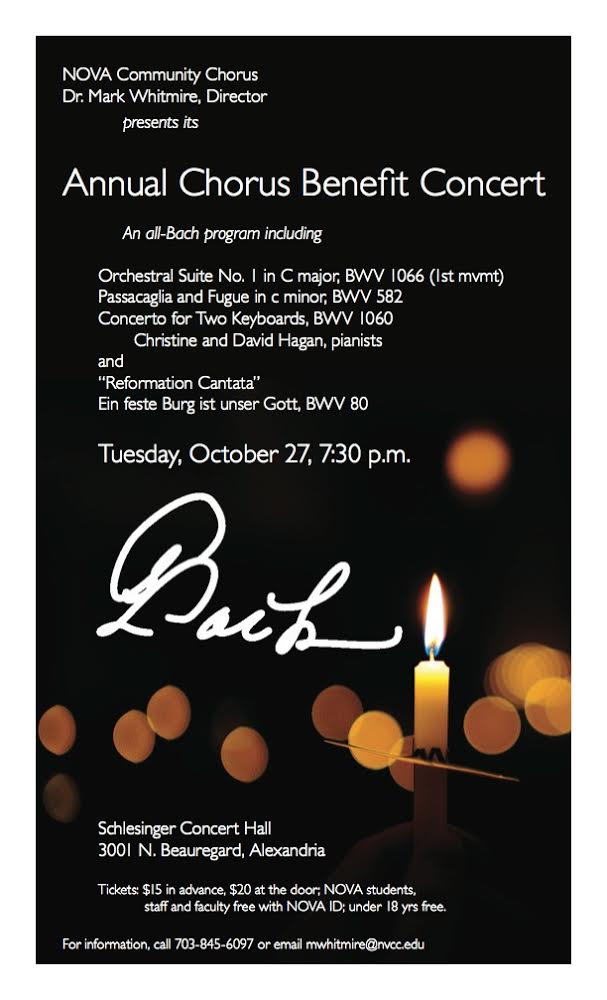
NOVA Community Chorus (Dr. Mark Whitmire, Director) will present it’s Annual Chorus Benefit Concert on Tuesday, October 27, at 7:30 pm in Schlesinger Concert Hall on the Alexandria Campus. It will be an all-Bach program including Cantata 80: Eine feste Burg ist unser Gott (A mighty fortress in our God), accompanied by orchestra.
Acclaimed duo pianists Christine and David Hagan will perform Passacaglia and Fugue in C minor and the Concerto for Two Keyboards in C Major.
NOVA students, staff and faculty are free with NOVA ID. Donations are requested. For information, call 703-845-6097 or email mwhitmire@nvcc.edu.
Don’t miss this chance for you and your students to hear the music of one of the greatest composers of all time.
Redditor NeokratosRed had an idea: depict the hands of great composers and pianists, according to the characteristics of their music. He shared it on the social media site, and also punted for suggestions of more. It has since received over 300,000 images views, and lots of further suggestions from fellow Redditors and piano geeks.
Whisks for Chopin’s elegant pianistic souffles, feather dusters for the gentle impressionism of Debussy, instruments of trade for the composer of the thunderous Hammerklavier sonata.
Piano, and the internet – top marks to the both of you.
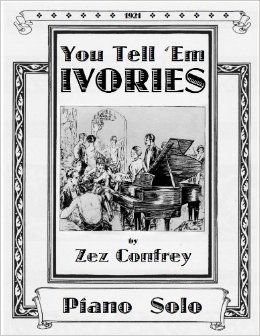
“This collection represents a cross-section of Confrey’s works and encompasses the broad range of his styles. Besides his famous 1920s novelty works (including Kitten on the Keys), there are many wonderful, lesser-known gems of remarkable quality included here from later in his career. Appearing for the first time in print are transcriptions of one of his disc recordings (Poor Buttermilk) and two of his player piano roll arrangements (My Pet and Humorestless). Many of Confrey’s later works have long been out of print and are included here for the first time in decades.”
Listening to music can help you while you’re studying for your exams.
This is 3.5 Hours of the Best Classical Music – Mozart, Beethoven, Bach, Chopin – Beautiful Piano, Violin & Orchestral Masterpieces by the greatest composers of all time.
. 1887 ~ Heitor Villa-Lobos, Brazilian composer and collector of Brazilian folk songs
More information about Villa-Lobos
. 1917 ~ The first jazz recording for Victor Records was released. The Original Dixieland ‘Jass’ Band performed on the tune The Dixie Jass Band One Step. The word ‘Jass’ was later changed to ‘Jazz‘.
. 1931 ~ Barry Tuckwell, Austrian French-horn player
. 1931 ~ Without a Song was recorded by Lawrence Tibbett for Victor Records. This wonderful melody came from the film, “The Southerner” and has been a hit for many, including Willie Nelson, Frank Sinatra and Tony Bennett.
. 1947 ~ Eddie Hodges, Singer, actor
. 1948 ~ Eddy Grant, Singer, songwriter
. 1950 ~ Eugene Fodor, Violinist, made solo debut at age 10 with the Denver Symphony, won first national competition at age 12, won first prize in International Paganini Competition, won highest prize in International Tchaikovsky Competition
More information about Fodor
. 1960 ~ Elvis Presley returned to civilian life after a two-year hitch in the U.S. Army. Not since General Douglas MacArthur returned from battle has a soldier received such publicity. Elvis said he probably would not be growing his famous and long sideburns back, though he did relent in later years.
. 1963 ~ Patsy Cline, Cowboy (Lloyd) Copas and Hankshaw Hawkins were killed in a plane crash at Camden, TN, near Nashville. The famous country music stars were returning from a benefit performance. Cline, the ‘Queen of Country Music’ was elected to the Country Music Hall of Fame in 1973. Jessica Lange played Patsy in the 1985 biographical film, Sweet Dreams, named after one of Cline’s hugely popular songs. Willie Nelson wrote her biggest hit,Crazy, which become a number one country hit and a top 10 pop song in November, 1961.
. 1969 ~ The rock magazine, Creem, was published for the first time this day.
. 1973 ~ Roberta Flack, riding at #1 on the pop music charts with, Killing MeSoftly with His Song, could hardly wait to rip into the fancy frame containing her brand new gold record. She flew to the stereo machine and set the needle down on the shiny surface, only to hear Come Softly to Me. She was so impressed by this unexpected turn of the table that she wound up humming the old Fleetwoods song for three days.
The thought-provoking talk on February 10th was given by Keith Pascoe, second violinist of the Vanbrugh Quartet, in connection with tomorrow night’s violin and piano recital by Ray Chen and Julien Quentin. Pascoe came up with a great title, David and Goliath, The Ballet of Unequals: A Stradivari and Model D Steinway Recital. Using videos from YouTube as illustrations (which unfortunately allowed in snippets of a couple of unwanted advertisements), Pascoe began at the beginning, with the emergence of the piano and violin as instruments in their own right, and traced some of the changes they have both undergone in the centuries since.
The piano has become bigger, stronger and louder. Not only were extra notes added to the keyboard, but the early wooden frames were replaced with cast iron. The violin may not have grown externally, but the shape of the body was remoulded, the neck and fingerboard realigned, and internal buttressing extended, all with the intention of producing greater sound.
What composers did with the combination of violin and piano – and before that, violin and harpsichord – changed too. In the typical baroque violin sonata, the violin was to the fore. In the classical era, the roles were reversed, although this reversal has long been dishonoured by performers. And in the 19th century, the balance as we know it today began to take hold. That balance usually presents the two performers in a master-servant relationship, the violinist usually the boss whose bidding is carried out by the pianist.
• 1726 ~ The first performance of J. S. Bach‘s Sacred Cantata No. 55 Ich armer Mensch, ich Sündenknecht on the 22nd Sunday following Trinity. Was part of Bach’s third annual Sacred Cantata cycle in Leipzig 1725-27
• 1876~ The first performance of Peter Ilyich Tchaikovsky‘s March Slav in Moscow.
• 1877 ~ The first production of Gilbert and Sullivan’s opera, The Sorcerer, was presented, in London.
• 1888~ The first production of Tchaikovsky‘s Fifth Symphony in St. Petersburg.
• 1891 ~ Poland’s premier and premier ivory tickler, Ignace Jan Paderewski, made his American debut at Carnegie Hall in New York City. In later years, Paderewski, who suffered from arthritis, settled in Paso Robles, CA. The hot mineral baths located there eased his pain. He played only Steinway grand pianos custom-built to his specifications. In fact, five were made just for his use.
• 1925 ~ Sir Charles Mackerras, Australian conductor
• 1930 ~ David Amram, American composer and French-horn player
• 1938 ~ Gordon Lightfoot, Canadian folk singer, songwriter and guitarist
• 1938 ~ Orchestra leader Kay Kyser, speaking to an audience at the College of the City of New York (CCNY) told of the “inner workings and artistic features of swing music.” It marked the first of a series of lectures on swing music presented by Kyser, who went on to presentThe Kollege of Musical Knowledge on radio.
• 1941 ~ Gene Clark, Singer, guitar with The Byrds
• 1942 ~ Bob Gaudio, Singer with The Royal Teens; The Four Seasons
• 1946 ~ Martin Barre, Guitarist with Jethro Tull
• 1950 ~ Roberta Peters filled in for the lead in Mozart’s Don Giovanni, making her debut at the Metropolitan Opera in New York City. She would become one of the Met’s most famous stars.
• 1962 ~ The 4 Seasons, with Frankie Valli as lead singer, began a five-week run at the top of the tunedex with Big Girls Don’t Cry.
• 1967 ~ Ronald DeVoe, Singer with New Edition
• 1970 ~ Elton John recorded an album live, on what was WABC-FM in New York City. It marked the first time that a concert was aired live and recorded for release as aired. The LP was titled, 11/17/70.
• 2001 ~ Jerry Jerome, a tenor sax player who was a featured soloist with the bands of Glenn Miller and Benny Goodman, died of leukemia. He was 89. One of the big names in the Big Band era, Jerome was a featured soloist with the Glenn Miller, Benny Goodman, Red Norvo and Artie Shaw orchestras. He then became a successful musical director and conductor on radio and television. Jerome also established a music business, scoring and arranging commercial jingles. Three years ago, Arbors Records released Jerome’s “Something Old, Something New.” The sequel recording, “Something Borrowed, Something Blue,” will be released in December. Born in Brooklyn, N.Y., Jerome started playing the sax while in high school. He attended the University of Alabama and went on the medical school, playing gigs at jazz clubs to earn tuition money. He joined Goodman’s orchestra at the height of its popularity in 1938. When Goodman broke up his band in 1940, Jerome joined Shaw. While with Shaw, he appeared in the film “Second Chorus,” with Fred Astaire and Burgess Meredith.
• 2003 ~ Arthur Conley, a 1960s soul singer and protege of Otis Redding’s, died at his home in the town of Ruurlo, in the eastern Netherlands. He was 57. Conley was born in Atlanta and started his recording career in 1959 as leader of the group Arthur and the Corvets. He was best known for his 1967 hit, Sweet Soul Music, which he co-wrote with Redding based on a number by Sam Cooke. Conley had several minor hits in the following two years. He moved to Europe in the early 1970s after several tours of the continent, deciding that he was “fed up with the pressure” in the United States, said Giesen. In the Netherlands, Conley appeared on television and radio, and ran an independent record label. In the last five years he was an adviser to The Original Sixties R&B and Soul Show, which sought to reproduce the sound and look of the heyday of soul.






 MaryO'Studio