Composers – D


Dallapiccola

Luigi Dallapiccola was an Italian composer known for his lyrical twelve-tone compositions.

Debussy

Claude Debussy lived between 1862 and 1918. He is considered to be a impressionistic composer, because he tried to capture the mood of the action instead of the action itself, and was known as the Father of Impressionistic Music. Debussy’s work influenced another Impressionistic composer, Maurice Ravel.

The French Impressionistic painters like Auguste Renoir were painting at the same time that Debussy was composing and that influenced his music. “Clair de Lune” is a famous example of this as it creates the feeling of rippling water.

Debussy liked to create tonal “impressions” rather than conventional melodies. “Rêverie” was one of his first successes, although the critics of the 1890’s said things like “strangeness”, “dissonance”, “ugliness” and “difficulties” about it, missing the fragile loveliness and vague shimmer which were stylistic innovations.

Debussy was playing piano and composing by the time he was 12.

DeForest

Lee DeForest was born in 1873 in Council Bluffs, Iowa. We’re sure his parents had big plans for him; but they could never have realized how their son, Lee, would change the world.

DeForest seemed to be a born inventor. He held patents for hundreds of different items including the photoelectric cell and the surgical radio knife. But none had as much impact on the world as his invention of the electron tube, specifically the triode, a three element vacuum tube, which later became the audion tube ~~ possibly the most significant invention that made radio possible.

Wireless radio broadcasting was unthinkable in the early 1900s and DeForest was considered a fraud. He was arrested for selling stock to underwrite the development of his invention, which no one believed would work. He was forced into selling the rights to his patent to American Telephone and Telegraph for $500,000; considered by most to be foolish of AT&T. The rest is history.

Lee DeForest’s 1950 autobiography is called “Father of Radio”.

Delius

Frederick Delius was born in Bradford, England. His father owned a wool company and hoped that his son would follow a career in business. Delius, however, wanted to study music. In 1884, he left England for Florida, where he worked on a plantation as an orange grower. Delius proved to be a failure as an orange grower, and began supporting himself as a musician. During 1886 – 1887, he composed Florida Suite.

Des Prez

Josquin Des Prez was born around 1440 and he died: August 27, 1521 in Cond?-sur-l-Escaut, France.

He was a French/Franco-Flemish composer and generally acknowledged as the greatest composer of the High Renaissance.

Martin Luther, who had a good knowledge of music, said of Josquin Desprez, “he alone is the master of the notes, they have to do as he bids them.” Indeed, Josquin was acknowledged by nearly all his contemporaries as the greatest composer of his time. If so, he stands as the first among many great musicians, for the composers of what we often term the Netherlands School created one of the richest periods in Western musical history. His contemporaries — including Antoine Brumel (c.1460-c.1515), Pierre de la Rue (c.1460-1518) and Loyset Comp?re (c.1445-1518) — and the previous generation — led by Johannes Ockeghem (c.1410-1497) — created a style of music that can rightly be compared to the art of Leonardo da Vinci and Michelangelo.

As for Josquin himself, we know surprisingly little of his early life. We know that in the 1470s he began service in the court of Cardinal Ascanio Sforza, and that by 1489 he was a member of the papal choir in Rome. But we know nothing of his early training, or even when he came to Italy (it was believed that he came in 1459 as a choirboy in the Milan cathedral, but it seems that this was a case of mistaken identity). Later in his life he served Duke Ercole d’Este in Ferrara, and possibly King Louis XII of France. The final years of his life were spent in the town of Cond?-sur-l’Escaut in northern France (possibly his birthplace). The rest of his biography is still subject to scholarly speculation.

What we do know is just what Josquin’s contemporaries knew: that he created wonderful music. What stands out most in this music is his care for the words. This is seen in part by the way he uses imitation to allow each voice to present the text before the texture becomes too dense to be clear. He also made use of homophonic textures to give the text an added clarity. Some of his works, especially his Masses, use the older cantus firmus technique. Here he uses the borrowed melody to create a huge scaffolding upon which he constructs the other melodies. Some of these pieces display a high level of technical complexity. At the same time, he could create pieces of marvelous simplicity and elegance, as he did so often in his motets and chansons.

Musical Examples:

  • Inviolata, integra et casta es Maria
  • Miserere mei, Deus
  • Missa “La sol fa re mi” (Agnus Dei II)
  • Tu solus, qui facis mirabilia

Works:

  • Sacred works, including 18 masses (Missa “La sol fa re mi”, 2 L’homme arm?
  • Masses, Missa “Pange lingua”), more than 100 motets
  • Secular works, including nearly 70 French chansons and settings of German,
    Spanish and Italian texts

Diaghilev

Sergei Pavlovich Diaghilev lived from 1872 until 1929. He was a ballet impresario, born in Novgorod, Russia. Diaghilev obtained a law degree, but was preoccupied with the arts. In 1898 he became editor of Mir Iskousstva (World of Art), and during the next few years arranged exhibitions and concerts of Russian art and music. His permanent company was founded in 1911, and remained perilously in existence for 20 years, triumphantly touring Europe. Many of the great dancers, composers, and painters of his period contributed to the success of his Ballets Russes. He also encouraged several major choreographers (eg Fokine, Nijinsky, Balanchine), and gave them opportunities for artistic collaboration.

Dispeker

Thea Dispeker molded operatic talent from Lauritz Melchior to Richard Leech and lived to be 97 years old.

Dispeker owned a classical music artists agency for more than 50 years. In her career, she influenced musicians such as Richard Tucker, Judith Blegen, Roberta Peters and Pablo Casals, among others.

In 1947, she helped found the Little Orchestra Society for children’s concerts and went into business for herself.

Even in her 80s and 90s, Dispeker continued to seek out young singers and musicians to promote. Her portfolio also included the Swedish baritone Hakan Hagegard.

Her agency, Thea Dispeker Inc., received an International Society for the Performing Arts Foundation award of merit in 1997, its 50th anniversary year.

Dittersdorf

Carl Ditters von Dittersdorf lived from 1739 until 1799. He was a composer and violinist. He had composition lessons from Giuseppe Bonno in his native Vienna and served as a violinist in the orchestra of the Prince of Sachsen-Hildburghausen, followed by a position in the imperial theatre. There followed a period as Kapellmeister to the Bishop of Grosswardein, where, in 1762, he succeeded Michael Haydn. In 1769 he became Kapellmeister to the Prince-Bishop of Breslau, at this period acquiring the patent of nobility that added to the name of Ditters the honorific von Dittersdorf. Conditions in Johannisberg, the seat of the Prince-Bishop, deteriorated in the political circumstances of the time, and on the death of his employer in 1795, he moved with his family to join the household of a nobleman in Bohemia.

Dohnányi

Ernő Dohnányi lived from 1877 until 1960. He was born in Poszony (now Bratislava) in 1877 and opted for further musical study in Budapest rather than, more conventionally, in Vienna, setting an example that was followed by his younger contemporary Bartok. He played a leading part in forming the musical culture of Hungary, although there were difficulties with the regime that replaced the first republican government of the country. Due to his overt opposition to the association of Hungary with National Socialist Germany, he found it necessary to spend his final years in America, dying in New York in 1960.

As a composer Dohnányi was versatile, continuing existing traditions of music, while as a pianist he enjoyed international fame.

Domingo

Opera king Plácido Domingo
joins the Global Music Network and serves up an aria for online listeners. Live events and interviews, along with jazz and classical clips.

Donizetti

Gaetano Donizetti was born in in Bergamo, November 29, 1797 and died in Bergamo, April 8, 1848.

Inheriting the bel canto tradition from Rossini, Donizetti’s operas are today mostly admired for their many attractive melodies and fine ensembles. Although he composed over seventy operas, only a handful have remained in the general repertory, but those are generally regarded as outstanding examples of the Italian Bel Canto period. Donizetti’s most famous opera is surely Lucia di Lammermoor, based on a novel by Sir Walter Scott. The plot concerns a young girl who is tricked by her brother into thinking her lover has been unfaithful to her and forces her into a marriage of political convenience. During the wedding scene, Lucia’s lover makes an unexpected entrance, and all the protagonists give vent to their varied emotions in the celebrated Sextet from Lucia di Lammermoor. As was popular in Italian opera of the time, Lucia then goes mad, giving the prima donna an opportunity to display great acting and vocal skill in an extended scena.

The Italian operatic tradition was continued and taken to sublime heights later in the nineteenth century in the works of Giuseppe Verdi.

Dowland

John Dowland lived from 1562 until 1626. He was an English composer, singer and lutenist who wrote about 90 works for the Renaissance lute, several psalm harmonizations and many sacred songs.

Driggo

Riccardo Drigo was born and educated in Padua but he spent most of his life – from 1878 until 1915 – among Russian royalty as conductor ot the Marinsky Theater. He lived from 1846 until 1930.

Du Fay

Guillaume Du Fay was born on August 5, 1397(?) in Cambrai, France and died on November 27, 1474 in Cambrai, France. He was a French composer and was considered the leading composer of the early Renaissance.

The fifteenth century saw the rise of a new musical style, one in which harmonies began to center on full triads and the setting of the text became an important concern to composers. Guillaume Du Fay is one of the most important figures in the transition from the medieval to Renaissance style, which took place mainly among composers associated with the rich court of Burgundy. For this reason, Du Fay and his contemporaries are usually referred to as the “Burgundian School.”

Guillaume Du Fay probably received his early musical training in the cathedral choir at Cambrai, in northern France. But his career took a decidedly international turn early on. By the age of twenty-five he had gone to Italy. During his years there, he worked for courts in Pesaro, Ferrara and sang in the Papal choir in Rome. During that time he also earned a degree in canon law, probably at the University of Bologna. He spent the latter part of his life back at the cathedral in Cambrai. Du Fay wrote both sacred and secular music; he is perhaps best known for his cantus firmus Masses. Before he died, he composed a Requiem Mass (now lost) to be sung at his funeral, and asked that four of the best singers from the cathedral sing his motet Ave regina caelorum (Hail, Queen of Heaven) to him on his deathbed.

Du Fay’s music set the tone for the Renaissance (one scholar credits him with defining the “central style” of the period). His triad-based harmonies and arching melodies create a pleasant balance of melody and harmony. In his sacred music, he changed the overall sound by a more regular use of four-voice textures. At the same time, we can still find the medieval concern with structure and isorhythm in his sacred music, especially his cantus firmus Masses.

Sacred works including at least 7 complete Mass settings, numerous Mass movements and pairs, 30 motets and 60 other sacred works (hymns, etc.)
Secular works including more than 50 rondeaux, 10 ballades, 4 virelais, 15 other works.

Dukas

Paul Dukas’ The Sorcerer’s Apprentice was featured in the Walt Disney movie Fantasia and Fantasia 2000.

Dvorák

Antonín Dvorák’s piece, “Humoresque” became one of the most famous pieces ever written nearly overnight. It was later discovered that this could be played simultaneously with Steven Foster’s “Way Down Upon the Swanee River”.

Dvorák, a native of Bohemia, traveled in the United States in 1892 and found American music to be “magical” and “spacious”. When Dvorák visited the United States, he encouraged American composers to use their native music. He himself incorporated folk melodies into 19th century Romantic music. His compositions include Slavonic Dances, Fifth Symphony, The Water Nymph, Carnival, Gypsy Melodies.

Dvorák lived from 1841 until 1904.
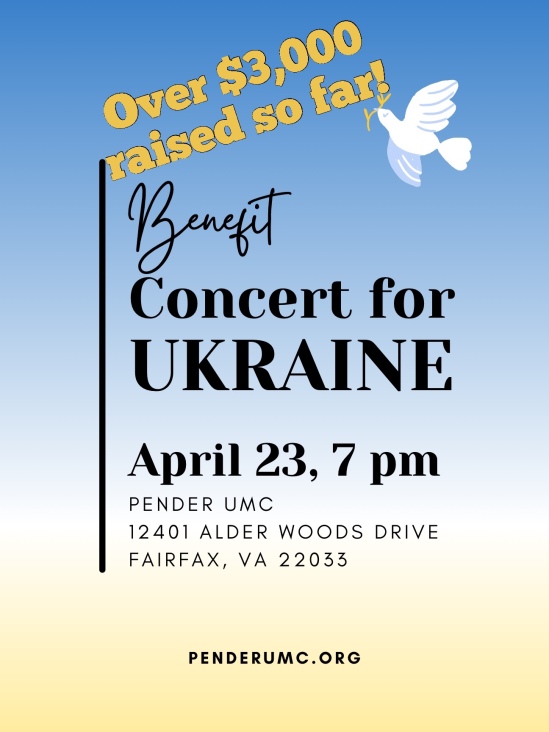
Clair de lune by Claude Debussy from Concert for Ukraine


Brian Stevenson, Director of Music Ministries at Pender UMC in Fairfax, VA, performed Clair de lune from Debussy’s Suite bergamasque during Pender’s new Concert Series which began on April 23, 2022.

‘Clair de lune’, meaning moonlight, was written by the Impressionist French composer Claude Debussy.  It is the third movement of a four-movement work, Suite bergamasque.  Originally composed for piano in D♭ major, It is written in 9/8 meter and marked andante très expressif.

‘Clair de lune’ takes its title from an atmospheric poem by the French poet Paul Verlaine which depicts the soul as somewhere full of music ‘in a minor key’ where birds are inspired to sing by the ‘sad and beautiful’ light of the moon.

The Pender Concert Supporting Ukraine on April 23 featured Liz Sellers on piano, Brian on harp, and local professional musicians, including woodwind quintet, drums, organ, guitar, flute, penny whistle, singing and violin.

Concert repertoire included: Harp arrangements by Debussy, Piano trio of Jazz/Baroque, Flute Concertino by Chaminade, Woodwind Quintet with music of Duke Ellington, The Widor Toccata Organ Symphony Movement V and an Irish session!

There was no charge for this concert but there was a free will offering taken to support Ukraine through Advance #982450, UMCOR International Disaster Response and Recovery. This fund provides direct assistance to those in Ukraine as well as assistance to Ukrainians fleeing to neighboring countries.

One hundred percent of all Advance contributions go to the designated cause. (The independent charity watchdog, “Charity Watch,” gives UMCOR an “A+” ranking, and includes the UM organization on a highly selective list of charities it recommends when considering how to support the Ukrainian people. Read more)

The United Methodist community in Ukraine, though quite small, is actively engaged in assisting neighbors in need. Global Ministries is in touch with the church’s leadership as well as with church leaders in countries welcoming those who are fleeing from violence in Ukraine.

Click this link and choose UMCOR to send direct aid. In the memo line, put Advance #982450, UMCOR International Disaster Response and Recovery.

Thank you for your support!

Harp: En bateau (Sailing) from Concert for Ukraine


Brian Stevenson, Director of Music Ministries at Pender UMC in Fairfax, VA,  performed En bateau (Sailing) from The Petite Suite, L 65, by Claude Debussy on the harp during Pender’s new Concert Series which began on April 23, 2022.

Debussy’s music captures perfectly a mood of water-borne serenity and languor, opening with a kind of musical sigh that made the Petite Suite immediately popular with a wide audience.


The Pender Concert Supporting Ukraine on April 23 featured Liz Sellers on piano, Brian on harp, and local professional musicians, including woodwind quintet, drums, organ, guitar, flute, penny whistle, singing and violin.

Concert repertoire included: Harp arrangements by Debussy, Piano trio of Jazz/Baroque, Flute Concertino by Chaminade, Woodwind Quintet with music of Duke Ellington, The Widor Toccata Organ Symphony Movement V and an Irish session!

There was no charge for this concert but there was a free will offering taken to support Ukraine through Advance #982450, UMCOR International Disaster Response and Recovery. This fund provides direct assistance to those in Ukraine as well as assistance to Ukrainians fleeing to neighboring countries.

One hundred percent of all Advance contributions go to the designated cause. (The independent charity watchdog, “Charity Watch,” gives UMCOR an “A+” ranking, and includes the UM organization on a highly selective list of charities it recommends when considering how to support the Ukrainian people. Read more)

The United Methodist community in Ukraine, though quite small, is actively engaged in assisting neighbors in need. Global Ministries is in touch with the church’s leadership as well as with church leaders in countries welcoming those who are fleeing from violence in Ukraine.

Click this link and choose UMCOR to send direct aid. In the memo line, put Advance #982450, UMCOR International Disaster Response and Recovery.

Thank you for your support!

Benefit Concert for Ukraine


Concert repertoire will include:
Harp arrangements by Debussy
Piano trio of Jazz/Baroque
Flute Concertino by Chaminade
Woodwind Quintet with music of Duke Ellington
The Widor Toccata Organ Symphony Movement V
and an Irish session!

August 22: On This Day in Music

today

OCMS   1862 ~ Claude Debussy, French composer. Along with Maurice Ravel, he was one of the most prominent figures associated with Impressionist music, though he himself disliked the term when applied to his compositions.
More information about Debussy

• 1906 ~ The Victor Talking Machine Company of Camden, New Jersey began to manufacture the Victrola (record player). The hand-cranked unit, with horn cabinet, sold for $200. Records sold separately.

• 1917 ~ John Lee Hooker, American blues guitarist and singer, born in Clarksdale, Miss. He began his career in Detroit in 1948 with the release of Boogie Chillun, the biggest of his several hit records and a staple of both the blues and rock repertoires. He toured continually, and among “deep blues” artists, enjoyed an unusually successful career, appearing in concerts and on recordings with many of the leading figures in rock. He was inducted into the Rock ‘n’ Roll Hall of Fame in 1991.

OCMS  1928 ~ Karlheinz Stockhausen, German composer
More information about Stockhausen
Read quotes by and about Stockhausen

• 1926 ~ Bob Flanigan, Singer with The Four Freshmen

• 1932 ~ The British Broadcasting Corporation (BBC) began its first experimental TV broadcast in England.

• 1938 ~ Fred Astaire and Ginger Rogers appeared, dancing, on the cover of LIFE magazine, published on this day.

• 1938 ~ Count Basie recorded the classic swing tune, Jumpin’ at the Woodside, for Decca Records.

• 1942 ~ Joe Chambers, Musician: guitar, singer with The Chambers Brothers

• 1950 ~ Sam Neely, Singer

• 1960 ~ Debbi Peterson, Drummer, singer with Bangles

• 1961 ~ Roland Orzabal, Singer, guitarist

• 2002 ~ Frederick Selch, an advertising executive and magazine publisher who collected hundreds of antique musical instruments, died at the age of 72.
Selch began collecting almost 50 years ago and owned more than 300 musical instruments by 1977.
In that year, he founded the Federal Music Society, an organization dedicated to performing music from the Colonial-Federal period. The group’s 26 players used instruments in Selch’s collection to perform in more than 70 concerts.
Selch was also the owner, editor and publisher of Ovation, a monthly magazine about classical music, from 1983 to 1989. He produced the Broadway musical “Play Me a  Country Song” in 1982, and in the past 10 years was involved in a series of American  Music Festivals at Illinois Wesleyan University.
Selch, who received a master’s degree in radio-television production from Syracuse University, worked at the J. Walter Thompson advertising agency from 1955 to 1974.
He is to be awarded a posthumous doctorate from the American Studies program at New York University.

• 2002 ~ Richard Lippold, a sculptor whose abstract works are featured at New York’s Avery Fisher Hall and at Harvard University, died. He was 87. Lippold created giant metal abstractions, many of which are suspended by wires so they appear to be hovering or moving through space.
His piece World Tree, a 27-foot structure of straight and circular metal tubes that resembles a radio antenna, stands on the Harvard University campus.
He is also known for Ad Astra, a double spire that rises 115 feet in front of the National Air and Space Museum in Washington, and Orpheous and Apollo, a constellation of bronze bars connected by wires in the lobby of Avery Fisher Hall in Lincoln Center.
Lippold studied industrial design, piano and dance at the Art Institute of Chicago and the University of Chicago. He worked as a freelance industrial designer for several years before teaching art at the University of Michigan.
He later taught at Goddard College in Plainfield, Vt., and Hunter College in New York.

• 2018 ~ Ed King, former guitarist for Lynyrd Skynyrd who co-wrote ‘Sweet Home Alabama,’ died at the age of 68

Piano Puzzlers!

puzzlers


The Piano Puzzlers book is available in the O’Connor Music Studio library if you’d like to give any a try.  Piano Puzzlers as heard on American Public Media’s “Performance Today.” Includes 32 tunes with songs by Gershwin, Berlin, Arlen, Porter, Rodgers, Fats Waller, Lennon & McCartney, and others disguised in the styles of Bach, Handel, Haydn, Mozart, Beethoven, Brahms, Schubert, Schumann, Chopin, Janacek, Debussy, Ravel, Rachmaninoff, Stravinsky, Prokofiev, Bartok, and Copland.

Includes an introduction by Fred Child, host of “Performance Today” as well as background info by Bruce Adolphe. “Bruce Adolphe has taken a common musician’s party game and elevated it to high art and truly funny musical slapsticks. The Piano Puzzlers are a unique combination of extraordinary insight into the styles of many composers subtle, expert workmanship and great, great fun!”


From http://jasonmorris.blogsome.com/2008/08/08/piano-puzzlers/

If you’re a music geek (like me), I have a program for you. Now, let me be clear, to fully qualify as a music geek…you must have a fond appreciation for classical music (no, Poison, Quiet Riot, and Zepplin do not count as classical music). So, if you’re a “music geek” without an appreciation for classical music…well, I hate to burst your bubble…but, you’re not truly a music geek. Instead, you’re a music appreciator, but not a geek. So, if you just listen to indie music and scowl at anything on a label larger than Matador…don’t bother following the link I’ll provide…the fun will be lost on you…And, you probably won’t have a chance.


Every Wednesday night, on my way home from WNL, I turn on my local NPR station to listen to Piano Puzzlers on Performance Today. It’s absolutely incredible. A pianist/composer (Bruce Adolphe) takes a familiar folk or pop tune and sets it inside a classical masterpiece (or in the style of a particular composer). Sometimes it’s easy…sometimes it’s ridiculously difficult. There are days when I say, “got it” on the first pass. Then there are days when I say, “what the heck?” And, more often than not, I’m able to get either the popular/folk tune or the composer.


This is sad to admit, but there are nights when I’ll slow down on the drive home or sit in the car in the driveway to finish an episode. In fact, I get a little worked up if someone stops me after WNL…as I might miss the beginning of Piano Puzzlers (it usually hits around 8:20pm on our local station).


Take a listen to some of the archives and see if you can figure it out! It’s really cool…but probably only appreciated by music geeks (the kind of people that listen to NPR for their musical programs and not just the snipets of cool indie rock between segments on All Things Considered…which is a great show too).


Play Piano Puzzlers HERE!

March 25: On This Day in Music

. 1699 ~ Johann Adolph Hasse, German composer, singer and teacher of music. Immensely popular in his time, Hasse was best known for his prolific operatic output, though he also composed a considerable quantity of sacred music.

. 1784 ~ François-Joseph Fetis, Belgian musicologist, composer, teacher, and influential music critic.

. 1851 ~ The Playel piano factory in Paris was destroyed by fire.  Playel was the favorite of Chopin in the 19th century, and it was identified with French composers known as the impressionist musicians of the early 20th century — like Ravel and Debussy.

Pleyel was founded in 1807 by Ignaz Pleyel, a composer and music publisher who studied with Franz Joseph Haydn.

https://youtu.be/_sBvZh_GI9A

. 1867 ~ Arturo Toscanini, Italian conductor and musical director. Famed for his temper in rehearsals, he was director of La Scala and the Metropolitan opera houses. He also conducted the NBC symphony orchestra. With a career spanned 68 years, he was a cellist at age 19
Read quotes by and about Toscanini
More information on Toscanini

. 1881 ~ Béla Bartók, Hungarian composer and pianist, born. His knowledge of western musical techniques allied to the inspiration he derived from Hungarian peasant songs enabled him to become a unique musical force.
More information about Bartók

. 1903 ~ Grammy winner Frankie Carle (Carlone), Pianist and bandleader

. 1913 ~ The Palace Theatre opened its doors in New York City. Ed Wynn was first on the vaudeville bill. Some 20 years later, Wynn would be named as radio’s top entertainer. He later became popular on television, as well.

. 1918 ~ Claude Debussy, French composer, died. His music, described as “musical Impressionism”, explored original avenues of expression.

. 1931 ~ Hal Kemp and his orchestra recorded Whistles, with Skinnay Ennis, for Brunswick Records. Both Kemp and Ennis sang in the Dorsey Brothers Concert Orchestra, under the direction of Dr. Eugene Ormandy (later, conductor of the Philadelphia Symphony Orchestra). The pair were part of the orchestra vocal quartet that also featured Nye Mayhew and Saxey Dowell in 1928.

. 1934 ~ Johnny Burnette, ‘The Master’, singer, brother of singer Dorsey Burnette

. 1938 ~ Hoyt Axton, Singer, musician and songwriter. Axton’s mother, Mae Boren Axton, wrote Elvis Presley’s Heartbreak Hotel

. 1940 ~ Anita Bryant, Singer

. 1942 ~ Aretha Franklin, American soul singer, known as the “Queen of Soul” and “Lady Soul”, she won 15 Grammy Awards and was the first woman inducted into Rock and Roll Hall of Fame (1987)

. 1947 ~ Elton John (Reginald Kenneth Dwight), Entertainer
More information about John

. 1948 ~ Kelly Garrett, Actress, singer

. 1949 ~ Neil Jones, Musician with Amen Corner

. 1951 ~ Maizie Williams, Singer with Boney M

. 1961 ~ “Gypsy” closed at the Broadway Theater in New York City after 702 performances

. 1966 ~ Jeff Healey, Guitarist, singer, songwriter with the Jeff Healey Band, CBC radio show: My Kind of Jazz

. 1971 ~ Tom Jones went gold with his single, She’s a Lady.

. 1972 ~ The group, America, rode to the top of the pop music charts with their LP, America, and the single (included on the LP), A Horse with No Name. A Horse With No Name would be the group’s only gold record.

. 1991 ~ Eileen Joyce, pianist, died at the age of 78

March 18: On This Day in Music

today

. 1842 ~ Stephane Mallarme, French Symbolist poet, born. His “L’Apres-midi d’un Faune” inspired composer Claude Debussy to write an orchestral prelude of the same name.

https://youtu.be/Rpw4-J49auQ

. 1844 ~ Nicolai Rimsky-Korsakov, Russian composer
More information about Rimsky-Korsakov

. 1882 ~ Gian Francesco Malipiero, Italian composer and musicologist

. 1902 ~ Enrico Caruso recorded 10 arias for the Gramophone Company. The recording session took place in Milan, Italy and Caruso walked away with $500 for his effort.

. 1905 ~ John Kirkpatrick, American pianist (Concord Sonata)

. 1910 ~ Hold on to your hats! The opera, Pipe of Desire, was first performed this day at the Metropolitan Opera House in New York City. Frederick Sheperd Converse wrote the work that turned out to be the first opera by an American composer to be performed at the Met.

. 1927 ~ John Kander, composer (Cabaret, Chicago, Funny Lady, Kramer vs Kramer)

https://youtu.be/ynR2VmwzRHk

. 1940 ~ Glen Gray and his orchestra recorded No Name Jive on Decca Records.

. 1941 ~ Wilson Pickett, American soul singer and songwriter; the Rock and Roll Hall of Fame

. 1959 ~ Irene Cara, Singer and actress

. 1963 ~ Vanessa Williams, Singer and actress

. 1967 ~ The day The Beatles, Penny Lane went gold

. 1970 ~ Brook Benton received a gold record for the hit single, Rainy Night in Georgia. It was Benton’s first hit since 1963’s Hotel Happiness.

. 1970 ~ Queen Latifah (Dana Elaine Owens), American rapper, songwriter, singer, actress, and producer

. 1978 ~ The Bee Gees started an eight-week stay at the top of the pop music charts with Night Fever from the Saturday Night Fever soundtrack.

. 2001 ~ John Phillips died at the age of 65. He was the singer-songwriter who founded the 1960s pop act the Mamas the Papas.

. 2017 ~ Trisha Brown, American choreographer and dancer, died at the age of 80

March 9: On This Day in Music

today

. 1706 ~ Johann Pachelbel, German organist/composer, died at the age of 52
More about Pachelbel


Just the cello part:

and a bit of humor


. 1745 ~ The first carillon was shipped from England to Boston, MA.

.1903 ~ “The Master of Charms“. ~ Claude Debussy on fellow composer Gabriel Fauré in the Paris periodical Gil Blas

. 1910 ~ Samuel Barber, Pulitzer Prize-winning American composer
Read quotes by and about Barber
More information about Barber

https://youtu.be/9J3g7y1DyOk

. 1925 ~ Billy Ford, Singer with Billy & Lillie

. 1927 ~ John Beckwith, Canadian composer and music critic

. 1930 ~ Thomas Schippers, American conductor

. 1930 ~ Ornette Coleman, American jazz saxophonist and composer (Downbeat Musician of Year 1966), born in Fort Worth, Texas

. 1932 ~ Keely Smith (Dorothy Keely), Singer, was married to Louis Prima

. 1942 ~ Tommy Dorsey and his orchestra recorded Well, Git It! for Victor Records. Ziggy Elman was featured on the session which was recorded in Hollywood. Sy Oliver arranged the Dorsey classic.

.1950 ~ Howard Gordon Shelley OBE, British pianist and conductor

. 1974 ~ Many new musical faces were on the scene, including Terry Jacks, who was starting week two of a three-week stay at the top of the pop charts with his uplifting ditty, Seasons in the Sun. Other newcomers: Jefferson Starship, Billy Joel, Kiss, Olivia Newton-John, Kool & the Gang and The Steve Miller Band.

. 1985 ~ The most requested movie in history, “Gone With The Wind”, went on sale in video stores across the U.S. for the first time. The tape cost buyers $89.95. The film, starring Clark Gable and Vivien Leigh, cost $4.5 million to produce and has earned over $400 million, making it one of the biggest money-makers in motion picture history. “GWTW” is now the cornerstone of the massive MGM film library owned by Ted Turner.

. 1986 ~ Bill Cosby broke Liberace’s long-standing record and earned the biggest box-office gross in the 54-year history of Radio City Music Hall in New York City.

. 1993 ~ Bob Crosby, swing-era bandleader, passed away

. 2001 ~ Richard Stone, whose musical compositions for such popular cartoon shows as “Animaniacs” and “Freakazoid” won him more than a half-dozen Emmys, died Friday at the age of 47. Stone grew up watching Warner Bros. “Looney Tunes” cartoons in the 1950s and ’60s before going on to study cello and music composition in college. He not only emulated the style of Carl Stalling, who composed hundreds of musical scores for classic Warner Bros. cartoons in the 1930s, ’40s and ’50s, but also incorporated elements of jazz, Broadway, country and rock music into his work. Stone also carved out his own style on modern-day shows, winning seven Emmys since 1994 for such cartoons as “Animaniacs,” “Freakazoid” and “Histeria!” He also worked on the cartoons “Pinky & the Brain,” “Taz-Mania,” “Road Rovers” and “The Sylvester & Tweety Mysteries” and scored several movies, including the cult classics “Sundown: The Vampire in Retreat” and “Pumpkinhead.”

. 2016 ~ George Martin, British record producer (The Beatles), died at the age of 90

https://youtu.be/jQvHePwCXig

What Does Music Mean? ~ Leonard Bernstein

On January 18, 1958 Leonard Bernstein began presenting his television series What does music mean?  The series ran for 53 programs.  Some of the episodes can be found below:

Part 1 What is Classical Music?

Plot: Bernstein conducts Handel’s Water Music and cites it as an indisputable example of classical music. “Exact” is the word that best defines classical music, Bernstein says and he demonstrates with musical illustrations from Bach’s Fourth Brandenburg Concerto, Mozart’s Concerto No. 21 in C Major and The Marriage of Figaro, and Haydn’s Symphony No. 102.

The decline of classical music at the end of the eighteenth century is tied to Beethoven’s innovations and the Romantic movement, and Bernstein conducts Beethoven’s Egmont Overture.

https://youtu.be/rxwWlQNGeKE


Part 2 What is Melody?

Plot: Bernstein discusses the different forms melody can take, including tune, theme, motive, melodic line and musical phrase. He illustrates by conducting the orchestra in excerpts from Tchaikovsky, Wagner, Hindemith, and Brahms.

https://youtu.be/O09V4NQkOKI


Part 3 What is a Mode?

Plot: Bernstein discusses scales, intervals, and tones, and analyzes several pieces, including Debussy’s Fêtes, Rimsky-Korsakov’s Scheherazade, and music from the Kinks and the Beatles, to illustrate different modes.

An excerpt from Bernstein’s ballet Fancy Free is also performed.

https://youtu.be/k5dWEPXF_ZU