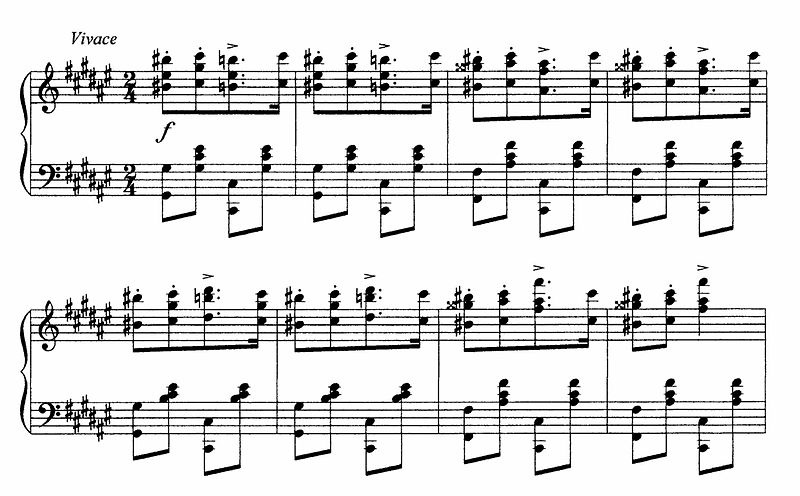
Hungarian Rhapsody No. 2, S.244/2, is the second in a set of 19 Hungarian Rhapsodies by composer Franz Liszt, and is by far the most famous of the set. Few other piano solos have achieved such widespread popularity, offering the pianist the opportunity to reveal exceptional skill as a virtuoso, while providing the listener with an immediate and irresistible musical appeal.
In both the original piano solo form and in the orchestrated version this composition has enjoyed widespread use in animated cartoons. Its themes have also served as the basis of several popular songs.
It is probable that you have heard this piece of music somewhere at one time or another because it is perhaps the most prominent piece of classical (romantic, actually) music featured in animated cartoons across the years.
Now, let the anvils fall and dynamite explode!
And, in real life, Valentina Lisitsa plays Liszt’s Hungarian Rhapsody No. 2
All children should be compelled to learn about classical music in the same way they must do maths and science, Nicola Benedetti has argued.
Benedetti, the award-winning violinist, said all youngsters should be exposed to classical music, whether they like it or not.
Saying the concept of letting children do exactly what they want in other areas of education is “alien”, she admitted she is “bemused” by the current approach to teaching art and culture.
“It actually really upsets me when people say: ‘Kids hate listening to a symphony, why would we do that to them?’” she said, in an interview with Scotland on Sunday.
“I think, hang on a minute, if you were to turn round and say to a kids: ‘Would you like to play video games or would you like to have a maths lesson?’ Of course, they’re going to go for the video games.”
Benedetti is involved with the Sistema Scotland music education and its Big Noise Orchestra.
She added: “Needing the child’s approval for what they do in school is just such an alien concept when you’re talking about maths, science, history or English.
“But, suddenly, when you bring music into the mix, it’s: ‘Oh no, we can’t show them anything that they don’t instantly love because that would be like forcing children into something that they don’t want to do.’
. 1770 ~ Anton Reicha, Czech-born, later naturalized French composer of music very much in the German style
. 1802 ~ Victor Hugo, author of Les Miserables and many other works
. 1879 ~ Frank Bridge, English composer, violist and conductor
. 1922 ~ Dancing to jazz music and tango bands was criticized in Paris. It seems that dancing was detracting the French from their postwar reconstruction, according to “La Revue Mondiale”.
. 1928 ~ “Fats” (Antoine) Domino, American rock-and-roll pianist and singer. His works include: Ain’t That a Shame, Goin’ Home, I’m inLove Again, Blue Monday, I’m Walkin’ and Blueberry Hill
. 1930 ~ Lazar Berman, Soviet pianist
. 1932 ~ Johnny Cash, American country-music singer guitarist and songwriter. He is married to June Carter. Some of his songs are: Folsom Prison Blues, I Walk the Line,Don’t Take Your Guns to Town, A Boy Named Sue and Ring of Fire. More information about Cash
. 1945 ~ Mitch Ryder (William Levise), Singer with Mitch Ryder & the Detroit Wheels
. 1947 ~ Sandie Shaw (Goodrich), Singer
. 1950 ~ Jonathan Cain, Keyboard with Babys
. 1954 ~ Michael Bolton, Grammy Award-winning singer. Some of his songs are: When a Man Loves a Woman and How Am I Supposed to Live Without You
. 1961 ~ John-Jon (John Andrew Foster), Musician with Bronski Beat
. 1972 ~ Harry Nilsson started his second week at number one with that toe- tapping ditty, Without You. The whiny love song stayed at the top for a total of four weeks.
. 1977 ~ The Eagles’ New Kid in Town landed in the top spot on the pop music charts for one week beginning this day.
. 1981 ~ Howard Hanson died. He was an American composer, conductor, educator, music theorist, and champion of American classical music.
. 1983 ~ Charley Pride’s Why Baby Why topped the country charts. The song was written by George Jones (who found national fame with his own version in 1955) and Darrell Edwards. Legend has it that inspiration for the song came when Edwards overheard a couple squabbling in their car in Orange, TX.
. 2003 ~ Otha Turner, 94, who created his own niche in blues music with an ethereal mix of early American colonial drums and West African flute, died in Como, Miss. His recording Everybody Hollerin’ Goat was rated among the Top 10 blues releases in 1997 by Rolling Stone magazine. Members of a Senegalese drum troupe performed with Mr. Turner on the album. Mr. Turner was presented with a National Endowment for the Arts Heritage Award, the Smithsonian Lifetime Achievement Award and the Charlie Patton Lifetime Achievement Award from the Mississippi Delta Blues and Heritage Festival.
. 1727 ~ Armand-Louis Couperin, French composer, organist, and harpsichordist of the late Baroque and early Classical periods.
. 1890 ~ Dame Myra Hess, British pianist
. 1929 ~ Tommy Newsom, Musician: tenor sax, arranger, composer, back-up conductor for NBC’s Tonight Show Band
. 1943 ~ George Harrison, British rock singer, guitarist and songwriter and former member of The Beatles group
. 1952 ~ The complete choreographic score of Cole Porter’s “Kiss Me Kate” became the first musical choreography score given a copyright. The work was the effort of Hanya Holm.
. 1953 ~ The musical, “Wonderful Town”, opened at the Winter Garden Theatre in New York City. The show was based on the book, “My Sister Eileen”, and the ran for 559 performances.
. 1957 ~ Buddy Holly and The Crickets traveled to Clovis, NM, to record That’ll Be the Day (one of the classics of rock ‘n’ roll) and I’m Looking for Someone to Love. Both songs were released on Brunswick Records in May of that year.
. 1963 ~ Please Please Me was the second record released in the U.S. by The Beatles. Some labels carried a famous misprint, making it an instant, and valuable, collector’s item. The label listed the group as The Beattles.
. 1986 ~ We are the World captured four Grammy Awards. The song, featuring more than 40 superstar artists gathered at one time, was awarded the Top Song, Record of the Year, Best Pop Performance and Best Short Video Awards.
. 2001 ~ Ann Colbert, a manager of classical musicians, died at the age of 95. Colbert founded Colbert Artists Management Inc. Her clientele included the Juilliard String Quartet; conductors Sir Georg Solti, Christoph von Dohnanyi and Richard Bonynge; singers Dame Joan Sutherland, Elizabeth Schwarzkopf, Christa Ludwig and Dietrich Fischer-Dieskau; and musicians Alfred Brendel and the late Jean-Pierre Rampal. Colbert moved to the United States from Berlin in 1936 and started the management company with her husband, Henry Colbert, in 1948. She retired in 1991, leaving the company to her longtime associate, Agnes Eisenberger. The company has retained Colbert’s name.
. 2003 ~ Walter Scharf, 92, a composer who earned 10 Academy Award nominations and worked on more than 200 movies and television programs, including “Funny Girl,” “Mission: Impossible” and “White Christmas,” died in Los Angeles. He received Oscar nominations for the scores for such films as “Mercy Island” (1941), “Hans Christian Andersen” (1952), “Funny Girl” (1968), “Willy Wonka and the Chocolate Factory” (1971) and “Ben” (1972). He won an Emmy for his work on a National Geographic television special and a Golden Globe for “Ben,” whose theme song helped launch singer Michael Jackson’s solo career.
The thought-provoking talk on February 10th was given by Keith Pascoe, second violinist of the Vanbrugh Quartet, in connection with tomorrow night’s violin and piano recital by Ray Chen and Julien Quentin. Pascoe came up with a great title, David and Goliath, The Ballet of Unequals: A Stradivari and Model D Steinway Recital. Using videos from YouTube as illustrations (which unfortunately allowed in snippets of a couple of unwanted advertisements), Pascoe began at the beginning, with the emergence of the piano and violin as instruments in their own right, and traced some of the changes they have both undergone in the centuries since.
The piano has become bigger, stronger and louder. Not only were extra notes added to the keyboard, but the early wooden frames were replaced with cast iron. The violin may not have grown externally, but the shape of the body was remoulded, the neck and fingerboard realigned, and internal buttressing extended, all with the intention of producing greater sound.
What composers did with the combination of violin and piano – and before that, violin and harpsichord – changed too. In the typical baroque violin sonata, the violin was to the fore. In the classical era, the roles were reversed, although this reversal has long been dishonoured by performers. And in the 19th century, the balance as we know it today began to take hold. That balance usually presents the two performers in a master-servant relationship, the violinist usually the boss whose bidding is carried out by the pianist.
. 1709 ~ Charles Avison, English composer during the Baroque and Classical periods. He was a church organist at St John The Baptist Church in Newcastle and at St. Nicholas’s Church.
. 1878 ~ Selim Palmgren, Finnish composer, pianist, and conductor
. 1866 ~ David Mannes, American violinist and conductor; founder of the Mannes College of music
. 1896 ~ Alexander Brailowsky, Pianist
. 1901 ~ Wayne King, ‘The Waltz King’, saxophonist and bandleader
. 1907 ~ Alec Wilder, American composer, arranger and songwriter
. 1918 ~ Patti Andrews (Patricia Marie Andrews), Lead singer with The AndrewsSisters
. 1935 ~ Sonny (Salvatore) Bono, Singer in the group Sonny and Cher. He later became mayor of Palm Springs, CA and a US Congressman
. 1938 ~ John Corigliano, American composer
More information about Corigliano
. 1939 ~ Herbie & Harold Kalin, Singers, The Kalin Twins
. 1942 ~ Shep Fields and his orchestra recorded Jersey Bounce on Bluebird Records.
. 1956 ~ James Ingram, Singer
. 1963 ~ The Beatles moved to the top of the British rock charts with Please,Please Me exactly one month after the record was released. It was the start of the Beatles domination of the British music charts, as well as the beginning of the British Invasion in America and elsewhere around the world.
. 1968 ~ Elvis Presley received a gold record for his sacred album of hymns, How< Great Thou Art. Despite his popularity in the pop music world, Elvis won only 3 Grammy Awards — one for this album, the Lifetime Achievement Award in 1970; then for He Touched Me in 1972. He did, however, receive over a dozen Grammy nominations.
. 2015 ~ Leslie Gore died. She was an American singer. At the age of 16, in 1963, she recorded the pop hit “It’s My Party”, and followed it up with other hits including “Judy’s Turn to Cry” and “You Don’t Own Me”.
What better way to get things started than with a party?
At Wolfie, that means the first worldwide event in honor of Mozart’s birthday – taking place this Tuesday, January 27th! Every musician – concert pianist or 2nd-grader – playing a score on the Wolfie app on January 27th will automatically appear on an interactive world map at www.wolfiepiano.com.
Share this special event with colleagues and inspire your students by enabling them to take part in a worldwide event that will connect them to piano players around the world! It all starts by joining the event, here.
Finally, we’d love to hear from you. You, Mozart’s ambassadors, are keeping his legacy alive and instilling the gift of music appreciation into young peoples’ lives every day.
See you on Tuesday – on the map!
~~~~~~~~ Wolfgang Amadeus Theophilus Mozart lived between 1756 and 1791. He is considered to be a classical composer. Mozart, born in Salzburg, Austria, began composing before most children go to kindergarten. By the time he was six he had played the piano and violin in public.
A Wunderkind, a prodigy of the first rank before the age of five, Mozart astounded the musical world with compositions of unsurpassed brilliance. His father Leopold had recognized his talent at the age of three and immediately set out to teach him to play the harpsichord, violin, and organ. Mozart and his sister made their debut in Munich when he was just six and traveled about Europe together, performing at courts and before royalty, always with success. While still a little child Mozart was inventing symphonies, sonatas, and his first opera. Legends abound about how Mozart could hear an entire work in his head and write everything down without making even one change.
As a child performer he was often treated as a freak. People would cover his hands as he played the piano, make him compose tunes on the spot and perform all sorts of other musical tricks.
In 1787 Mozart became court composer to Joseph II. He played for royalty, received commissions from aristocrats and in his short lifetime composed nearly a thousand masterpieces, including symphonies, operas, serenades, sonatas, concertos, masses, vocal works, and church works.
Mozart was a prolific composer writing masterpieces using every form of music, including his operas “The Marriage of Figaro” (based on a play by Pierre Beaumarchais), “Don Giovanni”, “Cosi fan tutte” and “The Magic Flute”. His mastery of instrumental and vocal forms, from symphony to concerto and opera, was unrivalled in his own time and perhaps in any other.
Composing the Requiem Mass commissioned for Count Walsegg, he felt he was writing his own requiem and he died before it was finished.
Wolfgang Amadeus Mozart, composer, died in Vienna Austria at the age of 35, penniless, on December 5th, 1791, of malignant typhus. Mozart, the precocious child prodigy, composed several pieces that are deemed central to the classical era. Though he ranked as one of the greatest musical genius, he did not live a life of affluence as none of his compositions earned him a decent commission but the world is forever enriched by such works as Eine Kleine Nachtmusik, the Symphonies No. 38 through 41 and the Coronation Mass.
Hungarian Rhapsody No. 2, S.244/2, is the second in a set of 19 Hungarian Rhapsodies by composer Franz Liszt, and is by far the most famous of the set. Few other piano solos have achieved such widespread popularity, offering the pianist the opportunity to reveal exceptional skill as a virtuoso, while providing the listener with an immediate and irresistible musical appeal.
In both the original piano solo form and in the orchestrated version this composition has enjoyed widespread use in animated cartoons. Its themes have also served as the basis of several popular songs.
It is probable that you have heard this piece of music somewhere at one time or another because it is perhaps the most prominent piece of classical (romantic, actually) music featured in animated cartoons across the years.
Now, let the anvils fall and dynamite explode!
And, in real life, Valentina Lisitsa plays Liszt’s Hungarian Rhapsody No. 2





 Wolfgang Amadeus Theophilus Mozart lived between 1756 and 1791. He is considered to be a classical composer. Mozart, born in Salzburg, Austria, began composing before most children go to kindergarten. By the time he was six he had played the piano and violin in public.


 MaryO'Studio