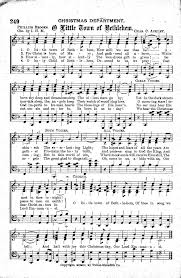
“O Little Town of Bethlehem” is a popular Christmas carol. The text was written by Phillips Brooks (1835–1893), an Episcopal priest, Rector of the Church of the Holy Trinity, Philadelphia. He was inspired by visiting the Palestinian city of Bethlehem in 1865.
Three years later, he wrote the poem for his church and his organist, Lewis Redner, added the music. Redner’s tune, simply titled “St. Louis”, is the tune used most often for this carol in the United States.
The Mormon Tabernacle Choir sings O Little Town Of Bethlehem
I could have turned the Alfred Burt Carols into the next 15 parts of this series but I decided that was a bit too easy on me!
I love this story – it’s a wonderful family tradition from the Burt family.
Starting in 1922, Alfred Burt’s father created a Christmas card for family members and parishioners. On these cards were original Christmas carols, with both the words and music by the Reverend Bates Burt. For the family Christmas card in 1942, Bates asked his son to write the music for that year’s carol, “Christmas Cometh Caroling.”
From then on, Alfred would write the music for the family’s Christmas cards, and the “Alfred Burt carols” were born.
Over the next several years, and as the Burts’ circle of friends grew, the Christmas card list grew from 50 to 450 people. But still, the Alfred Burt Carols remained unknown outside the Burts’ growing mailing list.
That changed with the 1952 carol, “Come, Dear Children”. Burt finished writing the music during a rehearsal with the Blue Reys, the vocal group with Alvino Rey’s orchestra. He asked them to sing it so he could make sure the harmonies worked; they liked it so much that they asked Burt if they could sing it at the annual King Sisters Christmas party. It proved to be a hit among the partygoers, and served to introduce Burt’s carols to Hollywood, California.
“This Is Christmas” (also known as “Bright, Bright, the Holly Berries”) (1950)
“Some Children See Him” (1951)
“Come, Dear Children” (1952)
“O, Hearken Ye” (1953)
“Caroling Caroling” (1954)
“We’ll Dress the House” (1954)
“The Star Carol” (1954)
Burt finished the last of his carols, “The Star Carol”, on February 5, 1954. He died less than 24 hours later, at the age of 33.
One of the best known of these today is Caroling Caroling (lyrics by the church organist at his father’s church, Wihla Hutson)
The Salt Lake Vocal Artists perform 2 carols; “Caroling, Caroling” and “We’ll Dress the House” by Alfred Burt live in concert on December 17, 2011 in Holy Family Catholic Church, South Ogden, Utah under the direction of Dr. Brady Allred.
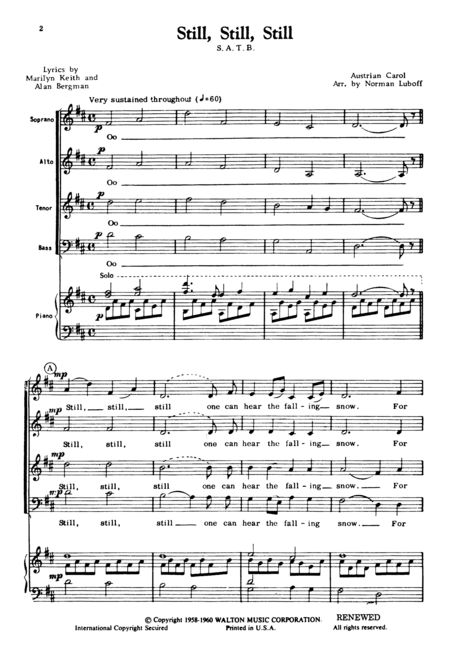
Still, Still, Still is an Austrian Christmas carol and lullaby. In German its first line is “Still, still, still, weil’s Kindlein schlafen will!” (Hush, hush, hush, for the little child wants to sleep!)
The melody is a folk tune (authorship unknown) from the State of Salzburg. The tune appeared for the first time in 1865 in a folksong collection of Maria Vinzenz Süß (1802-1868), founder of the Salzburg Museum; it has changed slightly over the years but remains attributed to G. Götsch.
The words, which run to six verses in German, describe the peace of the infant Jesus and his mother as they sleep. There are various English translations. This is one version:
Still, still, still,
One can hear the falling snow.
For all is hushed,
The world is sleeping,
Holy Star its vigil keeping.
Still, still, still,
One can hear the falling snow.
Sleep, sleep, sleep,
‘Tis the eve of our Saviour’s birth.
The night is peaceful all around you,
Close your eyes,
Let sleep surround you.
Sleep, sleep, sleep,
‘Tis the eve of our Saviour’s birth.
Dream, dream, dream,
Of the joyous day to come.
While guardian angels without number,
Watch you as you sweetly slumber.
Dream, dream, dream,
Of the joyous day to come.
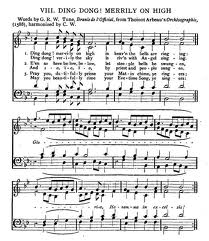
“Ding Dong Merrily on High” first appeared as a secular dance tune known as “le branle de l’Official” in a dance book written by Jehan Tabourot (1519–1593). The lyrics are from English composer George Ratcliffe Woodward (1848–1934), and it was first published in 1924 in his The Cambridge Carol-Book: Being Fifty-two Songs for Christmas, Easter, And Other Seasons. Woodward had an interest in church bell ringing, which no doubt helped inspire this carol
Ding dong! merrily on high
In heav’n the bells are ringing:
Ding dong! verily the sky
Is riv’n with Angel singing.
REFRAIN
Gloria,
Hosanna in excelsis!
Gloria,
Hosanna in excelsis!
E’en so here below, below,
Let steeple bells be swungen,
And “Io, io, io!”
By priest and people sungen.
REFRAIN
Pray you, dutifully prime
Your matin chime, ye ringers;
May you beautifully rime
Your evetime song, ye singers.
REFRAIN
Note: “Swungen” and “Sungen” in the second verse are archaic English verb forms.
O come, O come, Emmanuel is the mid-19th-century translation by John Mason Neale and Henry Sloane Coffin of the Ecclesiastical Latin text “Veni, veni, Emmanuel”.
The text is based on the Biblical prophecy from Isaiah 7:14 that states that God will give Israel a sign that will be called Emmanuel (Literally: God with us). Matthew 1:23 states fulfillment of this prophecy in the birth of Jesus of Nazareth.
O come, O come, Emmanuel
And ransom captive Israel
That mourns in lonely exile here
Until the Son of God appear
Rejoice! Rejoice! Emmanuel
Shall come to thee, O Israel.
O come, Thou Rod of Jesse, free
Thine own from Satan’s tyranny
From depths of Hell Thy people save
And give them victory o’er the grave
Rejoice! Rejoice! Emmanuel
Shall come to thee, O Israel.
O come, Thou Day-Spring, come and cheer
Our spirits by Thine advent here
Disperse the gloomy clouds of night
And death’s dark shadows put to flight.
Rejoice! Rejoice! Emmanuel
Shall come to thee, O Israel.
O come, Thou Key of David, come,
And open wide our heavenly home;
Make safe the way that leads on high,
And close the path to misery.
Rejoice! Rejoice! Emmanuel
Shall come to thee, O Israel.
O come, O come, Thou Lord of might,
Who to Thy tribes, on Sinai’s height,
In ancient times did’st give the Law,
In cloud, and majesty and awe.
Rejoice! Rejoice! Emmanuel
Shall come to thee, O Israel.
The Pender Choir sang an arrangement of this Christmas Carol December 2, 2012 and as part of the 2015 Christmas Cantata.
Mark Lowry wrote the words in 1984 when his pastor asked him to write the program for the living Christmas tree choir presentation. The music was written by Buddy Greene.
Mary did you know that your baby boy would some day walk on water?
Mary did you know that your baby boy would save our sons and daughters?
Did you know that your baby boy has come to make you new?
This child that you’ve delivered, will soon deliver you.
Mary did you know that your baby boy would give sight to a blind man?
Mary did you know that your baby boy would calm a storm with his hand?
Did you know that your baby boy has walked where angels trod?
And when your kiss your little baby, you have kissed the face of God.
Oh Mary did you know
The blind will see, the deaf will hear, the dead will walk again.
The lame will leap, the dumb will speak, the praises of the lamb
Mary did you know that your baby boy is Lord of all creation?
Mary did you know that your baby boy would one day rule the nations?
Did you know that your baby boy is heaven’s perfect Lamb?
This sleeping child you’re holding is the great I AM
In 1850, Richard Storrs Willis, a composer who trained under Felix Mendelssohn, wrote the melody called “Carol.” This melody is most often set in the key of B-flat major in a six-eight time signature. “Carol” is the most widely known tune to the song in the United States.
It came upon the midnight clear,
That glorious song of old,
From angels bending near the earth,
To touch their harps of gold:
“Peace on the earth, goodwill to men,
From heaven’s all-gracious King.”
The world in solemn stillness lay,
To hear the angels sing.
Still through the cloven skies they come,
With peaceful wings unfurled,
And still their heavenly music floats
O’er all the weary world;
Above its sad and lowly plains,
They bend on hovering wing,
And ever o’er its Babel sounds
The blessèd angels sing.
Yet with the woes of sin and strife
The world has suffered long;
Beneath the angel-strain have rolled
Two thousand years of wrong;
And man, at war with man, hears not
The love-song which they bring;
O hush the noise, ye men of strife,
And hear the angels sing.
And ye, beneath life’s crushing load,
Whose forms are bending low,
Who toil along the climbing way
With painful steps and slow,
Look now! for glad and golden hours
come swiftly on the wing.
O rest beside the weary road,
And hear the angels sing!
For lo!, the days are hastening on,
By prophet bards foretold,
When with the ever-circling years
Comes round the age of gold
When peace shall over all the earth
Its ancient splendors fling,
And the whole world give back the song
Which now the angels sing.
Charles Wesley (1707-1788), the younger brother of John Wesley wrote the words to this Christmas Carol.
Charles was a hymn writer and a poet, also known as one of the people who began the Methodist movement in the Church of England. Hark the Herald Angels Sing appeared in 1739 in a book called Hymns and Sacred Poems.
Wesley envisioned this being sung to the same tune as his hymn, Christ the Lord Is Risen Today, and in some hymnals it is included along with the more popular version.
This hymn was regarded as one of the Great Four Anglican Hymns and published as number 403 in “The Church Hymn Book” (New York and Chicago, USA, 1872).
To celebrate the invention of the printing press, Felix Mendelssohn composed a cantata in 1840 called Festgesang or “Festival Song”. The melody of Mendelssohn’s cantata was then used by William H. Cummings and adapted it to the lyrics of Wesley’s “Hark the Herald Angels Sing”.
Hark the herald angels sing
“Glory to the newborn King!
Peace on earth and mercy mild
God and sinners reconciled”
Joyful, all ye nations rise
Join the triumph of the skies
With the angelic host proclaim:
“Christ is born in Bethlehem”
Hark! The herald angels sing
“Glory to the newborn King!”
And, of course, no one can do it better than The Mormon Tabernacle Choir.
From RevKev, Pender’s Former Associate Pastor – “As it was, so it is, Christmas about Jesus. We are all distracted by the glitz and festivities, but let us hear the sound of Angels and the call to worship our Newborn King. Just in time for Christmas, a gift from God to you: A baby in a manger who would love us through and through..”
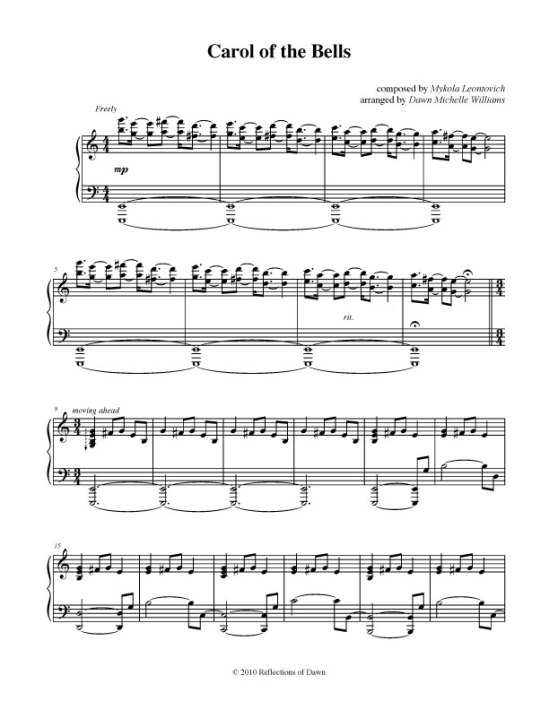
Carol of the Bells was composed by Mykola Dmytrovych Leontovych (1877-1921) in 1916. Originally titled Shchedryk, this Ukrainian folk song is sometimes called Ukrainian Bell Carol. “Shchedryk” which was associated with the coming New Year, originally celebrated in April.
Leontovych used this tune in 1904 along with lyrics by Peter J. Wilhousky to create the version that everyone knows today. It gained popularity during the 1920s and 1930s, and was introduced to an even wider audience when it was used in the movie “Home Alone”.
It was first performed in the Ukraine on the night of January 13, 1916, on the Julian calendar this is considered New Year’s Eve. In the United States the song was first performed on October 5, 1921 at Carnegie Hall.
This video is from the Christmas special of the Mormon Tabernacle Choir, presented at the BYU channel. The orchestra and choir produce a very beautiful sound.
Not the standard version –
The O’Connor Music Studio has several versions of this Christmas Carol available for loan, including this version from the Mannheim Steamroller:






 MaryO'Studio