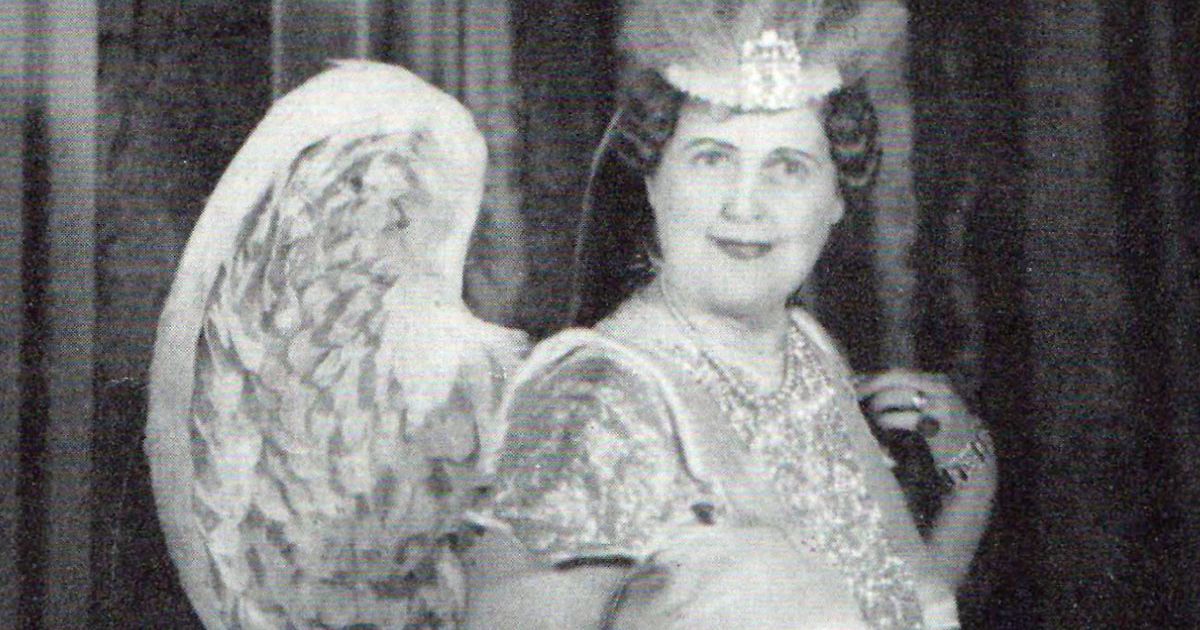
In the 1940s, New York socialite Florence Foster Jenkins (Meryl Streep) dreams of becoming a great opera singer. Unfortunately, her ambition far exceeds her talent. The voice Florence hears in her head is beautiful, but to everyone else it is quite lousy. Her husband St. Clair goes to extreme lengths to make sure his wife never finds out how awful she truly is. When Florence announces her plans for a concert at Carnegie Hall, St. Clair soon realizes that he’s facing his greatest challenge yet.
• 1853 ~ Percy Goetschius, American music teacher and critic
• 1919 ~ Kitty Wells (Muriel Ellen Deason),‘The Queen of Country Music’, Country Music Hall of Fame, married to Johnny Wright
• 1922 ~ Regina Resnik, American mezzo-soprano
• 1922 ~ The New Orleans Rhythm Kings recorded Tiger Rag, one of the most familiar ragtime jazz tunes ever. It was released on the General record label.
• 1935 ~ John Phillips, Singer with The Mamas & The Papas, actress MacKenzie Phillips’ father
• 1941 ~ John McNally, Singer, guitarist with The Searchers
• 1945 ~ Van Morrison, Irish blues-rock singer, songwriter and instrumentalist
• 1968 ~ The Beatles recorded their first songs for their own Apple label. The initial session included the big hits Revolution and Hey Jude.
• 1968 ~ The stars came out for charity as John and Yoko Lennon hosted the One on One concert in New York’s Madison Square Garden. Among the music greats appearing were Stevie Wonder and Roberta Flack. Over $250,000 was raised to aid mentally retarded children.
• 1984 ~ Beatles fans paid $271,180 dollars for memorabilia at an auction in London, England. An unpublished manuscript by John Lennon brought the largest amount – $23,056. A snare drum belonging to Ringo Starr brought $1,440.
The Piano Puzzlers book is available in the O’Connor Music Studio library if you’d like to give any a try. Piano Puzzlers as heard on American Public Media’s “Performance Today.” Includes 32 tunes with songs by Gershwin, Berlin, Arlen, Porter, Rodgers, Fats Waller, Lennon & McCartney, and others disguised in the styles of Bach, Handel, Haydn, Mozart, Beethoven, Brahms, Schubert, Schumann, Chopin, Janacek, Debussy, Ravel, Rachmaninoff, Stravinsky, Prokofiev, Bartok, and Copland.
Includes an introduction by Fred Child, host of “Performance Today” as well as background info by Bruce Adolphe. “Bruce Adolphe has taken a common musician’s party game and elevated it to high art and truly funny musical slapsticks. The Piano Puzzlers are a unique combination of extraordinary insight into the styles of many composers subtle, expert workmanship and great, great fun!”
If you’re a music geek (like me), I have a program for you. Now, let me be clear, to fully qualify as a music geek…you must have a fond appreciation for classical music (no, Poison, Quiet Riot, and Zepplin do not count as classical music). So, if you’re a “music geek” without an appreciation for classical music…well, I hate to burst your bubble…but, you’re not truly a music geek. Instead, you’re a music appreciator, but not a geek. So, if you just listen to indie music and scowl at anything on a label larger than Matador…don’t bother following the link I’ll provide…the fun will be lost on you…And, you probably won’t have a chance.
Every Wednesday night, on my way home from WNL, I turn on my local NPR station to listen to Piano Puzzlers on Performance Today. It’s absolutely incredible. A pianist/composer (Bruce Adolphe) takes a familiar folk or pop tune and sets it inside a classical masterpiece (or in the style of a particular composer). Sometimes it’s easy…sometimes it’s ridiculously difficult. There are days when I say, “got it” on the first pass. Then there are days when I say, “what the heck?” And, more often than not, I’m able to get either the popular/folk tune or the composer.
This is sad to admit, but there are nights when I’ll slow down on the drive home or sit in the car in the driveway to finish an episode. In fact, I get a little worked up if someone stops me after WNL…as I might miss the beginning of Piano Puzzlers (it usually hits around 8:20pm on our local station).
Take a listen to some of the archives and see if you can figure it out! It’s really cool…but probably only appreciated by music geeks (the kind of people that listen to NPR for their musical programs and not just the snipets of cool indie rock between segments on All Things Considered…which is a great show too).
• 1942 ~ Sterling Morrison, Bass, guitar, singer with The Velvet Underground
• 1943 ~ Paul Whiteman Presents, a summertime radio replacement show, was heard for the last time. The hostess for the show was Dinah Shore. Whiteman’s 35-piece orchestra serenaded listeners on the NBC radio network. Whiteman’s well~known theme song was Rhapsody in Blue, composed by George Gershwin.
• 1946 ~ Ella Fitzgerald and The Delta Rhythm Boys recorded It’s a Pity to Say Goodnight on Decca Records. The song turned out to be one of Lady Ella’s most popular.
• 1964 ~ Roy Orbison’sOh, Pretty Woman was released. It hit number one (for 3 weeks) on September 26th and became the biggest of his career. The title was inspired by Orbison’s wife Claudette interrupting a conversation to announce she was going out; when Orbison asked if she was okay for cash, his co-writer Bill Dees interjected “A pretty woman never needs any money.” Oh, Pretty Woman was Orbison’s second #1 hit. The other was Running Scared on 6/05/61.
• 1966 ~ The Beatles performed at Candlestick Park in San Francisco, CA. It was the group’s last live appearance before they disbanded in 1970.
• 1986 ~ The former American Bandstand studio, at the original home of WFIL-TV in Philadelphia, PA, was placed on the National Register of Historic Places. The studio is located at 4548 Market Street. We expect that any day now, Bandstand host Dick Clark will also be placed on the National Register.
• 1850 ~ Wagner’s opera, Lohengrin, was performed for the first time.
• 1894 ~ Karl Böhm, Austrian conductor
1913 ~ Richard Tucker, American tenor
More information about Tucker
• 1924 ~ Dinah Washington, American rhythm-and-blues singer. She popularized many, many great songs, including What a Diff’rence a Day Makes, Unforgettable, and several hits with Brook Benton.
• 1925 ~ Billy (William Wayne) Grammer, Singer
• 1931 ~ You Rascal You was recorded by Henry Allen, with the Luis Russell Band, for the Victor label.
• 1939 ~ Clem Cattini, Drummer with Tornados
• 1948 ~ Daniel Seraphine, Drummer with Chicago
• 1951 ~ Wayne Osmond, Singer with The Osmond Brothers
• 1964 ~ The Beatles appeared on the cover of LIFE magazine.
• 1984 ~ The Jacksons’ Victory Tour broke the record for concert ticket sales. The group surpassed the 1.1 million mark in only two months.
• 2002 ~ Kay Gardner, whose last musical work with the Bangor Symphony Orchestra memorialized the Sept. 11 terrorist attacks, died of a heart attack. She was in her early 60s.
On hearing of her death, symphony officials scheduled Gardner’s work, “Lament for Thousand,” for the orchestra’s season-opening concert Oct. 13 at the Maine Center for the Arts in Orono.
Gardner was a pianist, flutist and conductor who performed in 46 states and several countries.
More than 20 years ago, she sued the Bangor Symphony, unsuccessfully, for sex discrimination after she had applied for a conducting position and learned that orchestra members had been asked how they felt about working with a female conductor.
In 2000, she was the guest conductor for a 40-member orchestra of women from the Bangor Symphony, playing a repertoire written by women.
Gardner studied music at the University of Michigan and at the State University of New York at Stony Brook. In 1972, she helped found a feminist and openly lesbian women’s band, Lavender Jane.
• 1521 ~ Josquin Desprez, French/Franco-Flemish composer, died. Generally acknowledged as the greatest composer of the High Renaissance.
More information about Desprez
1886 ~ Eric Coates, British composer and violist
More information about Coates
• 1889 ~ Charles G. Conn of Elkhart, IN patented the metal clarinet. More than 100 years later the name, Conn, still represents one of the most popular musical instrument names, especially for clarinets.
• 1909 ~ Lester Willis “Prez” Young, American jazz tenor and saxophonist
• 1927 ~ Jimmy ‘Cajun’ Newman, Singer
• 1937 ~ Tommy (Adrian) Sands, Singer
• 1939 ~ Singer Allan Jones recorded I’m Falling in Love with Someone on Victor Records.
• 1942 ~ Daryl Dragon, Grammy Award-winning musician, songwriter, duo in The Captain and Tennille
• 1944 ~ Barry Conyngham, Australian composer
• 1944 ~ Tim Bogert, Bass with these groups: Showmen, Cactus, Vanilla Fudge
• 1949 ~ Jeff Cook, Singer, guitar with Alabama
• 1953 ~ Alex Lifeson, Guitarist with Rush
• 1970 ~ The Troubadour in Los Angeles, CA was the venue of singer Elton John’s first concert appearance in America and a record company executive for UNI records (a division of MCA) signed Elton to a recording contract.
• 1984 ~ The Menetta Lane Theatre in Greenwich Village opened. It was the first new off-Broadway theatre to be built in 50 years in New York City. The ribbon cutting was done by “America’s First Lady of the Stage”, Helen Hayes.
Let’s face it. Most kids don’t want to practice the piano. And if they do find the time to practice, it’s usually because their parent kept nagging them. How frustrating!
Piano teachers are frustrated too. It’s nearly impossible to teach students new concepts when they don’t understand the old ones–all because of a lack of practice.
If you’re a parent in this situation, I have just the solution you’re looking for.
In this upbeat book, I share all the tips I’ve discovered in my 14 years of teaching piano. You’ll learn fun, practical ways to get your kids to the keyboard.
But this easy-to-read guide goes one step further. I’ll show you simple ways to encourage better quality practice. Even if you’ve never had a music lesson in your life!
I wrote this book for kids of all ages. There are creative ideas for elementary students and also a section for teens.
There’s even a section for what to do if your child wants to stop taking piano lessons. That’s right, there is hope and my book will show you exactly how to get them interested in piano again.
Don’t be the kind of parent who sits on the sidelines waiting until their child wants to practice. Piano lessons are too expensive for you to let another “no-practice” day go by.
This book is your answer to get your child to the keyboard, have good quality practice and develop a life-long love of music.
• 1873 ~ Lee DeForest, Inventor of the triode vacuum tube, possibly the most significant invention that made radio possible.
More information about DeForest
• 1894 ~ Arthur Loesser, American pianist and writer
• 1915 ~ Humphrey Searle, British composer and writer
• 1928 ~ Peter Appleyard, British jazz vibraphonist and drummer
• 1939 ~ The radio program Arch Oboler’s Plays presented the NBC Symphony, for the first time, as the musical backdrop for the drama, This Lonely Heart.
• 1942 ~ Vic Dana, Singer
• 1949 ~ Bob Cowsill, Singer with The Cowsills
• 1957 ~ John O’Neill, Musician, guitar with That Petrol Emotion
• 1970 ~ Jimi Hendrix opened his recording studio in New York City. Because of its state-of-the-art 36-track recording capability, it attracted many top rock groups.
• 2000 ~ George Edmund Sandell, a noted violin and viola player, teacher and inventor died at the age of 88.
Sandell studied in New York under the viola virtuoso William Primrose and on scholarship at the Royal Swedish Conservatory in Stockholm.
Sandell moved to Los Angeles in 1938, where he played with the Los Angeles Philharmonic and the Pasadena and Santa Monica Symphonies.
Along with classical music, he performed pop, swing and Latin music, and played with the string sections of big band luminaries Harry James, Jimmy Dorsey and Xavier Cugat.
Sandell also played on some of Frank Sinatra’s recordings and worked for most of the big Hollywood studios on orchestral sound tracks, including the sound track for the movie Citizen Kane.
In 1947, he invented the Gee-Bee, a kitchen sponge with a plastic handle for washing dishes. He sold the company to DuPont in 1953.
• 2001 ~ Alix Williamson, the classical music publicist who suggested to Baroness Maria von Trapp that she write a book about her family’s experiences, died at the age of 85.
Williamson’s suggestion resulted in the Rodgers and Hammerstein musical “The Sound of Music.”
She represented artists such as André Watts and Frederica von Stade and helped the New York Grand Opera get a citation in the Guinness Book of World Records for its performances of a complete cycle of Verdi’s operas in Central Park. Williamson also ghostwrote books.



 1913 ~ Richard Tucker, American tenor
 MaryO'Studio