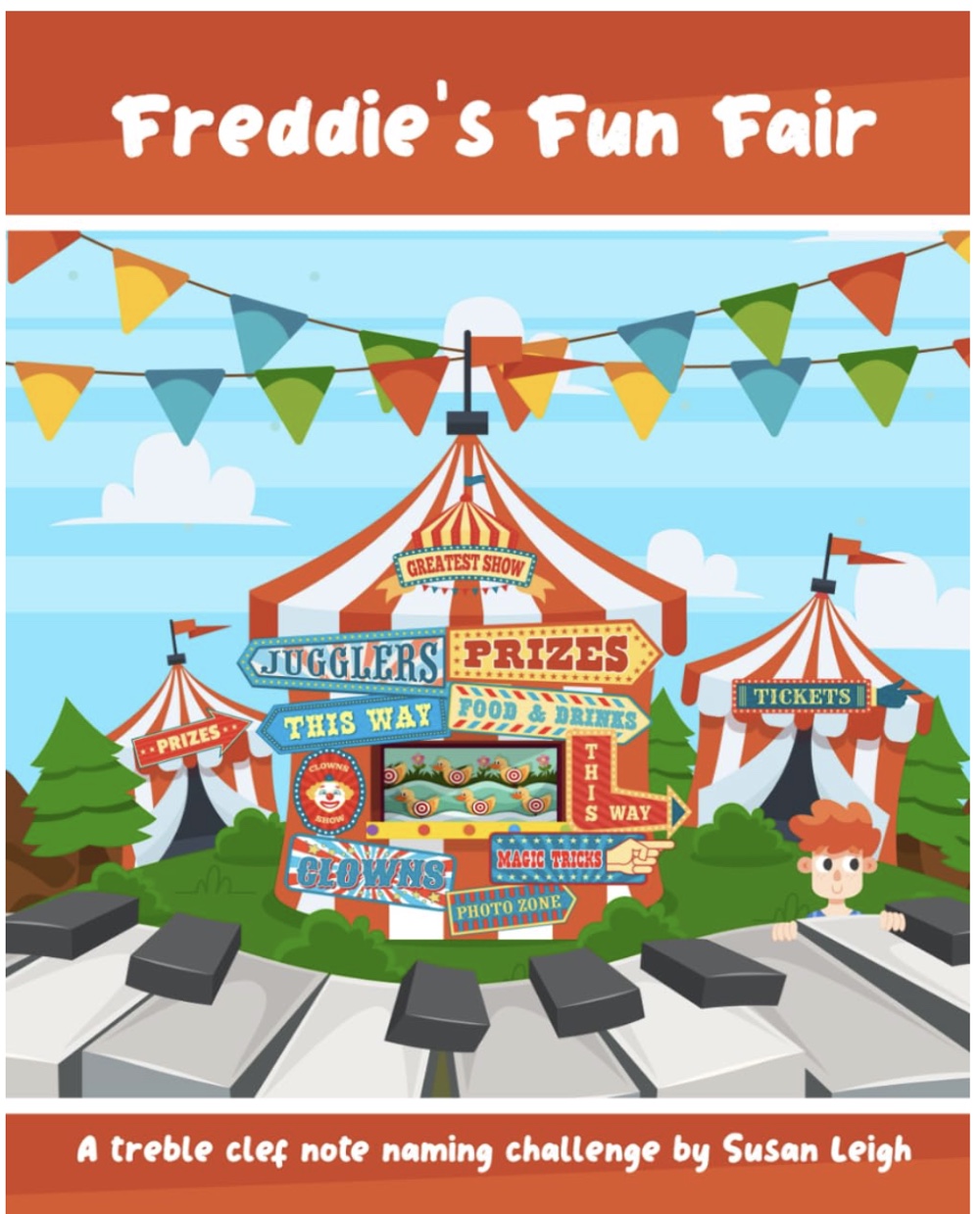
NEW! Freddie’s Fun Fair

Susan Leigh’s other books have been a huge hit with students and I’m sure this one will be, too.  It was just published and I’ve ordered it to arrive in time for students returning after winter break.

Freddie invites you to a treble clef challenge at the fun fair! Can you beat him in events like ‘Tin Can Alley’, ‘Hook a Duck’, ‘Balloon Darts’ and more? Improve your note reading and aim for the gold medal!

The note range includes all the lines and spaces of the treble clef stave, making it ideal for instrumentalists who play the piano, flute, saxophone and more.

Puzzles include traditional fairground games like the Coconut Shy, Bumper Cars, Hoopla, Toy Grabber, Skittles and Test Your Strength. There are match ups, scrambles, mazes, and also games against the clock like Tabletop Giraffe Racing, Splash the Shark and Whack-a-monster.

Students compete against Freddie in all events until the overall winner is crowned. There are two certificates to compete for; but who will win gold or silver and become the ultimate champion of both the treble clef and the fairground?!

A Helpful Book For Parents or Adult Students


I have several copies of this book for the music studio so parents can check it out to see if it would be useful for them to buy for home use.  If any of the studio parents have this book already, please let me know what you think.

Some of my adult students have this and have found it helpful in doing theory assignments.


From Amazon:

Help Your Kids with Music is a step-by-step visual guide to music theory and is the perfect primer to help students gain a solid foundation in music, no matter their age, skill level, or instrument.

Help Your Kids with Music clearly explains key concepts in five step-by-step chapters:

  • The Basics explains the types of instruments, notation for keyboard and stringed instruments, the “musical alphabet,” and counting a beat.
  • Rhythm covers the length of notes and rests, as well as basic rhythms and meters, phrasing, syncopation, tempo, and using a metronome.
  • Tone and Melody includes everything a student needs to know about tones and how they work together to build a melody.
  • Chords and Harmony shows how intervals work together and includes examples for horn and woodwind instruments.
  • Form and Interpretation helps students understand how musical form can aid appreciation and interpretation for classical, jazz, blues, and other musical styles.

Sample pages:


All About Music Theory

theory


As all my students know, I teach theory with all piano and organ lessons.  Sometimes, it’s from a theory book that matches a lesson book, sometimes on the fly on an “as needed” basis.

This book looks like it would be interesting to use as a review or to look ahead and see what’s coming.  I have just ordered a copy for the studio if you want to check it out at the next lesson.

From amazon.com:

 If you wish there was a fun and engaging way to help you understand the fundamentals of music, then this is it. Whether it’s learning to read music, understanding chords and scales, musical forms, or improvising and composing, this enjoyable guide will help you to finally start understanding the structure and design of music.

This fun-filled, easy-to-use guide includes:
* Music notation
* Scales and modes
* Melody harmonization and counterpoint
* Chord progressions
* Song form and structure

Listen and learn with the CD that has 90 tracks, including over 50 popular songs such as:
* Beauty and the Beast
* Candle in the Wind
* Imagine
* In the Air Tonight
* Killing Me Softly with His Song
* Let It Be
* Message in a Bottle
* Misty
* Satin Doll
* Take the ‘A’ Train
* Unchained Melody
* What’d I Say
* and more!

maryOivoryandroses

Technic Series: Scales and Arpeggios

scales

PDF Article on Scales and Arpeggios

In music, a scale is any set of musical notes ordered by fundamental frequency or pitch.

An arpeggio (it. /arˈpeddʒo/) is a musical technique where notes in a chord are played or sung in sequence, one after the other, rather than being played together like a chord. This word comes from the Italian word “arpeggiare”, which means “to play on a harp”. An alternative translation of this term is “broken chord”.

Make any scale or chord here