“I used to play piano, when I was a child,” Fitzgerald explained. “My mother liked it, because she could just say, ‘Go play piano!’ and I’d go off and play it by myself.”
Fitzgerald stopped playing when she was young, due to the large size of her family. None of her brothers or sisters were much interested in the instrument, and she began to feel uncomfortable about her hobby.
She explained that big families can’t afford everything, and that keeping an expensive object like a piano for just one person would have been selfish.
So Fitzgerald gave up her piano, grew up, and moved on. But she always remembered her love of the piano. And when she moved into the Cartmell Home, and found out about the lessons, she was hooked.
“I decided to give it a try,” she said, laughing, “I’ve already got one foot in the grave! When else will I get the chance to?”
Although Fitzgerald’s skill with the instrument has atrophied since she was younger, (she laughs while pointing out that her music practice book is designed for children) her innate talents are as sharp as ever.
“I’ve always had an ear for music” she explains, “I can play a tune just from hearing it.”
Picture a seven-foot grand piano in a studio. The lid’s missing, so you can see all the strings. Researchers suspend a rod embedded with 32 microphones over the piano’s body.
“We played this middle C at a very soft level, a medium level, and a very loud level,” says Agnieszka Roginska, a professor in NYU’s music technology program. She says using a pianist to play middle C over and over wouldn’t be scientific. So they’re using a disklavier, a fancy player piano triggered by electronics. “So we could hit the same note, with the same velocity, thousands of times,” she says.
They’d record the piano in one spot. Then move the microphones eight inches. Record the note. Move the mics again. Record the note. Over and over and over, until they reach the back of the piano. At the end, they get “what is basically a very dense acoustical scan of the radiation pattern of the grand piano,” Roginska says.
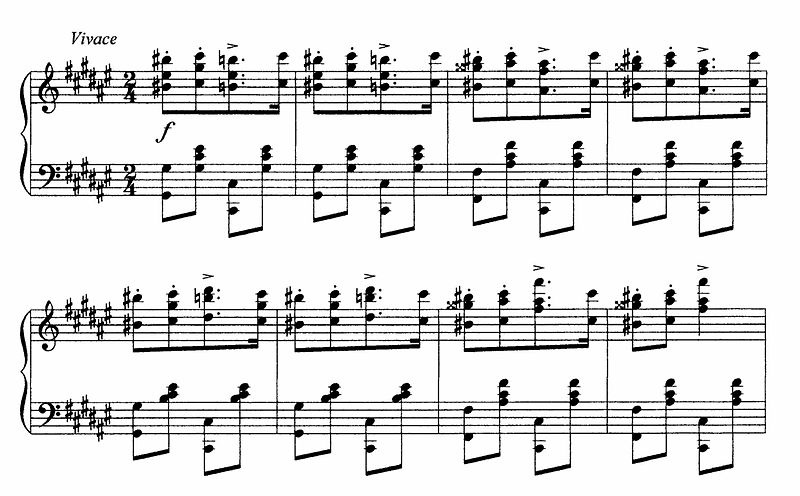
Hungarian Rhapsody No. 2, S.244/2, is the second in a set of 19 Hungarian Rhapsodies by composer Franz Liszt, and is by far the most famous of the set. Few other piano solos have achieved such widespread popularity, offering the pianist the opportunity to reveal exceptional skill as a virtuoso, while providing the listener with an immediate and irresistible musical appeal.
In both the original piano solo form and in the orchestrated version this composition has enjoyed widespread use in animated cartoons. Its themes have also served as the basis of several popular songs.
It is probable that you have heard this piece of music somewhere at one time or another because it is perhaps the most prominent piece of classical (romantic, actually) music featured in animated cartoons across the years.
Now, let the anvils fall and dynamite explode!
And, in real life, Valentina Lisitsa plays Liszt’s Hungarian Rhapsody No. 2
Many homeowners don’t realize that there are movers available to them who specialize in the transportation and storage of pianos. A piano is a delicate instrument and not something you want to take risks with. By trusting this major job to a piano mover, you can rest easy knowing that one of the most valuable items in your home is being transported with the care it deserves.
But It Weighs 1500 Pounds. How Delicate Can It Be?
This is exactly where many homeowners go wrong. Sure, that piano in your living room is heavy enough to throw out the backs of four or five of your best buddies as you wrestle it out the door and up into the truck, but don’t let that fool you. Despite its bulky appearance, it is also a precision musical instrument with over 1000 moving parts and 200 finely-tuned strings, any number of which can be damaged and require repair if your piano isn’t handled properly in a move.
Your Piano Mover Understands Pianos
These intricate inner workings of a piano are exactly why hiring an expert in piano moving is so important. These professionals understand pianos and moving them, from the safest way to lift and twist a standard upright piano to get it out the door, to how to properly disassemble a grand piano and transport it without causing any damage. And even more importantly, a piano mover understands that when your piano is delivered to your new home, you expect to be able to sit down and play it right away. It’s why many piano movers keep tuners and repairmen on staff, and why the rest will have a trusted list of professionals available on request if you need it.
I have copies of the above sheet music in the music studio, if anyone wants to play this!
Having trouble counting various note values?
In music notation, a note value indicates the relative duration of a note, using the color or shape of the note head, the presence or absence of a stem, and the presence or absence of flags/beams/hooks/tails.
A rest indicates a silence of an equivalent duration.
The following ornament table is a transcription of the one appearing in the Clavier-Büchlein vor Wilhelm Friedemann Bach, written by Johann Sebastian Bach for the keyboard instruction of his eldest son.
A scan of the original manuscript appears at Dave’s J.S. Bach Page.
The German title translates as “Explanation of various signs, showing how to play certain ornaments correctly.”{1} Bach gives the sign for each ornament on the upper of the paired staves, while the lower shows its execution directly beneath.
(This blog has) simply modernized the clefs in my transcription, since Bach’s manuscript uses soprano clefs, as several composers continued to do throughout the 18th century in place of the treble clef now used in all keyboard music.
After the transcription graphic showing the table, there appear clickable buttons which are keyed to AU sound files; you can click on any of the ornaments and hear a sound file play its execution.
Independence Day, commonly known as the Fourth of July, is a federal holiday in the United States commemorating the adoption of the Declaration of Independence on July 4, 1776, declaring independence from Great Britain.
Independence Day fireworks are often accompanied by patriotic songs such as the national anthem “The Star-Spangled Banner”, “God Bless America”, “America the Beautiful”, “My Country, ‘Tis of Thee”, “This Land Is Your Land”, “Stars and Stripes Forever”, and, regionally, “Yankee Doodle” in northeastern states and “Dixie” in southern states. Some of the lyrics recall images of the Revolutionary War or the War of 1812.
A bit of audio for your listening pleasure, as played by Vladimir Horowitz…
cdcovers/tchaikovsky/concerto no 1 van cliburn.jpg (Photo credit: exquisitur)
Van Cliburn was just a pianist much the way Neil Armstrong was merely an astronaut. Simply put, the tall Texan’s musical talent and successes were out of this world.
Cliburn, who died Wednesday February 27, 2013 at age 78 at his Fort Worth home due to complications from bone cancer, was 23 when he strode into Moscow for the inaugural International Tchaikovsky Competition, created to showcase Soviet cultural superiority.
Playing with unerring precision and sublime emotion, he took the top prize and was given a ticker-tape parade in Manhattan, the first and last time a pianist won such an honor.
“Imagine galvanizing the attention of the entire world in the pre-Internet, pre-global TV year of 1958,” says Howard Reich, who got to know the Texas-based pianist while researching his 1993 biography, Van Cliburn. “As a Texan, he was so emblematic of the United States. But the Russians fell in love with his romanticism.”
In many ways, however, that seminal performance both made his name and sealed his fate.
The pieces that won him the competition — Tchaikovsky’s Piano Concerto No. 1 and Rachmaninoff’s Piano Concerto No. 3 — sold countless records (his Tchaikovsky No. 1 was the first classical record to sell more than a million copies) and became required concert staples.
“Playing on that treadmill for the next 20 years led him to burn out, and by 1978 he looked terrible and bowed out of public life,” says Reich. “He was a gentle soul, and that harsh public spotlight had a negative effect on him.”
It would be nine years before Cliburn performed again, at the White House for Ronald Reagan and Soviet premier Mikhail Gorbachev. Although he made occasional appearances in the following decades, he spent most of his time overseeing his foundation and a quadrennial competition that bears his name.
“I can’t think of anyone who has done more to help promote the instrument and young performers than Van,” says Cliburn’s friend Yoheved Kaplinsky, chairman of the piano department at New York’s Juilliard School of Music, which Cliburn attended. “He was an icon in Fort Worth, and a person of great humility.”
Born Harvey Lavan Cliburn Jr. in Shreveport, La., Cliburn started piano lessons at age 3 and immediately showed prowess under the watchful eye of his mother, who had trained on the instrument under a teacher who had studied with Franz Liszt.
After moving to Texas, Cliburn played with Houston’s symphony at age 12, and at 17 entered Juilliard. At 20, he performed with the New York Philharmonic at Carnegie Hall, setting the stage for his triumphant coup in Russia.
No one can imagine a ticker-tape parade for a pianist in this era, but in Cliburn’s heyday he was as much an inevitable cultural icon as he was a reluctant political figure. In the late ’50s, the Cold War was raging, the Beatles were still practicing and classical music still held sway.
But what truly made Cliburn unique was the humble ease with which he went about seducing the alleged enemy.
“Van marched in full of the musical values of the Old World, full of tremendous sincerity and with a remarkable ability to connect with audiences,” says Kaplinsky. “He may have transcended the boundaries of the art world and breached into the political world, but foremost Van was a consummate artist.”
That artistry is on display in various YouTube clips of Cliburn reprising his competition-winning form in Moscow in 1962. The pianist’s eyes are often closed as massive hands fly across the length of the keyboard. Utterly lost in the music, Cliburn seems almost oblivious to his audience.
“He had more of everything,” says Reich. “More height, more smiles, more sweep on the piano.”
In his later years, Cliburn collected the usual array of awards accorded cultural heroes. A Kennedy Center Honors tribute in 2001, a Presidential Medal of Freedom in 2003, and in 2004 Russia’s equivalent, the Russian Order of Friendship. In 2004, there was a predictable Grammy Lifetime Achievement Award, and in 1994 a less-expected guest appearance as himself in the TV cartoon Iron Man.
On the personal front, Cliburn was a devout Baptist but also quietly gay; in the late ’90s, his longtime partner, Thomas Zaremba, unsuccessfully sued the pianist over compensation claims.
Ultimately, Cliburn will be remembered not just as a performer of startling skill, but also as a global cultural sensation in the age of shortwave radio.
“He did something that no one could have ever imagined back then,” says Reich. “He was ubiquitous.”