Pianos in harmony with palace halls – ARTS

pianos-Istanbul

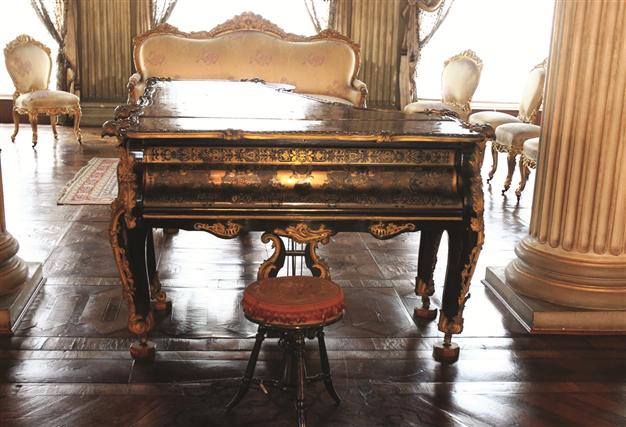
The pianos in Istanbul’s Dolmabahçe Palace, which hosted some 1 million people last year, draw great interest from local and foreign visitors for their magnificence and harmony with their surroundings.

National Palace guide Osman Nihat Bişgin said Dolmabahçe Palace was a Tanzimat (reform-era) palace, adding, “All features of the reform era are clearly seen in Dolmabahçe Palace. This process, which we call the Europeanization and westernization process, made western music enter Dolmabahçe Palace.”

He said the palace had a total of 12 pianos, and all of them had ornamentations suitable to the style and harmony of the palace.

Bişgin said the palace opened in 1856 and the pianos were brought there nearly at the same time. “The wives of sultans were taking piano education in the palace, particularly in the final years of the Ottomans. There are many pianos and none of them were inactive; all of them were being played,” he said.

He said most of the piano brands in the palace were Hertz, Pleyel, Gaveau and Erard, and that the number of grand pianos was less.

Speaking of a striking green piano in Zülvecheyn Hall on the upper floor of the palace, Bişgin said it was a classical Pleyel-brand palace piano.

“Since the magnificence and glory was dominant in the palace, the pianos draw our attention visually. Their sound is not very famous, but they are very important and famous visually,” he said.

Bişgin said Zülvecheyn Hall had gilded ornamentation on its white and beige ceiling, adding, “We see enormous harmony between the piano and the ceiling.”

He said the furniture in Dolmabahçe Palace was in its original place, and added, “We can say that the pianos belong to these halls. The pianos in the Zülvecheyn and Süfera halls were designed to add visual richness to halls like them. They are not generally played.”

Crystal piano and chair in the Glass Kiosk

As for the rare crystal piano in the Glass Kiosk, Bişgin said the following: “The Glass Kiosk is a big venue hidden behind the walls of the palace. Mustafa Kemal Atatürk greeted the public in this place. It is like a winter garden surrounded with glass. In harmony with this kiosk, there is a crystal piano. It is a Paris-made Gaveau piano. Its chair is crystal, too.”

Another piano in the palace is a plain black German-made Steinway. Bişgin said its sound was very strong and it was very valuable.

“It was produced as a Hamburg Steinway in 1912. Then the factory moved to the U.S. Accordingly, there were only five Steinway pianos made in Germany. This is one of them. Its estimated price is 200,000 euros. It also has the emblem of the sultan Abdulmecid,” Bişgin added.

Speaking of the piano, which was used during the acceptance of ambassadors in the Süfera Hall, Bişgin said, “Süfera is the plural of the word sefir [ambassador]. This hall was created to address foreigners. The furniture is gold-plated; the ceiling is the same. There is a boulle-work piano here to show the beauty of metal and gold. This piano is wonderful for decoration.”

More pictures at Pianos in harmony with palace halls – ARTS.

June 1 ~ Today in Music History

today

• 1893 ~ Allesandre Spontone, Composer

• 1653 ~ Georg Muffat, Composer

• 1755 ~ Frederico Fiorillo, Italian Violist and composer

• 1757 ~ Ignaz Playel, Austrian Composer and piano builder

• 1763 ~ Johann Caspar Vogler, Composer, died at the age of 67

• 1765 ~ Friedrich Ludwig Seidel, Composer

• 1769 ~ Joseph Antoni Frantiszek Elsner, Composer

• 1771 ~ Ferdinando Paer, Composer

• 1776 ~ John George Schetky, Composer

• 1804 ~ Mikhail Glinka, Russian composer; “The Father of Russian Music”
More information about Glinka

• 1810 ~ Johann Paul Wessely, Composer, died at the age of 47

• 1826 ~ Carl Bechstein, German piano inventor

• 1826 ~ Hermann Zopff, Composer

• 1848 ~ Otto Valdemar Malling, Composer

• 1886 ~ Ernst Kurth, Austrian/Swiss musicologist

• 1892 ~ Samuel L M Barlow, Composer

• 1893 ~ Opera “Falstaff” was produced in Berlin

• 1898 ~ Edgar “Cookie” Fairchild, Bandleader for the Jerry Colonna Show

• 1898 ~ Lieb Glantz, Composer

• 1903 ~ Percy William Whitlock, Composer

• 1905 ~ Dinora de Carvalho, Composer

• 1909 ~ Szymon Goldberg, Polish/American violinist and conductor

• 1909 ~ Giuseppe Martucci, Composer, died at the age of 53

• 1918 ~ Friedrich Richard Faltin, Composer, died at the age of 83

• 1918 ~ Jaroslav Novotny, Composer, died at the age of 32

• 1919 ~ Boris Lazarevich Klyuzner, Composer

• 1921 ~ Nelson Riddle, Grammy Award-winning orchestra leader and arranger of popular music for Frank Sinatra and Nat King Cole

• 1926 ~ Vasily Mikhaylovich Metallov, Composer, died at the age of 64

• 1929 ~ Yehudi Wyner, Composer

• 1934 ~ Pat (Charles Eugene) Boone, Singer, married to Red Foley’s daughter, Shirley

• 1935 ~ Alberto Cametti, Composer, died at the age of 64

• 1941 ~ Edo de Waart, Dutch conductor

• 1942 ~ Ernest Pingoud, Composer, died at the age of 53

• 1943 ~ Ely van Tongeren, Dutch guitarist and singer

• 1943 ~ Richard Goode, Concert pianist. In 1980 he won the Avery Fisher Award

• 1945 ~ Frederica Von Stade, American mezzo-soprano

• 1945 ~ Linda Scott, Singer

• 1946 ~ Carol Neblett, American soprano with the NYC Opera

• 1947 ~ Ron Wood, Guitar with Rolling Stones after 1975

• 1949 ~ Mike Levine, Rock keyboardist/bassist

• 1950 ~ Graham Russell, Singer with Air Supply

• 1955 ~ F Melius Christiansen, Composer, died at the age of 84

• 1959 ~ Celebrating a solid year at the top of the album charts was “Johnny’s Greatest Hits” on Columbia Records. The LP stayed for several more years at or near the top of the album charts. It became the all-time album leader at 490 weeks.

• 1960 ~ “Finian’s Rainbow” closed at 46th St Theater NYC after 12 performances

• 1961 ~ There was a new sound in the air this day. FM multiplex stereo broadcasting was enjoyed for the first time by listeners to FM radio in Schenectady, NY, Los Angeles and Chicago. The FCC adopted the standard a year later.

• 1964 ~ Rutkowski Bronislaw, Composer, died at the age of 66

• 1966 ~ George Harrison was impressed by Ravi Shankar’s concert in London

• 1967 ~ The Beatles’ “Sgt. Pepper’s Lonely Hearts Club Band” was released. One of the first critically-acclaimed rock albums, “Sgt. Pepper’s” became the number one album in the world and was at the top of the U.S. album list for 15 weeks.

• 1968 ~ Simon and Garfunkel’s Mrs Robinson hit #1

• 1970 ~ Everything was Beautiful by Ray Stevens hit #1

• 1971 ~ “You’re a Good Man Charlie Brown” opened at Golden NYC for 31 performances

• 1972 ~ Dmitri Shostakovitch’s 15th Symphony premiered in West Berlin

• 1973 ~ George Harrison’s Living in the Material World went gold

• 1973 ~ Paul McCartney and Wings released Live and Let Die

• 1974 ~ Alanis Nadine Morisette, Singer

• 1974 ~ “My Girl Bill” by Jim Stafford hit #12

• 1975 ~ “Chicago” opened at 46th St Theater NYC for 947 performances

• 1980 ~ Barbra Streisand appeared at an ACLU Benefit in California

• 1988 ~ “Les Miserables” opened at Shubert Theatre, LA

• 1996 ~ Don Grolnick, Jazz musician, died at the age of 48

May 31 ~ Today in Music History

today


• 1656 ~ Marin Marias, Composer

• 1674 ~ Friedrich Erhard Niedt, Composer

• 1696 ~ Heinrich Schwemmer, Composer, died at the age of 75

• 1802 ~ Cesare Pugni, Composer

• 1804 ~ Jeanne-Louise Farrenc, Composer

• 1809 ~ Franz Joseph Haydn passed away

https://youtu.be/1qSudNUalpU

• 1817 ~ Edouard Deldevez, Composer

• 1854 ~ Vatroslav Lisinski, Composer, died at the age of 34

• 1866 ~ Vladimir Ivanovich Rebikov, Composer

• 1875 ~ Italo Montemezzi, Composer

• 1879 ~ Mark Hambourg, Composer

• 1892 ~ Louis Fourestier, Composer

• 1892 ~ Willem Ravelli, baritone singer

• 1898 ~ Johan Brouwer, Dutch pianist, writer and resistance fighter

• 1902 ~ Billy Mayerl, Composer

• 1902 ~ Ralph Walter Wood, Composer

• 1912 ~ Alfred Deller, British countertenor

• 1914 ~ Akira Ifukube, Composer

• 1917 ~ First jazz record released (Dark Town Strutters Ball)

• 1919 ~ Chet Gierlach, Music publisher and composer

• 1919 ~ Emmanual Tettey Mensah, Musician

• 1923 ~ Wolfgang Lesser, Composer

• 1928 ~ Jacob Lateiner, Cuban pianist and professor at Juilliard

• 1929 ~ Aladar Zoltan, Composer

• 1933 ~ Shirley Verrett, American mezzo-soprano, New York Met

• 1934 ~ Karl-Erik Welin, Composer

• 1938 ~ Peter Yarrow, American folk singer and guitarist
More information on Yarrow

• 1939 ~ Charles Drain, singer

• 1940 ~ Augie Meyers, Keyboardist with Texas Tornados

• 1941 ~ Johnny Paycheck (Don Lytle), Country singer
More information about Paycheck

• 1944 ~ Mick Ralphs, Guitarist with Mott the Hoople

• 1947 ~ Henri G Casadesus, French alto violist (viola d’amour) and composer, died at the age of 66

• 1948 ~ Jose Vianna da Motta, Composer, died at the age of 80

• 1955 ~ Raoul Gunsbourg, Composer, died at the age of 95

• 1961 ~ Rock ’n’ roll fans were ready for a good old-fashioned summertime as Chuck Berry’s amusement park, Berryland, opened near St. Louis, MO.

• 1962 ~ Eduardo Toldra, Composer, died at the age of 67

• 1969 ~ Stevie Wonder’s My Cherie Amour was released by Tamla Records. The song made it to number four on the pop music charts on July 26 and stayed on the nation’s radios for eleven weeks.

https://youtu.be/6eQ5pMJrVy8

• 1969 ~ John Lennon, Yoko Ono recorded Give Peace a Chance

https://youtu.be/yU0tahJ4f7k

• 1974 ~ William DeVaughn, a soul singer, songwriter and guitarist from Washington, DC, received a gold record for his only hit, Be Thankful for What You Got.

• 1976 ~ Ear doctors didn’t have to drum up business this day. There were plenty of walk-ins as The Who put out a total of 76,000 watts of power at 120 decibels. They played the loudest concert anyone had ever heard, making it into “The Guinness Book of World Records”.

• 1977 ~ “Beatlemania” opened at Winter Garden Theater NYC for 920 performances

• 1979 ~ Radio City Music Hall (NYC) reopened

• 1989 ~ First presentation of rock n roll Elvis awards

• 1994 ~ Herva Nelli, Soprano, died at the age of 85

• 1997 ~ “Once Upon a Matress,” closed at Broadhurst Theater NYC after 187 performances.

• 2002 ~ Mario Lago, an influential composer, actor and political dissident, died of lung failure. He was 90. Throughout a multifaceted career, Lago wrote more than 200 popular songs and appeared in 20 films and more than 30 telenovelas, Brazil’s version of television soap operas. He was also an active member of Brazil’s Communist Party, and was imprisoned six times during Brazil’s 1964-86 military regime. One of Lago’s most successful songs, Amelia, sang the praises of a woman happy with very little from her husband. The name came to signify a submissive woman in Brazilian slang. Lago continued acting until January, 2002 when he was hospitalized for a month with emphysema.

Master Chopin By Practicing Just 20 Minutes A Day

Here are 8 bits of wisdom from Play It Again that remind us that it is possible to make time for what matters most in the face of life’s demands and stresses.

Own Your Stress

Rusbridger is completely clear-eyed about just how stressful his job is, and by confronting — rather than denying — the reality of his stress, he’s able to seek out ways to reduce it. Being editor of the Guardian is “one of those jobs which expands infinitely to fill the time and then spill beyond it,” he writes. “An editor, particularly within a modern global media company, is never truly off duty.”

A typical day in the life of a newspaper editor, he writes, means “a hum of low-level stress much of the time, with periodic eruptions of great tension.”

Find Your Metaphor

When Rusbridger felt frustration and self-doubt — which was nearly all the time — he found it helpful to think of people who took on great challenges in different fields. This helped put his own project in perspective, and also let him feel solidarity with others who had taken on great challenges. He compares learning Chopin to climbing the Matterhorn, the forbidding mountain in the Alps.

He writes: “Jerry R. Hobbs, an American computational linguistics expert and amateur climber, described the mountain as ‘just about the hardest climb and ordinary person can do’, which, apropos the G minor Ballade, sounds familiar.”

You’re Not Alone

Rusbridger supplements his piano practice with lots of reading. One book in particular, Arnold Bennett’s 1910 How to Live on 24 Hours a Day, reminds him that the sense of having not enough time to do all we want to do is universal, and not exactly new.

As Bennett writes: “We never shall have any more time. We have, and we have always had, all the time there is.”

There’s Power In A Morning Routine

Rusbridger learns quickly that his daily 20 minutes have to happen in the morning, before the unpredictable demands of work kick in. Here is how he describes his routine:

“I get up half an hour earlier. I fit in ten minutes of yoga listening to the Todayprogramme – not exactly meditative. Then breakfast and the papers with more Today programme all at the same time. Then I slip upstairs to the sitting room to play before driving into work.”

Pursuing Your Passion Is An Investment

Even though his morning piano practice is a solitary activity, he undertakes it knowing that it will have social benefits. After all, when he was a child, his mother told him that playing the piano would help him make friends. She’s right, and he finds her message echoed in the pages of Charles Cooke’s book Playing the Piano for Pleasure: “The better you play, the more your circle of friends will expand. You can count on this as confidently as you can count on the sun rising. Music is a powerful magnet which never fails to attract new, congenial, long-term friends.”

Mortality Is A Good Motivator

When Rusbridger’s former girlfriend gets in touch to tell him that her breast cancer has returned, he finds himself reflecting on mortality, and thinking of other friends more or less his age who are undergoing treatment for various serious diseases. Each brush with illness or mortality strengthens his determination to lean the Ballade. “In terms of getting on with life’s ambitions,” he writes, “I’m hit by more than a tinge of carpe diem.”

“Amateur” Is Not An Insult

Rusbridger has no illusions or intentions about becoming a professional pianist. He’s a dedicated amateur from the start, and his conversations and meetings with other music lovers — both professional and amateur — is a reminder that “amateur” isn’t a value judgment (i.e. worse than a professional), but a worthy end in itself. In fact, it’s probably a good deal more enjoyable and less stressful than being a pro.

In conversation with Rusbridger, the New York Times music critic Michael Kimmelman talks about the perks of being an amateur. “You have another life, it’s a full and interesting life, but you decide to add this life as well because music gives you something that you can’t get from this other life. It isn’t about having a career and making a living from it, it’s about something that only music-making will give you.”


It’s Never Too Late

As he improves and comes closer to learning the entire Ballade, no one is as surprised as Rusbridger himself. “It’s a funny thing to discover about yourself in your mid-50s — that you spent the previous forty years not doing something on the assumption that you couldn’t do it, when all along you could.”

He is astonished to learn, after memorizing complex passages of the Ballade, just how powerful his own memory is. “Back in the summer of 2010 I had no idea of just how capable a 56-year-old brain was of learning new tricks,” he writes. “So it’s heartening to know that, quite well into middle age, the brain is plastic enough to blast open hitherto unused neural pathways and adapt to new and complicated tasks. So, no, it’s not too late.”

From http://www.huffingtonpost.com/2013/10/14/how-alan-rusbridger-edito_n_4080735.html

May 30 ~ Today in Music History

today


• 1578 ~ Valentin Dretzel, Composer

• 1746 ~ Giovanni Antonio Pollarolo, Composer, died at the age of 69

• 1778 ~ Voltaire, (François-Marie Arouet), French writer of Candide, died at the age of 42 Candide was later set to music by Leonard Bernstein

• 1791 ~ Ildephons Haas, Composer, died at the age of 56

• 1797 ~ Johann Christian Lobe, Composer

• 1797 ~ Carl Ludwig Junker, Composer, died at the age of 48

• 1794 ~ Ignaz Moschelles, Composer

• 1808 ~ Joaquim Casimiro Jr, Composer

• 1833 ~ Josef Slavik, Composer, died at the age of 27

• 1844 ~ Louis Varney, Composer

• 1853 ~ Karl Fritjof Valentin, Composer

• 1866 ~ Opera “Die Verkaufte Braut” premiered in Prague

• 1870 ~ Gustave Vogt, Composer, died at the age of 89

• 1883 ~ Riccardo Zandonai, Composer

• 1887 ~ Gino Tagliapietra, Composer

• 1906 ~ William Yeates Hurlstone, Composer, died at the age of 30

• 1909 ~ Benny Goodman, American jazz clarinetist, composer and bandleader. He became a leading player with his own bands during the 1930’s and also commissioned works from classical composers including Bartok and Copland.
More information on Goodman

• 1913 ~ Pee Wee (George) Erwin, Trumpet with Tommy Dorsey Band and Isham Jones Band

• 1913 ~ Cedric Thorpe Davie, Composer

• 1920 ~ George London, Baritone singer with Bel canto Trio (with Frances Yeend and Mario Lanza); member: Vienna State Opera, Metropolitan Opera; Artistic Director of the Kennedy Center for the Performing Arts; Director: National Opera Institute; head of the Washington Opera and established the George London Foundation for Singers in 1971.

• 1922 ~ ‘Smilin’ Ed McConnell debuted on radio, smiling and playing his banjo. McConnell quickly became a legend in the medium.

• 1923 ~ Howard Hanson’s 1st Symphony “Nordic,” premiered

• 1923 ~ Camille Chevillard, Composer, died at the age of 63

• 1925 ~ Claude Prey, Composer

• 1928 ~ Gustav Leonhardt, Dutch organist and harpsichordist

• 1935 ~ Lothar Windsperger, Composer, died at the age of 49

• 1936 ~ Galina Shostakovitch, daughter of Russian Composer Shostakovitch

• 1940 ~ Olivia Stapp, American soprano

• 1944 ~ Lenny Davidson, Musician with The Dave Clark Five

• 1947 ~ Sidney Hugo Nicholson, Composer, died at the age of 72

• 1952 ~ Zoltan Kocsis, Composer

• 1952 ~ Darius Milhaud’s “West Point Suite,” premiered

• 1954 ~ Heitor Villa-Lobos’ “Odisseia de Uma Raca,” premiered

• 1959 ~ Thomas Carl Whitmer, Composer, died at the age of 85

• 1962 ~ Benjamin Britten’s “War Requiem,” premiered

• 1962 ~ The King of Swing, Benny Goodman, turned 53 and led the first American jazz band to play in the Soviet Union. Goodman and his band played six concerts in the U.S.S.R.

• 1964 ~ The Beatles 1961 record of Cry for a Shadow was #1 in Australia

• 1964 ~ The Beatles’ Love Me Do, single was #1

• 1968 ~ The Beatles begin work on their only double album “Beatles”

• 1969 ~ Gaston Brenta, Composer, died at the age of 66

• 1971 ~ Marcel Dupré, French organist and composer, died at the age of 85. He was organist of St. Sulpice from 1934 until 1971.

• 1972 ~ Margaret Ruthven Lang, Composer, died at the age of 104

• 1973 ~ Hal Hastings, Orchestra leader for Chevrolet on Broadway, died at the age of 66

• 1975 ~ Wings released “Venus and Mars” album

• 1977 ~ Paul Desmond, American jazz saxophonist, died at the age of 52

• 1980 ~ Carl Radle, bassist with Derek and the Dominoes, died of a kidney ailment

• 1986 ~ Hank Mobley, American jazz saxophonist, died at the age of 55

• 1987 ~ Turk Murphy, Jazz trombonist, died at the age of 71

• 1989 ~ Zinka Milanov, Metropolitan Opera Diva, died at the age of a stroke at 83

• 1992 ~ Paul Simon married Edie Brickell

• 1993 ~ Sun Ra, Blues pianist/orchestra leader, died of a stroke at the age of 79

• 1996 ~ Bob Stroup, trombonist, died at the age of 57

• 1996 ~ John Kahn, bassist, died at the age of 47

May 29 ~ Today in Music History

today


• 1680 ~ Abraham Megerle, Composer, died at the age of 73

• 1680 ~ Luca Fumagalli (1837) Composer

• 1730 ~ William Jackson, Composer

• 1731 ~ Orazio Mei, Composer

• 1741 ~ Johann Gottfried Krebs, Composer

• 1750 ~ Giuseppe Porsile, Composer, died at the age of 70

• 1753 ~ Joseph Haydn’s “Krumme Teufel,” premiered

• 1791 ~ Pietro Romani, Composer

• 1833 ~ William Marshall, Composer, died at the age of 84

• 1860 ~ Isaac Albéniz, Spanish composer
More information about Albéniz

• 1843 ~ Emile Pessard, Composer

• 1862 ~ Franciszek Wincenty Mirecki, Composer, died at the age of 71

• 1881 ~ Frederik Septimus Kelly, Composer

• 1883 ~ William Beatton Moonie, Composer

• 1889 ~ August Strindberg’s “Hemsoborna,” premiered in Copenhagen

• 1890 ~ Francis de Bourguignon, Composer

• 1897 ~ Erich Wolfgang Korngold, Austrian-born American composer
More information about Korngold

• 1897 ~ Ignace Lilien, Composer

• 1899 ~ Frantz Jehin-Prume, Composer, died at the age of 60

• 1903 ~ Bob Hope, Entertainer

• 1905 ~ Fela Sowande, Composer

• 1905 ~ Leon Francis Victor Caron, Composer, died at the age of 55

• 1906 ~ Hans Joachim Schaeuble, Composer

• 1910 ~ Mily Alexeyevich Balakirev, Russian Composer, died at the age of 73

• 1911 ~ Sir William Gilbert, English librettist who together with the composer Sir Arthur Sullivan collaborated on many operettas, died of a heart attack after rescuing a woman from drowning. He was 74.

• 1911 ~ Carl M Story (1916) Fiddler

• 1912 ~ Fifteen women were dismissed from their jobs at the Curtis Publishing Company in Philadelphia, PA — for dancing the Turkey Trot while on the job!

• 1919 ~ (Walter) (Wladziu Valentino) Liberace, American concert pianist and showman. His trade mark was a candelabra on his piano.
More information about Liberace

• 1922 ~ Iannis Xenakis, Rumanian-born French theorist and composer
More information on Xenakis

• 1923 ~ Eugene Wright, Jazz musician, bass with Dukes of Swing, played with Brubeck

• 1935 ~ Josef Suk, Czech violinist and composer, died at the age of 61

• 1930 ~ Eleanor Fazan, Opera and show choreographer

• 1937 ~ Peter Kolman, Composer

• 1941 ~ Roy Crewsdon, Guitarist with Freddie and The Dreamers

• 1942 ~ The biggest selling record of all time was recorded. A little out of season, perhaps, but White Christmas, the Irving Berlin classic, was recorded by BingCrosby for Decca Records. The song was written for the film “Holiday Inn”. More than 30-million copies of Crosby’s most famous hit song have been sold and a total of nearly 70-million copies, including all versions of the standard, have been sold.

• 1943 ~ Hermann Hans Wetzler, Composer, died at the age of 72

• 1943 ~ “The Million Dollar Band” was heard for the first time on NBC radio. Charlie Spivak was the first leader of the band that featured Barry Wood as vocalist. The unusual feature of the show was the awarding each week of five diamond rings!

• 1945 ~ Gary Brooker, Keyboard player, singer

• 1948 ~ Linda Esther Gray, opera singer

• 1948 ~ Michael Berkley, Composer and broadcaster

• 1949 ~ Francis Rossi, Guitarist

• 1949 ~ Gary Brooker, Rock keyboardist with Procol Harum

• 1950 ~ Rebbie (Maureen) Jackson, Singer, oldest member of the Jackson family

• 1951 ~ Dimitrios Levidis, Composer, died at the age of 66

• 1951 ~ Fanny Brice, Ziegfeld Girl (Baby Snooks Show), died at the age of 59

• 1951 ~ Josef Bohuslav Foerster, Composer, died at the age of 91

• 1951 ~ Robert Kahn, Composer, died at the age of 85

• 1951 ~ Danny Elfman (1953) Singer with Oingo Boingo;, composer of soundtracks to Batman, Beetlejuice and The Simpsons

• 1956 ~ LaToya Jackson, Singer

• 1956 ~ Hermann Abendroth, German conductor (Gewandhausorkest), died at the age of 73

• 1956 ~ Arnold Schoenberg’s “Modern Psalm,” premiered

• 1960 ~ Everly Brothers Cathy’s Clown hit #1

• 1961 ~ Melissa Etheridge, Singer

• 1961 ~ Uuno Kalervo Klami, Composer, died at the age of 60

• 1961 ~ Ricky Nelson reached the top spot on the “Billboard” singles chart withTravelin’ Man. It was was Nelson’s second chart-topping hit. Poor Little Fool made it to the top in August of 1958.

• 1962 ~ Barbra Streisand appeared on “Garry Moore Show”

• 1967 ~ Geronimo Baqueiro Foster, Composer, died at the age of 69

• 1971 ~ Max Trapp, Composer, died at the age of 83

• 1972 ~ The Osmonds received a gold record for the album, “Phase III”.

• 1975 ~ Melanie “Scary Spice” Brown, Singer

• 1976 ~ One Piece At A Time by Johnny Cash hit #29

• 1977 ~ Goddard Lieberson, Composer, died at the age of 66

• 1989 ~ Danielle Riley Keough, grand daughter of Elvis Presley

• 1991 ~ “Les Miserables” opened at ACTEA Theatre, Auckland NZ

• 1992 ~ Peter John “Ollie” Halsall, Guitarist, died of a heart attack at 43

• 1994 ~ Oliver “Bops Junior” Jackson, drummer, died at the age of 61

• 1994 ~ “Joseph and the Amazing Technicolor Dreamcoat” closed at Minskoff Theater NYC after 223 performances

• 1996 ~ James George “Jimmy” Rowles, Jazz pianist, died at the age of 77

• 1997 ~ Jeff Buckley, Musician, drowned at age 30

• 2003 ~ Janet Collins, the first black prima ballerina to appear at the Metropolitan Opera and one of a few black women to become prominent in American classical ballet, died. She was 86. In 1951, Collins performed lead roles in “Aida” and Bizet’s Carmen and danced in “La Gioconda” and “Samson and Delilah” at the Met in New York City. That was four years before Marian Anderson made her historic debut as the first black to sing a principal role at the Met. Collins left the Met in 1954. During the 1950s, she toured with her own dance group throughout the United States and Canada and taught. Collins also danced in films, including the 1943 musical “Stormy Weather” and 1946’s “The Thrill of Brazil.” The Alvin Ailey American Dance Theater in 1974 paid homage to Collins and Pearl Primus as pioneering black women in dance.

A different music from this piano

Renowned pianist and conductor Daniel Barenboim has unveiled a new type of piano, which he says is a “sound alternative” to the standard concert grand piano that has not undergone much change over a century.

Barenboim, 72, launched the instrument at the Royal Festival Hall here on Tuesday, in advance of his Schubert recital series.

Declaring the new piano a “sound alternative”, Barenboim said: “I’ve fallen in love with it and I want to spend as much time with it as possible.”

The exterior of the new piano looks much the same as any other modern concert grand piano, but inside, there are some dramatic differences, The Guardian reported.

Designed by the Belgian instrument-maker Chris Maene, the Barenboim has straight parallel strings instead of the diagonal-crossed ones of a contemporary piano. The wooden soundboard veins go in different directions. The bridges, ribs and bracings are specially designed and the hammers and strings have been repositioned.

Barenboim, currently heading Berlin’s flagship opera house, the State Opera, said he intended to perform the entire series on the new piano.

Modern pianos have become highly standardised, with few changes to their fundamental design over the past 100 years.

They are largely cross-strung, with the bass strings crossing over the middle and treble strings in an “X” pattern, allowing the sound to be concentrated on the centre of the soundboard.

He developed his idea with Belgian instrument maker Chris Maene, with support from Steinway & Sons.

via A different music from this piano.

As well as the straight strings, the Barenboim-Maene piano features a double bridge and horizontal soundboard veins.

According to a press release, the piano “combines the touch, stability, and power of a modern piano with the transparent sound quality and distinguishable colour registers of more historic instruments”.

Pianist Gwendolyn Mok, who plays an 1875 straight-strung Erard piano, has said that such instruments possess superior clarity.

“If you look inside your own piano, you will notice that the strings are all crossing each other,” she told the San Francisco Examiner in 2013.

“With the straight strung piano you get distinct registral differences – almost like listening to a choir where you have the bass, tenor, alto, and soprano voices.

“It is very clear and there is no blending or homogenizing of the sound. It therefore gives you huge opportunities in experimenting with colour.”

Via http://www.bbc.com/news/entertainment-arts-32885683

Igudesman & Joo – Rachmaninov Had Big Hands

Pianist/composer Sergei Rachmaninov was possessed of both unusually large hands and a staggering lack of empathy when it came to writing piano music for other people.  Hyung-ki Joo is by no means the first pianist to have been confounded by the mammoth chords of his Prelude in C sharp minor (Op.3, No.2).

He probably is the first to have come up with this particular solution helped by his partner in crime, violinist Alek­sey Igudes­man.

May 27 ~ Today in Music History

today


• 1638 ~ Nicolas Forme, Composer, died at the age of 71

• 1652 ~ Jacques Huyn, Composer, died at the age of 39

• 1690 ~ Giovanni Legrenzi, Italian Composer, died at the age of 63

• 1708 ~ Jacques Danican Philidor, Composer, died at the age of 51

• 1738 ~ Bonaventura Furlanetto, Composer

• 1796 ~ James S McLean patents his piano

• 1799 ~ Jacques-François-Fromental-Elie Halévy, French composer whose five-act grand opera La Juive (1835) was, with Giacomo Meyerbeer’s Les Huguenots, the prototype of early French grand opera.

• 1806 ~ Charles-Joseph Tolbecque, Composer

• 1819 ~ Julia Ward Howe, Battle Hymn of the Republic
Read about Julia Ward Howe
Read about the Battle Hymn of the Republic
More information about Howe

• 1822 ~ Joseph Joachim Raff, German composer and teacher, greatly celebrated in his lifetime but nearly forgotten in the late 20th century.

• 1822 ~ Henry Wylde, Composer

• 1840 ~ Niccolò Paganini Composer and violinist died at the age of 57. He wrote six concertos for violin.
Read quotes by and about Paganini
More information about Paganini

• 1849 ~ “Blind” Tom Bethune, Pianist and composer

• 1878 ~ Isadora Duncan, Dancer

• 1878 ~ Carlo Marsili, Composer, died at the age of 49

• 1884 ~ Bax Brod, Composer

• 1888 ~ Louis Durey, Composer

• 1891 ~ Claude Adonai Champagne, Composer

• 1900 ~ Leopold Godowsky, Jr., American musician and photographic technician primarily known as a codeveloper of Kodachrome film (1935).

• 1902 ~ Celius Dougherty, Composer

• 1906 ~ First outlining of Gustav Mahler’s 6th symphony

• 1907 ~ Felix de Nobel, Dutch orchestra leader

• 1908 ~ Harold Rome, Composer

• 1909 ~ Isador Goodman, Composer

• 1914 ~ Hugh Le Caine, Composer

• 1915 ~ Mario del Monaco, Italian opera singer famed for Verdi and Puccini

• 1928 ~ Thea Musgrave, Scottish composer, best known for her concertos operas and choral and other vocal works.

• 1929 ~ Donald Howard Keats, Composer

• 1930 ~ Eino Tamberg, Composer

• 1931 ~ Veroslav Neumann, Composer

• 1932 ~ Jeffrey Bernard, Singer

• 1935 ~ Ramsey Lewis, American jazz pianist, composer and bandleader

• 1935 ~ Elias Gistelinck, Flemish Composer

• 1939 ~ Don Williams, Country singer

• 1940 ~ Rene Koering, Composer

• 1942 ~ Priscilla Anne McLean, Composer

• 1947 ~ Liana Alexandra, Composer

• 1950 ~ Frank Sinatra made his TV debut as he appeared on NBC’s “Star-Spangled Review” with show biz legend, Bob Hope.

• 1957 ~ Siouxsie Sioux (Susan Dallion), Singer with Siouxsie and the Banshees

• 1957 ~ That’ll be the Day, by The Crickets and featuring Buddy Holly, was released by Brunswick Records. On September 14th, the tune became the most popular record in the U.S. It was the first hit for Holly and his group after two previous releases went nowhere on Decca Records in 1956.

• 1961 ~ Singer Johnny Cash turned TV actor. He appeared on the NBC drama, “The Deputy”.

• 1972 ~ “Applause” closed at the Palace Theater in New York City after 900 performances

• 1975 ~ Paul McCartney released Venus & Mars

• 1983 ~ Arnoldus Christian Vlok van Wyk, Composer, died at the age of 67

• 1988 ~ Melvin J “Cy” Oliver, American jazz composer and orchestra leader died at the age of 77

• 1994 ~ Red Rodney, Bebop-trumpeter died at the age of 66

• 1995 ~ C W Stubblefield, Music Promoter died at the age of 64

• 1995 ~ Ulysses Simpson Kay, Composer, died at the age of 78

• 1996 ~ Albert “Pud” Brown, Clarinetist and saxophonist died at the age of 79

• 1996 ~ Ivan Sutton, Concert Promoter died at the age of 82

May 26 ~ Today in Music History

today

• 1591 ~ Dirk Janszoon Sweelinck, Composer

• 1773 ~ Hans Georg Nageli, Composer

• 1782 ~ Joseph Drechsler, Composer

• 1832 ~ François-Louis Perne, Composer, died at the age of 59

• 1846 ~ Arthur Coquard, Composer

• 1853 ~ Monroe A Althouse, Composer

• 1856 ~ George Templeton Strong, Composer

• 1866 ~ Al Jolson, The first performer to sing in a sound movie ( The Jazz Singer)

• 1871 ~ Aime Maillart, Composer, died at the age of 54

• 1873 ~ August Conradi, Composer, died at the age of 51

• 1880 ~ John Curwen, Composer, died at the age of 63

• 1891 ~ Frederick Bowen Jewson, Composer, died at the age of 67.

• 1898 ~ Ernst Bacon, Composer

• 1898 ~ Gerard Bertouille, Composer

• 1905 ~ Hans Holewa, Composer

• 1912 ~ Jan Blockx, Belgian opera composer, died at the age of 61

• 1920 ~ Peggy Lee, American singer of popular music
More about Peggy Lee

• 1924 ~ Johann Heinrich Beck, Composer, died at the age of 67

• 1926 ~ Maria de Lourdes Martins, Composer

• 1933 ~ Jimmie (James Charles) Rodgers passed away

• 1937 ~ Yehuda Yannay, Composer

• 1937 ~ Lionel Hampton and his band recorded the classic, Flying Home, for Decca Records.

• 1938 ~ William Bolcom, American pianist, composer and writer
More information about Bolcom

• 1941 ~ Imants Kalnins, Composer

• 1942 ~ Lenny Kravitz, Musician

• 1942 ~ Ray Ennis, Musician, guitar, singer with The Swinging Blue Jeans

• 1943 ~ Levon Helm, Drummer

• 1944 ~ Verden Allen, Keyboards

• 1948 ~ Stevie Nicks, Singer and songwriter

• 1949 ~ Hank Williams, Jr, Singer

• 1949 ~ Teresa Stratas, Canadian soprano

• 1950 ~ Antonina Neshdanova, Russian soprano (Bolshoi Theater), died

• 1954 ~ Liberace presented a three-hour, one-man concert at Madison Square Garden in New York City. 13,000 women and 3,000 men attended. The performance nearly broke the box office mark of 18,000 set by pianist Ignace Jan Paderewski.


• 1967 ~ “Sgt. Pepper’s Lonely Hearts Club Band”, by The Beatles, was released. It took the Fab Four only 12 hours to record their first album, “Please, Please Me”. It took them 700 hours to complete “Sgt. Pepper’s”.

• 1973 ~ Tippett’s 3rd Piano sonata, premiered

• 1993 ~ Cor de Great, Pianist, conductor and composer, died at the age of 78

• 1994 ~ Michael Jackson (35) and Elvis and Pricilla Presley’s daughter Lisa Marie (26)

• 1995 ~ Ron Weatherburn, Jazz pianist, died at the age of 61

• 1996 ~ Matima Kinuani Mpiosso, Musician, died at the age of 45

• 2002 ~ Oscar Florentino Tellez, one of San Antonio’s best known bajo sexto players who was a regular with the Grammy-winning Texas Tornados, died in a one-vehicle traffic accident near Cotulla. He was 56. Tellez, a native of Laredo, taught himself to play music as a small boy. By his teens, he had learned to play the bass, drums, accordion, the keyboard and the bajo sexto, a Mexican bass guitar that resembles a 12-string guitar. In Europe, Tellez was affectionately called the ‘Frito Bandito.’

• 2003 ~ Almir Chediak, a music producer who dedicated his life to preserving the memory of Brazilian popular music, was shot to death. He was 52. Chediak was best known for transcribing the music of Brazil’s top musicians such as Caetano Veloso and Antonio Carlos Jobim and publishing them in the form of song books. He was also a music professor who taught some of Brazil’s top stars, including Gal Costa, Tim Maia, Cazuza and Morares Moreira, and in recent years he had gone on teach a new generation of Brazilian musicians. He also wrote two music text books that took harmonic theory out of the conservatory and made it more accessible for popular musicians. His publishing company, Lumiar, also produced CDs of important Brazilian musicians.