August 26 ~ in Music History

today

• 1661 ~ Louis Couperin, composer, died

• 1813 ~ Daniel Gottlob Turk, composer, died at the age of 63

• 1873 ~ Lee DeForest, Inventor of the triode vacuum tube, possibly the most significant invention that made radio possible.
More information about DeForest

• 1894 ~ Arthur Loesser, American pianist and writer

• 1915 ~ Humphrey Searle, British composer and writer

• 1919 ~ Ronny Graham (Ronald Montcrief Stringer), Singer, actor

• 1928 ~ Peter Appleyard, British jazz vibraphonist and drummer

• 1939 ~ The radio program Arch Oboler’s Plays presented the NBC Symphony, for the first time, as the musical backdrop for the drama, This Lonely Heart.

• 1942 ~ Vic Dana, Singer

• 1949 ~ Bob Cowsill, Singer with The Cowsills

• 1957 ~ John O’Neill, Musician, guitar with That Petrol Emotion

• 1958 ~ Ralph Vaughan Williams, Composer, passed away
More information on Vaughan Williams

• 1960 ~ Branford Marsalis, Musician, saxophone, bandleader with The Tonight Show, toured with Sting
More information about the Marsalis family


• 1967 ~ Brian Epstein passed away

• 1970 ~ Jimi Hendrix opened his recording studio in New York City. Because of its state-of-the-art 36-track recording capability, it attracted many top rock groups.

• 2000 ~ George Edmund Sandell, a noted violin and viola player, teacher and inventor died at the age of 88.
Sandell studied in New York under the viola virtuoso William Primrose and on scholarship at the Royal Swedish Conservatory in Stockholm.

Sandell moved to Los Angeles in 1938, where he played with the Los Angeles Philharmonic and the Pasadena and Santa Monica Symphonies.

Along with classical music, he performed pop, swing and Latin music, and played with the string sections of big band luminaries Harry James, Jimmy Dorsey and  Xavier Cugat.

Sandell also played on some of Frank Sinatra’s recordings and worked for most of the big Hollywood studios on orchestral soundtracks, including the soundtrack for the movie Citizen Kane.

In 1947, he invented the Gee-Bee, a kitchen sponge with a plastic handle for washing dishes. He sold the company to DuPont in 1953.

• 2001 ~ Alix Williamson, the classical music publicist who suggested to Baroness Maria von Trapp that she write a book about her family’s experiences, died at the age of 85.

Williamson’s suggestion resulted in the Rodgers and Hammerstein musical “The Sound of Music.”

She represented artists such as André Watts and Frederica von Stade and helped the New York Grand Opera get a citation in the Guinness Book of World Records for its performances of a complete cycle of Verdi’s operas in Central Park. Williamson also ghostwrote books.

• 2018 ~ Neil Simon died at the age of 91. He was an American playwright, screenwriter and author. He wrote more than 30 plays and nearly the same number of movie screenplays, mostly adaptations of his plays. He received more combined Oscar and Tony nominations than any other writer.

August 25 ~ in Music History

Screenshot 2016-08-25 10.48.11


• 1879 ~ New York’s Madison Square Garden displayed a real floating ship in a gigantic water tank as Gilbert and Sullivan’s operetta, H.M.S. Pinafore, was performed.

• 1902 ~ Stefan Wolpe, German-born American composer

• 1909 ~ Ruby (Ethel Hilda) Keeler, Dancer, actress

• 1913 ~ Bob Crosby, Bandleader with The Bob Cats, brother of Bing Crosby

OCMS   1918 ~ Leonard Bernstein, American conductor, composer and pianist
Read quotes by and about Bernstein
Links to more information about Bernstein
Grammy winner


• 1939 ~ Dorothy embarked on a journey down the yellow brick road with a lion, a tin man and a scarecrow in the classic film “The Wizard of Oz.”

• 1941 ~ Skinnay Ennis and his orchestra recorded the tune Don’t Let Julia Fool Ya.

• 1942 ~ Walter Williams, Singer with The O’Jays

• 1955 ~ Elvis Costello (Declan McManus), Musician, songwriter

• 1961 ~ Billy Ray Cyrus, Singer

• 1964 ~ The Beatles received a gold record for their hit single A Hard Day’s Night. It was the third gold record for the Fab Four. They would collect 18 more through 1970.

• 1971 ~ Ted Lewis passed away.  He was an American entertainer, bandleader, singer, and musician.

• 1982 ~ The group, Fleetwood Mac, received a gold record for the album Mirage.

• 2001 ~ Aaliyah died at the age of 22. She was a R&B singer and budding actress who made her film debut in “Romeo Must Die” and was killed in a plane crash in the Bahamas.

• 2001 ~ Jazz musician John Nelson, the father of pop star Prince, died at the age of 85. Nelson was the model for a character in the 1984 Prince movie “Purple Rain.” He also co-wrote songs on several of his son’s hit albums.
In the 1950s, Nelson was a pianist in the jazz group Prince Rogers Trio featuring singer Mattie Shaw. Shaw and Nelson married, and they named their son Prince Roger Nelson.
Nelson left the household when Prince was about 10 and his sister Tyka was 8. The father and son reconciled after Prince began his climb to fame.
Nelson co-wrote Computer Blue on the Purple Rain album, The Ladder on Around the World in a Day; Christopher Tracy’s Parade and Under the Cherry Moon on Parade and Scandalous on the Batman soundtrack.

• 2008 ~ Josef Tal, Israel composer (Israeli art music), died at the age of 97

Hands According to Pianists.

pianist-hands

Redditor NeokratosRed had an idea: depict the hands of great composers and pianists, according to the characteristics of their music. He shared it on the social media site, and also punted for suggestions of more. It has since received over 300,000 images views, and lots of further suggestions from fellow Redditors and piano geeks.

Whisks for Chopin’s elegant pianistic souffles, feather dusters for the gentle impressionism of Debussy, instruments of trade for the composer of the thunderous Hammerklavier sonata.

Piano, and the internet – top marks to the both of you.

via This infographic of composers’ hands is painfully (and hilariously) accurate | Classic FM.

August 24 ~ in Music History

today

• 1837 ~ Théodore Dubois, French organist and composer

• 1856 ~ Felix Mottl, Austrian conductor, composer and arranger

• 1919 ~ Neils Viggo Bentzon, Danish composer

• 1924 ~ Louis Teicher, Pianist with the duo, Ferrante and Teicher

• 1938 ~ David Freiberg, Bass guitar with Jefferson Starship

• 1938 ~ Mason Williams, Guitarist, Emmy Award-winning writer

• 1941 ~ Ernest Wright, Singer with Little Anthony and the Imperials

• 1943 ~ John Cipollina, Guitarist with Quicksilver Messenger Service

• 1944 ~ Jim Brady, Singer with The Sandpipers

• 1945 ~ Ken Hensley, Musician, guitar, keyboard, composer, with Uriah Heep

• 1955 ~ Jeffrey Daniel, Singer with Shalamar

• 1969 ~ Arlo Guthrie’s Alice’s Restaurant premiered in both New York and Los Angeles.

• 1979 ~ B.B. King celebrated his 30th year in show business at a special celebration held at the Roxy Theatre in Los Angeles, CA.

• 1985 ~ Huey Lewis and The News reached the top. The Power of Love was #1 on the Billboard Hot 100 for two weeks.

August 22 ~ in Music History

today

OCMS   1862 ~ Claude Debussy, French composer. Along with Maurice Ravel, he was one of the most prominent figures associated with Impressionist music, though he himself disliked the term when applied to his compositions.
More information about Debussy

• 1906 ~ The Victor Talking Machine Company of Camden, New Jersey began to manufacture the Victrola (record player). The hand-cranked unit, with horn cabinet, sold for $200. Records sold separately.

• 1917 ~ John Lee Hooker, American blues guitarist and singer, born in Clarksdale, Miss. He began his career in Detroit in 1948 with the release of Boogie Chillun, the biggest of his several hit records and a staple of both the blues and rock repertoires. He toured continually, and among “deep blues” artists, enjoyed an unusually successful career, appearing in concerts and on recordings with many of the leading figures in rock. He was inducted into the Rock ‘n’ Roll Hall of Fame in 1991.

OCMS  1928 ~ Karlheinz Stockhausen, German composer
More information about Stockhausen
Read quotes by and about Stockhausen

• 1926 ~ Bob Flanigan, Singer with The Four Freshmen

• 1932 ~ The British Broadcasting Corporation (BBC) began its first experimental TV broadcast in England.

• 1938 ~ Fred Astaire and Ginger Rogers appeared, dancing, on the cover of LIFE magazine, published on this day.

• 1938 ~ Count Basie recorded the classic swing tune, Jumpin’ at the Woodside, for Decca Records.

• 1942 ~ Joe Chambers, Musician: guitar, singer with The Chambers Brothers

• 1950 ~ Sam Neely, Singer

• 1960 ~ Debbi Peterson, Drummer, singer with Bangles

• 1961 ~ Roland Orzabal, Singer, guitarist

• 2002 ~ Frederick Selch, an advertising executive and magazine publisher who collected hundreds of antique musical instruments, died at the age of 72.
Selch began collecting almost 50 years ago and owned more than 300 musical instruments by 1977.
In that year, he founded the Federal Music Society, an organization dedicated to performing music from the Colonial-Federal period. The group’s 26 players used instruments in Selch’s collection to perform in more than 70 concerts.
Selch was also the owner, editor and publisher of Ovation, a monthly magazine about classical music, from 1983 to 1989. He produced the Broadway musical “Play Me a  Country Song” in 1982, and in the past 10 years was involved in a series of American  Music Festivals at Illinois Wesleyan University.
Selch, who received a master’s degree in radio-television production from Syracuse University, worked at the J. Walter Thompson advertising agency from 1955 to 1974.
He is to be awarded a posthumous doctorate from the American Studies program at New York University.

• 2002 ~ Richard Lippold, a sculptor whose abstract works are featured at New York’s Avery Fisher Hall and at Harvard University, died. He was 87. Lippold created giant metal abstractions, many of which are suspended by wires so they appear to be hovering or moving through space.
His piece World Tree, a 27-foot structure of straight and circular metal tubes that resembles a radio antenna, stands on the Harvard University campus.
He is also known for Ad Astra, a double spire that rises 115 feet in front of the National Air and Space Museum in Washington, and Orpheous and Apollo, a constellation of bronze bars connected by wires in the lobby of Avery Fisher Hall in Lincoln Center.
Lippold studied industrial design, piano and dance at the Art Institute of Chicago and the University of Chicago. He worked as a freelance industrial designer for several years before teaching art at the University of Michigan.
He later taught at Goddard College in Plainfield, Vt., and Hunter College in New York.

• 2018 ~ Ed King, former guitarist for Lynyrd Skynyrd who co-wrote ‘Sweet Home Alabama,’ died at the age of 68

August 21 ~ This Day in Music History


• 1904 ~ (William Allen) Count Basie, Bandleader, pianist
More information about Count Basie

• 1928 ~ Art Farmer, Trumpeter, flugelhorn, worked with Horace Henderson, Johnny Otis, Lionel Hampton Band; recorded be-bop classic Farmer’s Market; developed musical instrument called ‘flumpet’

OCMS   1933 ~ Dame Janet Baker, British mezzo-soprano Read quotes by and about Baker
More information about Baker

• 1938 ~ Kenny (Kenneth Donald) Rogers, Grammy and CMA Award-winning singer; groups: The Kirby Stone Four, The New Christy Minstrels, The First Edition

• 1938 ~ A classic recording was made this day when Fats Waller performed Ain’t Misbehavin.

• 1939 ~ Harold Reid, Singer with The Statler Brothers

• 1944 ~ Jackie DeShannon (Sharon Myers), Singer, songwriter

• 1947 ~ Carl Giammarese, Guitarist with The Buckinghams

• 1952 ~ Joe Strummer (John Mellors), Guitarist and singer

• 1957 ~ Kim Sledge, Singer with Sister Sledge

• 1976 ~ RCA Victor Records announced that sales of Elvis Presley records had passed the 400 million mark.

• 1980 ~ Linda Ronstadt debuted on Broadway in the production of Gilbert and Sullivan’s, The Pirates of Penzance.

August 20 ~ This Day in Music History

today

• 1561 ~ Jacopo Peri, Italian composer
More information about Peri

• 1882 ~ Tchaikovsky’s “1812 Overture” first performed in Moscow.

• 1885 ~ The Mikado, by Gilbert and Sullivan, opened at the Fifth Avenue Theatre in New York City.

• 1905 ~ Weldon Leo ‘Jack’ Teagarden, Jazz musician, trombonist and singer whose relaxed, melodic instrumental style was highly influential
More information about Teagarden

• 1923 ~ Jim (James Travis) Reeves, American country singer and actor

• 1926 ~ Frank Rosolino, Musician: trombone, played with Stan Kenton, Harold Land, Bob Cooper, Clarke-Boland Big Band

• 1927 ~ Joya Sherrill, Singer

• 1931 ~ Frank Capp, Musician, drummer with the big jazz band, Capp-Pierce Juggernaut

• 1935 ~ Justin Tubb, Singer, Ernest Tubb’s son

• 1939 ~ Orrin Tucker’s orchestra recorded Oh, Johnny, Oh, Johnny, Oh!, on Columbia Records.

• 1942 ~ Issac Hayes, Grammy and Academy Award-winning American rhythm-and-blues singer, songwriter and arranger

• 1947 ~ Jim Pankow, Trombonist, songwriter with Chicago

• 1948 ~ Robert Plant, British rock singer with Honeydrippers and composer

• 1951 ~ Phyl Lynott, Musician: bass, singer with Thin Lizzy

• 1952 ~ Doug Fieger, Musician, guitar, singer with The Knack

• 1952 ~ Rudy Gatlin, Singer with The Gatlin Brothers

• 1969 ~ Andy Williams received a gold record for the album Happy Heart on Columbia   Records.

• 1977 ~ Best of My Love, by the Emotions, topped the pop charts. It had a number one run of four weeks.

• 2001 ~ Frank C. “Papa” Mangione, father of jazz musicians Chuck and Gap Mangione, died at age 91.
Mangione worked at Eastman Kodak Co., ran a grocery store for about two decades and returned to the photography company until his retirement in 1975. For the next 15 years, he sold music and merchandise on worldwide tours with his more famous son, Chuck, a flugelhorn ace.
A son of Italian immigrants, Mangione’s childhood was chronicled by his brother, Jerry, in a best-selling 1942 memoir called “Mount Allegro: A Memoir of Italian American Life.”
Three of Chuck Mangione’s songs, 60 Miles Young, 70 Miles Young and Papa Mangione, were dedicated to his father.

• 2013 ~ Marian McPartland, British jazz pianist (Marian McPartland’s Piano Jazz), died at the age of 95

• 2016 ~ Irving Fields, American composer and pianist (Miami Beach Rhumba), died at the age of 101


Chopstick Therapy

Chopsticks

Stephen Powers first thought of his grand piano as an impressive piece of furniture.

But he enjoyed listening to music so much when friends played at parties at his home in North Wilmington that he began taking lessons.

“I enjoy having a couple of songs under my belt,” says Powers, a 52-year-old banker. “I play Happy Birthday. I play Getting to Know You for my mom.”

Powers is part of a boomlet of adults who are studying piano. Many took lessons briefly as children and regret giving it up. Some simply enjoy music. Others gravitated toward the keyboard because studies suggest piano improves mental acuity while reducing the odds of dementia.

A Swedish study published in 2014 in the International Journal of Alzheimer’s Disease found that when a twin played a musical instrument later in life, he or she was 64 percent less likely to develop dementia than the twin who did not play.

A study published in Frontiers in Psychology in 2013 evaluated the impact of piano lessons on cognitive function, mood and quality of life in adults age 60 to 84.

The group that studied piano showed significant improvement in tests that measure executive function, controlling inhibitions and divided attention, as well as enhanced visual scanning and motor ability. Piano students also reported a better quality of life.

Some grownups simply relish a challenge.

In the United Kingdom, Alan Rusbridger, editor of the Guardian, took to the keyboard at age 56. He chronicled the year he spent learning Chopin’s demanding No. Ballade 1 in G Minor in the book Play It Again: An Amateur Against the Impossible.

Richard Swarmer, 57, of Lewes, played the trumpet from grade school through college. He has sung in several choirs. This year, he began piano lessons.

Learning the piano isn’t easy even for someone with a musical background. Still, Swarmer appreciates that the creative thought process is different from the focus required by his job for a medical benefits company.

“I have thoroughly enjoyed taking piano lessons as an adult,” he says. “It provides a welcome respite from the demands of my job.”

Ethel Thirtel of North Wilmington is 71 and a student at the Music School of Delaware. She is also taking French lessons to help keep her intellect sharp.

“Both pursuits involve active studying and practice to master new skills,” she says.

To meet rising demand, the Music School of Delaware offers adults-only evening group classes to accommodate working people, says Matthew Smith, student and alumni relations officer. The school also provides instruction for adults 50 and older through the Osher Lifelong Learning Institute at University of Delaware.

“In addition to professionals, we are getting a lot more inquiries from older adults who are retired and have time on their hands,” he says.

Geri Smith, a Julliard-trained singer, musician and composer, has taught piano to children in public schools as well as private arts centers. Her adult students include a 59-year-old writer who took up piano after the death of her husband, a gifted musician.

“Teaching children is a different experience than teaching adults,” says Smith, of Unionville. “Kids pretty much do what you ask them to do but adults ask lots of questions. They want to know why things have to be done a certain way.”

An important part of learning piano is creating new pathways in the brain. A Harvard Medical School study examined the impact of practicing the piano on synapses, the connections between neurons that encode memories and learning.

Volunteers practiced two hours a day for five days, playing a five-finger exercise to the beat of a metronome. To learn how that impacted the neurons scientists used transcranial-magnetic-stimulation (TMS), in which a wire coil sends magnetic impulses to the brain.

They discovered that after a week of practice, the stretch of motor cortex devoted to the finger exercises had expanded like crabgrass.

“Playing the piano creates new synapses,” Smith says. “Think of it as creating a conduit so your right hand can talk to your left hand.”

Meldene Gruber of Rehoboth Beach, who has taught piano for more than 40 years, has seen a surge in adult students in the past two years. Now, half her students are adults.

“A number of my adults say they think playing the piano will help with mental acuity,” she says. “Playing the piano forces you to use both sides of the brain, which is great for neuron firing.”

Most adults have specific goals in mind, such as learning to play Christmas carols or a few favorite pieces.

“You don’t get adults who are focused on becoming concert pianists,” Gruber says. “They come for the joy of playing, not because their mothers made them.”

via Chopstick therapy: how piano lessons could help us age better — NewsWorks.

August 19 ~ in Music History

today

• 1881 ~ Georges Enesco, Rumanian composer, violinist and conductor

• 1918 ~ Sgt. Irving Berlin’s musical about army life in World War I opened at the Century Theatre in New York City. Yip Yip Yaphank included songs, such as Mandy and Oh, How I Hate to Get Up in the Morning.

• 1939 ~ Ginger (Peter) Baker, Trumpeter, drummer with Cream

• 1939 ~ The Dick Jurgens Orchestra recorded Day Dreams Come True at Night on Okeh Records. Eddy Howard was the vocalist on the piece. It became Jurgens’ theme song.

• 1940 ~ Johnny Nash, American pop-reggae singer, songwriter and guitarist

• 1943 ~ Billy J. Kramer (William Ashton), Singer with The Dakotas

• 1945 ~ Ian Gillan, Singer with Deep Purple

• 1947 ~ Gerard Schwarz, American trumpeter and conductor

• 1951 ~ John Deacon, Bass with Queen, score of Flash Gordon

• 1964 ~ The Beatles began their first North American concert tour. They would visit 26 cities.

• 1972 ~ NBC-TV presented The Midnight Special for the first time. John Denver was the host for the first show. Wolfman Jack was the show’s announcer. The Midnight Special proved to be a ratings success.

• 1991 ~ Richard Maltby passed away. He was an American musician, conductor, arranger and bandleader.

• 2001 ~ Singer Betty Everett, whose recording of The Shoop Shoop Song (It’s In His Kiss) made Billboard’s Top 10 in 1964, died Sunday. She was 61.

Everett is remembered primarily for one huge hit song in the 1960s, but she also recorded many other songs and was recognized as one of the top soul singers of her time.

Starting at age 9, Everett played the piano and sang in church. She continued to sing in gospel choirs before moving to Chicago in 1957, where she recorded a string of hits on local record labels such as C.J. Cobra and OneDerful that included I’ll Be There and I’ve Got a Claim On You.

Everett signed a contract in the early 1960s with VeeJay, a record label that was then issuing recordings by The Beatles.
Everett recorded The Shoop Shoop Song in the spring of 1964, and it soared to Billboard’s Top 10.

The song was later recorded by Cher in the soundtrack for the 1990 movie Mermaids and more recently by Vonda Shepard of the Fox television show Ally McBeal.

Liszt: Hungarian Rhapsody no. 2 in c-sharp minor

liszt

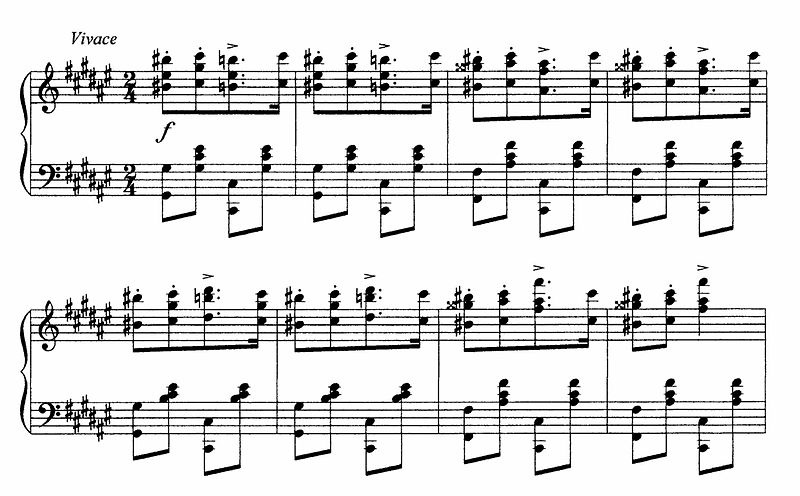
Hungarian Rhapsody No. 2, S.244/2, is the second in a set of 19 Hungarian Rhapsodies by composer Franz Liszt, and is by far the most famous of the set. Few other piano solos have achieved such widespread popularity, offering the pianist the opportunity to reveal exceptional skill as a virtuoso, while providing the listener with an immediate and irresistible musical appeal.

In both the original piano solo form and in the orchestrated version this composition has enjoyed widespread use in animated cartoons. Its themes have also served as the basis of several popular songs.

It is probable that you have heard this piece of music somewhere at one time or another because it is perhaps the most prominent piece of classical (romantic, actually) music featured in animated cartoons across the years.

Now, let the anvils fall and dynamite explode!

And, in real life, Valentina Lisitsa plays Liszt’s Hungarian Rhapsody No. 2

This piece is available in Piano Pronto Movement 5 and several anthologies of classical music.