Cassidy Turley and The Durst Organization announced that they secured a 15-year, 40,000 s/f lease for renowned piano manufacturer and retailer, Steinway & Son, at 1133 Avenue of the Americas.
…
Given Steinway’s time pressure to move out of its existing location by the end of 2014, the team secured a temporary location at 1155 Avenue of the Americas, also with The Durst Organization.
This short-term “pop-up store” will allow Steinway to remain open as the new headquarters is being constructed, allowing for continuous service to its customers.
Steinway, well-known for handcrafting the world’s finest pianos, will now have a gallery space that encompasses approximately 18,000 s/for both retail and showroom, and a small concert hall that caters to the world’s most prominent pianists.
The space will be designed by architect Annabelle Selldorf. There will also be a private space that can be used by concert pianists looking to sample Steinway’s collection of instruments.
The piano was once the heart of the home. In 1909, people bought more than 350,000 of the instruments.
“Back in the early 1900s, there were very little forms of entertainment,” says Stephen Scharbrough, a second-generation piano tuner and technician. “It was a time that was pre-radio, so if you wanted entertainment, music, or something to interact with at your house, place of business, or a restaurant or bar, you had to hire a musician or pianist.”
The piano eventually caught on, and individuals learned how to play the piano on their own to entertain themselves. But today, “things have obviously changed a bit since then,” Scarborough says.
The television has adopted the piano’s former role in the modern era, and children are easily entertained with tablets instead of having to practice musical scales. Annual piano sales have dropped to between 30,000 and 40,000.
Instead of serving as the family entertainment center, Scharbrough says pianos are now owned by specific sets of people. “It’s the family that places priority on self-discipline and has a respect for arts and music,” he says.
. 1925 ~ Russian composer, Igor Stravinsky, appeared in his first American concert, as he conducted the New York Philharmonic Orchestra in a program of his own compositions.
. 1935 ~ Elvis Presley, American rock-and-roll singer and guitarist. He had 90 top-20 hits.
. 1937 ~ Shirley Bassey, Singer
. 1940 ~ Anthony Gourdine, Singer with Little Anthony and The Imperials
. 1940 ~ Vincent Lopez and his orchestra recorded the third version of Lopez’ theme song titled Nola. This version, recorded in Hollywood on Bluebird Records, is recognized as his best rendition of the classic song.
. 1946 ~ Robbie Krieger, Guitarist with The Doors
. 1947 ~ David Bowie, British rock singer and actor
. 1947 ~ Terry Sylvester, Musician with the groups Swinging Blue Jeans and the Hollies
. 1952 ~ Vladimir Feltsman, Pianist
. 1961 ~ Robert Goulet made his national TV debut this night on “The Ed SullivanShow” on CBS.
. 1965 ~ The TV dance show, “Hullabaloo”, debuted on NBC~TV. The show, a weekly trip into the world of rock and roll, featured plenty of mini-skirted go~go girls; which didn’t hurt ratings any. ABC countered with “Shindig”, a similar show, similar concept, similar everything.
. 1966 ~ The Beatles LP, “Rubber Soul”, began a 6-week reign at the top of the album chart. This was the seventh Beatles LP to reach the #1 position since February, 1964. “Rubber Soul” stayed on the charts for 56 weeks. The other #1 albums for the Fab Four to that date were: “Meet The Beatles“, “The Beatles Second Album”, “A Hard Day’s Night”,“Beatles ’65”, “Beatles VI” and “Help!”.
. 1973 ~ Carly Simon received a gold record for the single, You’re So Vain.
. 1998 ~ Sir Michael Tippett, British Composer and librettist, died
More information about Tippett
. 2000 ~ Pianist Jeffrey Biegel appeared on Good Morning America. He discussed his performance of the New York Premiere with Maestro Vakhtang Jordania and the American Symphony Orchestra and performed selections from the manuscript edition of Rhapsody in Blue, with more than 50 bars restored that hadn’t been heard in New York since the famous 1924 premiere concert at Aeolian Hall.
The concert that evening was at Lincoln Center’s Avery Fisher Hall. The Rhapsody was be the feature piece in an evening of premieres by American composers and Russian orchestral masterpieces. Works on the program includedVariations on The Wayfaring Stranger (New York Premiere) by James Cohn; Peanuts Gallery for Piano and Orchestra by Ellen Taaffe Zwilich; the Rhapsody in Blue by Gershwin; Islamey by Balakirev (World Premiere-transcription for piano and orchestra by Jeffrey Biegel), and Mussorgsky’sPictures at an Exhibition.
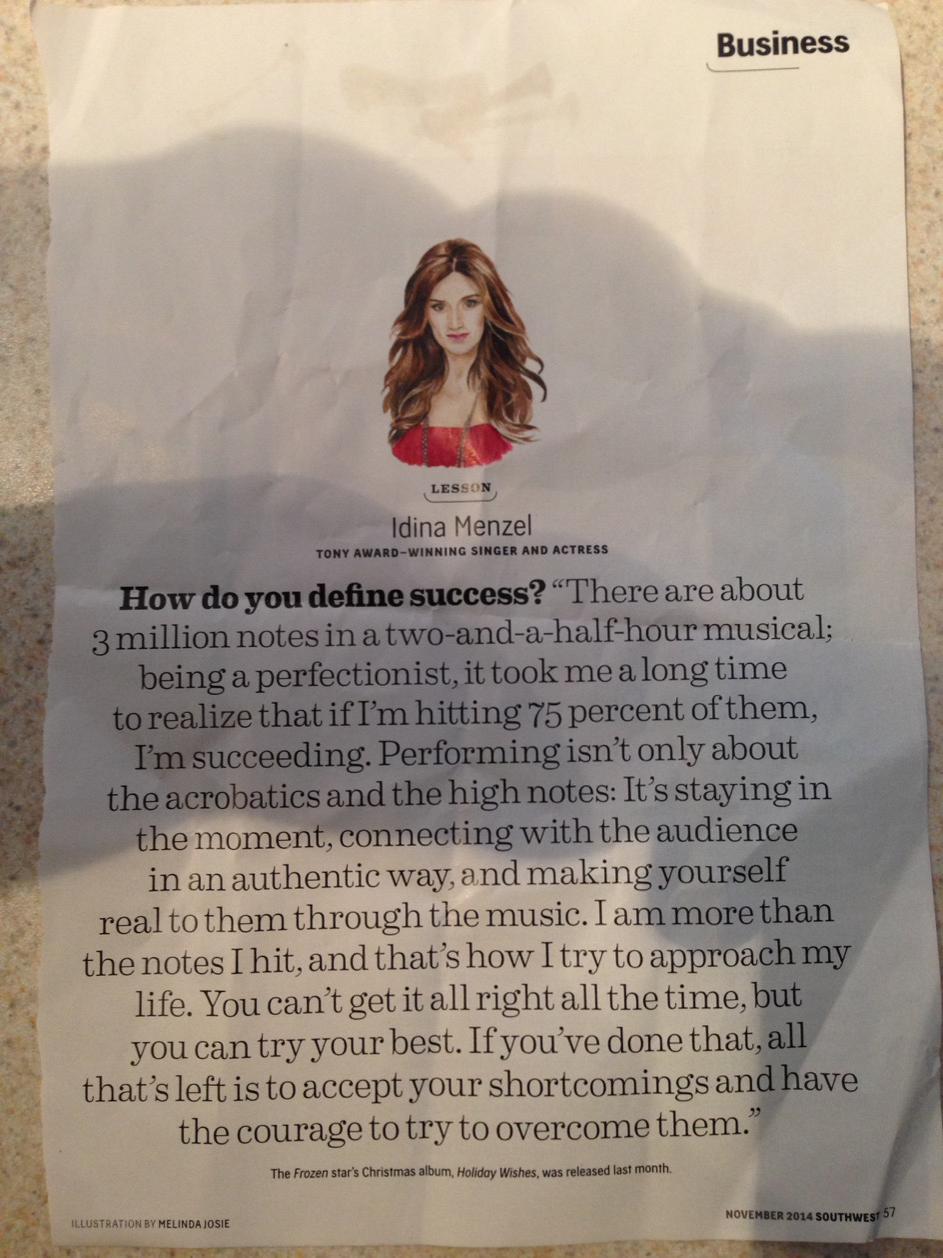
Idina Menzel has seems to have a chilly response for the social media stooges who trashed her performance of “Frozen” hit “Let It Go” in Times Square on New Year’s Eve.
Menzelpiped up on Twitter late Thursday by posting an interview she gave to Southwest Airlines magazine recently in which she said,
“I am more than the notes I hit.”
“There are about 3 million notes in a two-and-a-half-hour musical; being a perfectionist, it took me a long time to realize that if I’m hitting 75 percent of them, I’m succeeding,” she told the magazine in the November issue.
“Performing isn’t only about the acrobatics and the high notes: It’s staying in the moment, connecting with the audience in an authentic way, and making yourself real to them through the music.”
“I am more than the notes I hit, and that’s how I try to approach my life.”
. 1937 ~ Nino Tempo, Sax musician, singer with April Stevens
. 1937 ~ Doris Troy, Singer
. 1938 ~ Trummy Young played trombone and sang with the Jimmy Lunceford Orchestra in New York City as Margie became Decca record number 1617.
. 1946 ~ Roger Keith, Lead guitarist, Pink Floyd
. 1946 ~ Syd (Roger) Barrett, Guitarist, singer with Pink Floyd
. 1959 ~ Kathy Sledge, Singer with Sister Sledge
. 1964 ~ Premier of “Hello Dolly”
. 1966 ~ Duke Ellington’s concert of sacred music, recorded at 5th Avenue Presbyterian Church in New York City, was broadcast on CBS-TV.
. 1975 ~ The Broadway premiere of “The Wiz” opened, receiving enthusiastic reviews. The show, a black version of “The Wizard of Oz”, ran for 1,672 shows at the Majestic Theatre. Moviegoers, however, gave a thumbs down to the later cinema version of the musical that starred Diana Ross and Michael Jackson. One memorable song from the show is Ease on Down the Road.
. 1993 ~ The great jazz trumpeter, Dizzy Gillespie died of cancer at age 75. He has been credited with being a co-founder (with Charlie Parker) of ‘bebop’ music and wrote many jazz numbers (Salt Peanuts, Night in Tunisia). Gillespie also created the ‘afro-cuban’ sound in jazz music. A few of the disciples who preached Dizzy’s gospel of bebop were Thelonious Monk, Earl ‘Bud‘ Powell, Charlie Parker and Miles Davis.
The tribute show of Billy Joel’s winning The Library of Congress Gershwin Prize for Popular Song took place on 19 November at Washington D.C.’s DAR Hall. The prize ‘’celebrates the work of an artist whose career reflects lifetime achievement in promoting song as a vehicle of musical expression and cultural understanding.
The styles in which these works are composed reflect myriad contemporary traditions like rock, jazz, country, pop, blues, folk, and gospel.’’
The first Gershwin Prize Honoree was Paul Simon and other recipients are Stevie Wonder, Paul McCartney, Hal David, Burt Bacharach or Carole King.
. 1941 ~ Decca record #23210 was recorded. The title was Chica Chica Boom Chic by the lovely Carmen Miranda. She sang the song in the film, “That Night in Rio”.
. 1942 ~ Maurizio Pollini, Italian pianist
. 1949 ~ George ‘Funky’ Brown, Drummer with Kool and The Gang
. 1950 ~ Chris Stein, Guitarist with Blondie
. 1955 ~ A tune used in a “Studio One” production became the #1 song on the pop music charts this day. Joan Weber’s song, Let Me Go, Lover, rode the hit parade as the most popular record in the U.S. for four weeks straight. Before being aired on television, the song had only been heard on a limited basis. In fact, the title was even different. It used to be known as Let MeGo, Devil.
. 1972 ~ John Denver received a gold record for the album, “Aerie”, this day.
. 1979 ~ John Travolta probably remembers that the soundtrack LP of “Saturday Night Fever” reached $25 million in sales.
. 1984 ~ The group, The Police, planned a farewell concert for March 2 in Australia. After nine years together, band members decided to go their separate ways.
. 2000 ~ Mejla Hlavsa, a Czech rock performer and friend of President Vaclav Havel, died of cancer at the age of 49. He was a bass player and singer with the band Plastic People of the Universe. Hlavsa, whose group was banned in the 1970s, was imprisoned in 1976 for unauthorized performances, deemed political protests under the former communist regime. At the time, the band had been performing at private gatherings, including parties at Havel’s summer house in Hradecek, northern Bohemia. Now the country’s president, Havel was Czechoslovakia’s best known anti-communist dissident at the time. After the collapse of the communist regime in 1989, the band resumed public performances. Hlavsa also performed at the White House in September 1998, at a dinner organized by President Clinton during an official visit by the Czech president. One of Hlavsa’s influences, Lou Reed, also performed during Havel’s visit. Reed was a founding member of the rock group Velvet Underground, which helped inspire Havel’s leadership of the “Velvet Revolution” that brought democracy to the Czech Republic. Havel had called the musicians “two legends from our two nations who both, in one way or another, are bound with the ideal of freedom.”
. 1809 ~ Louis Braille, Inventor of the Braille system which enables the blind to read words and music. When he was only 3, Louise Braille, was permanently blinded in an accident with a leatherworking awl in his father’s saddlemaking shop in Coupvray, France. Several years later, he was admitted to a school for the blind, the Institution Nationale des Jeunes Aveugles. Later, as a teacher at the school, he worked at adapting Charles Barbier’s system of writing with points. Ironically, his method centered around using an awl-like stylus to punch marks in paper that could be felt and interpreted by the blind, allowing them to “read” with their fingertips. Braille’s work went unnoticed until after his death, in poverty, in 1852.
1874 ~ Joseph Suk, Czech violinist and composer
More information about Suk
. 1928 ~ NBC radio debuted one of radio’s first variety shows. “The Dodge Victory Hour” starred Will Rogers, Paul Whiteman and his Orchestra and singer AlJolson. The cost to produce this one show was $67,600.
. 1932 ~ NBC Red presented “The Carnation Contented Hour”. The show continued on network radio for 19 years as a showcase for top singers and musicians.
. 1935 ~ Bert Ambrose and his orchestra recorded the song that became the group’s theme song. It was titled Hors d’oeuvres and was cut in London for Decca Records.
. 1935 ~ Bob Hope was first heard on network radio as part of “The Intimate Revue” with Jane Froman, James Melton and the Al Goodman Orchestra.
. 1936 ~ The first pop music chart based on national sales was published by “Billboard” magazine this day. Joe Venuti, jazz violinist, was at the top of the chart with a little ditty called Stop! Look! Listen!.
1937 ~ Grace Bumbry, American mezzo-soprano
More information about Bumbry
. 1950 ~ RCA Victor announced that it would manufacture long-playing (LP) records. This news came two years after Columbia Records debuted the ‘album’.
. 1954 ~ Elvis Presley strolled into the Memphis Recording Service and put $4 on the counter. He recorded Casual Love and I’ll Never Stand in Your Way, two songs that so impressed record executive Sam Phillips that he had Elvis record his first professional sides for Sun Records the following August.
. 1965 ~ The Fender Guitar Company was sold to CBS for $13 million.
. 1979 ~ With a new interest in Beatles music on this day, the Star Club reopened in Hamburg, Germany. None of The Beatles returned to their beginnings to attend the gala opening.
. 2001 ~ Les Brown, whose Band of Renown scored a No. 1 hit with SentimentalJourney during America’s big band era of the 1930s and ’40s, died of lung cancer at the age of 88. A conductor-clarinetist whose smooth arrangements of swing melodies transcended changes in musical tastes, Brown was cited in 1996 by the Guinness Book of Records recognized him as the leader of the longest lasting musical organization in pop music history. He started his professional career in 1936, and his Band of Renown was still performing about 60 dates a year as recently as five months ago, often conducted by son Les Brown Jr. Brown formed his Band of Renown in 1936. In the 1940s heyday of swing, Brown never achieved the greatness of TommyDorsey, Glenn Miller or Benny Goodman. But the band scored two hit records – Sentimental Journey, with Doris Day as vocalist, and the instrumental I’ve Got My Love to Keep Me Warm. Sentimental Journey, co-written with Ben Homer and Bud Green, became a theme for soldiers returning home from World War II. “The happiest times in my life were the days when I was traveling with Les and his band,” Day said. “I loved Les very much, I am going to miss his phone calls.” Brown’s career included a close association with Bob Hope. In 1950, he joined Hope for the first of 18 Christmas tours to entertain American troops at military bases around the world. Day also participated. “The world has lost a great musician,” Hope said. “I have lost my music man, my sideman, my straight man and a special friend.” As the first president of the Los Angeles chapter of the Academy of Recording Arts and Sciences, Brown helped make the Grammy Awards a televised event. He convinced Hope, Frank Sinatra and Bing Crosby to participate in the first telecast.
. 2004 ~ Jake Hess, a four-time Grammy winner who sang with some of the premier quartets in gospel music and influenced the career o fElvis Presley, died. He was 76. Hess, whose career spanned more than 60 years, is best known to contemporary audiences as a regular member of Bill Gaither’s Homecoming Friends, on various Christian and country music cable channels, including TBN and TNN. Hess joined The John Daniel Quartet in 1943 and reached stardom with The Statesmen Quartet. He was founder of The Imperials and sang with The Masters V. Each of these groups is enshrined in the Southern Gospel Music Hall of Fame, as is Hess. He is also a member of the Alabama Music Hall of Fame. As a teen, Elvis Presley was a regular at Statesmen concerts. Later, Hess was a backup singer on several of Presley’s Grammy-winning albums. When Presley died in 1977, Hess sang at his funeral, as he had at the funeral of country legend Hank Williams in 1953. Peter Guralnick, author of a two-volume biography of Presley, said the rock star always wanted to emulate the voices of Hess and crooner Roy Hamilton.
• 1940 ~ The Southland Shuffle was recorded on Bluebird Records by Charlie Barnet and his orchestra. A young trumpet player named Billy May was featured.
• 1945 ~ Stephen Stills born, American rock guitarist, singer and songwriter for Buffalo Springfield and also Crosby, Stills, Nash and Young
• 1946 ~ John Paul Jones (Baldwin), Bass with Led Zeppelin
• 1969 ~ 30,000 copies of the John Lennon, Yoko Ono album, “Two Virgins”, were confiscated by police in Newark, NJ. John and Yoko were nude on the cover.
• 1972 ~ Don McLean received a gold record for his 8-minute-plus hit, American Pie.
• 1974 ~ Following eight years of inactivity, Bob Dylan toured for 39 dates in 25 cities. His first stop was in Chicago, IL. The tour was recorded and later released as a double-LP set titled, “Before the Flood”.
• 1981 ~ John Lennon’s(Just Like) StartingOver and the album “Double Fantasy” topped the pop music charts just weeks after the death of the former Beatle.
• 1985 ~ Soprano Leontyne Price bid adieu to the Metropolitan Opera in New York. She sang the title role of “Aida”. Price had been part of the Met since 1961.



 1710 ~ Giovanni Battista Pergolesi, Italian Composer
