Music theory has never sounded so catchy with this witty remake of the holiday classic The Christmas Song (with apologies to Mel Torme) Try not to laugh at the ending.
Though it is a bit humorous, this version titled ‘Intervals Roasting’, with lyrics by David Rakowski, attempts to encapsulate the fundamentals of music theory in just over two minutes.
It does a good job of explaining the intervals and harmonic structure of the song and also gives you an idea of how to use music theory to analyze or compose music.
The O’Connor Music Studio has a copy if anyone wants to learn this 🙂
“O Come, All Ye Faithful” (originally written in Latin as Adeste Fideles) is a Christmas carol which has been attributed to various authors, including John Francis Wade (1711–1786), John Reading (1645–1692) and King John IV of Portugal (1604–1656), with the earliest manuscript of the hymn bearing his name, located in the library of the Ducal Palace of Vila Viçosa.
The original four verses of the hymn were extended to a total of eight, and these have been translated into many languages. The English translation of “O Come, All Ye Faithful” by the English Catholic priest Frederick Oakeley, written in 1841, is widespread in most English speaking countries.
There are now several versions in the O’Connor Music Store if you are interested in learning this Christmas carol.
Gesù Bambino by Pietro Yon has always had a place in my childhood memories since my church choir sang it every Christmas. Other than that, it didn’t seem to be too well known but this song has been turning up in piano books lately. There are now several versions in the O’Connor Music Studio if you are interested in learning this beautiful older Christmas carol.
Gesù bambino was written in 1917. The melody was used by Frederick H. Martens in his English language carol “When Blossoms Flowered ‘mid the Snows”. The melody and lyrics of the chorus are derived from “Adeste Fideles” (O Come All Ye Faithful).
A piano version
Piano and Organ
Sung by David Archuleta and the Mormon Tabernacle Choir
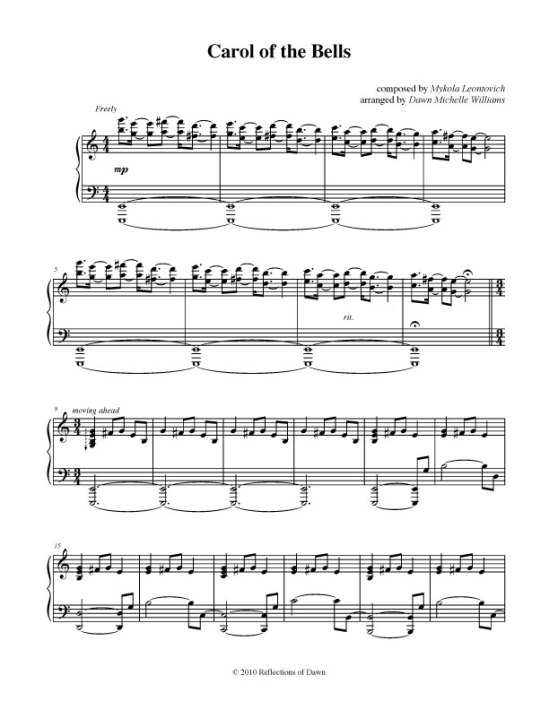
Carol of the Bells was composed by Mykola Dmytrovych Leontovych (1877-1921) in 1916. Originally titled Shchedryk, this Ukrainian folk song is sometimes called Ukrainian Bell Carol. “Shchedryk” which was associated with the coming New Year, originally celebrated in April.
Leontovych used this tune in 1904 along with lyrics by Peter J. Wilhousky to create the version that everyone knows today. It gained popularity during the 1920s and 1930s, and was introduced to an even wider audience when it was used in the movie “Home Alone”.
It was first performed in the Ukraine on the night of January 13, 1916, on the Julian calendar this is considered New Year’s Eve. In the United States the song was first performed on October 5, 1921 at Carnegie Hall.
This video is from the Christmas special of the Mormon Tabernacle Choir, presented at the BYU channel. The orchestra and choir produce a very beautiful sound.
Not the standard version –
The O’Connor Music Studio has several versions of this Christmas Carol available for loan, including this version from the Mannheim Steamroller:
Isaac Watts wrote the words to “Joy to the World” in 1719, based on Psalm 98 in the Bible. The hymn originally glorified Christ’s triumphant return at the end of the age, rather than a song celebrating His first coming. Only the second half of Watts’ lyrics are still used today.
The music was adapted and arranged to Watts’ lyrics by Lowell Mason in 1839 from an older melody which was then believed to have originated from Handel. The name “Antioch” is generally used for the hymn tune.
As of the late 20th century, “Joy to the World” was the most-published Christmas hymn in North America.
There are versions of Joy to the World available at the O’Connor Music Studio for any level of playing, starting with Pre-Reading, all the way up through Advanced and duets.
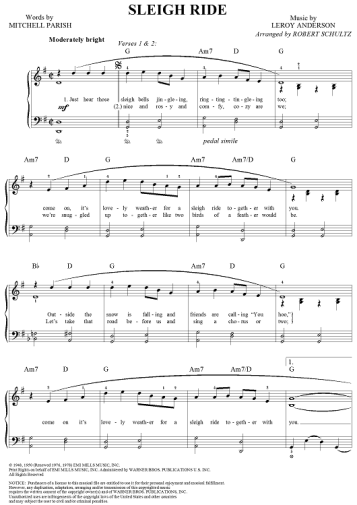
I’ve always liked Leroy Anderson’s Sleigh Ride as a secular Christmas song 🙂 It’s not technically a Christmas song since the words never mention Christmas but it’s often played now so it seems like a way to ease into the season.
Anderson had the original idea for the piece during a heatwave in July 1946; he finished the work in February 1948. Lyrics, about a person who would like to ride in a sleigh on a winter’s day with another person, were written by Mitchell Parish in 1950.
The orchestral version was first recorded in 1949 by Arthur Fiedler and The Boston Pops Orchestra. The song was a hit record and has become the equivalent of a signature song for the orchestra.
A fun arrangement has been made for piano duet. I have copies here to lend and it’s available on amazon (of course! What isn’t?)
Johann Sebastian Bach’s towering monument of organ music, with its deep sense of foreboding, will forever be associated with Halloween.
Get a free copy of the sheet music at IMSLP or borrow a copy from the O’Connor Music Studio. I have this arranged for organ, piano, duet, 2-piano, simplified…
The Funeral March of a Marionette (Marche funèbre d’une marionnette) is a short piece by Charles Gounod. It was written in 1872 for solo piano and orchestrated in 1879. It is perhaps best known as the theme music for the television program Alfred Hitchcock Presents, which originally aired from 1955 to 1965.
In 1871-72, while residing in London, Gounod started to write a suite for piano called “Suite Burlesque”. After completing one movement, the Funeral March of a Marionette, he abandoned the suite and had the single movement published by Goddard & Co. In 1879 he orchestrated the piece. The instrumentation is: piccolo, flute, 2 oboes, 2 clarinets in A, 2 bassoons, 2 horns in D, 2 trumpets in A, 3 trombones, ophicleide, timpani, bass drum, triangle, strings. The work is in the key of D minor, with a central section in D major. Various arrangements by other hands exist.
There is a program underlying the Funeral March of a Marionette: The Marionette has died in a duel. The funeral procession commences (D minor). A central section (D major) depicts the mourners taking refreshments, before returning to the funeral march (D minor).
The score contains the following inscriptions in appropriate places:
La Marionnette est cassée!!! (The Marionette is broken!!!)
Murmure de regrets de la troupe (Murmurs of regret from the troupe)
Le Cortège (The Procession)
Ici plusieurs des principaux personnages de la troupe s’arrêtent pour sa rafrâichir (Here many of the principal personages stop for refreshments)
Retour a la maison (Return to the house). (Wikipedia)
Download this music in several versions from IMSLP. Click on Arrangements and Transcriptions. There are also some arrangements for piano at the O’Connor Music Studio.
On Alfred Hitchcock:
From Faber Piano Adventures Performance Book Level 3B No.7 (Also available in the OCMS Library):
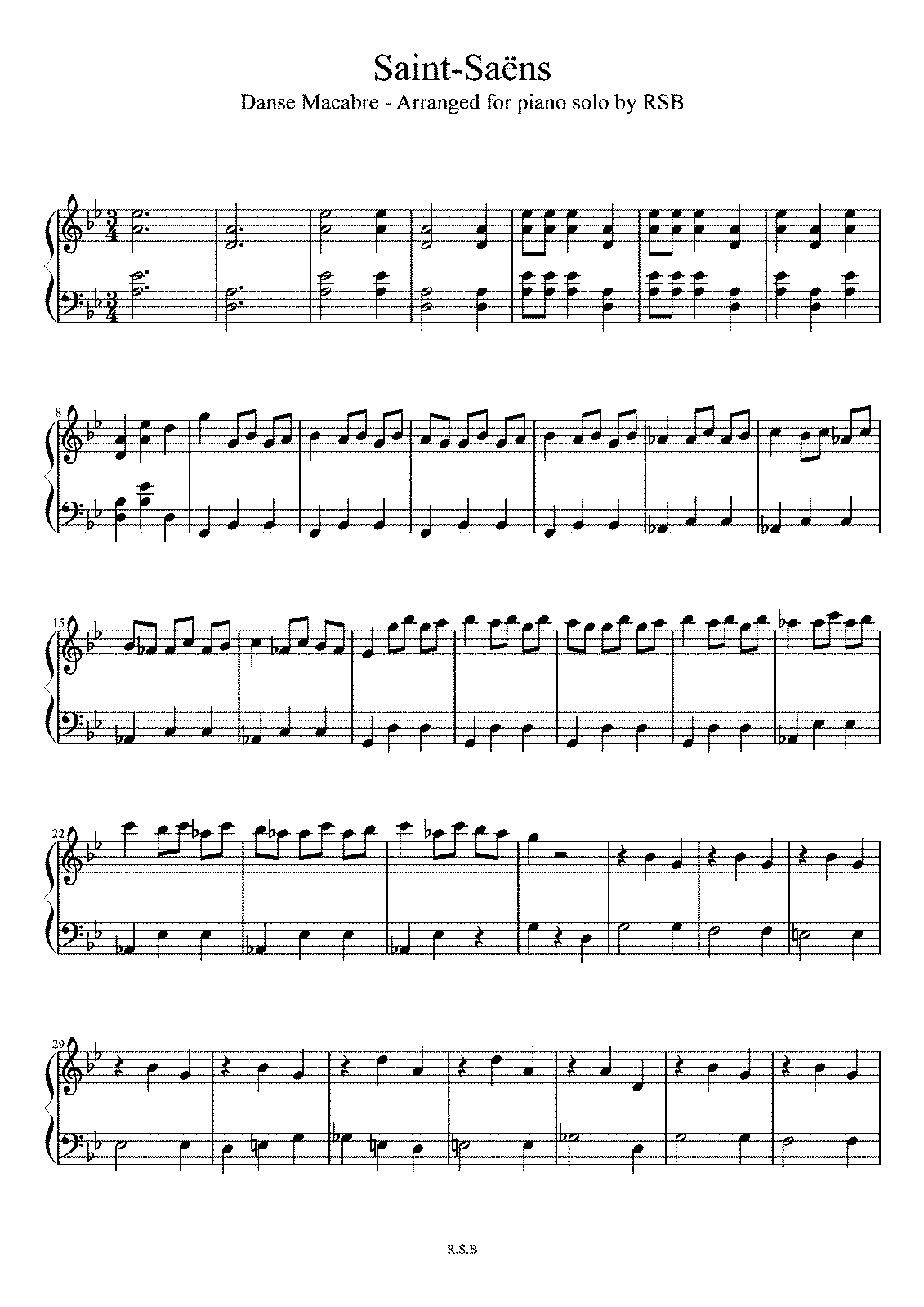
Danse macabre, Op. 40, is a tone poem for orchestra, written in 1874 by French composer Camille Saint-Saëns. It started out in 1872 as an art song for voice and piano with a French text by the poet Henri Cazalis, which is based on an old French superstition. In 1874, the composer expanded and reworked the piece into a tone poem, replacing the vocal line with a solo violin.
Get a free copy of the sheet music at IMSLP (Look for Arrangements and Transcriptions) or borrow a copy from the O’Connor Music Studio. I have this arranged for organ, piano, duet, simplified…
Amazon has a great Dover edition for solo piano. This splendid compilation features a variety of the composer’s best piano works, all reproduced from authoritative sources. Taking its title from the popular orchestral work “Danse Macabre” (presented here in the brilliant arrangement by Liszt), this collection also includes “Allegro appassionato,” “Album” (consisting of six pieces), “Rhapsodie d’Auvergne,” “Theme and Variations,” plus six etudes, three waltzes, and six etudes for left hand alone.
1874 ~ Charles Ives, American composer
More information on Ives
• 1890 ~ Ferdinand “Jelly Roll” Morton, jazz pianist/composer
• 1913 ~ Grandpa (Louis Marshall) Jones, Country Music Hall of Famer, Grand Ole Opry, singer
• 1914 ~ Fayard Nicholas, American tap dancer, one-half of The Nicholas Brothers and actor (The Five Heartbeats)
• 1923 ~ Robert Craft, American conductor and writer
• 1935 ~ Jerry Orbach, American singer and actor for the musical theater
• 1937 ~ Wanda Jackson, Singer, songwriter
• 1939 ~ Jay Siegel, Singer with The Tokens
• 1939 ~ All the Things You Are was recorded by the Tommy Dorsey Orchestra on the Victor label. Jack Leonard was the featured vocalist.
• 1945 ~ Ric Lee, Drummer with Ten Years After
• 1950 ~ Tom Petty, Singer with The Traveling Wilburys
• 1951 ~ Al Greenwood, Keyboards with Foreigner
• 1955 ~ “Day-O. Day-ay-ay-ay-o!” One of the most popular of the Harry Belafonte hits was recorded for RCA Victor. Day-O didn’t make it to the pop charts for over a year, until January of 1957, after its name had been changed to The Banana Boat Song (Day-O).
• 1958 ~ Mark King, Bass, singer with Level 42
• 1958 ~ Ivo Pogorelić, Croatian pianist (1978 Casagrande winner)
• 1962 ~ With Halloween just around the corner, we remember that Bobby “Boris” Picket and the Crypt Kickers reached the top of the charts this day (for two weeks) with The Monster Mash. And someone, somewhere, has resurrected it every Halloween since.
This piece is now in Piano Maestro in the Halloween section and there is sheet music, if you are interested.
• 1962 ~ The musical, Mr. President, written by Irving Berlin, opened on Broadway. Mr. President ran for 265 performances.
• 1965 ~ The Beatles received a gold record for the single, Yesterday. This song marked the first time a cello was used in a pop hit.
• 2000 ~ Li Yundi, an 18-year-old virtuoso from China, has won Poland’s Frederic Chopin piano competition, becoming one of the youngest players to capture the prestigious international prize. Read the whole story








 1874 ~ Charles Ives, American composer
 MaryO'Studio