Music theory has never sounded so catchy with this witty remake of the holiday classic The Christmas Song (with apologies to Mel Torme) Try not to laugh at the ending.
Though it is a bit humorous, this version titled ‘Intervals Roasting’, with lyrics by David Rakowski, attempts to encapsulate the fundamentals of music theory in just over two minutes.
It does a good job of explaining the intervals and harmonic structure of the song and also gives you an idea of how to use music theory to analyze or compose music.
The O’Connor Music Studio has a copy if anyone wants to learn this 🙂
Redditor NeokratosRed had an idea: depict the hands of great composers and pianists, according to the characteristics of their music. He shared it on the social media site, and also punted for suggestions of more. It has since received over 300,000 images views, and lots of further suggestions from fellow Redditors and piano geeks.
Whisks for Chopin’s elegant pianistic souffles, feather dusters for the gentle impressionism of Debussy, instruments of trade for the composer of the thunderous Hammerklavier sonata.
Piano, and the internet – top marks to the both of you.
Today we’re going to listen and learn about the opera Carmen.
I chose this for today since it’s the anniversary of French composer Georges Bizet‘s death.
Georges Bizet was born in Paris, France. Both his parents were musicians, and they actually wanted their son to become a composer when he grew up! Bizet loved music, but he also loved to read books. His parents wound up hiding his books so that he would spend more time on his music.
When Georges was 10 years old, his father enrolled him in the Paris Conservatory. While he was there, he wrote his only symphony, but it wasn’t performed until many years after he died. Bizet graduated from the Conservatory with awards in both composition and piano.
Bizet also composed operas. His most famous opera is Carmen. When Carmen first opened in Paris, the reviews were terrible. Many critics said there were no good tunes in it, so audiences stayed away.
In the middle of the night during the first round of Carmen performances, Bizet died. He was only 36. Four months later, Carmen opened in Vienna, Austria, and was a smash hit. It is now one of the most popular operas ever written. Bizet never knew that audiences would come to consider it his masterpiece.
Vladimir Horowitz made Carmen his own by turning it into a fantasy (or the more musical spelling – fantasie).
The fantasia (Italian; also English: fantasy, fancy, fantazy, phantasy, German: Fantasie, Phantasie, French: fantaisie) is a musical composition with its roots in the art of improvisation. Because of this, like the impromptu, it seldom approximates the textbook rules of any strict musical form.
When you play wrong notes for an audience, just tell the audience it’s a “Fantasie”, not the original work!
As you can see, Carmen is a popular work. Here it is for two pianos, played by Anderson and Roe.
The Canadian Brass tell the story of Carmen in their own humorous words.
I thought this would surely interest all piano teachers and lovers out there – JoyTunes’ just came out with new piano teaching GLOVES!
Take a look in the clip and share it with all piano lovers everywhere.
The JoyTunes gloves, still in beta version, will turn you into Mozart in the blink of an eye! Don’t know how to play piano? These gloves will take you from 1 note to Beethoven in a flash. Our gloves allow your hands to auto magically bend and move to play any song your heart desires! Check out the video for more info.
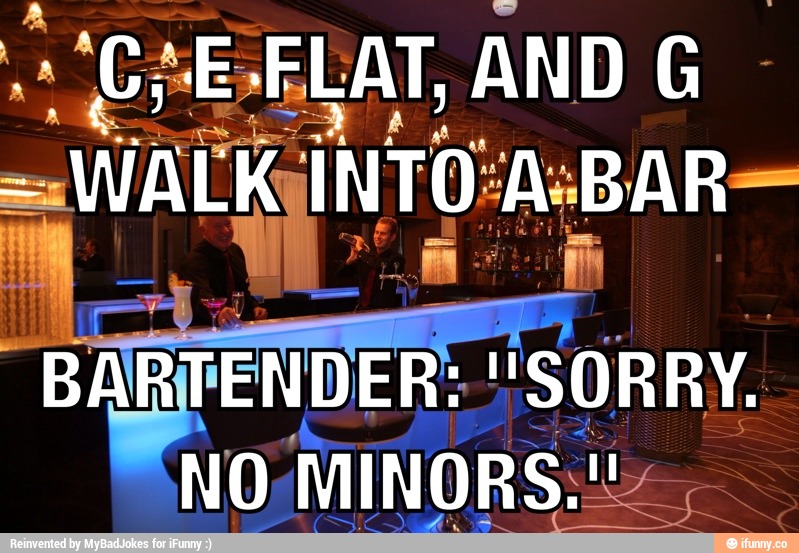
Some of these might make you think… C, E-flat, and G go into a bar. The bartender says, “Sorry, but we don’t serve minors.” So E-flat leaves, and C and G have an open fifth between them.
After a few drinks, the fifth is diminished, and G is out flat. F comes in and tries to augment the situation, but is not sharp enough. D comes in and heads for the bathroom, saying, “Excuse me; I’ll just be a second.”
Then A comes in, but the bartender is not convinced that this relative of C is not a minor. Then the bartender notices B-flat hiding at the end of the bar and says, “Get out! You’re the seventh minor I’ve found in this bar tonight.”
E-flat comes back the next night in a three-piece suit with nicely shined shoes. The bartender says, “You’re looking sharp tonight. Come on in, this could be a major development.” Sure enough, E-flat soon takes off his suit and everything else, and is au natural.
Eventually C sobers up and realizes in horror that he’s under a rest. C is brought to trial, found guilty of contributing to the diminution of a minor, and is sentenced to 10 years of D.S. without Coda at an upscale correctional facility.
On appeal, however, C is found innocent of any wrong doing, even accidental, and that all accusations to the contrary are bassless.