Johann Sebastian Bach’s towering monument of organ music, with its deep sense of foreboding, will forever be associated with Halloween.
Get a free copy of the sheet music at IMSLP or borrow a copy from the O’Connor Music Studio. I have this arranged for organ, piano, duet, 2-piano, simplified…
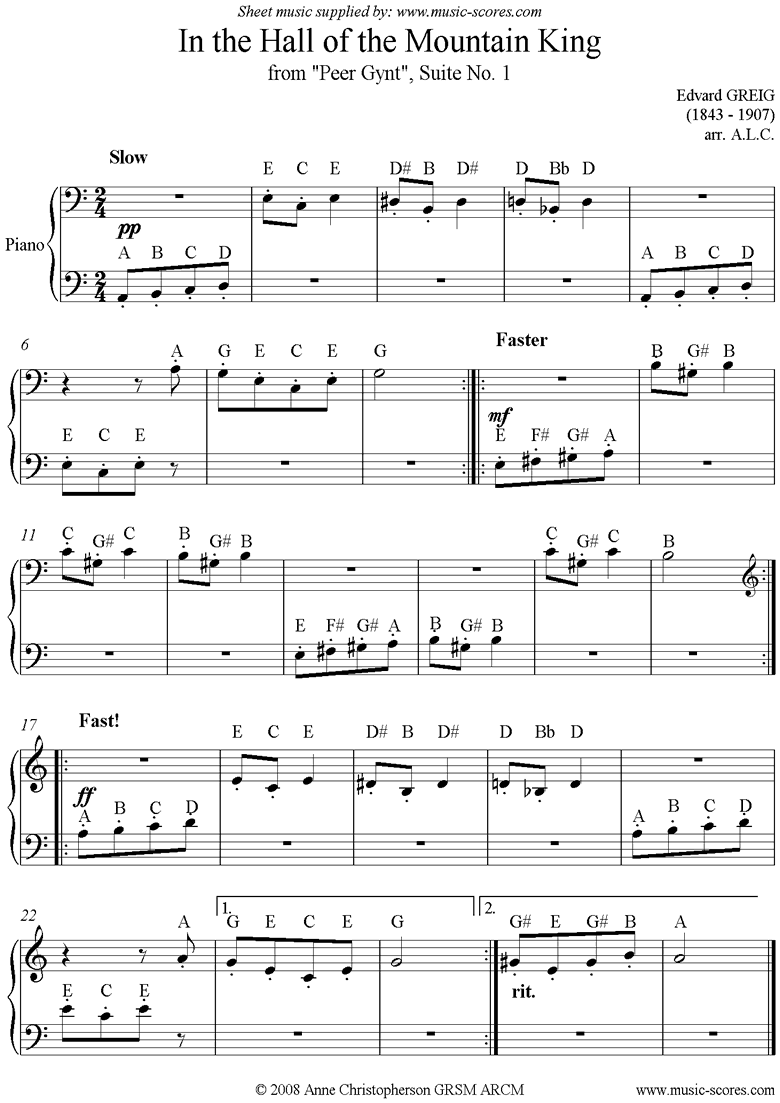
“In the Hall of the Mountain King” is a piece of orchestral music composed for the sixth scene of act 2 in Henrik Ibsen’s 1867 play Peer Gynt. It was originally part of Opus 23 but was later extracted as the final piece of Peer Gynt, Suite No. 1, Op. 46. Its easily recognizable theme has helped it attain iconic status in popular culture, where it has been arranged by many artists, including for the piano.
Borrow a copy of the sheet music from the O’Connor Music Studio. I have this arranged for piano, duet, 2-piano, simplified…
8 part vocal orchestra (plus a tiny pair of cymbals)
Night on Bald Mountain refers to a series of compositions by Modest Mussorgsky (1839–1881). Inspired by Russian literary works and legend, Mussorgsky composed a “musical picture”, St. John’s Eve on Bald Mountain on the theme of a witches’ sabbath occurring on St. John’s Eve, which he completed on that very night, June 23, in 1867.
Get a free copy of the sheet music at IMSLP or buy it on amazon.com.
From Disney’s Fantasia
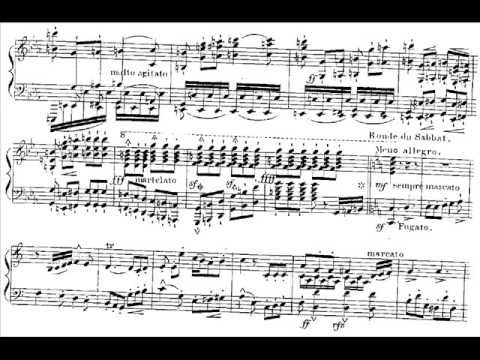
Piano version transcribed for solo piano by Konstantin Chernov (1865-1937).
The Ludwig Symphony Orchestra, conducted by Maestro Thomas Ludwig
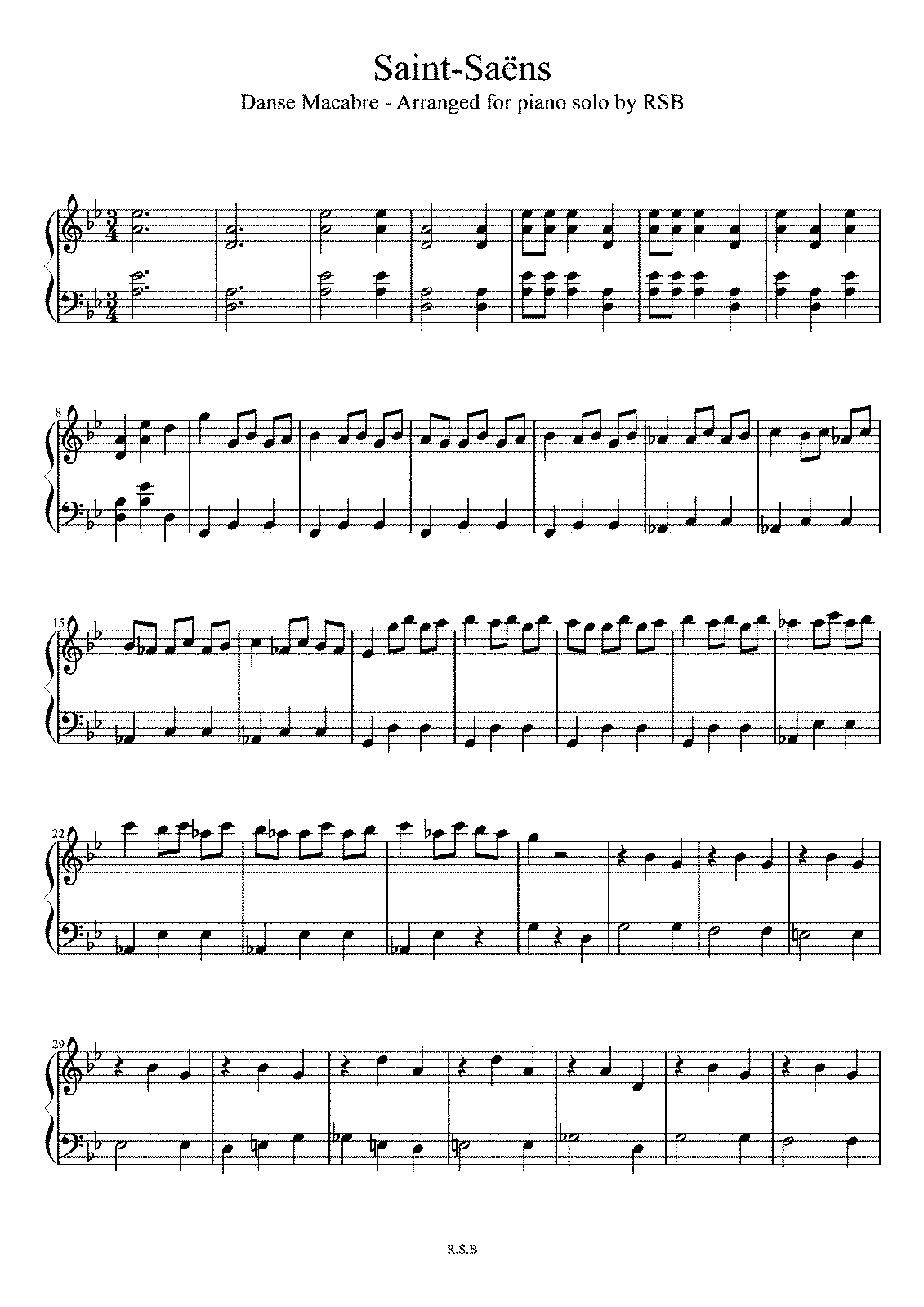
Danse macabre, Op. 40, is a tone poem for orchestra, written in 1874 by French composer Camille Saint-Saëns. It started out in 1872 as an art song for voice and piano with a French text by the poet Henri Cazalis, which is based on an old French superstition. In 1874, the composer expanded and reworked the piece into a tone poem, replacing the vocal line with a solo violin.
Get a free copy of the sheet music at IMSLP (Look for Arrangements and Transcriptions) or borrow a copy from the O’Connor Music Studio. I have this arranged for organ, piano, duet, simplified…
Amazon has a great Dover edition for solo piano. This splendid compilation features a variety of the composer’s best piano works, all reproduced from authoritative sources. Taking its title from the popular orchestral work “Danse Macabre” (presented here in the brilliant arrangement by Liszt), this collection also includes “Allegro appassionato,” “Album” (consisting of six pieces), “Rhapsodie d’Auvergne,” “Theme and Variations,” plus six etudes, three waltzes, and six etudes for left hand alone.
The final movement is the best known part of the symphony, thanks to its use in the Julia Roberts movie, Sleeping With The Enemy. It features a four-part structure, which Berlioz described in his own program notes from 1845 as follows:
“He sees himself at a witches’ Sabbath, in the midst of a hideous gathering of shades, sorcerers and monsters of every kind who have come together for his funeral. Strange sounds, groans, outbursts of laughter; distant shouts which seem to be answered by more shouts. The beloved melody appears once more, but has now lost its noble and shy character; it is now no more than a vulgar dance tune, trivial and grotesque: it is she who is coming to the Sabbath… Roar of delight at her arrival… She joins the diabolical orgy… The funeral knell tolls, burlesque parody of the Dies irae, the dance of the witches. The dance of the witches combined with the Dies irae.”
The Dies irae melody is one of the most-quoted in musical literature, appearing in the works of many diverse composers.
The traditional Gregorian melody has also been used as a theme or musical quotation in a number of classical compositions, notable among them:
The Funeral March of a Marionette (Marche funèbre d’une marionnette) is a short piece by Charles Gounod. It was written in 1872 for solo piano and orchestrated in 1879. It is perhaps best known as the theme music for the television program Alfred Hitchcock Presents, which originally aired from 1955 to 1965.
In 1871-72, while residing in London, Gounod started to write a suite for piano called “Suite Burlesque”. After completing one movement, the Funeral March of a Marionette, he abandoned the suite and had the single movement published by Goddard & Co. In 1879 he orchestrated the piece. The instrumentation is: piccolo, flute, 2 oboes, 2 clarinets in A, 2 bassoons, 2 horns in D, 2 trumpets in A, 3 trombones, ophicleide, timpani, bass drum, triangle, strings. The work is in the key of D minor, with a central section in D major. Various arrangements by other hands exist.
There is a program underlying the Funeral March of a Marionette: The Marionette has died in a duel. The funeral procession commences (D minor). A central section (D major) depicts the mourners taking refreshments, before returning to the funeral march (D minor).
The score contains the following inscriptions in appropriate places:
La Marionnette est cassée!!! (The Marionette is broken!!!)
Murmure de regrets de la troupe (Murmurs of regret from the troupe)
Le Cortège (The Procession)
Ici plusieurs des principaux personnages de la troupe s’arrêtent pour sa rafrâichir (Here many of the principal personages stop for refreshments)
Retour a la maison (Return to the house). (Wikipedia)
Download this music in several versions from IMSLP. Click on Arrangements and Transcriptions. There are also some arrangements for piano at the O’Connor Music Studio.
On Alfred Hitchcock:
From Faber Piano Adventures Performance Book Level 3B No.7 (Also available in the OCMS Library):
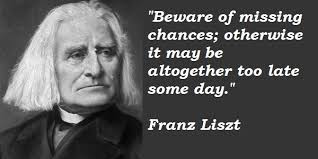
Franz Liszt was born in Raiding, near Ödenburg, October 22, 1811 and died in Bayreuth, July 31, 1886. He was a Hungarian composer and pianist who was a major influence during the romantic period. Liszt was an outstanding pianist at seven, composed at eight and made concert appearances at nine. In addition to being a piano virtuoso, he was also a critic, conductor, city music director, literary writer and transcriber of the works of other composers. He transcribed Beethoven’s Symphonies for the piano.
Franz Liszt began his career as the outstanding concert pianist of the century, who, along with the prodigious violinist Niccoló Paganini (1782-1840), created the cult of the modern instrumental virtuoso. To show off his phenomenal and unprecedented technique, Liszt composed a great deal of music designed specifically for this purpose, resulting in a vast amount of piano literature laden with dazzling, and other technical marvels. In this vein, Liszt composed a series of virtuosic rhapsodies on Hungarian gypsy melodies, the best-known being the all too familiar Hungarian Rhapsody no. 2. Liszt developed the rhapsody as a form of serious music. This kind of music is worlds apart from the generally more introspective, poetic music of pianist-composer Frédéric Chopin.
Liszt was wildly handsome and hugely talented. He was extremely popular in Paris during the 1830’s. It is said that women actually fainted at his piano recitals. He was the first to position the piano so that its lid reflected the sound and the audience could see his profile as he performed.
Liszt was the first to write a tone poem, which is an extended, single-movement work for orchestra, inspired by paintings, plays, poems or other literary or visual works, and attempting to convey the ideas expressed in those media through music. Such a work is Les Préludes, based on a poem in which life is expressed as a series of struggles, passions, and mysteries, all serving as a mere prelude to . . .what? The Romantic genre of the symphonic poem, as well as its cousin the concert overture, became very attractive to many later composers, including Saint-Saëns, Tchaikovsky, Dvorák, Sibelius, and Richard Strauss.
Listen to Liszt’s transcription of Meyerbeer’s Hellish Waltz from Robert du Diable, which probably caused more public commotion than any other piano piece in history.
The day signifies Christopher Columbus’ arrival to America on October 12, 1492
1813 ~ Giuseppe Verdi, Italian composer
Read quotes by and about Verdi
More information about Verdi
1835 ~ Camille Saint-Saëns, French composer, organist and conductor Saint-Saëns’ Carnival of the Animals is featured in Disney’s Fantasia and Fantasia 2000.
Read quotes by and about Saint-Saëns
More information about Saint-Saëns
• 1931 ~ Russ Columbo’s Prisoner of Love was recorded on Victor Records.
1940 ~ John Lennon, British rock singer, songwriter and guitarist
More information about Lennon
• 1935 ~ Cavalcade of America was first broadcast on radio this very day. The CBS show featured some of Hollywood and Broadway’s most famous stars in leading roles in the half-hour radio dramas. Thomas Chalmers narrated the stories about obscure incidents and people in American history. The orchestra (yes, radio shows had live orchestras back then) was led by Donald Voorhees. The show aired from 1935 to 1953, changing from CBS to NBC in 1939; with one sponsor for its entire duration. The DuPont Company introduced its slogan on Cavalcade of America …”Better things for better living through chemistry…”
• 1947 ~ “High Button Shoes”, opened on Broadway in New York City with an entertainer named Phil Silvers in the lead. The popular show ran for 727 performances.
• 1948 ~ Jackson Browne, Songwriter, singer
• 1967 ~ “And now…heeeeeeeeerrrree’s the Doctor!” Coming out of the NBC Tonight Show Orchestra to become musical director of The Tonight Show Starring Johnny Carson, Doc Severinsen replaced Skitch Henderson on this night. Doc became famous for an eccentric wardrobe, quick wit, great trumpet solos and fabulous charts. Tommy Newsome became Doc’s backup arranger for many of the tunes the band played. Later, Doc and the band would move to solo albums, group CDs and incredibly successful concert tours. Doc went on to play with various symphony orchestras and even became the owner of a custom trumpet company in the San Francisco Bay Area.
• 1973 ~ Priscilla Presley, was divorced from Elvis in Santa Monica, CA. Ms. Presley got $1.5 million in cash, $4,200 per month in alimony, half interest in a $750,000 home plus about 5% interest in two of Elvis’ publishing companies.
• 1973 ~ Paul Simon got a gold record this day for his hit, Loves Me like a Rock.
• 1975 ~ John Lennon turned 35. To celebrate, Yoko Ono Ono presented John with a newborn son, Sean Ono Lennon.
• 1976 ~ Ludwig van Beethoven’s “Symphony number 5 in c minor” landed for a twenty-two-week stop in the first spot on the Top 5. Beethoven is dead and this isn’t a ghost story. It’s simply a case of Beethoven being updated with a disco-rock beat and a catchy new title: A Fifth of Beethoven.
• 1985 ~ A 2½ acre garden memorial was dedicated to John Lennon by his widow,Yoko Ono, this day. The memorial in New York City’s Central Park is named Strawberry Fields.
• 2001 ~ Herbert Ross died at the age of 76. He was a director and choreographer whose credits include the hit movies “The Goodbye Girl,” “The Sunshine Boys” and “The Turning Point.”
• 2003 ~ Don Lanphere, a saxophone player who came on strong at the dawn of bebop, nearly succumbed to drugs and drinking, then recovered to become the city’s jazz “grandpop,” died of hepatitis C. He was 75. As lead tenor in the Seattle Repertory Jazz Orchestra and in smaller groups, Lanphere’s versatility and virtuosity ranged from blazing riffs on the tenor to a solo jazz rendition of the Lord’s Prayer on the soprano sax. Many who were born long after Lanphere’s boyhood gigs with such legends as Charlie Parker, Fats Navarro and Max Roach hailed him as a jazz patriarch or, as his Web site proclaimed, “Seattle jazz grandpop.” Born in the apple country of central Washington about 95 miles east of Seattle, Lanphere played as a teenager with touring bands in Seattle, then studied music briefly at Northwestern University in Evanston, Ill. By the time he got to New York, captivated by the post-World War II bebop revolution, he was hooked on heroin. By his early 20s he had recorded with Navarro and Roach and played gigs with Parker, Woody Herman and top big bands, including one led by Artie Shaw. He could write a chart, the chord arrangement on which jazz improvisation is based, from the sound of water dripping in a tub. Battling alcohol and narcotics addictions that resulted in at least one arrest, he was back at his father’s store in Wenatchee – “from the Big Apple to the little apple,” he once said – by 1960. Only after he and his wife Midge became born-again Christians in 1969 did he dust off his horn. In an interview in 1998, he said that without the conversion, “I would be dead by now.”
Destined to become one of the world’s greatest pianists, Vladimir Horowitz was born in 1903 in Kiev, Russia. While most young children were playing games, Vladimir was playing with the ivories. His time was well spent as he was fully capable of performing publicly by the time he was sixteen.
Within four years, the young piano virtuoso was entertaining audiences at recitals throughout Leningrad – 23 performances in one year, where he played over 200 different works of music, never repeating a composition. After Leningrad, Horowitz played in concerts in Berlin, Hamburg and Paris.
In 1928, the Russian pianist traveled to the United States to play with the New York Philharmonic Orchestra at Carnegie Hall. Arturo Toscanini chose Horowitz to perform his first solo with the New York Philharmonic. It was there that Horowitz met his bride-to-be, Toscanini’s daughter, Wanda. The two were wed in Milan in 1933. New York became Horowitz’ permanent home in 1940. He became a U.S. citizen a few years later, devoting the rest of his career to benefit performances, and helping young, aspiring artists.
His return to the concert stage in May of 1965 was a triumphant success, as was his television recital, Vladimir Horowitz at Carnegie Hall.
Just three years before his death, Vladimir Horowitz returned to his homeland to perform once again for the Russian people on April 20, 1986. They felt he had been away far too long … close to sixty years.
Johann Sebastian Bach (1685-1750) was also apparently a coffee enthusiast. So much so that he wrote a composition about the beverage. Although known mostly for his liturgical music, his Coffee Cantata (AKA Schweigt stille, plaudert nicht, BWV 211) is a rare example of a secular work by the composer. The short comic opera was written (circa 1735) for a musical ensemble called The Collegium Musicum based in a storied Zimmerman’s coffee house in Leipzig, Germany. The whole cantata seems very much to have been written with the local audience in mind.
Coffee Cantata is about a young vivacious woman named Aria who loves coffee. Her killjoy father is, of course, dead set against his daughter having any kind of caffeinated fun. So he tries to ban her from the drink. Aria bitterly complains:
Father sir, but do not be so harsh!
If I couldn’t, three times a day,
be allowed to drink my little cup of coffee,
in my anguish I will turn into
a shriveled-up roast goat.
Ah! How sweet coffee tastes,
more delicious than a thousand kisses,
milder than muscatel wine.
Coffee, I have to have coffee,
and, if someone wants to pamper me,
ah, then bring me coffee as a gift!
The copywriters at Starbucks marketing department couldn’t have written it any better. Eventually, daughter and father reconcile when he agrees to have a guaranteed three cups of coffee a day written into her marriage contract.






 1813 ~ Giuseppe Verdi, Italian composer


 MaryO'Studio