Get Them Started Early!

piano-gym

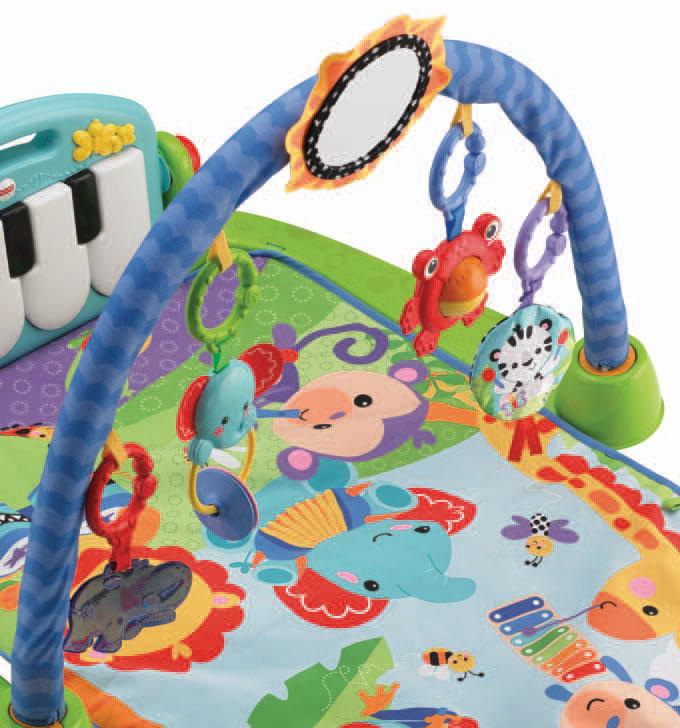
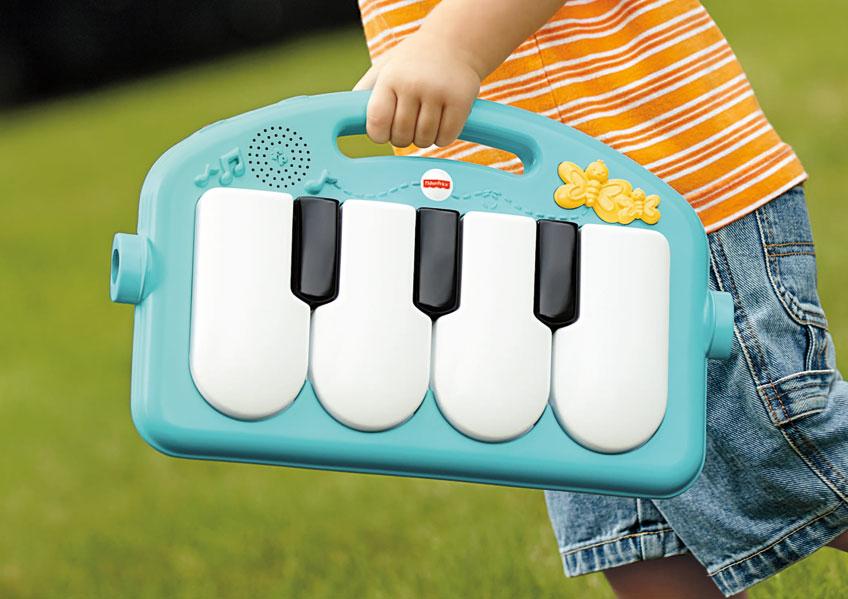
Baby kicks. Music plays. And that’s just the beginning. Movable toys on the overhead gym encourage baby to bat and grasp. Move the arch down for tummy-time play, or let baby sit and entertain you with a piano concert! And now with a removable piano, you can take the musical fun wherever you and baby go!


Features
  • Four ways to play: Lay & play; Tummy time; Sit & play; Take-along
  • Music rewards baby as she kicks the piano keys
  • Five busy activity toys & a large mirror
  • Toys include a hippo teether, elephant clackers, rollerball frog, and more
  • Short or long-play music—up to 15 minutes
  • Soft, comfy mat
  • Power/volume control
  • Requires 3 AA batteries

Toys overhead encourage batting and grasping, including a hippo teether, elephant clackers, rollerball frog and more!

Stretching & kicking

With four ways to play, this musical toy grows with your little one! From laying and playing, to tummy time and sitting up, busy activities at each stage are just the beginning of the fun. Baby’s in charge of the action as her little kicky feet activate music. Moveable toys overhead encourage batting and grasping, including a hippo teether, elephant clackers, rollerball frog and more.

When it’s time to change modes, move the arch down for tummy time or let baby sit up and entertain you with a piano concert. Remove the piano and take the fun on-the-go. Includes long and short play modes with up to 15 minutes of music. Power and volume control for quiet play.

Removable piano provides musical fun wherever you and baby go!

Learning through play!

As baby plays, new discoveries are made and key developmental skills get stronger and stronger. As baby stretches and kicks at the piano keys or bats at and reaches for the busy activity toys, gross motor skills are enhanced. Music, lights and bright colors stimulate baby’s senses.

Help baby learn the connection between actions and reactions. Put baby’s foot within reach of the piano. From there, it’s bound to happen: baby’s foot will connect and activate a fun and rewarding response from the gym!

Science Tries to Understand What Gives a Piano its Voice

Picture a seven-foot grand piano in a studio. The lid’s missing, so you can see all the strings. Researchers suspend a rod embedded with 32 microphones over the piano’s body.

“We played this middle C at a very soft level, a medium level, and a very loud level,” says Agnieszka Roginska, a professor in NYU’s music technology program. She says using a pianist to play middle C over and over wouldn’t be scientific. So they’re using a disklavier, a fancy player piano triggered by electronics. “So we could hit the same note, with the same velocity, thousands of times,” she says.

They’d record the piano in one spot. Then move the microphones eight inches. Record the note. Move the mics again. Record the note. Over and over and over, until they reach the back of the piano. At the end, they get “what is basically a very dense acoustical scan of the radiation pattern of the grand piano,” Roginska says.

Read the entire article here: http://www.pri.org/stories/2014-08-10/science-tries-understand-what-gives-piano-its-voice

Pianos are Popping Up all over Corvallis

Lee Eckroth couldn’t hold back a smile as piano music filled the air Wednesday afternoon on the streets of downtown Corvallis.

The moment marked the culmination of months of work from by Eckroth, Corvallis Imagination Music & Art founder David Lundahl and dozens of volunteers who’d banded together to create the first Play Corvallis, Play.

The art installation features eight theme-decorated pianos, placed at outdoor locations around Corvallis. It is open to the public from 7 a.m. to 10 p.m. daily through Aug. 16 as a prelude event to the Imagination Music and Art festival at Bruce Starker Arts Park on Aug. 15 and 16.

Play Corvallis, Play is intended to inspire appreciation of the arts, and it is just what it sounds like: an invitation to residents to stop and play the piano to showcase local musical creativity and art as a way of drawing attention to the fundraising at Corvallis public schools.

Read the whole article at Pianos are popping up all over Corvallis.

Are You Moving this Summer?

Many homeowners don’t realize that there are movers available to them who specialize in the transportation and storage of pianos. A piano is a delicate instrument and not something you want to take risks with. By trusting this major job to a piano mover, you can rest easy knowing that one of the most valuable items in your home is being transported with the care it deserves.

But It Weighs 1500 Pounds. How Delicate Can It Be? 

pianomovingThis is exactly where many homeowners go wrong. Sure, that piano in your living room is heavy enough to throw out the backs of four or five of your best buddies as you wrestle it out the door and up into the truck, but don’t let that fool you. Despite its bulky appearance, it is also a precision musical instrument with over 1000 moving parts and 200 finely-tuned strings, any number of which can be damaged and require repair if your piano isn’t handled properly in a move.

Your Piano Mover Understands Pianos

These intricate inner workings of a piano are exactly why hiring an expert in piano moving is so important. These professionals understand pianos and moving them, from the safest way to lift and twist a standard upright piano to get it out the door, to how to properly disassemble a grand piano and transport it without causing any damage. And even more importantly, a piano mover understands that when your piano is delivered to your new home, you expect to be able to sit down and play it right away. It’s why many piano movers keep tuners and repairmen on staff, and why the rest will have a trusted list of professionals available on request if you need it.


From: http://www.homeadvisor.com/article.show.Don-t-Take-Risks-Moving-Your-Piano-Hire-an-Expert.14222.html#ixzz39Gny25qc

8 Daily Practice Reminders…

Great tips for practicing!

Melanie Spanswick's avatar

Several students have recently asked me for a ‘practice reminder list’ consisting of important elements to consider during their daily practice session. We all want to ensure fruitful practice; there’s nothing more depressing and dispiriting than spending an hour or two working away at the piano only to discover that nothing has really been achieved. We’ve all done this at some point, but helpful, solid practice can only take place when the right physical and mental conditions have been instilled. This does require some thought and preparation at each practice session.

These suggestions can be applied to any standard or grade, although the students who requested this list are all around Grade 8 and the DipABRSM level. Even at higher levels of piano playing, the following should still serve as a reminder in order to establish good habits and purely to ‘feel’ comfortable during practice time. These tips have all no doubt been mentioned before…

View original post 536 more words

Summer Schedules!

It’s hard to believe but summer is nearly upon us.  FCPS students are getting out later this year due to snow days, so the regular school year piano lessons are going a bit longer, as well.

Here’s the basic schedule from now through the start of fall lessons.  Please remember that students must take at least 6 summer lessons to hold a current school year lesson time for the fall.

The last day of school is  June 25, so there are no lessons week of June 23 (school age students only.  Adults continue, as always)

No lessons 4th of July weekend – July 3-5

No lessons after noon the week of July 7-11 (Pender UMC Music Camp)

No lessons August 15-Sept 2


Lessons (11 adult lessons, 10 school age students offered):

June 2 9, 16, 23 (except FCPS students – last week of school), 30
July 7 (mornings only), 14, 21, 28
Aug 4, 11

Sept 8, the fall semester begins


If you need to reschedule, please call, email or FaceBook me and with at least 24-hours notice. There are some open spots available on the schedule.  You can view them here: https://ocms.youcanbook.me/.   Those times are “more like guidelines.  I will contact you to confirm any changes.  As always, the PW is “piano”.


happy_summer

A chance to win PIANIST Magazine’s NEW PIANO TECHNIQUES APP

Unknown's avatar

ipad-black

Those who read this blog regularly will know how I enjoy holding little competitions. Today I’m offering a chance to win a  Piano Techniques app designed especially by Pianist magazine for your iPad.

Pianist magazine, in association with Steinway Hall London, is proud to present its first-ever stand-alone app: Piano Techniques. When you’ve read the articles, watched the lessons, listened to the music, your playing will be better! It doesn’t matter what level you are – there’s something here for beginner through to advanced players.

The app contains some of the best articles from within the pages of Pianist written by its expert pianist teachers. Topics include sight-reading, chords, memorising, starting from scratch, returning to the piano after a long break, fingering, a star interview with Lang Lang and more. You can even watch and listen to Lang Lang perform at the end of the interview. He’s playing the gorgeous Liszt Romance (this piece was featured inside Pianist magazine’s Scores section in the current issue 76).

Aside from the articles…

View original post 145 more words

Mozart’s Fantasia in d minor, K. 397

I have always really enjoyed playing Mozart’s Fantasia in d minor and when I was asked to play for the new piano dedication service at my church I knew what I would “dust off” to perform.

The Grove’s Dictionary of Music and Musicians defines the genre of musical fantasia as “a piece of instrumental music owning no restriction of formal construction, but the direct product of the composer’s impulse.”

The Fantasia in d minor has somewhat unusual rhythm, constantly changing tempo (seven different tempi occur throughout the piece), three cadenzas and its apparent lack of any recognizable musical form (as indicated by the “Fantasy” title). Although it begins in d minor, the final section is in D Major.

Mozart composed this, his third and final, Fantasia in 1782 and it was unfinished at the time of his death in 1791.  Even Mozart’s sister, “Nannerl”, who came across the work in 1807, was astounded to have discovered a previously unknown composition of such quality.

In its original form this Fantasia was probability only a fragment of what was to be a larger work. The closing bars which are most frequently performed today originated from an unauthorized print believed to have been composed in 1806 by August Eberhard Müller, one of Mozart’s admirers.

Because it was unfinished, many of the dynamic and pedal markings are nonexistant and left for the performer to choose.

As you can see from these videos, there is a wide range of tempi and interpretation from Frederich Gulda’s 4 minute, 36 second rendition 

to Glenn Gould’s version which lasts for 8 minutes, 22 seconds

Both these composers have added their own ornamentation to Mozart’s original work.

I will be playing from a G. Henley Verlag urtext edition instead of one of the many edited versions available.  I prefer to make my own musical decisions wherever possible.

The version below is originally from http://imslp.org/wiki/Fantasia_in_D_minor,_K.397/385g_(Mozart,_Wolfgang_Amadeus)  I had printed it out as another source to compare with mine, since this one has different dynamic and other interpretive markings.  This version also has 3 notes which differ from the urtext edition.

Mozart-fantasia-d-minor.pdf
Download this file

I also used 3 other sources before I finally decided how I would shape my performance and choose my fingerings.

Some sites that I consulted as part of the learning process: 

I’ve played this for just about everyone I know and on 4 different pianos and I think it’s ready for Sunday night!