I think the first time I ever came across anything related to Calloway was in the late 1960s when I was watching That Girl on TV – Ann’s father (Lew Parker) sang Minnie the Moocher for a talent show. The song stuck in my head. I wish I could find a video of that performance.
“Minnie the Moocher” is a jazz song first recorded in 1931 by Cab Calloway and His Orchestra, selling over a million copies. “Minnie the Moocher” is most famous for its nonsensical ad-libbed (“scat”) lyrics (for example, “Hi De Hi De Hi De Hi”).
In performances, Calloway would have the audience participate by repeating each scat phrase in a form of call and response. Eventually, Calloway’s phrases would become so long and complex that the audience would laugh at their own failed attempts to repeat them.
“Minnie the Moocher” was inducted into the Grammy Hall of Fame in 1999.
Lots of others have sung this song, as well including Stephen Fry and Hugh Laurie in “Jeeves and Wooster”.
and the Three Mo’ Tenors performed it in 2001
Calloway appeared in the 1980 film The Blues Brothers and sang a shortened version “Minnie The Moocher” in the film, in the original style of big band.
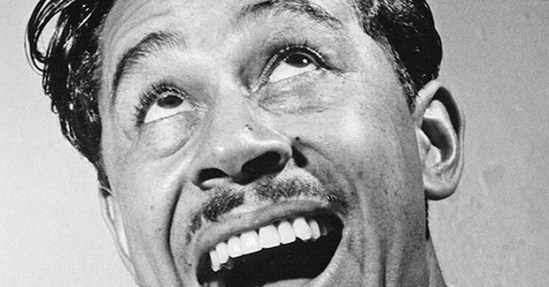
Cabell “Cab” Calloway III (December 25, 1907 – November 18, 1994) was an American jazz singer and bandleader. He was strongly associated with the Cotton Club in Harlem, New York City, where he was a regular performer.
Calloway was a master of energetic scat singing and led one of the United States’ most popular big bands from the start of the 1930s through to the late 1940s. Calloway’s band featured performers including trumpeters Dizzy Gillespie and Adolphus “Doc” Cheatham, saxophonists Ben Webster and Leon “Chu” Berry, New Orleans guitar ace Danny Barker, and bassist Milt Hinton. Calloway continued to perform until his death in 1994 at the age of 86.
An old Paramount short film of Cab Calloway singing many of his hits.
“The Old Man of The Mountain” is non-stop Cab from beginning to end. He appears first as an owl, singing the title song. The words have been changed for the cartoon, in which the Old Man is a villain. In the original song, the Old Man is a benevolent character. Next we see Cab as the Old Man himself, rotoscoped and singing, “You Gotta Hi-De-Hi,” followed by “The Scat Song.”
The cartoon begins with live footage of Cab and his Orchestra playing around with the tune of Minnie the Moocher while Cab scats mildly and grins at the camera. Whereas Cab may have been caught by surprise when they used live footage of him in the earlier cartoon, “Minnie the Moocher”, this time he is ready. He and his band are in dress white uniforms, Cab’s hair is slicked back, and he pays attention to the camera. (The drummer, Leroy Maxey, is still playing with his drumsticks, though!)
Of the three cartoons starring Cab Calloway, this one has the least interesting and least surreal plot, and the animation is the crudest. Never-the-less, the very early live footage of Cab is a treasure, and this cartoon showcases his music from beginning to end, featuring three of his songs. He does some of his most remarkable ever scat singing in this version of The Scat Song.
In all of the Fleisher cartoons, Cab’s characters are set in caves with menacing and ominous background illustrations: skeletons, skulls, ghosts, leering faces, and gambling, alcohol and drug paraphernalia. People have claimed that the Fleischers were unaware of the drug references in Cab’s songs (for example, “kicking the gong around” meaning “smoking opium”), but the imagery in the animations suggests otherwise.
Cab’s scat singing, dancing, comedic personality and flashy elegance had made him a star and a million-selling recording artist. He continued to perform right up until his death in 1994 at the age of 88.
Gunther Schuller sums up Calloway’s brilliance as an entertainer: “People still remember Cab Calloway as a dancer and vaudevillian with his wonderful white tuxedos and all of that — and, as a great, great showman.”
. 1497 ~ Johannes Ockeghem, Flemish singer/composer, died at the age of 79
. 1843 ~ The first minstrel show in America, “The Virginia Minstrels”, opened at the Bowery Amphitheatre in New York City.
. 1903 ~ Claudio Arrau, Chilean pianist
. 1917 ~ Arthur Gold, pianist, born in Toronto, Ontario
. 1929 ~ Rudy Vallee and his orchestra recorded Deep Night. It says in the fine print, under the artist’s name, that the tune was written by Vallee, himself.
. 1943 ~ Fabian (Fabian Forte), Singer
. 1943 ~ Frank Sinatra made his debut as a vocalist on radio’s “Your Hit Parade” this night. Frankie had left the Tommy Dorsey Band just four months prior to beginning the radio program. He was described as, “…the biggest name in the business.”
. 1945 ~ Bob Marley, Jamaican reggae singer and songwriter
. 1947 ~ Alan Jones, Saxophone with Amen Corner
. 1950 ~ Natalie Cole, Grammy Award-winning singer, Best New Artist in 1975 with This Will Be, I’ve Got Love on My Mind. She is the daughter of Nat ‘King’ Cole.
. 1966 ~ Rick Astley, Singer, songwriter
. 1976 ~ Vince Guaraldi, jazz pianist and composer (Peanuts TV specials), died at the age of 43
. 1981 ~ Former Beatle, Paul McCartney, Ringo Starr and George Harrison teamed up once again to record a musical tribute to John Lennon. The result of that session became All Those Years Ago. The song went to #2 on the pop music charts for three weeks. It was recorded on Harrison’s own Dark Horse label.
. 2005 ~ Lazar Berman, Soviet Russian classical pianist. He was hailed for a huge, thunderous technique that made him a thrilling interpreter of Liszt and Rachmaninoff and a late representative of the grand school of Russian Romantic pianism.
. 2007 ~ Frankie Laine, Italian-American singer, songwriter, and actor (Frankie Laine Show, Rawhide), died of heart failure at the age of 93
. 2024 ~ Toby Keith, Country Singer-Songwriter died at the age of 62. He was battling stomach cancer,
. 1748 ~ Christian Gottlob Neefe, German composer/conductor/tutor of Beethoven
. 1916 ~ Enrico Caruso recorded O Solo Mio for the Victor Talking Machine Company, which eventually became Victor Records, then RCA Victor.
. 1921 ~ Sir John Pritchard, British conductor
. 1928 ~ Singer Jessica Dragonette was seen on one of the first television shows. She was used only to test the new medium. She didn’t even get to sing.
. 1930 ~ Don Goldie, Trumpeter on Basin Street Blues with vocals by Jack Teagarden
. 1931 ~ Eddie Cantor’s long radio career got underway as he appeared on Rudy Vallee’s “The Fleischmann Hour”.
. 1933 ~ Claude King, Singer
. 1940 ~ One of the great classic songs of the Big Band era was recorded. Glenn Miller and his band played Tuxedo Junction at the RCA Victor studios in Manhattan. The flip side of the record (released on the Bluebird label) was Danny Boy.
. 1941 ~ Barrett Strong, Singer, songwriter
. 1942 ~ Cory Wells, Singer with Three Dog Night
. 1943 ~ Charles Winfield, Musician with Blood, Sweat and Tears
. 1958 ~ A year after its founding, the National Academy of Recording Arts and Sciences (NARAS) formed a New York chapter. NARAS is better known as the Grammy Awards organization.
. 1961 ~ The Shirelles were winding up their first week at #1 on the music charts with Will You Love Me Tomorrow. The song was at the top for two weeks. It was the group’s first #1 tune and the first #1 tune from the pen of a New York Brill Building songwriter who worked right down the hall from Neil Sedaka. She became a huge star in her own right with several #1 singles and albums in the 1970s. Her name: Carole King.
. 1969 ~ Bobby Brown, Grammy Award-winning singer, married singer, Whitney Houston
. 2003 ~ Clyde Douglas Dickerson, 80, a saxophone player who played for four decades at Washington area jazz clubs and held down a day job for 20 years as doorman at the Watergate Hotel, died after a stroke. Mr. Dickerson, known as “Watergate Clyde,” appeared at such spots as Blues Alley, Pigfoot and One Step Down and at jazz joints along 14th Street NW. He freelanced for a number of decades as far away as Upstate New York and Ohio. He collaborated with pianist and trumpet player Jimmy Burrell at the old Crow’s Toe at 10th and K streets NW, the Chaconia Lounge on upper Georgia Avenue NW and Today’s in Rockville. Mr. Dickerson also played with performers who included Oran “Hot Lips” Page, the Mangione brothers, ex-Temptation David Ruffin and Rick James. He also appeared in a Lester Young tribute with Shirley Horn and saxmen Byron Morris and Ron Holloway.
His last performance was on Capitol Hill, at Ellington’s at Eighth, shortly before his death. Washington Post staff writer Eve Zibart wrote of Mr. Dickerson that he might once have thought of himself as a musician who worked hotels on the side, but over the years the occupations began to blur. “You take Rostropovich,” Mr. Dickerson said of the National Symphony Orchestra conductor. “Slava gets up there, and whatever composer it is, he can read the score and tell what the composer felt, and he can get that out to the musicians. “It’s the same with being a doorman: If you really know the general manager, you know how he feels about the hotel — it’s like his home, and the people coming in are like his personal guests. I’m the substitute for the general manager . . . playing the overture to the hospitality.” Zibart interviewed him in 1988, his 16th year at the hotel, shortly after the Watergate management threw him a birthday party.
It featured Gerard Schwarz, guest conductor of the Washington Opera and a trumpet virtuoso; pianist Christopher Norton; Rep. John Conyers Jr. (D-Mich.), sponsor of a bill recognizing jazz as a national treasure — and a birthday cake topped by a saxophone. Mr. Dickerson was born in Bristol, Tenn. He attended the Berklee College of Music in Boston.
. 2014 ~ Richard Hayman, American orchestra leader (Vaughn Monroe Show), died at the age of 93
. 1677 ~ Johann Ludwig Bach, German composer/violinist and second cousin of Johann Sebastian Bach. (d. 1731)
. 1893 ~ Bernard Rogers, American composer
. 1894 ~ Adolphe Sax, Belgian musician and inventor of the saxophone, died at the age of 79
More about Sax
. 1912 ~ Erich Leinsdorf, Austrian-born American conductor
. 1937 ~ Glen Gray and his Casa Loma Orchestra recorded A Study in Brown, on Decca Records.
. 1938 ~ The animated film Snow White and the Seven Dwarfs was released and had major success in the box-office, making more money than any other motion picture up till that point.
. 1941 ~ John Steel, Singer, drummer with The Animals
. 1944 ~ Florence LaRue (Gordon), Singer with The Fifth Dimension
. 1962 ~ Clint Black, Singer, actor
. 1975 ~ Louis (Thomas) Jordan passed away
. 1983 ~ Karen Carpenter died at 32 of cardiac arrest at her parent’s house in Downey, California; the coroner’s report gave the cause of death of imbalances associated with anorexia nervosa. The Carpenters 1970 album Close to You, featured two hit singles: “(They Long to Be) Close to You” and “We’ve Only Just Begun.” They peaked at No.1 and No.2, on the US chart. In 1975 – In Playboy’s annual opinion poll; its readers voted Karen Carpenter the Best Rock Drummer of the year.
. 1987 ~ The show-biz world was saddened when Liberace died at his Palm Springs, CA estate. He was 67. Lee, as he was known, was the master of Las Vegas. Hundreds of thousands flock to his museum there (operated by his brother, George) to see Liberace’s garish suits, trademark candelabra, and learn of the myths behind this hugely successful star of television, stage and concerts the world over.
. 2001 ~ James Louis “J.J.” Johnson, an influential jazz trombonist who later forged a career arranging and recording scores for motion pictures and television, died at the age of 77. The Indianapolis native, who began playing piano at age 11, was a perennial winner of “Down Beat” magazine’s reader’s poll as best trombonist. While he was praised by jazz aficionados, Johnson also made his mark in popular culture, writing and arranging music for such television shows as “Starsky and Hutch”, “Mayberry, R.F.D.” and “That Girl”. His film music credits included “Cleopatra Jones” and “Shaft.” During his long career, he performed with such jazz greats as Count Basie and Dizzy Gillespie. While touring with jazz bands during the heyday of those ensembles, he played with the Clarence Love and Snookum Russell bands. He got his first big break with the Benny Carter band in 1942.
. 2016 ~ Leslie Bassett, American classical composer (Variations for Orchestra – Pulitzer Prize 1966), died at the age of 93
. 1736 ~ Johann Georg Albrechtsberger, Austrian musician
. 1809 ~ (Jacob Ludwig) Felix Bartholdy Mendelssohn, German composer
More information about Mendelssohn
. 1900 ~ Mabel Mercer, British-born American cabaret singer
. 1904 ~ Luigi Dallapiccola, Italian composer
More information about Dallapiccola
. 1911 ~ Jehan Alain, French organist and composer
. 1928 ~ Frankie Vaughn (Abelson), Singer
. 1929 ~ Russell Arms, Singer
. 1940 ~ Angelo D’Aleo, Singer with Dion and The Belmonts
. 1941 ~ Jimmy Dorsey and his orchestra recorded the classic, Amapola, on Decca Records. Helen O’Connell and Bob Eberly joined in a vocal duet on this very famous and popular song of the Big Band era.
. 1943 ~ Eric Haydock, Bass with The Hollies
. 1943 ~ Dennis Edwards, singer with the Temptations since 1968. He sang on a string of the group’s hits including “I Can’t Get Next to You,” “Ball of Confusion” and “Papa Was a Rollin’ Stone” in an initial tenure that stretched to 1977.
. 1947 ~ Melanie (Safka), Singer
. 1947 ~ Dave Davies, Singer, guitarist with The Kinks
. 1950 ~ Ed, Gene, Joe and Vic, The Ames Brothers, reached the #1 spot on the pop music charts for the first time, as Rag Mop became the most favorite song in the U.S. The brothers enjoyed many successes with their recording efforts.
.
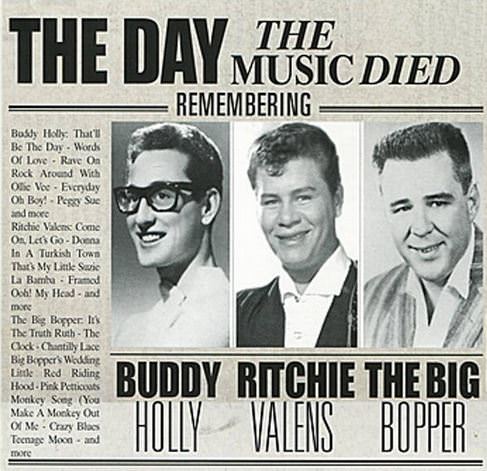
1959 ~ 22-year-old Buddy Holly, 28-year-old J.P. Richardson (The Big Bopper) and 17-year-old Ritchie Valens died in an airplane crash near Mason City, Iowa. February 3rd has been remembered as ‘The Day the Music Died’ since Don McLean made the line popular in his 1972 hit, “American Pie”. Buddy Holly, born Charles Hardin Holly in Lubbock, Texas, recorded That’ll Be the Day, Peggy Sue, Oh, Boy, Maybe Baby, and others, including It Doesn’tMatter Anymore (recorded just before his death, a smash in the U.K., non-top-10 in the U.S.). Buddy was inducted into the Rock and Roll Hall of Fame in 1986. A convincing portrait of the singer was portrayed by Gary Busey in The Buddy Holly Story, a made for TV movie. J.P. (Jiles Perry) Richardson was from Sabine Pass, TX. He held the record for longest, continuous broadcasting as a DJ at KTRM Radio in Beaumont, TX in 1956. He was on the air for 122 hours and eight minutes. In addition to his smash hit, Chantilly Lace, Richardson also penned Running Bear (a hit for Johnny Preston) plus White Lightning (a hit for country star, George Jones). Richard Valenzuela lived in Pacoima, CA (near LA) and had a role in the 1959 film, Go Johnny Go. Ritchie Valens’ two big hits were Donna and La Bamba … the last, the title of a 1987 film depiction of his life. La Bamba also represented the first fusion of Latin music and American rock. Of the three young stars who died in that plane crash, the loss of Buddy Holly reverberated the loudest over the years. But, fans of 1950s rock ‘n’ roll will agree, all three have been sorely missed.
. 1959 ~ Lol (Laurence) Tolhurst, Drummer, keyboard with The Cure
. 1964 ~ The British group, The Beatles, received its first gold record award for the single, I Want To Hold Your Hand. The group also won a gold LP award for “Meet The Beatles”. The album had been released in the United States only 14 days earlier.
. 1971 ~ Lynn Anderson received a gold record for the single, Rose Garden. The Grand Forks, ND country singer was raised in Sacramento, CA. In addition to being a singer, she was an accomplished equestrian and California Horse Show Queen in 1966.
. 1974 ~ “Pajama Game” closed at Lunt Fontanne Theater NYC after 65 performances
. 1979 ~ “YMCA“ by Village People peaked at #2 on the pop singles chart. It was fun to dance to!
. 2002 ~ Remo Palmier, a self-trained guitarist who was a fixture in the New York jazz scene in the 1940s, died at the age of 78, and had been suffering from leukemia and lymphoma, his wife said. Over the course of his career, Palmier played with jazz legends Charlie Parker, Billie Holiday and Dizzy Gillespie, among others. Born Remo Palmieri in the Bronx, Palmier achieved his greatest fame performing with broadcaster Arthur Godfrey on CBS, and taught Godfrey how to play the ukulele. After Godfrey retired, Palmier released his own albums, “Windflower and “Remo Palmier”.
. 1912 ~ Erich Leinsdorf, Austrian-born American conductor
. 1937 ~ Glen Gray and his Casa Loma Orchestra recorded A Study in Brown, on Decca Records.
. 1941 ~ John Steel, Singer, drummer with The Animals
. 1944 ~ Florence LaRue (Gordon), Singer with The Fifth Dimension
. 1962 ~ Clint Black, Singer, actor
. 2002 ~ Blues and jazz pianist Abie “Boogaloo” Ames died at the age of 83. Ames was born on Big Egypt Plantation in Cruger, Miss., on May 23, 1918. He began playing piano at the age of 5 and his style earned him the nickname “Boogaloo” in the 1940’s. Ames moved to Detroit as a teenager and started a band, touring Europe with Louis Armstrong in 1936. Ames worked at Motown Studio and befriended other great musicians like Nat King Cole and Erroll Garner. In 1980, Ames moved to Greenville, where he became a regular performer at local clubs and festivals. Cassandra Wilson’s forthcoming Blue Note CD tentatively titled “Belly of the Sun” is set to include Darkness in the Delta, a song written by Ames for the CD. Ames was named the 2001 winner of the Artist’s Achievement Award of the Governor’s Awards for Excellence in the Arts in the state of Mississippi. With his protege and 1990s musical partner Eden Brent, Ames performed at the Kennedy Center for Performing Arts in Washington, D.C., in 2000. Ames’ last public performance was in October 2001 at the E.E. Bass Cultural Center in Greenville with another former student, Mulgrew Miller.
. 2002 ~ David Stetler, a big band swing drummer who played with Benny Goodman and Spike Jones, died of pneumonia. He was 79. A Seattle native, Stetler was discovered in high school by Lunceford. With a style close to that of Gene Krupa and Jo Jones, Stetler toured the country in the 1940s but returned to Seattle after his first son was born. He backed up national acts in local performances, including many during the world’s fair in 1962.
. 2003 ~ Charlie Biddle, a leader of Montreal’s jazz scene in the 1950s and ’60s who played bass with Thelonious Monk and Charlie Parker, died after a battle with cancer. He was 76. Biddle was a native of Philadelphia who moved to Canada in 1948. Over the next five decades, the World War II veteran and former car salesman became synonymous with jazz in Montreal. Biddle opened his own club, Uncle Charlie’s Jazz Joint, in suburban Ste- Therese in 1958. He later performed in such legendary Montreal nightspots as The Black Bottom and the Penthouse, where he worked with the likes of Oscar Peterson, Art Tatum, Charlie Parker and Lionel Hampton. When there were no jobs in Montreal, Biddle played smaller Quebec cities with a group called Three Jacks and a Jill. Until recently, Biddle played four nights a week at Biddle’s Jazz and Ribs, a Montreal landmark for nearly 25 years. Coincidentally, the club closed Tuesday for planned renovations, which included erecting a wall of fame to honor Biddle and others who have played at the club. In 1979, he organized the three-day festival that some say paved the way for the renowned Montreal International Jazz Festival. News Item about Charlie Biddle
. 2003 ~ Jerome Hines, a bass vocalist who performed regularly at the Metropolitan Opera during a career that spanned more than six decades, died. He was 81. Hines spent 41 years performing at the Met, more than any other principal singer in its history. He was known for his timbral richness, as well as the research he conducted into the historical and psychological background of the roles he portrayed. During his career at the Met, he portrayed 45 characters in 39 works, including title roles in Mussorgsky’s “Boris Godunov” and Mozart’s “Don Giovanni,” and Colline in Puccini’s “La Boheme.” He gave a total of 868 performances at the Met, retiring in 1987. He went on to perform with regional opera companies and at benefits. Hines, who became a born-again Christian in the 1950s, composed his own opera, “I Am the Way,” about the life of Jesus. He sang the title role at the Met in 1968 and 93 times around the world.
. 2003 ~ Saxophonist Cornelius Bumpus, a former member of the Doobie Brothers who had performed with Steely Dan since 1993, died en route to a series of performances in California. He was 58. Bumpus began his career at age 10, playing alto saxophone in the school band in Santa Cruz, Calif. In 1966, he spent six months performing with Bobby Freeman, and joined Moby Grape in 1977, writing one tune for the “Live Grape” album. Bumpus also recorded two solo albums and toured with his own band. Since performing with The Doobie Brothers in the early 1980s, Bumpus played with a number of bands, most recently with Steely Dan, which won the “Album of the Year” Grammy for its 2000 “Two Against Nature” release. His relations with his former Doobies bandmates turned contentious in the late 1990s, when they sued him and several other musicians over their use of the Doobies name. A federal judge in 1999 ruled against Bumpus and the other musicians, ordering them not to use the name.
It’s Groundhog Day…again! In weather lore, if a groundhog, also known as a woodchuck, or marmot emerges from its burrow on this day and fails to see its shadow winter will soon end. If on the other hand, it is sunny and the groundhog sees its shadow, winter will continue for 6 more weeks.
. 1714 ~ Gottfried August Homilius, German composer, cantor and organist
. 1789 ~ Armand-Louis Couperin, French composer, organist, and harpsichordist died at the age of 63
. 1875 ~ Fritz Kreisler, Austrian-born American violinist and virtuoso/composer Some of his best-known works are Caprice Viennois, Tambourin Chinois, Liebesfreud and La Gitana
. 1901 ~ Jascha Heifetz, Russian-born American violinist
Read quotes by and about Heifetz
More information about Heifetz
. 1911 ~ Jussi Björling, Swedish tenor
. 1912 ~ Burton Lane (Levy), Composer of How Are Things in Glocca Morra, That Old Devil Moon, Look to the Rainbow, How About You, I Hear Music, Come Back to Me, On a Clear Day You Can See Forever, How Could You Believe Me?; His Broadway musicals were Finian’s Rainbow (collaboration with Yip Harburg), On a Clear Day You Can See Forever (collaboration with Alan Jay Lerner). He contributed songs to over 30 films: Babes on Broadway, Royal Wedding, Ship Ahoy, St. Louis Blues and credited with discovering Judy Garland
. 1927 ~ Stan Getz (Stanley Gayetzby), American jazz tenor saxophonist
. 1937 ~ Tom Smothers, Entertainer, The Smothers Brothers Comedy Hour, The Smothers Brothers Show, The Steve Allen Show, Dick’s Brother
. 1937 ~ Guy Lombardo and his orchestra recorded one of Guy’s most famous tunes. Boo Hoo was waxed on Victor Records and became one of the group’s all-time great hits.
. 1940 ~ Alan Caddy, Guitarist with The Tornados
. 1941 ~ Serge Alexandrovich Tcherepnin, composer
. 1942 ~ Graham Nash, Singer with Crosby, Stills, Nash and Young
. 1947 ~ Peter Lucia, Drummer with Tommy James and The Shondells
. 1945 ~ The first 45 RPM vinyl record was released. It was one of the most popular ways for music lovers to enjoy their favorite song without buying an entire record. The cassette single during the 1980s and 1990s was a comparable format.
. 1949 ~ Ross Valory, Bass with Journey
. 1959 ~ The Coasters tune, Charlie Brown, was released. The tune went to #2 and stayed there for three weeks, but didn’t make it to the top spot of the charts. A catchy song (“Fee fee fi fi fo fo fum. I smell smoke in the auditorium…”), it was on the charts for a total of 12 weeks. The song at number one, preventing Charlie Brown from reaching the top, was Venus, by Frankie Avalon.
. 1996 ~ Gene Kelly, American actor and dancer (Singin’ in the Rain), died at the age of 83
. 2001 ~ French pianist Nicole Henriot, who entered the Paris Conservatory at age 7 and went on to perform around the globe with conductor Charles Munch, died at the age of 75. Emerging on the world music scene after World War II, Henriot built her reputation on interpretations of works from Liszt to Prokofiev, and especially French composers such as Ravel, Fauré and Milhaud. She was most famous for her performances with Munch, music director of the Boston Symphony from 1949 to 1962. Munch, who died in 1968, was the uncle of Henriot’s husband. Born in 1925, Henriot won the Paris Conservatory’s first prize at age 13. During the war, Henriot gave aid to her brother, a member of the French Resistance. When Gestapo agents searched her home in 1944, she managed to destroy her brother’s secret documents but was badly beaten. After the war, Henriot became the first French pianist to appear in Britain and began an international tour that took her from Scandinavia to Egypt. She made her American debut in 1948 as a soloist with the New York Philharmonic under Munch’s direction. When Munch formed the Orchestra of Paris in 1967, Henriot was one of the fledgling orchestra’s first soloists. In the 1970s and 1980s, Henriot devoted herself to teaching, and worked at the Conservatory of Liege, Belgium, and at the Walloon Conservatory of Brussels.
. 2001 ~ Victor Norman, who founded the Eastern Connecticut Symphony Orchestra and conducted the group for three decades, died at the age of 95. Colleagues said Norman was a visionary who needed to be as skilled in politics as he was in music to keep the symphony together. “He had this idea that a symphony orchestra could be created around here, when really it had been tried several times before, never with any kind of significant success,” said Charles Frink, a New London composer who studied with Norman. Norman founded the New London Civic Orchestra in 1946. It merged with the Willimantic Orchestra in 1952 to become the Eastern Connecticut Symphony Orchestra. He stepped down from the podium in 1980. In his retirement, Norman composed music. Two of his orchestral pieces were performed by the New Britain Symphony Orchestra and the Westminster Community Orchestra in Princeton, N.J. His memoirs, “Victor Norman: A Life in Music, a Lifetime of Learning,” were published in 1999.
. 2015 ~ French piano virtuoso Aldo Ciccolini died at age 89. Born on August 15, 1925, into a musical family in Naples, Aldo Ciccolini was a child prodigy, beginning composition classes in the city’s conservatory at age nine.
. 1669 ~ Miquel Lopez, composer, born. He died sometime in 1723
. 1671 ~ Francesco Stradivari, Italian violin maker
. 1862 ~ The Battle Hymn of the Republic was first published in “Atlantic Monthly”. The lyric was the work of Julia Ward Howe. The Battle Hymn of the Republic is still being sung and to the tune of a song titled John Brown’s Body.
. 1869 ~ Victor Herbert, Composer, cellist and conductor of the Pittsburgh Symphony. He composed operettas such as Babes in Toyland, Naughty Marietta and songs like Ah Sweet Mystery of Life (At Last I’ve Found You)
. 1877 ~ Thomas Frederick Dunhill, English composer and writer on musical subjects
. 1894 ~ James P. Johnson, American pianist and composer (Charleston), born in New Brunswick, New Jersey
. 1896 ~ Puccini’s “La Bohème” premiered in Turin, Italy. La Bohème is an opera in four acts, composed by Giacomo Puccini between 1893 and 1895 to an Italian libretto by Luigi Illica and Giuseppe Giacosa, based on Scènes de la vie de bohème (1851) by Henri Murger. The story is set in Paris around 1830, and shows the Bohemian lifestyle of a poor seamstress and her artist friends.
. 1904 ~ Enrico Caruso recorded his first sides for Victor Records. He did ten songs in the session and was paid only $4,000.
. 1937 ~ Don Everly born, Singer with his brother, Phil, in The Everly Brothers. Some of their hits were: Wake Up Little Susie, Bye Bye Love, Cathy’s Clown and All I Have To Do Is Dream
. 1937 ~ Ray Sawyer, Singer with Dr. Hook and The Medicine Show
. 1939 ~ Benny Goodman and his orchestra recorded And the Angels Sing on Victor Records. The vocalist on that number, who went on to find considerable fame at Capitol Records, was Martha Tilton.
. 1940 ~ Frank Sinatra sang Too Romantic and The Sky Fell Down in his first recording session with the Tommy Dorsey Band. The session was in Chicago, IL. Frankie replaced Jack Leonard as lead singer with the band.
. 1941 ~ “Downbeat” magazine reported this day that Glenn Miller had inked a new three-year contract with RCA Victor Records. The pact guaranteed Miller $750 a side, the fattest record contract signed to that time.
. 1949 ~ RCA Victor countered Columbia Records’ 33-1/3 long play phonograph disk with not only a smaller, 7-inch record (with a big hole in the center), but an entire phonograph playing system as well. The newfangled product, the 45- rpm, which started a revolution (especially with the new rock and roll music), soon made the 78-rpm record a blast from the past.
. 1952 ~ Rick James (James Johnson), Singer
. 1954 ~ Mike Campbell, Guitarist with Tom Petty and The Heartbreakers
. 1968 ~ Elvis Presley celebrated the birth of his daughter, Lisa Marie. Lisa Marie married and divorced the ‘Gloved One’, Michael Jackson, in the ’90s.
. 1971 ~ The soundtrack album from the movie, “Love Story”, starring Ryan O’Neal and Ali McGraw, with music by Frances Lai, was certified as a gold record on this day.
. 1995 ~ Richey Edwards, guitarist with the Manic Street Preachers, vanished leaving no clues to his whereabouts. He left The Embassy Hotel in London at 7am, leaving behind his packed suitcase. His car was found on the Severn Bridge outside Bristol, England sixteen days later. Edwards has never been found, despite constant searching, and in November 2008 he was declared officially dead.
. 2002 ~ Hildegard Knef, a smoky-voiced actress and singer who starred in Germany’s first post-World War II movie and scandalized church officials with a 1951 nude scene, died of a lung infection at a Berlin hospital. She was 76. Knef became a star for her role as a former concentration camp inmate returning home in Wolfgang Staudte’s 1946 “Murderers Are Among Us.” Knef, who sometimes went as Hildegard Neff in the United States, appeared in more than 50 films, most of them made in Europe. She reportedly turned down a Hollywood studio contract after being told she would have to change her name and say she was Austrian, not German. She scandalized Roman Catholic authorities with a brief nude scene in the 1951 German film “The Story Of A Sinner.” Her work in the United States included the role of Ninotchka in Cole Porter’s Broadway musical “Silk Stockings” in the 1950s, and a supporting role in “The Snows of Kilimanjaro.” She launched a career as a singer in the 1960s and wrote a best-selling 1970 autobiography. She continued to act and sing almost until the end of her life, appearing as herself in the 2000 documentary “Marlene Dietrich: Her Own Song” and in the 1999 German comedy, “An Almost Perfect Wedding.”
. 2003 ~ Latin jazz musician Ramon “Mongo” Santamaria, a Cuban-born percussionist and bandleader known for his conga rhythms, died in Miami at age 85. He was best known for his 1963 recording of Herbie Hancock’s song Watermelon Man, which became his first Top 10 hit. In 1959, Santamaria penned Afro Blue, which quickly became a jazz standard covered by stars such as Count Basie and Dizzy Gillespie. Born in Havana, Santamaria performed at Havana’s famed Tropicana Club before moving to New York City in the early 1950s, touring with the Mambo Kings and performing with Tito Puente and Cal Tjader. Santamaria recorded scores of albums in a career that spanned nearly 40 years, mixing rhythm and blues with jazz and hip-swaying conga. In 1977 he was awarded a Grammy for Best Latin Recording for his album “Amancer.” In recent years, he divided his time between Manhattan and Miami.
. 2018 ~ Alan Stout, American composer, died at the age of 85
. 2018 ~ Dennis Edwards, who joined the Temptations in 1968 and sang on a string of the group’s hits including “I Can’t Get Next to You,” “Ball of Confusion” and “Papa Was a Rollin’ Stone” in an initial tenure that stretched to 1977, died at the age of 74.
. 1759 ~ François Devienne, French composer and professor of flute
. 1797 ~ Franz Peter Schubert, Austrian composer Read quotes by and about Schubert More information about Schubert
. 1798 ~ Carl Gottlieb Reissiger, German Kapellmeister and composer
. 1882 ~ Anna Pavlova, Russian ballerina and choreographer
. 1892 ~ Eddie Cantor (Iskowitz), Entertainer, ‘banjo eyes’ Some of his hits were: If You Knew Susie like I Know Susie, Alabamy Bound, Dinah, Ida, Makin’ Whoopee and Ma He’s Makin’ Eyes at Me
. 1906 ~ Benjamin Frankel, British composer
. 1921 ~ Mario Lanza, Opera singer. Some of his non-operatic songs were Be My Love, The Loveliest Night of the Year and Because You’re Mine
. 1923 ~ Carol Channing, Broadway entertainer and Tony Award-winning actress in shows such as Hello, Dolly! (1964) and Thoroughly Modern Millie
. 1934 ~ Ron Weatherburn, jazz pianist
. 1936 ~ “The Green Hornet” was introduced by its famous theme song, The Flight of the Bumble Bee, originally by Rachmaninoff. The radio show was first heard on WXYZ radio in Detroit, MI on this day. The show stayed on the air for 16 years. “The Green Hornet” originated from the same radio station where “The Lone Ranger” was performed.
. 1937 ~ Phillip Glass, American composer of minimalist music More information about Glass
. 1946 ~ Terry Kath, Guitarist with Chicago
. 1951 ~ Harry Wayne Casey, Keyboards, singer with KC and the Sunshine Band
. 1951 ~ Phil Collins, British rock drummer, songwriter and singer
. 1951 ~ Phil Manzanera (Targett-Adams), Guitarist with Roxy Music
. 1955 ~ Electronics pioneer RCA demonstrated the first music synthesizer that could electronically play musical sounds.
. 1960 ~ Julie Andrews, Henry Fonda, Rex Harrison and Jackie Gleason, appeared in a two-hour TV special titled, The Fabulous ’50s. 1961 ~ Lloyd Cole, Guitarist, singer with Lloyd Cole and The Commotions Dial Records founder Ross Russell died. He released 78-rpm recordings of Charlie Parker on his small jazz label and wrote a biography of Parker in 1973 called “Bird Lives! The High Life and Hard Times of Charlie (Yardbird) Parker”.
. 1976 ~ ABBA knocked Queen from the UK No.1 position on the UK singles chart with ‘Mamma Mia.’ Queen’s single ‘Bohemian Rhapsody’ had enjoyed a nine-week run at the top of the charts, by coincidence, Queen’s single contains the famous “mamma mia, mamma mia, mamma mia let me go” line.
. 1981~ Justin Timberlake, singer with *NSYNC who had the 2000 US No.1 single ‘It’s Gonna Be Me’ and the 1999 UK No.5 single ‘I Want You Back’. As a solo artist scored the 2003 UK No.2 & US No.3 single ‘Cry Me A River’. His second solo album ‘FutureSex/LoveSounds’ was released in 2006 with the US No.1 hit singles ‘SexyBack’, ‘My Love’ and ‘What Goes Around… Comes Around.’ With his first two albums, Timberlake has sold over fourteen million albums worldwide. Timberlake has his own record label called Tennman Records. He also has an acting career, having starred in films such as The Social Network, Bad Teacher and Friends with Benefits.
. 1982 ~ Sandy Duncan of Tyler, Texas gave her final performance as Peter Pan in Los Angeles, CA. The actress completed 956 performances without missing a show. She flew a total of 261.5 miles while on stage.
. 1985 ~ John Fogerty, former leader of Creedence Clearwater Revival, returned to the A&M recording studios in Hollywood, CA to give his first ‘live’ performance in 14 years. Actually, Fogerty performed in a video called Rock and Roll Girls.
. 1987 ~ Madonna’s record, Open Your Heart, moved to the #2 spot on the pop charts (right behind At This Moment by Billy Vera and The Beaters). A week later, Open Your Heart became Madonna’s fifth #1 hit since 1983. She had 11 consecutive singles in the Top 10, the most for any female artist of the rock era.
. 1995 ~ George Abbott, Director, passed away.
. 2002 ~ Evelyn Scott, the city’s first female disc jockey who later played a tough-talking tavern keeper on the television soap opera “Peyton Place,” died at the age of 86. Born in Brockton, Mass., Scott moved to Los Angeles and landed a job as a disc jockey on radio station KMPC. She later was hired as a singing DJ on KHJ’s “Rise and Shine” morning show. She began acting in theater companies and eventually landed small roles in films such as “Wicked Woman,” “The Green-Eyed Blonde” and “I Want to Live.” She may be best remembered as saloon keeper Ada Jacks in the soap “Peyton Place,” which showed the extramarital affairs and other dark secrets of the residents of a small New England town. Scott played the role from 1965 to 1969, and then reprised the role on “Return to Peyton Place” from 1972 to 1974. She also came back for the 1985 television movie “Peyton Place: The Next Generation.” Scott appeared in episodes of other TV shows including “Bonanza,” “Gunsmoke” and “Perry Mason.” After she retired from acting, she dedicated her time to helping the homeless and served as a board member of Portals House Inc., a center for mentally ill people.
. 2004 ~ Roberto Ocasio, a versatile musician and bandleader of Latin Jazz Project, died in a car accident. He was 49. Ocasio performed more than 250 times last year, mostly in Cleveland. He has shared stages with such other Latino musicians as Eddie Palmieri and NestorTorres. His band played venues from street festivals to Cleveland’s Severance Hall. Ocasio played the piano and six other instruments. He earned a degree in composition and arranging from the Berklee College of Music in Boston. He formed Latin Jazz Project in 1997. Ocasio composed and arranged the band’s music, a repertoire ranging from original pieces to rock tunes and American standards with his own twist. He performed songs in Spanish and English.
. 1566 ~ Alessandro Piccinini born. He was an Italian lutenist and composer who died sometime in 1638
. 1697 ~ Johann Joachim Quantz, German flutist, flute maker and composer
. 1861 ~ Charles Martin Tornow Loeffler, Alsatian-born American composer
. 1862 ~ Walter Johannes Damrosch, German conductor and composer
. 1911 ~ (David) Roy ‘Little Jazz’ Eldridge, Trumpeter and soloist with Gene Krupa’s Band, U.S. President Carter’s White House jazz party in 1978
. 1917 ~ The Original DixielandJazzBand recorded a classic for Columbia Records titled, The Darktown Strutters’ Ball. It was one of the first jazz compositions recorded.
. 1921 ~ Bernie Leighton, Jazz pianist
. 1928 ~ Ruth Brown, R&B and jazz singer
. 1928 ~ Harold Prince, Broadway producer and director of A Little Night Music and Sweeney Todd: The Demon Barber of Fleet Street
. 1936 ~ Horst Jankowski, Pianist, most famous work was A Walk In The Black Forest
. 1938 ~ Norma Jean (Beasler), Country singer
. 1941 ~ Joe Terranova, Singer with Danny and the Juniors
. 1943 ~ Marty Balin (Buchwald), Singer with Jefferson Airplane/Starship
. 1943 ~ The Nat King Cole Trio reached the top of the charts with the song “That Ain’t Right.” It stayed there for one week before dropping off the top spot.
. 1944 ~ Lynn Harrell, American cellist
. 1947 ~ Steve Marriott, Singer, songwriter, guitarist
. 1949 ~ William King, Trumpeter, keyboard with The Commodores
. 1951 ~ Phil Collins, English singer-songwriter, drummer, keyboard player with Genesis. As a solo performer he had a number of world wide singles to his credit including “You Can’t Hurry Love”, “Take a Look at Me Now)” “One More Night”, “A Groovy Kind of Love” and “Another Day in Paradise”. He is also remembered for his role in Live Aid 1985 when he performed at Wembley Stadium, England and JFK Stadium Philadelphia using the Concorde to fly from England to the US.
. 1969 ~ The Beatles made their last public appearance. It was at a free concert at their Apple corporate headquarters in London. The group recorded Get Back and also filmed the movie “Let It Be”.
. 2004 ~ Jazz bassist Malachi Favors, who played with such bandleaders as Dizzy Gillespie and Freddy Hubbard before beginning a 35-year association with the Art Ensemble of Chicago, died. After service in the Army during the Korean War, he studied with the bassists Wilbur Ware and Israel Crosby, and worked with the pianists Andrew Hill and King Fleming. After playing with Gillespie, Hubbard, and other members of the bebop revolution, Favors joined the band of Chicago saxophonist Roscoe Mitchell and played a major part on Mitchell’s influential free-jazz album, “Sound”, in 1966. Mitchell’s band soon evolved into the Art Ensemble of Chicago, which combined traditional elements of jazz and blues, West African music, chanting, ritual, abstract sound and silence. Although founded in Chicago, the group was based in Europe until 1971. In addition to his distinctive bass sound, Favors also added vocals and such folk instruments as banjo, zither and harmonica to group’s compositions. He also recorded a solo bass album, “Natural and the Spiritual”.
. 2011 ~ John Barry, English film score composer died at the age of 77
. 2013 ~ Patty Andrews, American singer (Andrews Sisters), died at the age of 94
Since the first release of this classic Schirmer edition over 100 years ago, almost anyone who has taken piano lessons for more than two years has played from The Virtuoso Pianist.
Most anyone who has ever played piano has a love-hate relationship with the “Hanon”.
The Virtuoso Pianist (Le Pianiste virtuose) by Charles-Louis Hanon, is a compilation of sixty exercises meant to train the pianist in speed, precision, agility, and strength of all of the fingers and flexibility in the wrists.
First published in Boulogne, in 1873, The Virtuoso Pianist is Hanon’s most well-known work, and is still widely used by piano instructors and pupils although some teachers are getting away from the mechanical playing these can produce.
Personally, I’ve sometimes played these on “auto-pilot” since all one really needs is to get the first pattern going, then move up a step, up a step…
Notes by C. L. Hanon: Preparatory exercises for the Acquirement of Agility, Independence, Strength and Perfect Evenness in the Fingers. For studying the 20 exercises, begin with the metronome set at 60, gradually increasing the speed up to 108.
The exercises are intended to address common problems which could hamper the performance abilities of a student. These include “crossing of the thumb”, strengthening of the fourth and fifth fingers, and quadruple- and triple-trills.
The exercises are meant to be individually mastered and then played consecutively in the sections they are placed in.
Apart from increasing technical abilities of the student, when played in groups at higher speeds, the exercises will also help to increase endurance. The exercises are divided in three parts:
Exercises 1 – 20: Labeled “preparatory exercises”, these are also the most famous exercises, and are used to develop finger strength and independence. Each exercise contains a sequence of 8 semiquavers, beginning on C, which is then repeated starting on D, and so on across two octaves. The exercise is then repeated in reverse down two octaves to the starting C. The exercises are intended to be practiced in groups of three, except for the first two which are practiced together.
Exercises 21 – 43: Labeled “further exercises for the development of a virtuoso technique.” This more difficult section is meant to be played after the pianist has fully mastered Part 1. Part 2 includes scales and arpeggios.
Exercises 44 – 60: Labeled “virtuoso exercises for mastering the greatest technical difficulties.” Since this section is considerably more difficult, Hanon recommends the mastery of both previous parts before proceeding to this one. This part includes repeated notes,, and more.
After all three parts are mastered, Hanon recommends all exercises be played through daily to retain technique.
The O’Connor Music Studio has several editions of this work, including:
Hanon: The Virtuoso Pianist in Sixty Exercises, Complete. Since the first release of this classic Schirmer edition over 100 years ago, almost anyone who has taken piano lessons for more than two years has played from The Virtuoso Pianist . Millions of copies have been sold of these progressive exercises which guide a player’s technique, building finger independence and strength. This was the first American edition released of this music, and remains a classic at a remarkably affordable price.
Junior Hanon (Alfred Masterwork Edition). A slight condensation of Hanon’s first exercises. The simplification in layout and range make the exercises appear less difficult to a young student. Includes the complete Book 1 and excerpts from Books 2 & 3 of C. L. Hanon’s famous studies, The Virtuoso Pianist in 60 Exercises.
Hanon for Students, Bk 1: 6 Varied Exercises from The Virtuoso Pianist for Late Elementary Pianists. Hanon for Students, Book 1, contains the first six exercises from The Virtuoso Pianist, Book 1. The exercises are notated in eighth notes for one octave so that students may begin to use them effectively at the late-elementary level. Each exercise appears five times to be played with a legato touch, varied articulation, varied dynamics, varied rhythm, and transposed to F or G.
Jazz Hanon. Inspired by Charles-Louis Hanon’s The Virtuoso Pianist the essential technical method for any classical player these new volumes present a modern-day equivalent for the musician seeking to play the key piano styles of the 20th century. Each book develops basic technique and true facility in each genre through authentic, progressive exercises and etudes. The music in these books is fun to play for pianists at every level, building the necessary skills in each style while providing extensive musical and stylistic insight.







 MaryO'Studio