Steinway Place, Queens, New York, 11105. steinway.com or 718-721-2600.
It all begins with bare wood, rough and fragrant.
Skilled craftsmen then use muscle, fine motor skills and magic to transform simple planks into magnificent instruments. In the bridge-notching process, the “bellymen” use tools they’ve constructed themselves, the better to execute this highly skilled operation.
Alaskan Sitka Spruce becomes a soundboard, with ribs of Sugar Pine.
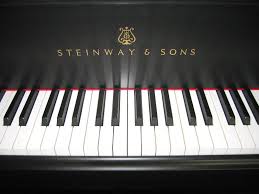
Eighty-eight keys, 88 hammers, more than 230 strings — all are carefully created, installed and tested in every piano.
All in all, it takes about 11 months to make a Steinway grand piano.
Steinway & Sons has been located in the same spot in the Astoria section of Queens since the early 1870s. Founded in 1853 in a loft on Varick Street in Manhattan, the company’s reputation grew quickly, and the company needed space to expand their operations.
Factory tours are offered from September through the end of June. (Factory tours are not available in July and August.) Tours are scheduled from 9:30 a.m. to noon on Tuesdays, for a maximum of 15 people.
Needless to say, tours fill up quickly and must be booked in advance. Steinway currently has no openings for the rest of 2017 and is not yet taking reservations for 2018. Plan way ahead, and check for updates by emailing tours@steinway.com or by calling 718-721-2600.
• 1841 ~ Antonin Dvorák, Czech composer
More information about Dvorák
• 1897 ~ Jimmie (James Charles) Rodgers,‘The Blue Yodeler’, Country Music Hall of Famer, First country singer to be in a film
• 1932 ~ Patsy Cline (Virginia Petterson Hensley), Country Music Hall of Famer, American country-music singer
• 1934 ~ Peter Maxwell Davies, British composer
• 1935 ~ The Hoboken Four, featuring Frank Sinatra as lead singer, appeared on Major Bowes Amateur Hour on WOR radio. The group won the competition held at the Capitol Theatre in New York City.
• 1941 ~ Dante Drowty, Singer with Dante and The Evergreens
• 1941 ~ Harry James and his orchestra recorded Misirlou for Columbia Records.
• 1942 ~ Brian Cole, Bass, singer with The Association
• 1947 ~ Valery Afanassiev, Russian pianist
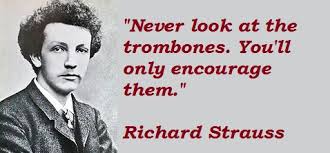
• 1949 ~ Richard Strauss, German composer and conductor, died at the age of 85. Strauss wrote in nearly every genre, but is best known for his tone poems and operas.
Richard Strauss was born June 11, 1864 in Munich, Germany. He died on September 8, 1949 in Garmisch-Partenkirchen, Germany. He was a German composer and conductor known for his intense emotionalism in his symphonic poems. He characterized himself as ‘composer of expression’ which is born out in his colorful orchestration. In his operas he employed Wagnerian principles of music drama, but in a more compact form.
Strauss was composing by the age of six, having received basic instruction from his father, a virtuoso horn player. This was, however, his only formal training. The elder Strauss instilled in his son a love of the classical composers, and his early works follow in their path. Strauss’ first symphony premiered when he was seventeen, his second (in New York) when he was twenty. By that time, Strauss had directed his energies toward conducting, and in 1885 he succeeded Hans von Bülow as conductor of the orchestra in Meiningen. For the next forty years, he conducted orchestras in Munich, Weimar, Berlin and Vienna.
As a conductor, Strauss had a unique vantage point from which to study the workings of the orchestra. From this vantage point he developed a sense for orchestration that was unrivaled. He immediately put this sense to use in a series of orchestral pieces that he called “tone poems”, including Macbeth, Don Juan, Tod und Verklärung, Till Eulenspeigels lustige Streiche and Don Quixote. These works are intensely programmatic, and in the last two, Strauss elevated descriptive music to a level not approached since the techniques of text painting during the Renaissance. He also used his knowledge of orchestral techniques to produce a revised version of Hector Berlioz’s important orchestration treatise; this edition remains a standard to this day.
After the turn of the century, Strauss began to shift his focus to opera. With his principal librettist Hugo von Hofmannsthal, he created two forward-looking and shocking works: Salome, based on Oscar Wilde’s controversial play, andElektra, Hoffmannsthal’s version of the classical Greek tragedy. In these works, the intense emotions and often lurid narrative elicited a more daring and demanding musical language full of extreme chromaticism and harsh timbres. But with his next opera, Der Rosenkavalier, Strauss seems to have left this aside, turning to a more focused, almost neoclassical approach in his later works. With this, Strauss settled into a comfortable place in German musical society, perhaps too comfortable, given his willingness to acquiesce to the artistic maneuverings of the rising Nazi regime. In the end, he broke with the Nazis on moral grounds, and died virtually penniless in the aftermath of the Second World War.
Musical Examples:
Don Quixote
Suite from Le Bourgoise gentilhomme, Op.60, Prelude
Also Sprach Zarathustrahttps://youtu.be/3rzDXNQxjHsOne of Richard Strauss’ most popular works is Also Sprach Zarathustra since it was made popular in the 1968 Stanley Kubrick science-fiction movie 2001: A Space Odyssey.Also sprach Zarathustra, Op. 30 (Thus Spoke Zarathustra or Thus Spake Zarathustra) is a tone poem by Richard Strauss, composed in 1896 and inspired by Friedrich Nietzsche’s philosophical treatise of the same name. The composer conducted its first performance on 27 November 1896 in Frankfurt. A typical performance lasts half an hour.The work has been part of the classical repertoire since its first performance in 1896. The initial fanfare — entitled “Sunrise” in the composer’s program notes — became particularly well known to the general public due to its use in Stanley Kubrick’s 1968 film 2001: A Space Odyssey, and as the theme music of the Apollo program. The fanfare has also been used in many other productions.
The piece starts with a sustained double low C on the double basses, contrabassoon and organ. This transforms into the brass fanfare of the Introduction and introduces the “dawn” motif (from “Zarathustra’s Prologue”, the text of which is included in the printed score) that is common throughout the work: the motif includes three notes, in intervals of a fifth and octave, as C–G–C (known also as the Nature-motif). On its first appearance, the motif is a part of the first five notes of the natural overtone series: octave, octave and fifth, two octaves, two octaves and major third (played as part of a C major chord with the third doubled). The major third is immediately changed to a minor third, which is the first note played in the work (E flat) that is not part of the overtone series.
“Of Those in Backwaters” (or “Of the Forest Dwellers”) begins with cellos, double-basses and organ pedal before changing into a lyrical passage for the entire section. The next two sections, “Of the Great Yearning” and “Of Joys and Passions”, both introduce motifs that are more chromatic in nature.
“Of Science” features an unusual fugue beginning in the double-basses and cellos, which consists of all twelve notes of the chromatic scale. It is one of the very few sections in the orchestral literature where the basses must play a contra-b (lowest b on a piano). “The Convalescent” acts as a reprise of the original motif, and ends with the entire orchestra climaxing on a massive chord. “The Dance Song” features a very prominent violin solo throughout the section. The end of the “Song of the Night Wanderer” leaves the piece half resolved, with high flutes, piccolos and violins playing a B major chord, while the lower strings pluck a C.
One of the major compositional themes of the piece is the contrast between the keys of B major, representing humanity, and C major, representing the universe. Because B and C are adjacent notes, these keys are tonally dissimilar: B major uses five sharps, while C major has none.
Works:
Orchestral music, including symphonic poems: Macbeth (1888), Don Juan (1888-1889), Tod und Verklärung (Death and Transfiguration, 1889), Till Eulenspiegels lustige Streiche (Till Eulenspiegel’s Merry Pranks, 1895), Also sprach Zarathustra (Thus Spake Zarathustra, 1896), Don Quixote (1897) and Ein Heldenleben (A Hero’s Life, 1898); 2 symphonies (Domestic, 1903 and Alpine, 1915); 3 concertos (2 for horn, 1 for oboe)
15 operas, including Salome (1905), Elektra (1909), Der Rosenkavalier (The Cavalier of the Rose, 1911), Ariadne auf Naxos (1912) and Die schweigsame Frau (The Silent Woman, 1935)
Choral works (with and without orchestra), chamber works
• 1921 ~ Arthur Ferrante, Pianist, duo: Ferrante and Teicher
• 1924 ~ Hugh Aitkin, American composer
• 1929 ~ “Sonny” (Theodore) Rollins, American jazz tenor saxophonist, composer, awarded Guggenheim Fellowship in 1972
• 1936 ~ Buddy Holly (Charles Hardin Holley), American rock-and-roll singer and guitarist with The Crickets
• 1940 ~ Artie Shaw and his orchestra recorded Temptation on the Victor label.
• 1951 ~ Chrissie Hynde, Guitarist, singer, songwriter with The Pretenders
• 1972 ~ Curtis Mayfield earned a gold record for his Superfly album, from the movie of the same name. The LP contained the hits, Freddie’s Dead and Superfly. Both songs were also million sellers.
• 1975 ~ Steve Anderson set a record for picking a guitar. Anderson, 22, picked for 114 hours, 7 minutes, breaking the old record by over four hours.
• 2001 ~ Igor Buketoff, an American conductor who specialized in Russian music and contemporary opera, died at the age of 87. Buketoff was best known for his orchestration of the first act of Rachmaninoff’s unfinished opera, Monna Vanna. Buketoff led the Philadelphia Orchestra in the world premiere in 1984. Buketoff also was recognized for restoring folk texts to Tchaikovsky’s1812 Overture. Buketoff earned bachelor’s and master’s degrees at the Juilliard School, and later directed the choral departments there and at Adelphi College and Columbia University. He won the first Alice Ditson Award for outstanding American conductors in 1941. He won it again in 1967. In 1959, Buketoff established the World Music Bank – now called the International Contemporary Music Exchange – to promote modern orchestral music.
• 2001 ~ Stelios Kazantzidis, a legendary Greek folk singer with a career spanning more than half a century, died at the age of 70. His popularity crossed generations and his music reflected the joys, sorrows and battles of Greece, according to MBI, his recording company. Kazantzidis’ popularity was carried beyond Greek borders by immigrants to such countries as the United States, Canada and Australia, which he often visited. He abandoned the night club scene in 1965 and would only have contact with the public through recordings after that. During his prolific career, he released more than 120 albums. In a letter to the singer shortly before his death, Culture Minister Evangelos Venizelos said Kazantzidis occupied an “unrivaled” chapter in the history of Greek music.
Redditor NeokratosRed had an idea: depict the hands of great composers and pianists, according to the characteristics of their music. He shared it on the social media site, and also punted for suggestions of more. It has since received over 300,000 images views, and lots of further suggestions from fellow Redditors and piano geeks.
Whisks for Chopin’s elegant pianistic souffles, feather dusters for the gentle impressionism of Debussy, instruments of trade for the composer of the thunderous Hammerklavier sonata.
Piano, and the internet – top marks to the both of you.
The O’Connor Music Studio features fully functional parent/student portals. These are a great way to share information with you, save time, and add value to your lessons.
The student portal provides you with:
Student’s calendar with upcoming lessons and events
Student’s repertoire
Student’s practice log
Family’s account and invoice information (only visible to parents/adult students)
Access to your download library and a list of borrowed items
View student’s attendance
Track student’s practice time and leave notes or questions from the practice session
Add and track their repertoires
View their email history
View Mrs. O’Connor’s contact information
Keep up-to-date with studio news
Students can also join and cancel lessons based on the OCMS studio cancellation policy.
Using the student portal is completely optional, but highly recommended.
How do I join the Student Portal? To join the student portal your teacher must send you your login information. Once received you will be able to access the student portal and all of its features.
How do I cancel a Lesson? To cancel a scheduled lesson simply click on the lesson or event in your calendar and click “Cancel Attendance”. You can optionally leave your teacher a note about why you are canceling in the provided “Note to Teacher” dialogue box.
How do I register for an Open Lesson Slot? To register for an Open Lesson Slot click on the event or lesson on the calendar as select “Register”. A dialogue box will appear asking you if you “are you sure you want to register for this Open Slot?” Click “Yes”. If the lesson or event you are trying to register for is a recurring event, choose the dates you would like to attend.
Check your email for information about logging in!
• 1781 ~ Vincent Novello, English music publisher, organist and composer
• 1882 ~ John Powell, American pianist and composer
• 1899 ~ Billy Rose (Rosenberg), producer, author, songwriter
• 1923 ~ William Kraft, American percussionist, composer and conductor
• 1928 ~ Evgeny Svetlanov, Russian conductor and composer
• 1937 ~ Benny Goodman and his orchestra recorded “Sugar Foot Stomp” on Victor Records. The tune was a Fletcher Henderson arrangement.
• 1944 ~ Roger Waters, Musician: bass, songwriter with Pink Floyd
• 1948 ~ Claydes (Charles) Smith, Guitarist with Kool & The Gang
• 1954 ~ Banner Thomas, Bass with Molly Hatchet
• 1958 ~ Georgia Gibbs sang “The Hula-Hoop Song” on “The Ed Sullivan Show”. It was the first national exposure for the Hula-Hoop craze. Many people recorded the song to capitalize on the fad, including Teresa Brewer and Betty Johnson. Like sometimes happens with fads, these songs didn’t become very popular. The Hula-Hoop craze lasted a bit longer…
• 1961 ~ Paul Waaktaar, Guitarist, singer with a-ha
• 1975 ~ Glen Campbell hit #1 on the “Billboard” pop music chart with “Rhinestone Cowboy”. It had reached the top position on the country chart on August 23rd.
• 1976 ~ Dean Martin and Jerry Lewis were reunited by Frank Sinatra – after 20 years of going their separate ways. The former comedy team warmly met each other again during a surprise visit by Martin to Lewis’s annual “Labor Day Telethon” for Muscular Dystrophy.
• 1984 ~ Country-music star Ernest Tubb died this day, at the age of 70. Tubb was from Crisp, Texas and was known as the ‘Texas Troubadour’. He patterned his unique style after Jimmie Rodgers. Tubb recorded “I’m Walking the Floor Over You” and sold more than three million copies of the tune. “Blue Christmas”, “I Love You Because”, “Missing In Action” and “Thanks a Lot” were also classics made famous by Tubb. Other recording artists as diverse as The Andrews Sisters, Loretta Lynn and Red Foley recorded with Tubb. His 1979 album, “The Legend and the Legacy”, was a top-ten hit. Tubb was a member of the Grand Ole Opry since 1943 and was elected to the Country Music Hall of Fame in 1965.
• 1984 ~ Ginger Rogers was in Buffalo, NY for a homecoming at Shea’s Theatre. The star of so many great motion pictures, Rogers had played the Shea 55 years earlier.
• 1986 ~ Bananarama hit the top spot on the pop music charts with “Venus”. The tune had also been a number one hit for the Dutch group, The Shocking Blue (2/07/70).
• 1997 ~ The Westminster Abbey funeral for Diana, Princess of Wales, was an extraordinary event, marked by numerous poignant moments: The people sobbing and throwing flowers at the funeral cortege winding through the streets of London. Her sons, walking behind her casket with their heads bowed. And Diana’s brother, who during his funeral oration took aim at the media, who he said made the princess “the most hunted person of the modern age.” Elton John sang a rewritten version of “Candle in the Wind” to “England’s rose”. The song was originally a tribute to film legend Marilyn Monroe, whose own tragic life, like Diana’s, ended at the age of just 36.
• 2002 ~ Rafael Druian, a violinist and conductor who served as concertmaster of four American orchestras, died at the age of 80. Druian’s lengthy career spanned many roles – performer, conductor and teacher. He was the concertmaster of the Dallas Symphony, the Minnesota Orchestra, the Cleveland Orchestra and the New York Philharmonic. Born in Vologda, Russia, Druian grew up in Havana, Cuba and began his musical training at an early age. He came to Philadelphia when he was 10 to audition for Leopold Stokowski, who recommended him for a scholarship at the Curtis School of Music. He graduated from Curtis in 1942 and served in the United States Army for four years and played in the army band. During his career, Druian appeared on some groundbreaking recordings of lesser-known violin works. In the 1950s he made recordings of Block, Janácek and Enesco. After working with orchestras around the country, his final concertmaster position was at the Philharmonic from 1971 to 1974. When he finished there he taught at Boston University and the Curtis Institute of Music.
• 2007 ~ Luciano Pavarotti, Italian tenor, died at the age of 71
We have established that regular practice routines will not happen without proactive piano parents. So, how can parents be proactive practice assistants even if they have never touched a piano?
Day 2. The Practice Videographer: Piano teachers love to know what’s happening at home. By being a videographer, proactive piano parents can provide teachers with valuable home practice recordings that can be used to improve technique, posture, rhythm, and more.
• 1735 ~ Johann Christian Bach, German composer
J.C. Bach was one of Johann Sebastian Bach’s sons. After he moved to London, he became known as the London Bach.
• 1791 ~ Giacomo Meyerbeer, German Composer
More information about Meyerbeer
• 1912 ~ John Cage, American avant-guarde composer, pianist and writer
Read quotes by and about Cage
More information about Cage
• 1934 ~ Carol Lawrence (Laraia), Singer, actress
• 1939 ~ John Stewart, Singer with The Kingston Trio; songwriter
• 1945 ~ Al Stewart, Singer, guitarist with Time Passages
• 1946 ~ Freddie Mercury (Bulsara), singer, Queen, (1975 UK No.1 single ‘Bohemian Rhapsody’ also UK No.1 in 1991, plus over 40 other UK Top 40 singles. 1980 US No.1 single ‘Crazy Little Thing Called Love’). Solo, (1987 UK No. 4 single ‘The Great Pretender’). Mercury died of bronchio-pneumonia on November 24th 1991 aged 45, just one day after he publicly announced he was HIV positive.
• 1946 ~ Loudon Wainwright III, Songwriter, singer
• 1956 ~ Johnny Cash hit the record running with I Walk the Line. Cash’s debut hit song climbed to #17 on the pop music charts.
• 1969 ~ Dweezil Zappa, Musician: guitar: MTV; son of musician Frank Zappa, brother of singer Moon Unit Zappa
• 1972 ~ Roberta Flack and Donny Hathaway won a gold record for their duet, Where is the Love. The song got to number five on the pop music charts and was one of two songs that earned gold for the duo. The other was The Closer I Get To You in 1978.
• 2002 ~ Florence Lessing, a dancer who performed in films, nightclubs and Broadway musicals died. She was 86. Lessing worked with the famous jazz-dance choreographer Jack Cole, who spotted her as a teenager in an East Indian dance class. Lessing, Cole, and the teacher of the class, Anna Austin, formed a trio that performed at the Rainbow Room in 1938 and in the musical “Moon Over Miami” in 1939. Lessing went on to perform in many Broadway shows, including “Windy City,” choreographed by Katherine Dunham, and “Sailor Beware” and “Kismet,” both choreographed by Cole. She appeared in the 1952 film musical “Just for You,” which was choreographed by Helen Tamiris and starred Bing Crosby and Jane Wyman. Lessing, who studied a wide variety of dance forms, choreographed two of her own nightclub acts in the mid-1940s and taught dance at several schools.
• 2003 ~ Gisele MacKenzie, a singer-actress who became one of early television’s biggest stars through her appearances on “Your Hit Parade,” died. She was 76. Once known as Canada’s first lady of song, MacKenzie moved to Los Angeles with her family in 1951. In 1952 and 1953 she toured with Jack Benny, who recommended her for a spot on “Your Hit Parade.” In 1957, she left the show to headline her own musical variety program, “The Gisele MacKenzie Show.” It lasted half a year. She returned to weekly television in 1963 as a regular on “The Sid Caesar Show.” She also appeared on radio in Los Angeles with Edgar Bergen and Morton Downey. She was a regular on Bob Crosby’s Club 15 show and a featured performer on radio’s “The Mario Lanza Show.” She continued to appear regularly on television into the 1990s, on such shows as “Studio One,” “The Hollywood Squares,” “Murder, She Wrote,” “MacGyver” and “Boy Meets World.”
Handbells are not just for children and teens! We have adult handbell groups for beginner to advanced ringers. The difficulty level of handbell music is rated from Level 1 (easy) to Level 6 (most difficult). Each of the groups rings monthly in worship between September and June and participates in the annual Christmas handbell concert.
The groups also like to participate in the various festivals that are held by the regional handbell guild (Handbell Musicians of America – Area 3). Our rehearsals are full of laughing and ringing (sometimes more laughing than ringing!) You do not have to know how to read music to learn how to ring handbells!
Carillon Ringers group is for ringers who ring Level 2 and Level 3 music.
Carillon Ringers rehearse at 6:45 Tuesday. The handbells will play during worship about once every month. Brian will make out the usual schedule at the beginning of rehearsals starting on September 9th.
Joy Ringers group is for advanced ringers who ring Level 4 and Level 5 music
Joy Ringers rehearse at 7:30 Tuesday. The handbells will play during worship about once every month. Brian will make out the usual schedule at the beginning of rehearsals starting on September 9th.
On Pentecost Sunday, June 8, 2025, Pender’s combined handbell groups rang out a joyful and unforgettable rendition of “Hail, Holy Queen”, arranged by Marc Shaiman and adapted for handbells by Kevin McChesney—all under the spirited direction of Brian Stevenson.
🎶 Remember the movie Sister Act with Whoopi Goldberg? Well, hold onto your wimple—this rollicking handbell version of the classic SALVE REGINA hymn is sure to lift your spirits and put a smile on your face! 🔥 Joyful 🔥 Energetic 🔥 Pure Pentecost fun!
Let this electrifying performance fill your heart with the Spirit’s joy!







 MaryO'Studio