Gesù Bambino by Pietro Yon has always had a place in my childhood memories since my church choir sang it every Christmas. Other than that, it didn’t seem to be too well known but this song has been turning up in piano books lately. There are now several versions in the O’Connor Music Studio if you are interested in learning this beautiful older Christmas carol.
Gesù bambino was written in 1917. The melody was used by Frederick H. Martens in his English language carol “When Blossoms Flowered ‘mid the Snows”. The melody and lyrics of the chorus are derived from “Adeste Fideles” (O Come All Ye Faithful).
A piano version
Piano and Organ
Sung by David Archuleta and the Mormon Tabernacle Choir
• 1728 ~ Franz Xaver Pokorny, Czech Classical era composer and violinist.
• 1783 ~ Padre Antonio Francisco Javier Jose Soler
• 1871 ~ Henry Kimball Hadley, American composer and conductor
• 1890 ~ Yvonne Arnaud, French-born pianist, singer and actress
• 1898 ~ Irene (Marie) Dunne, Actress in Show Boat, Anna and the King of Siam, Alternate Delegate to the United Nations, Kennedy Center Honors Lifetime Achievement Award in 1985.
• 1909 ~ Vagn Holmboe, Danish composer and music critic
• 1920 ~ An English-born comedian named Leslie Downes became an American citizen. He had lived in the United States since 1908 and became one of the nation’s true ambassadors for show business and charity. We say, “Thanks for the memories,” to Bob Hope.
• 1928 ~ For the first time, a living actress in the United States had a theater named after her. The Ethel Barrymore Theatre opened in New York City.
• 1932 ~ Al Jolson recorded April Showers on Brunswick Records.
• 1938 ~ John Harbison, American composer and conductor
• 1944 ~ Bobby Colomby, Drummer, singer with Blood, Sweat & Tears
• 1948 ~ Little Stevie Wright, Singer with The Easybeats
• 1949 ~ Harry Belafonte had his second session with Capitol Records. Included in the session were Whispering and Farewell to Arms. With eight tunes then recorded and little enthusiasm from record buyers, Capitol decided to part company with Belafonte by not renewing the singer’s contract. He went to RCA Victor in April 1952.
• 1952 ~ Jimmy Boyd reached the #1 spot on the record charts with the Christmas song of the year, I Saw Mommy Kissing Santa Claus.
• 1957 ~ Billy (Steven) Bragg, Songwriter, guitarist, singer
• 1966 ~ Chris Robinson, Singer with The Black Crowes
• 1972 ~ Jack Albertson and Sam Levine starred as two retired vaudevillians in Neil Simon’s classic comedy, The Sunshine Boys, which opened at the Broadhurst Theatre in NYC. The play had a run of 538 performances. The movie version later became a box office smash, as well.
• 1973 ~ Singer Bobby Darin passed away following open-heart surgery at the age of 37. He left a legacy of memories in rock ’n’ roll and pop tunes, as well as on television and in movies (even an Oscar nomination for his role in Captain Newman, M.D.). The story of Darin being groomed to replace Frank Sinatra at Capitol Records is absolutely true. Unfortunately, Capitol didn’t think the grooming was going so well and withheld many of Darin’s songs for many years; releasing them in a compilation CD in 1995. Good stuff to listen to: Splish Splash, Queen of the Hop, Dream Lover, Mack the Knife, Beyond the Sea, If I Werea Carpenter, etc. At the end, Darin, who had recorded for Atco, Capitol and Atlantic Records had just begun recording for Motown.
• 1980 ~ Shirley Temple Black became a grandmother. Her oldest daughter gave birth to a baby girl.
• 1982 ~ Artur Rubinstein, pianist (My Young Years), died at the age of 95
• 1999 ~ Hank Snow passed away
• 2000 ~ Roebuck “Pops” Staples, patriarch of the Staple Singers whose lyrics on “Respect Yourself” and other hits delivered a civil rights message with a danceable soul beat, passed away. “They took this really positive message music and made it contemporary and popular by putting it with electric guitars and inserting a groove,” said Sherman Wilmott, who is helping create a museum in Memphis, Tennessee, honoring the musical stars at Stax Records, the Staple Singers’ principal label. Born in Winona, Mississippi, Staples learned to sing acapella and developed his Delta blues electric guitar style. Starting out as a gospel group in 1948, the Staple Singers with son Pervis and daughters Mavis and Cleotha as singers reached an even wider audience with 1970s soul hits such as Respect Yourself,I’ll Take You There and If You’re Ready (Come Go With Me). Before achieving stardom, Staples resisted taking his family on tour and held jobs in Chicago’s stockyards and steel mills. Staples came to believe he could contribute in song to the battle for blacks’ civil rights being waged by the Rev. Martin Luther King and others, Wilmott said. “He sang and played guitar. He was extremely well- spoken and calm and intelligent,” he said. Another daughter, Yvonne, told the Tribune: “When Dr. King started preaching, Pops said ‘I think we can sing it.’ That’s what he felt,” she said. “He believed that the world could be made a better place for all of us.” At age 80, Staples won a Grammy Award as a solo artist in 1994 for his album “Father Father.” He also received a National Heritage Fellowship Award at the White House from first lady Hillary Rodham Clinton. The group entered the Rock and Roll Hall of Fame last year. In a 1998 interview with the Tribune, Staples said his musical education began early. “We’d come home and didn’t have anything to do after we eat but go to bed. So we’d go out in the yard and sing.”
• 2000 ~ Rob Buck, lead guitarist for the rock band 10,000 Maniacs, died of liver failure at the age of 42, three weeks after he collapsed at his home in western New York.
2004 ~ Blues singer-guitarist Son Seals, one of the most distinctive voices to emerge in the genre during the 1970s, died at the age of 62.
More information about Son Seals
2004 ~ Italian soprano Renata Tebaldi, one of the great post-World War II opera divas who Arturo Toscanini said had the “voice of an angel,” died at the age of 82.
More information about Renata Tebaldi
During the holiday period, the entire Company is immersed in activities surrounding George Balanchine’s The Nutcracker™. All 90 dancers, 62 musicians, 32 stagehands and two casts of 50 young students each from the School of American Ballet join forces to make each performance as magical as possible. Children of all ages from New York City and the nation fill the David H. Koch Theater to be captivated by the lure of Tschaikovsky’s music, Balanchine’s choreography, Karinska’s sumptuous costumes, and Rouben Ter-Arutunian’s magical sets. George Balanchine’s The Nutcracker™, based on the Alexandre Dumas pere version of E.T.A. Hoffmann’s tale, The Nutcracker and the Mouse King (1816), demands a full-scale production.
The elaborate stage elements and intricate lighting unleash the viewers’ imagination by providing visual effects that are extraordinarily grand. The most famous example is the one-ton Christmas tree that grows from a height of 12 feet to 40 feet, evoking audible gasps of disbelief from the audience at each performance. Other notable feats include the comic figure of Mother Ginger — 85 pounds and nine feet wide, the costume requires handling by three people once it is lowered by pulley over the dancer’s head — as well as the continuous flutter of the purest, crystal-shaped snowflakes (which are swept up and conserved after each performance for reuse).
While these technical achievements are wonderful fun, it is Balanchine’s choreography that sustains the ballet through two acts. Act I introduces the characters — the Stahlbaum children, Marie and Fritz, Herr Drosselmeier and his Nephew — and also begins the transition from reality into fantasy with the concluding Snowflake Waltz. Act II offers the complete transformation. We have entered the “Kingdom of the Sugarplum Fairy” and there is no turning back.
George Balanchine’s The Nutcracker™ is one of the most complex theatrical, staged ballets in the Company’s active repertory. The popularity of the ballet is immense and it provides an unforgettable spark to everyone’s holiday season.
Although the original production was not a success, the 20-minute suite that Tchaikovsky extracted from the ballet was. However, the complete Nutcracker has enjoyed enormous popularity since the late 1960s and is now performed by countless ballet companies, primarily during the Christmas season, especially in North America. Major American ballet companies generate around 40 percent of their annual ticket revenues from performances of The Nutcracker.
Tchaikovsky’s score has become one of his most famous compositions, in particular, the pieces featured in the suite.
• 1888 ~ Fritz Reiner, Hungarian-born American conductor who was the musical director of the Pittsburgh Symphony, New York Metropolitan Opera and Chicago Symphony. He died in 1963
• 1915 ~ Edith Piaf (Edith Giovanna Gassion), French chanteuse and songwriter
• 1925 ~ ‘Little’ Jimmy Dickens, Country Music Hall of Famer
• 1928 ~ Galt MacDermot, Composer
• 1935 ~ Bobby Timmons, American jazz pianist
• 1940 ~ Phil Ochs, American folk singer, songwriter and guitarist
• 1941 ~ Maurice White, Singer, drummer, founder of the group Earth, Wind & Fire
• 1944 ~ Alvin Lee, Musician with Ten Years After
• 1944 ~ Zal Yanovsky, Guitarist, singer with The Lovin’ Spoonful
• 1952 ~ Jeff Davis, Bass with Amazing Rhythm Aces
• 1952 ~ Janie Fricke, Singer, Country Music Association Female Vocalist of the Year in 1982 and 1983
• 1957 ~ Meredith Willson’sThe Music Man opened at the Majestic Theatre in New York City. The Broadway show starred Robert Preston and had a run of 1,375 shows. It also had 76 trombones and 101 cornets in the band…
• 1960 ~ Neil Sedaka’s Calendar Girl was released on RCA Victor Records. The song became Sedaka’s fourth record to make the charts. Other hits from the guy who made money off of a love song for Carole King (Oh, Carol) include The Diary, Stairway to Heaven, Bad Girl, Next Door to an Angel, Happy Birthday Sweet Sixteen, Laughter in the Rain and Breaking Up is Hard to Do.
• 1960 ~ Frank Sinatra recorded his first session with his very own record company. Frank did Ring-A-Ding-Ding and Let’s Fall in Love for Reprise Records.
• 2000 ~ Milt Hinton, a jazz bassist and photographer called “The Judge” by the jazz greats he worked with and photographed during a 70-year career, died at the age of 90. During his career, Hinton performed with almost every luminary of jazz and popular music, from Louis Armstrong, Cab Calloway, Dizzy Gillespie and John Coltrane to Bing Crosby, Frank Sinatra, Barbra Streisand and Paul McCartney. Hinton also documented his world with a camera, compiling close to 60,000 negatives depicting hundreds of jazz artists and popular musicians on the road, in the studio, backstage and at parties.
• 2001 ~ Bill Bissell, a former University of Washington marching band director who helped create “The Wave”, died in his sleep. He was 70. Bissell directed the Huskies’ band with flair, innovation and humor from 1970 until he retired in 1994. He and former Washington yell leader Robb Weller introduced “The Wave,” in which fans stand with arms raised and cheer section by section, to college football 20 years ago. Bissell directed halftime shows at 14 bowl games, including six Rose Bowls and an Orange Bowl, and was awarded a Citation of Excellence from the National Band Association in 1981.
• 2004 ~ Renata Tebaldi, Italian soprano, died at the age of 82
• 2015 ~ Kurt Masur, German conductor (New York Philharmonic), died at the age of 88
Johnny Marks (November 10, 1909 – September 3, 1985) was an American songwriter. Although he was Jewish, he specialized in Christmas songs and wrote many holiday standards, including
“Rudolph, the Red-Nosed Reindeer” (a hit for Gene Autry and others)
“Rockin’ Around the Christmas Tree” (a hit for Brenda Lee)
“A Holly Jolly Christmas” (recorded by the Quinto Sisters and later by Burl Ives)
1644 ~ Antonio Stradivari, Italian, most celebrated of all violin makers, died on this date.
Read more information about Stradivari
• 1778 ~ Joseph Grimaldi, Clown: ‘greatest clown in history’, ‘king of pantomime’, Joey the Clown; singer, dancer, acrobat, his character was part of the plot for the movie “Her Alibi”. He died in 1837.
• 1786 ~ Baron Karl von Weber, Opera composer
• 1788 ~ Camille Pleyel, Austrian piano builder/composer
1869 ~ Edward Alexander MacDowell, American composer and pianist
More information about MacDowell
• 1892 ~ Premiere of The Nutcracker ballet by Tchaikovsky. This traditional Christmas ballet is so popular that its annual performances keeps many opera companies afloat. Act 1 tells a story of how little Clara aids her magical Christmas gift (a Nutcracker in the form of a soldier) defeat an army of mice. As a reward, he takes her to his magic kingdom and introduces her to a variety of subjects in a colorful stream of character dances. Tchaikovsky’s supply of themes is endless and he constantly provides brilliant orchestration.
• 1919 ~ Anita O’Day (Colton), American jazz singer
• 1920 ~ Conductor Arturo Toscanini made his first recording for Victor Records in Camden, New Jersey.
• 1934 ~ Willie Smith sang with Jimmy Lunceford and his orchestra on Rhythm is Our Business on Decca Records
• 1941 ~ Sam Andrew, Guitarist with Big Brother and the Holding Company
• 1943 ~ Keith Richards, British rock guitarist and singer with The Rolling Stones
• 1948 ~ Bryan ‘Chas’ Chandler, Bass with the Animals
• 1961 ~ The Tokens celebrated their first #1 hit single. The Lion Sleeps Tonight(Wimoweh) was a chart-topper for four weeks in a row.
• 1972 ~ Helen Reddy received a gold record for the song that became an anthem for women’s liberation, I Am Woman. The song had reached number one on December 9, 1972.
• 1975 ~ Rod Stewart announced that he was leaving the group, Faces, and was going solo in a deal with Warner Brothers.
• 1981 ~ Rod Stewart gave a concert at the Los Angeles Forum, which was televised to 23 countries and carried by FM radio stations in the US to an audience of about 35 million.
• 1982 ~ Daryl Hall and John Oates reached the #1 spot on the music charts for the fifth time with Maneater. The song stayed in the top spot for four weeks, making it Hall and Oates’ most popular hit.
• 2001 ~ Eddie Baker, whose efforts to create a jazz hall of fame planted the seeds for the American Jazz Museum in Kansas City, died after complications from heart surgery. He was 71. Baker, a trumpeter and pianist, had led the New Breed Jazz Orchestra since the 1960s, forming close relationships with many top jazz artists. He began calling for a jazz hall of fame as early as the 1970s. He held what he hoped would be the first annual induction to the International Jazz Hall of Fame in 1985 at the Music Hall. But attendance was low, despite a star-studded roster of talent that included the Count Basie Orchestra, George Benson and Woody Herman. He maintained the hall of fame on paper, even though it never had a physical home. Through the years, Baker suggested building a jazz hall in several spots in Kansas City, including the 18th and Vine district and Union Station. His push generated interest in the project, but the American Jazz Museum opened under a different name in 1997 without his involvement. He also was an original member of the Kansas City Jazz Commission, which organized pub crawls and promoted jazz in the 1980s, and he helped organize the Elder Statesmen of Jazz, a service organization of older musicians.
• 2004 ~ Legendary British saxophonist Dick Heckstall-Smith, who played with a list of musicians that reads like a who’s who of the international jazz and rock music scene, has died.
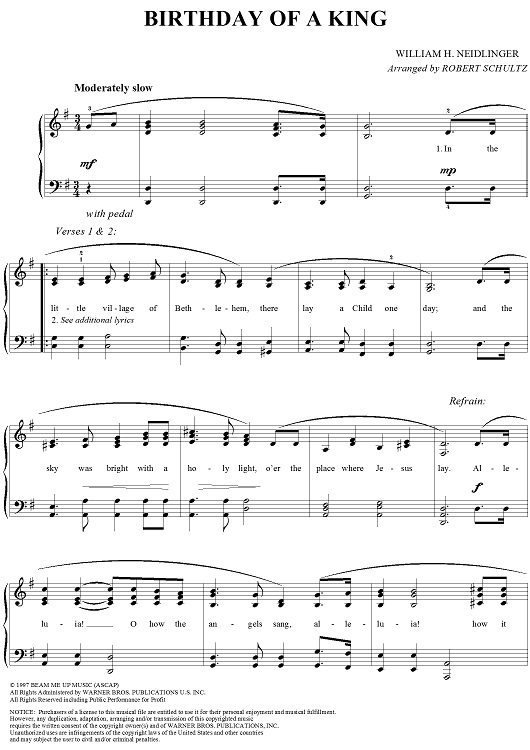
Words and music by William Harold Neidlinger (1863-1924), circa 1890. Neidlinger was a composer, conductor, organist at St. Michael’s Church, New York City, and voice teacher, but his main interest was working with retarded children, and he founded a school for this purpose in East Orange, N.J. Originally published in 1912 in Neidlinger’s native Brooklyn, the song has been popular ever since, particularly as a baritone solo, since it shows off the voice quite well and is not difficult to sing.
1. In the little village of Bethlehem,
There lay a Child one day;
And the sky was bright with a holy light
Over the place where Jesus lay.
Refrain Alleluia! O how the angels sang. Alleluia! How it rang! And the sky was bright with a holy light ‘Twas the birthday of a King.
2. ‘Twas a humble birthplace,
But O how much God gave to us that day,
From the manger bed what a path has led,
What a perfect, holy way. Refrain
Beautiful song of God’s love for His creation.
Done beautifully by The Brooklyn Tabernacle Choir.
• 1926 ~ Benny Goodman played a clarinet solo. This was not unusual for Benny except that it was his first time playing solo within a group recording session. Goodman was featured with Ben Pollack and His Californians on He’s the Last Word.
• 1930 ~ Peter Warlock [Philip Heseltine], British composer and music critic, died of a probable suicide at the age of 36
• 1936 ~ Tommy Steele (Hicks), Singer, actor
• 1937 ~ Art Neville, Keyboards, percussion, singer with The Neville Brothers
• 1937 ~ Nat Stuckey, Country singer, songwriter
• 1939 ~ Eddie Kendricks, Singer with The Temptations
• 1942 ~ Paul Butterfield, American blues singer and harmonica player with Paul Butterfield Blues Band
• 1943 ~ Dave Dee (Harmon), Tambourine, singer, record promoter
• 1955 ~ Carl Perkins wrote Blue Suede Shoes. Less than 48 hours later, he recorded it at the Sun Studios in Memphis. The tune became one of the first records to be popular simultaneously on rock, country and rhythm & blues charts.
• 1958 ~ Mike Mills, Bass with R.E.M
• 1961 ~ Sarah Dallin, Singer with Bananarama
• 1969 ~ Tiny Tim (Herbert Buchingham Khaury) married Miss Vickie (Victoria Budinger) on The Tonight Show starring Johnny Carson. This is the Tiny Tim of the falsetto version of Tiptoe Through the Tulips fame. The NBC-TV program earned the second-highest, all-time audience rating; second only to Neil Armstrong’s walking on the moon. Mr. Tiny Tim and Miss Vickie had a daughter, Tulip. Then in 1977 they stopped tiptoeing together.
• 1969 ~ Chicago Transit Authority became a gold record for the group of the same name (they later changed their name to Chicago). When the album was released by Columbia Records, it marked the first time an artist’s debut LP was a double record.
• 1970 ~ The Beach Boys played to royalty at Royal Albert Hall in London. Princess Margaret was in attendance and shook the royal jewelry to such classics as Good Vibrations, I Get Around and Help Me, Rhonda.
• 1977 ~ Elvis Costello, making a rare TV appearance, agreed to perform on NBC’s Saturday Night Live.
• 1978 ~ Don Ellis passed away
• 1999 ~ Rex Allen passed away
• 2004 ~ Johnnie Carl, Crystal Cathedral Orchestra conductor, took his life. Mr. Carl has been in the employment of the Crystal Cathedral for nearly 30 years and was internationally renowned as a conductor and as a composer and arranger of over 3,500 musical pieces. He was 57 years old.
• 2018 ~ Galt MacDermot, Canadian musician and composer (Hair), died at the age of 89
• 2018 ~ Raven Wilkinson, American ballerina, first African American woman to dance with a major ballet company, died at the age of 83
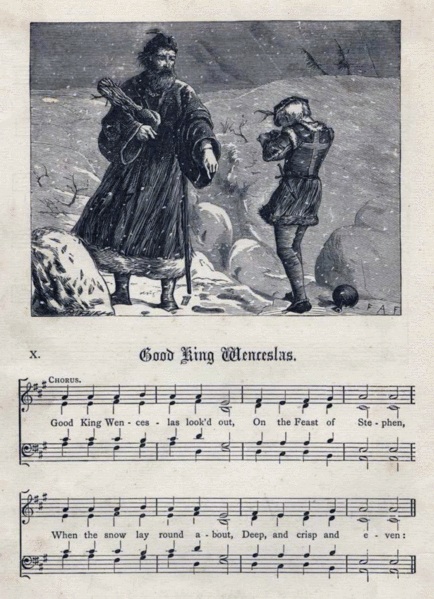
“Good King Wenceslas” is a popular Christmas carol that tells a story of Good King Wenceslas braving harsh winter weather to give alms to a poor peasant on the Feast of Stephen (the second day of Christmas, December 26). During the journey, his page is about to give up the struggle against the cold weather, but is enabled to continue by following the king’s footprints, step for step, through the deep snow. The legend is based on the life of the historical Saint Wenceslaus I, Duke of Bohemia or Svatý Václav in Czech (907–935).
In 1853, English hymn writer John Mason Neale wrote the “Wenceslas” lyrics, in collaboration with his music editor Thomas Helmore, and the carol first appeared in Carols for Christmas-Tide, 1853. Neales’ lyrics were set to a tune based on a 13th century spring carol “Tempus adest floridum” (“The time is near for flowering”) first published in the 1582 Finnish song collection Piae Cantiones.
Good King Wenceslas looked out
On the feast of Stephen
When the snow lay round about
Deep and crisp and even
Brightly shone the moon that night
Though the frost was cruel
When a poor man came in sight
Gath’ring winter fuel
“Hither, page, and stand by me
If thou know’st it, telling
Yonder peasant, who is he?
Where and what his dwelling?”
“Sire, he lives a good league hence
Underneath the mountain
Right against the forest fence
By Saint Agnes’ fountain.”
“Bring me flesh and bring me wine
Bring me pine logs hither
Thou and I will see him dine
When we bear him thither.”
Page and monarch forth they went
Forth they went together
Through the rude wind’s wild lament
And the bitter weather
“Sire, the night is darker now
And the wind blows stronger
Fails my heart, I know not how,
I can go no longer.”
“Mark my foteps, my good page
Tread thou in them boldly
Thou shalt find the winter’s rage
Freeze thy blood less coldly.”
In his master’s steps he trod
Where the snow lay dinted
Heat was in the very sod
Which the Saint had printed
Therefore, Christian men, be sure
Wealth or rank possessing
Ye who now will bless the poor
Shall yourselves find blessing
1882 ~ Zoltán Kodály, Hungarian composer and collector of folk songs
More information on Kodály
• 1893 ~ Antonin Dvorák attended the first performance of his New World Symphony at Carnegie Hall in New York City.
• 1899 ~ Sir Noel Coward, British composer of musical comedies, actor and producer
• 1905 ~ Sime Silverman published the first issue of Variety, the weekly showbiz magazine. The first issue was 16 pages in length and sold for a nickel. Variety and Daily Variety are still going strong.
• 1907 ~ Eugene H. Farrar became the first singer to broadcast on radio. He sang from the Brooklyn Navy Yard in New York. The song was Do You Really Want to Hurt Me?
• 1940 ~ Bob Crosby and his Bobcats backed up brother Bing as San Antonio Rose was recorded on Decca Records.
• 1960 ~ Lucille Ball took a respite from her weekly TV series to star in the Broadway production of Wildcat, which opened at the Alvin Theatre in New York City. The show ran for 171 performances.
• 1967 ~ The Lemon Pipers released Green Tambourine on an unsuspecting psychedelic world this day. The tune made #1 on February 3, 1968.
• 1971 ~ Melanie (Safka) received a gold record for the single, Brand New Key, about roller skates and love and stuff like that. This one made it to #1 on Christmas Day, 1971.
• 1971 ~ Don McLean’s eight-minute-plus (8:32) version of American Pie was released. It became one of the longest songs with some of the most confusing (pick your favorite interpretation) lyrics to ever hit the pop charts. American Pie hit #1 on January 15, 1972.
• 1972 ~ Paul McCartney’s single, Hi, Hi, Hi, was released. It peaked at #10 on the top tune tabulation (February 3, 1973).
• 2003 ~ Singer and guitarist Gary Stewart, who had a No. 1 country hit in 1975 with She’s Actin’ Single (I’m Drinkin’ Doubles), died of an apparently self-inflicted gunshot wound. He was 58. A native of Letcher County, Ky., Stewart was a compelling songwriter and performer of guitar-driven, honky-tonk country. His last album, Live at Billy Bob’s Texas, was released in 2003. Besides the 1975 chart-topper, his hits included Drinkin’ Thing and Out of Hand. He worked with Southern rock greats Dickie Betts and Gregg Allman of The Allman Brothers Band on the 1980 album Cactus and a Rose.
• 2017 ~ Z’ev, a percussionist, performer, composer, instrument builder, visual artist, poet and theorist who explored visceral and mystical dimensions of sound — becoming a pioneer of industrial music along the way — died in Chicago, where he lived. He was 66.
• 2017 ~ Keely Smith, American jazz and popular music singer (Mrs. Louis Prima), died from heart failure at the age of 89


 2004 ~ Blues singer-guitarist Son Seals, one of the most distinctive voices to emerge in the genre during the 1970s, died at the age of 62.
 Grammy winner
 MaryO'Studio