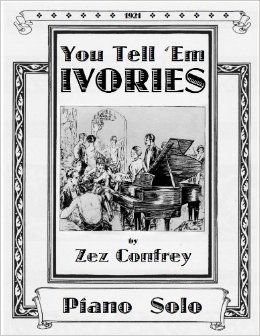
This is a more advanced piece but I really like it. Some students may have heard this since it’s an alarm tone on my phone. My dog, Mimi, recognizes this music as her signal to go out for a walk!
I just love Zez Confrey’s music. It’s not overplayed like some of Scott Joplin’s works but it’s just as much fun.
This is a piece I have often played in recitals and just for fun.
If any of my students are interested in tackling this piece, just let me know and we’ll start learning!
In 1921 Confrey wrote his novelty piano solo “Kitten on the Keys”, inspired by hearing his grandmother’s cat walk on the keyboard of her piano. It became a hit, and he went on to compose many other pieces in the genre.
Considered to be one of the fastest and most challenging of all “novelty” piano solos, “Dizzy Fingers” was composed in 1923. and was Confrey’s other biggest seller.
He left behind more than a hundred piano works, songs and miniature operas, and numerous piano rolls, music publications and sound recordings.
Not surprisingly, this piece is not available on Piano Maestro!
“This collection represents a cross-section of Confrey’s works and encompasses the broad range of his styles. Besides his famous 1920s novelty works (including Kitten on the Keys), there are many wonderful, lesser-known gems of remarkable quality included here from later in his career. Appearing for the first time in print are transcriptions of one of his disc recordings (Poor Buttermilk) and two of his player piano roll arrangements (My Pet and Humorestless). Many of Confrey’s later works have long been out of print and are included here for the first time in decades.”
• 1612 ~ Hans Leo Hassler, Composer, died at the age of 49
• 1722 ~ Jakob Friedrich Kleinknecht, Composer
• 1740 ~ Gabriele Mario Piozzi, Composer
• 1742 ~ Omobono Stradivari, Italian viol maker, son of Antonio, died at the age of 62
• 1753 ~ Nicolas-Marie Dalayrac, Composer
• 1783 ~ Joseph Lincke, Composer
• 1796 ~ Felice de Giardini, Composer, died at the age of 80
• 1805 ~ Luigi Ricci, Composer
• 1810 ~ Robert Schumann, German composer best known for his song cycles and piano music.
Read quotes by and about Schumann
More information about Schumann
• 1812 ~ Spyridon Xyndas, Composer
• 1814 ~ Friedrich Heinrich Himmel, Composer, died at the age of 48
• 1834 ~ George Garrett, Composer
• 1837 ~ Jan Kleczynski, Composer
• 1856 ~ Natalia Janotha, Composer
• 1858 ~ Antonio Nicolau, Spanish Composer and conductor
• 1876 ~ George Sand (Armandine-Aurore-Lucile Dupin), French author and romantic companion of the composer of Chopin, died at the age of 71
• 1881 ~ Prospero Bisquertt, Composer
• 1884 ~ Henry Clay Work, Composer, died at the age of 51
• 1888 ~ Poul Julius Ouscher Schierbeck, Composer
• 1906 ~ Christian Frederik Emil Horneman, Composer, died at the age of 65
• 1908 ~ Johan Lindegren, Composer, died at the age of 66
• 1913 ~ Janos Jagamas, Composer
• 1919 ~ Jacob Fabricius, Composer, died at the age of 78
• 1923 ~ Karel Goeyvaerts, Flemish Composer of Summer Games
• 1926 ~ Anatol Vieru, Composer
• 1927 ~ Paul Whiteman and his orchestra recorded When Day is Done on Victor Records.
• 1928 ~ Jiri Dvoracek, Composer
• 1930 ~ Yannis Ioannidis, Composer
• 1932 ~ Hans Gunter Helms, Composer
• 1936 ~ James Darren (Ercolani), Singer
• 1940 ~ Frederick Shepherd Converse, American Composer, died at the age of 69
• 1940 ~ Sherman Garnes, Rock vocalist with Frankie Lymon and The Teenagers
Joseph Haydn’s music contains many jokes, and the Surprise Symphony includes probably the most famous of all: a sudden very loud (fortissimo chord) at the end of the otherwise soft (piano) opening theme in the variation-form second movement. The music then returns to its original quiet dynamic, as if nothing had happened, and the ensuing variations do not repeat the joke. (In German it is commonly referred to as the Symphony “mit dem Paukenschlag”—”with the kettledrum stroke”).
In Haydn’s old age, his biographer George August Griesinger asked him whether he wrote this “surprise” to awaken the audience. Haydn replied:
No, but I was interested in surprising the public with something new, and in making a brilliant debut, so that my student Pleyel, who was at that time engaged by an orchestra in London (in 1792) and whose concerts had opened a week before mine, should not outdo me. The first Allegro of my symphony had already met with countless Bravos, but the enthusiasm reached its highest peak at the Andante with the Drum Stroke. Encore! Encore! sounded in every throat, and Pleyel himself complimented me on my idea.
The first time I saw this video during a piano lesson, both my students and I were surprised, too!
The melody is pretty basic and sometimes used to teach skips. I remember having it in one of my first books with words similar to See the Happy Little Frog, Hopping now from Log to Log.
Here’s a piano version.
Can you find the “surprise” indicated by the sforzando? Hint. It looks like this: Sforzando is one of those Italian words you get to learn in music and means a strong, sudden accent on a note or chord. Sforzando literally means subito forzando (fz), which translates to “suddenly with force.”
There’s some information about Haydn and this symphony in this video.
and this one
Beethoven’s Wig added some words
For 2 pianos, 8 hands. They’ve added their own surprise around minute 3.
• 1926 ~ Dick Williams, Choral director of the Andy Williams Show
• 1926 ~ Henry Charles Tonking, Composer, died at the age of 63
• 1928 ~ Charles Strouse, American of popular music
• 1931 ~ Henry Weinberg, Composer
• 1932 ~ Emil Pauer, Composer, died at the age of 76
• 1934 ~ Phillip Entremont, Pianist
• 1934 ~ Samuel Lipman, Music critic
• 1934 ~ Wynn Stewart, Singer
• 1939 ~ Larry Clinton and his orchestra recorded In a Persian Market (by Ketelbey) on Victor Records.
• 1940 ~ Tom Jones, Grammy Award-winning singer
• 1941 ~ Jaime Laredo, Bolivian-born American violinist Clarence White (1944) Guitarist with the Byrds
• 1945 ~ Ruben Marcos Campos, Composer, died at the age of 69
• 1945 ~ The opera “Peter Grimes” by Benjamin Britten, premiered in London, at Sadler’s Wells Theater.
• 1948 ~ Georges Adolphe Hue, Composer, died at the age of 90
• 1949 ~ Due to an impending lawsuit that stemmed from Milton Berle’s TV show, comedienne Cathy Mastice held the first musical press conference. She sang her way into announcing the court action. Due to the publicity she received, Ms. Mastice became an overnight success.
• 1953 ~ Kukla, Fran (Allison) and Ollie, along with the Boston Pops Orchestra under the direction of Arthur Fiedler, were featured on the first network telecast in ‘compatible color’. The program was broadcast from Boston, MA.
• 1958 ~ Prince (Prince Rogers Nelson), Singer
• 1963 ~ First Rolling Stones TV appearance (Thank Your Lucky Stars)
• 1965 ~ Pierre Cardevielle, French Composer/conductor, died at the age of 59
• 1993 ~ Prince celebrated his birthday by changing his name to a symbol and calling himself The Artist Previously Known as Prince. He went back to “Prince” in 2000
Today, we’ll be listening to the end of the William Tell Overture by Gioachino Rossini. This piece, originally the overture to an opera, has been arranged for piano and is in several method books, including Piano Pronto Movements 1 and 2. It’s also in Bastien Book 4 and Piano Maestro.
The original story
Maybe your grandparents watched the original Lone Ranger
Or you saw the newer Lone Ranger with Johnny Depp
Here’s the entire William Tell Overture played by an orchestra
Piano Solo
Franz Liszt made a really hard version for piano solo. See if you can follow along!
Piano Duet (1 piano, 4 hands)
Piano Duet arranged by Louis Moreau Gottschalk
Piano Duo (2 pianos, 8 hands)
Piano Quartet (4 pianos, 16 hands)
For pipe organ
For synthesizer
And then things get nuts with cartoons. Lots of cartoons used this music. Here are Mickey Mouse and friends
And Spike Jones
Handbells…
Poor Rossini – I think he’d have a fit if he knew how is music was being used.
• 1955 ~ Bill Haley and Comets, Rock Around the Clock hit #1
• 1958 ~ Lily Theresa Strickland, Composer, died at the age of 71
• 1962 ~ The Beatles met their producer George Martin for first time. After listening to a playback of the audition tapes, Martin said, “They’re pretty awful.” He changed his mind after meeting the group, however.
• 1966 ~ Claudette Orbison, wife of singer Roy, died in a motorcyle crash
• 1971 ~ Arnold Elston, Composer, died at the age of 63
• 1971 ~ John Lennon and Yoko Ono unannounced appearance at Fillmore East in NYC
• 1971 ~ For the last time, we saw Polish dancing bears, a little mouse named Topo Gigio, remembered The Beatles, The Dave Clark Five, the comedy of Jackie Mason, John Byner, Rich Little, Richard Pryor and so many more, as The Ed Sullivan Show left CBS-TV. Gladys Knight and The Pips and singer Jerry Vale appeared on the final show. The Ed Sullivan Show had been a showcase for more than 20 years for artists who ranged from Ethel Merman to Ella Fitzgerald, from Steve (Lawrence) andEydie (Gorme) to The Beatles. The Ed Sullivan Show was the longest running variety show on TV ~ a “rillly big sheeeew.”
• 1991 ~ Stan Getz, Jazz saxophonist (Girl from Impanima), died at the age of 64
• 1994 ~ Willie Humphrey, Jazz clarinetist, died at the age of 93
• 1995 ~ Imam Elissa, Singer, died at the age of 76
What can I say about John Cage’s 4′33″? Pretty much anyone can play this anytime.
It consists of the pianist going to the piano, and not hitting any keys for four minutes and thirty-three seconds. (He uses a stopwatch to time this.) In other words, the entire piece consists of silence or rests.
On the one hand, as a musical piece, 4’33” leaves almost no room for the pianist’s interpretation: as long as he watches the stopwatch, he can’t play it too fast or too slow; he can’t hit the wrong keys; he can’t play it too loud, or too melodramatically, or too subduedly.
On the other hand, what you hear when you listen to 4’33” is more a matter of chance than with any other piece of music — nothing of what you hear is anything the composer wrote.
With orchestra and soloist
Next time you come to a lesson and haven’t practiced, just tell me you’re playing Cage’s 4’33”!
• 1927 ~ Paul Lacombe, Composer, died at the age of 89
• 1932 ~ Pete Jolly (Cragioli), Pianist
• 1937 ~ Stanley Lunetta, Composer
• 1941 ~ Martha Argerich, Brazilian pianist
• 1941 ~ Floyd Butler, Singer with Fifth Dimension and Friends of Distinction
• 1941 ~ Roy Eldridge was featured on trumpet and vocal as drummer Gene Krupa and his band recorded After You’ve Gone for Okeh Records.
• 1942 ~ Sammy Kaye and his orchestra recorded the classic I Left My Heart at the Stage Door Canteen for Victor Records.
• 1942 ~ Charles Dodge, Composer
• 1943 ~ Bill Hopkins, Composer
• 1944 ~ Riccardo Zandonai, Composer, died at the age of 61
• 1945 ~ Don Reid, Singer, Grammy Award-winning group: The Statler Brothers and CMA Vocal Group of the Year from 1972 to 1980
• 1946 ~ Fred Stone, Singer with Sly and the Family Stone
• 1947 ~ Laurie Anderson, American composer and performance artist
• 1956 ~ Kenny G (Gorelick), Saxophonist
• 1956 ~ Elvis Presley made his second appearance on Milton Berle’s Texaco Star Theatre. Presley sang Heartbreak Hotel, his number one hit. The TV critics were not kind to Elvis’ appearance on the show. They panned him, saying his performance looked “like the mating dance of an aborigine.”
• 1959 ~ Bob Zimmerman graduated from high school in Hibbing, MN. Zimmerman was known as a greaser to classmates in the remote rural community, because of his long sideburns and leather jacket. Soon, Zimmerman would be performing at coffee houses at the University of Minnesota in Minneapolis, and later, in Greenwich Village in New York City. He would also change his name to Bob Dylan (after poet Dylan Thomas, so the story goes).
• 1964 ~ David Jones and The King Bees had their first record, Liza Jane, released by Vocalion Records of Great Britain. Less than a decade later, we came to know Jones better as David Bowie.
• 1965 ~ “Wooly Bully” by Sam the Sham and Pharaohs hit #2
• 1971 ~ Marky Mark (Mark Wahlberg), Guitarist, singer with Marky Mark and The Funky Bunch
• 1972 ~ Maureen McGovern quit her job as a full-time secretary for a new career as a full-time singer. Maureen was part of a trio before recording as a solo artist in July, 1973. Her first song, The Morning After, from the movie, The Poseidon Adventure, was a million-seller. She also sang the theme, Different Worlds, from ABC-TV’s Angie, and Can You Read My Mind from the movie, Superman. Ms. McGovern starred in Pirates of Penzance for 14 months on Broadway.
• 1993 ~ Conway Twitty, Country star (Linda on My Mind), died at the age of 59 during surgery
• 1994 ~ Ish Kabbible (Merwyn A Bogue), Cornetist with Kay Kyser, died at the age of 86
Happy Birthday is a song that I like to have each of my students learn at various levels appropriate to their level. When a friend or family member has a birthday, it’s great to be able to sit down and play.
It’s only been fairly recently that piano students could have this music in their books.
“Happy Birthday to You”, more commonly known as simply “Happy Birthday”, is a song that is traditionally sung to celebrate the anniversary of a person’s birth. According to the 1998 Guinness World Records, “Happy Birthday to You” is the most recognized song in the English language, followed by “For He’s a Jolly Good Fellow”.
The melody, or part you sing, of “Happy Birthday to You” comes from the song “Good Morning to All”, which has traditionally been attributed to American sisters Patty and Mildred J. Hill in 1893, although the claim that the sisters composed the tune is disputed.
Patty Hill was a kindergarten principal and her sister Mildred was a pianist and composer. The sisters used “Good Morning to All” as a song that young children would find easy to sing. The combination of melody and lyrics in “Happy Birthday to You” first appeared in print in 1912, and probably existed even earlier.
“Happy Birthday” in the style of Bach, Mozart, Beethoven, Mendelssohn, Chopin, Liszt, Dvorak, and Stravinsky. Find the melody!
Lots of legal stuff below which you can skip…
None of the early appearances of the “Happy Birthday to You” lyrics included credits or copyright notices. The Summy Company registered a copyright in 1935, crediting authors Preston Ware Orem and Mrs. R. R. Forman. In 1988, Warner/Chappell Music purchased the company owning the copyright for US$25 million, with the value of “Happy Birthday” estimated at US$5 million. Based on the 1935 copyright registration, Warner claimed that the United States copyright will not expire until 2030, and that unauthorized public performances of the song are illegal unless royalties are paid to Warner. In one specific instance in February 2010, these royalties were said to amount to US$700. By one estimate, the song is the highest-earning single song in history, with estimated earnings since its creation of US$50 million.In the European Union, the copyright for the song expired on January 1, 2017.
The American copyright status of “Happy Birthday to You” began to draw more attention with the passage of the Sonny Bono Copyright Term Extension Act in 1998. When the U.S. Supreme Court upheld the Act in Eldred v. Ashcroft in 2003, Associate Justice Stephen Breyer specifically mentioned “Happy Birthday to You” in his dissenting opinion. American law professor Robert Brauneis, who extensively researched the song, concluded in 2010 that “It is almost certainly no longer under copyright.”
In 2013, based in large part on Brauneis’s research, Good Morning to You Productions, a company producing a documentary about “Good Morning to All”, sued Warner/Chappell for falsely claiming copyright to the song. In September 2015, a federal judge declared that the Warner/Chappell copyright claim was invalid, ruling that the copyright registration applied only to a specific piano arrangement of the song, and not to its lyrics and melody.
In 2016, Warner/Chappell settled for US $14 million, and the court declared that “Happy Birthday to You” was in the public domain.
Legal stuff is finished and people can now sing and play “Happy Birthday to You” whenever and wherever they want.
One of my all-time versions of Happy Birthday, in duet form – and I have the music if you want to tackle it.
• 1934 ~ The Dorsey Brothers, Tommy and Jimmy, recorded Annie’s Aunt Fanny on the Brunswick label. The track featured trombonist Glenn Miller, who also vocalized on the tune.
• 1937 ~ Freddie Fender, Guitarist
• 1940 ~ Dorothy Rudd Moore, Composer
• 1942 ~ Glenn Wallichs did what was called ‘promotion’ for Capitol Records in Hollywood. He came up with the idea that he could send copies of Capitol’s new records to influential radio announcers all around the U.S. and, maybe, add to the chances that stations would play the records. The practice would soon become common among most record labels.
• 1944 ~ Roger Ball, Musician, saxophonist and keyboards with Average White Band
• 1945 ~ Anthony Braxton, Jazz musician Read more about Braxton
• 1945 ~ Michelle Phillips (Holly Michelle Gilliam), Singer with The Mamas and the Papas
• 1945 ~ Gordon Waller, Singer with Peter and Gordon
• 1951 ~ Conductor Serge Koussevitsky died. Born in Russia, he conducted the State Symphony Orchestra in Petrograd before moving to the U.S. to conduct the Boston Symphony Orchestra.
• 1989 ~ Vaclav Kaslik, Czech opera Composer/conductor, died at the age of 71
• 1994 ~ Derek Lek Leckenby, rock guitarist (Herman’s Hermits), died at the age of 48
• 1994 ~ Earle Warren, Alto sax player, died at the age of 79
• 1995 ~ 49th Tony Awards: Love! Valour! Compassion! and Sunset Boulevard won
• 1997 ~ Ronnie Lane, bassist (Faces), died at the age of 50 of multiple sclerosis
• 2001 ~ John Hartford, a versatile and wry performer who wrote the standardGentle on My Mind and turned his back on Hollywood to return to bluegrass music, died Monday at at the age of 63. He was a singer-songwriter, comedian, tap-clog dancer, television performer and riverboat enthusiast. Gentle on My Mind has been broadcast on radio or television more than 6 million times, according to Broadcast Music Incorporated, which collects song royalties. It has been recorded more than 300 times, most prominently by Glen Campbell in 1967. Hartford’s career rambled from Hollywood to Nashville, with stops writing and performing on network television, thousands of shows at bluegrass clubs and festivals, and stints as a licensed steamboat pilot on the Mississippi River. At the height of his fame in the early 1970s, Hartford reconsidered his decision to take an offer to star in a detective series on CBS. Instead, he returned to Nashville and resumed his career as an innovative, relatively low-profile bluegrass singer-songwriter. “I knew that if I did it, I would never live it down,” Hartford said of the television series in a 2000 interview. “Because then when I went back to music, people would start saying, `Oh, he didn’t make it in acting so he’s gone country.”‘ Born in New York City and raised in St. Louis, Hartford was enthralled as a youngster by riverboats and bluegrass music, in particular that of Lester Flatt and Earl Scruggs. He moved to Nashville in 1965, and his first album “John Hartford Looks at Life” was released the following year. Hartford’s version of Gentle on My Mind from second album “Earthwords & Music” was a minor hit in 1967. The song is about a hobo whose mind is eased by the thought of a former lover. Hartford moved to California in 1968, landing a job writing and performing on “The Smothers Brothers Comedy Hour.” His went on to the cast of “The Glen Campbell Goodtime Hour.” Returning to Nashville in 1971, Hartford released the landmark acoustic album “Aereo-Plain” and continued to record until his death. He was one of the performers on the hit soundtrack to the film “O Brother, Where Art Thou?”


“This collection represents a cross-section of Confrey’s works and encompasses the broad range of his styles. Besides his famous 1920s novelty works (including Kitten on the Keys), there are many wonderful, lesser-known gems of remarkable quality included here from later in his career. Appearing for the first time in print are transcriptions of one of his disc recordings (Poor Buttermilk) and two of his player piano roll arrangements (My Pet and Humorestless). Many of Confrey’s later works have long been out of print and are included here for the first time in decades.”


 MaryO'Studio