Today’s Daily Listening Assignment is a little different. Pop Goes the Weasel was chosen today because somehow, somewhere someone chose today as National Pop Goes the Weasel Day.
June 14 is set aside to observe National Pop Goes the Weasel Day. On this day people dig back into their memories to the nursery rhymes they learned as children and celebrate the day singing “Pop Goes the Weasel”.
The origins of this nursery rhyme are believed to date back to the 1700′s.
The following lyric was printed in Boston in 1858:
All around the cobbler’s house,
The monkey chased the people.
And after them in double haste,
Pop! goes the weasel.
In 1901 in New York the opening lines were:
All around the chicken coop,
The possum chased the weasel.
The most common recent version was not recorded until 1914. In addition to the three verses above, American versions often include some of the following:
All around the mulberry bush,
The monkey chased the weasel.
The monkey stopped to pull up his sock, (or The monkey stopped to scratch his nose)
Pop! goes the weasel.
Half a pound of tuppenny rice,
Half a pound of treacle.
Mix it up and make it nice,
Pop! goes the weasel.
A Piano Version:
And another one…
‘Pop Goes the Weasel’ is played by the oboe while Elgar’s ‘Enigma’ Theme is performed on piano.
If you want to play it, you know where to find it 🙂
• 1962 ~ Eugene Goossens, British Composer (Perseus), died at the age of 69. A member of a famed musical family, he spent his later years conducting in Australia where he trained many musicians.
• 1970 ~ The Summertime by Mungo Jerry hit #1 in England
• 1970 ~ The Beatles’ “Let It Be,” album went #1 & stayed #1 for 4 weeks
• 1970 ~ The Beatles’Long & Winding Road, single went #1 & stayed #1 for 2 weeks
• 1970 ~ The song Make It with You, by David Gates and Bread, was released. It turned out to be a number-one hit on August 22, 1970. Though Bread had a dozen hits, including one other million-seller (Baby I’m-A Want You, 1971); Make It with You was the soft-pop group’s only number one tune.
• 1971 ~ Singer Francis Albert Sinatra made an attempt to retire from show business following a performance this night at the Music Center in Los Angeles, CA. ‘Ol’ Blue Eyes’ got a bit restless in retirement, however, and was back in Sinatra – The Main Event at Madison Square Garden in November 1973.
• 1972 ~ Clyde L Mcphatter, American singer with the Drifters, died at the age of 39
• 1973 ~ Alvin Derold Etler, Composer, died at the age of 60
• 1973 ~ Frantisek Suchy, Composer, died at the age of 82
• 1989 ~ Jerry Lee Lewis got a star on the Hollywood Walk of Fame
• 1990 ~ “Les Miserables” opened at South Alberta Jubilee Centre, Calgary
• 1993 ~ “Someone Who’ll Watch Over Me” closed at Booth NYC after 232 performances
• 2001 ~ Makanda McIntyre, a jazz musician and educator, died at the age of 69. McIntyre’s best-known album was “Looking Ahead” (1960). He taught music in Manhattan schools and at Wesleyan University, Smith College, Fordham University and the New School. He was the founder and chairman of the American music, dance and theater program at the State University at Old Westbury, N.Y. McIntyre was born in Boston. After serving in the Army, he studied at the Boston Conservatory of Music and later earned a doctorate from the University of Massachusetts. Formerly Ken McIntyre, he changed his name to Makanda after a stranger in Zimbabwe handed him a piece of paper on which was written, “Makanda,” a word in the Ndebele and Shona languages meaning “many skins.”
Today’s piece is slow and easy going. The name “Largo” itself means slow. Antonin Dvorák wrote this as a part of his Symphony No. 9 in E minor, also known as From the New World, Op. 95, B. 178 or just the New World Symphony.
For Piano
And orchestra
The theme from the Largo was adapted into the spiritual-like song “Goin’ Home”, often mistakenly considered a folk song or traditional spiritual, by Dvořák’s pupil William Arms Fisher, who wrote the lyrics in 1922.
Find Largo in Keyboard Kickoff, Prelude (it’s called River Road, Movement 2 and Piano Maestro.
Whenever I think of slow things, I’m reminded of this clip from the old TV Show, Taxi
• 1928 ~ Vic Damone (Vito Farinola), American singer of popular music
• 1930 ~ Jim Nabors, Singer
• 1935 ~ Ella Fitzgerald recorded her first sides for Brunswick Records. The tunes were Love and Kisses and I’ll Chase the Blues Away. She was featured with Chick Webb and his band. Ella was 17 at the time and conducted the Webb band for three years following his death in 1939.
• 1938 ~ Ian Partridge, British tenor
• 1941 ~ “Chick” Corea, American Grammy Award-winning (4) Jazz musician and composer
• 1942 ~ Walter Leigh, Composer, died at the age of 36
• 1942 ~ Paul Whiteman and his orchestra recorded Travelin’ Light on Capitol Records of Hollywood, California. On the track with Whiteman’s orchestra was the vocal talent of ‘Lady Day’, Billie Holiday.
• 1944 ~ Reg Presley, Singer with Troggs
• 1947 ~ Jazeps Medins, Composer, died at the age of 70
• 1948 ~ William Tell Overture by Spike Jones (originally an opera by Rossini) peaked at #6
Original:
• 1951 ~ Bun Carlos (Brad Carlson), Musician, drummer with Cheap Trick
• 1951 ~ Brad Delp, Musician, guitarist, singer with Boston
• 1962 ~ John N Ireland, English Composer/pianist, died at the age of 82
• 1965 ~ The Queen of England announced that The Beatles would receive the coveted MBE Award. The Order of the British Empire recognition had previously been bestowed only upon British military heroes, many of whom were so infuriated by the news, they returned their medals to the Queen. In fact, John Lennon wasn’t terribly impressed with receiving the honor. He returned it (for other reasons) four years later.
• 1965 ~ Rolling Stones released Satisfaction
• 1965 ~ Sonny and Cher made their first TV appearance, “American Bandstand”
• 1966 ~ Hermann Scherchen, German conductor and music publisher, died at the age of 74
• 1966 ~ The Dave Clark Five set record as they appear for twelfth time on Ed Sullivan
• 1968 ~ Fidelio Friedrich Finke, Composer, died at the age of 76
• 1968 ~ “What Makes Sammy Run?” closed at 84th St Theater NYC after 540 performances
• 1977 ~ “Pippin” closes at Imperial Theater NYC after 1944 performances
• 1989 ~ Peter Conrad Baden, Composer, died at the age of 80
• 1992 ~ “Batman Returns”, music by Danny Elfman, was released in America
• 1993 ~ Three Little Pigs by Green Jelly hit #17
• 1994 ~ Cab Calloway suffered massive stroke at his home White Plaines NY
• 1995 ~ Arturo Benedetti Michelangeli, Italian Pianist, died at the age of 75. He was hailed as one of the greatest pianists of the 20th century.
• 1996 ~ MacKenzie John, Pipe major, died at the age of 83
• 2000 ~ Robert J. Lurtsema, a classical music show host with a sonorous voice and unique delivery who became a fixture of the Boston radio scene over nearly three decades, died of lung disease. He was 68. Lurtsema, who worked at WGBH-FM for more than 28 years, is well-known to classical music buffs as the host of “Morning pro musica”, which could be heard throughout the Northeast.
Since we had the Bridal Chorus a couple days ago, it’s time to march the bride and groom back up the aisle with the Wedding March by Felix Mendelssohn.
This Wedding March comes from Mendelssohn’s incidental music to A Midsummer Night’s Dream. It became customary to play this at marriage ceremonies from about the mid 19th Century, and particularly after the daughter (also called Victoria) of Queen Victoria chose the piece for her own wedding in 1858.
Notice all the triplets (3)! If you don’t know what they are, be sure to ask at your next lesson.
• 1864 ~ Richard Strauss, German composer and conductor. Strauss wrote in nearly every genre, but is best known for his tone poems and operas.
Read quotes by and about Strauss
More information about Richard Strauss
• 1874 ~ Richard Stohr, Composer
• 1896 ~ Friedrich Gottlieb Schwencke, Composer, died at the age of 72
• 1899 ~ George Frederick McKay, Composer
• 1900 ~ Charles Swinnerton Heap, Composer, died at the age of 53
• 1904 ~ Emil Frantisek Burian, Composer
• 1904 ~ Clarence “Pinetop” Smith, Jazz pianist and singer of Boogie Woogie Piano
• 1924 ~ Théodore Dubois, French organist and composer, died at the age of 86
• 1926 ~ Carlisle Floyd, American opera composer
• 1927 ~ Josef Anton Reidl, Composer
• 1928 ~ King Oliver and his band recorded Tin Roof Blues for Vocalion Records.
• 1939 ~ Wilma Burgess, Country singer
• 1940 ~ Joey Dee (Joseph DiNicola), Singer with Joey Dee and The Starliters
• 1940 ~ The Ink Spots recorded Maybe on Decca Records. By September, 1940, the song had climbed to the number two position on the nation’s pop music charts.
• 1946 ~ John Lawton, Singer
• 1949 ~ Hank Williams sang a show-stopper on the stage of the Grand Ole Opry at the Ryman Auditorium in Nashville. He sang the classic Lovesick Blues, one of his most beloved songs.
• 1951 ~ Bonnie Pointer, Grammy Award-winning singer (with sister Anita) in the Pointer Sisters
• 1955 ~ Marcel Louis Auguste Samuel-Rousseau, Composer, died at the age of 72
• 1961 ~ Roy Orbison was wrapping up a week at number one on the Billboard record chart with Running Scared, his first number one hit. Orbison recorded 23 hits for the pop charts, but only one other song made it to number one: Oh Pretty Woman in 1964. He came close with a number two effort, Crying, number four with Dream Baby and number five with Mean Woman Blues. Orbison was inducted into the Rock and Roll Hall of Fame in 1987, but suffered a fatal heart attack just one year later.
• 1964 ~ The group, Manfred Mann, recorded Do Wah Diddy Diddy
• 1966 ~ Janis Joplin made her first onstage appearance — at the Avalon Ballroom in San Francisco. She began her professional career at the age of 23 with Big Brother and The Holding Company. The group was a sensation at the Monterey Pop Festival in 1967. Piece of My Heart was the only hit to chart for the group in 1968. Big Brother and The Holding Company disbanded in 1972, though Joplin continued in a solo career with hits such as Down on Me and Me and Bobby McGee. Janis ‘Pearl’ Joplin died of a heroin overdose in Hollywood in October, 1970. The movie The Rose, starring Bette Midler, was inspired by the life of the rock star.
• 1966 ~ (I’m A) Road Runner by Jr Walker & The All-Stars peaked at #20
• 1990 ~ Clyde McCoy, Jazz trumpeter, died at the age of 86
• 1995 ~ Lovelace Watkins, Singer, died at the age of 58
• 2001 ~ Amalia Mendoza, one of Mexico’s most famous singers of mariachi and ranchera music, died at the age of 78. She was famous for songs such as Echame a mi la Culpa (Put the Blame on Me) and Amarga Navidad (Bitter Christmas). Born in the Michoacan town of San Juan Huetamo in 1923, she was part of a family of noted musicians. Ranchera music is a kind of Mexican country music that overlaps with Mariachi music.
• 2001 ~ Ponn Yinn, a flutist of traditional Cambodian music and dance who survived the Khmer Rouge purge and helped preserve his country’s culture, died of a stroke at the age of 82. Yinn was working under Prince Norodom Sihanouk, then Gen. Lon Nol, for the Classical Symphony of the Army for the Royal Ballet, when the Khmer Rouge overthrew Cambodia’s government in 1975. Khmer Rouge forces found Yinn during their campaign to uncover and eliminate Cambodia’s intellectuals and artists. He begged for his life and claimed to be a steel worker who enjoyed playing the flute. He was allowed to live, but was forced to play a makeshift flute nightly into loudspeakers to drown out the screams of people being slaughtered in fields nearby. In 1979, Yinn crossed through minefields and escaped to Thailand. In a border refugee camp, Yinn headed the Khmer Classical Dance Troupe. At a time when Cambodian culture was believed to have been almost eradicated – a result of the Khmer Rouge’s genocide of 1 million to 2 million people, the troupe was discovered by Western visitors. Yinn settled in Long Beach in 1984, where he taught music for more than 20 years and continued to perform.
• 2015 ~ Ornette Coleman died. He was an American jazz saxophonist, violinist, trumpeter and composer. He was one of the major innovators of the free jazz movement of the 1960s.
The other day, a student and I were looking at a piece with a l-o-n-g crescendo marking on it and she wondered how long the longest crescendo was in any piece.
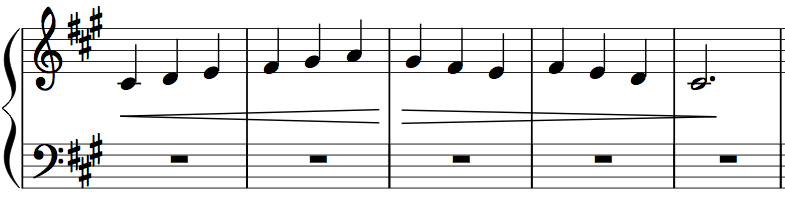
For those who don’t remember, crescendo means to get louder and decrescendo means to get softer. The sample below gets louder, then softer.
But I got a bit off-track. While my student was trying her hand (no pun intended!) and the long crescendo, I looked up how long the longest one might be and found…
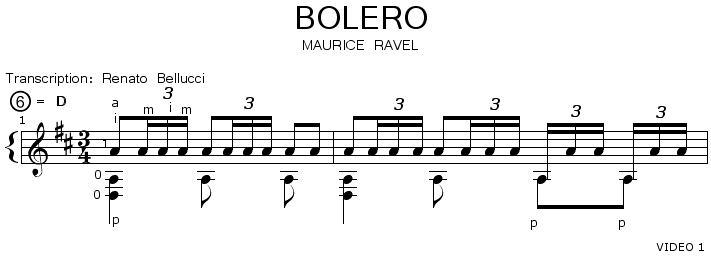
The longest crescendo in music is probably Ravel’s “Bolero,” which is, in fact, one long crescendo. Another very long crescendo occurs in the first movement of Shostakovich’s “Leningrad” Symphony. … “Rossini crescendos” are much shorter but quite effective. Jul 26, 2013
Most everyone, including my student, knows that this is possibly my least favorite piece of music but I still played a bit of it for her anyway.
Although not really a piano piece
From Russia
I like this flashmob version best
In a video that looks just like a segment of Disney’s Silly Symphonies or Fantasia, artist Simon Brethé animates the pentagram, making the notes of Ravel’s Bolero do feats ranging from charming a snake (the oboe) to serenading a girl at her window (the saxophone). At one point of the performance, one member of the string ensemble gets his bow tangled in the pentagram, a distraction that, subsequently, wreaks havoc in the entire orchestra.
• 1964 ~ Rolling Stones recorded their 12×5 album at Chess Studios Chicago
• 1966 ~ The BeatlesPaperback Writer was released in England
• 1966 ~ The Beatles recorded Rain, first to use reverse tapes
• 1966 ~ Janis Joplin’s first live concert in the Avalon Ballroom, San Francisco
• 1966 ~ The Mamas and The Papas won a gold record for Monday, Monday
• 1968 ~ Yury Sergeyevich Milyutin, Composer, died at the age of 65
• 1972 ~ Elvis Presley recorded a live album at NY’s Madison Square Garden
• 1972 ~ The Rolling Stones double album Exile On Main Street went to No.1 on the UK chart, the band’s seventh UK No.1 album. In 2010, the re-released album entered the UK chart at No.1, almost 38 years to the week after it first occupied that position. The Rolling Stones are the first act to ever have a studio album return to No.1 after it was first released.
• 1972 ~ Sammy Davis, Jr. earned his place at the top of the popular music charts for the first time, after years in the entertainment business. His number one song, The Candy Man, stayed at the top for three consecutive weeks. The Candy Man was truly a song of fate for Sammy. He openly did not want to record the song, but did so as a favor to MGM Records head Mike Curb, since it was to be used in the film, Willy Wonka and the Chocolate Factory. Davis said he would give the tune one take, “and that’s it!” Sure enough, in that one-time recording, Sammy nailed it. The Candy Man stayed on the pop charts for 16 weeks. The best the legendary performer had done before was 12 weeks for Love Me or Leave Me in 1955 and 11 weeks for I’ve Gotta Be Me (from Golden Rainbow) in 1969. After The Candy Man became a hit, Davis included it in his stage shows and concerts — and collected huge royalties from it.
• 1976 ~ Paul McCartney and Wings set a record for an indoor concert crowd as 67,100 fans gathered in Seattle, WA to hear the former Beatle and his new group.
• 1982 ~ Addie “Micki” Harris, American singer with the Shirelles, died at the age of 42
• 1985 ~ Nineteenth Music City News Country Awards: Statler Brothers, Barbara Mandrell
• 1990 ~ “Meet Me St Louis” closed at Gershwin Theater NYC after 253 performances
• 1992 ~ Hachidal Nakamura, Composer, died at the age of 61 of heart failure
• 1996 ~ Thirtyth Music City News Country Awards: Alan Jackson
• 2001 ~ Pianist Yaltah Menuhin, last of three famous siblings whose musical talents brought them fame at an early age, died at the age of 79. Yaltah, the youngest, and her sister Hepzibah, also a pianist, did not achieve the international renown of their brother, the violinist Yehudi Menuhin. But they often appeared with him in concerts around the world, including the Bath Festival in Britain, where Yehudi was artistic director in the 1960s. Yaltah Menuhin was born in San Francisco, to Russian-Jewish parents. Like her siblings, she began studying music as a child, and moved about the world performing. Her brother was astonishing audiences with his virtuosity by the age of 7. Yaltah Menuhin and her husband, pianist Joel Ryce, often performed together as a duo in the United States, and she also performed with violist Michael Mann.
• 2001 ~ Harold S. Grossbardt, a founder of Colony Records, the famed record collector’s store in Manhattan, died at the age of 85. Grossbardt founded the store in 1948 with his partner, Sidney Turk, and the shop quickly became popular with music lovers. Hundreds of musicians, including Frank Sinatra, John Lennon and Michael Jackson, shopped at the store. Grossbardt worked at Colony Records until his retirement in 1988.
• 2004 ~ US singer, songwriter Ray Charles died aged 73. Glaucoma rendered Charles blind at the age of six. He scored the 1962 UK & US No.1 single ‘I Can’t Stop Loving You’ plus over 30 other US Top 40 singles and the 2005 US No.1 album ‘Genius Loves Company.’ Charles who was married twice and fathered twelve children by nine different women appeared in the 1980 hit movie, The Blues Brothers was also the winner of 17 Grammy Awards.
It’s wedding season! Today and tomorrow, we’ll be looking at, and listening to, the music most associated with weddings.
The “Bridal Chorus” from the 1850 opera Lohengrin by German composer Richard Wagner is a march played for the bride’s entrance at many formal weddings throughout the Western world.
The piece was made popular when it was used as the processional at the wedding of Victoria the Princess Royal to Prince Frederick William of Prussia in 1858.
This piece is available in Keyboard Kickoff, Movement 2 and Piano Maestro.
The original from the opera
A piano version (this book is available for loan, if interested)
• 1361 ~ Philippe de Vitry, French Composer and poet, died at the age of at 69
• 1656 ~ Thomas Tomkins, Composer, died
• 1717 ~ Louis Le Quointe, Composer, died at the age of 64
• 1810 ~ (Carl) Otto (Ehrenfried) Nicolai, Composer
More information about Nicolai
• 1828 ~ Carlo Marsili, Composer
• 1829 ~ Gaetano Braga, Composer
• 1832 ~ Manuel Garcia, Composer, died at the age of 57
• 1849 ~ Joseph Vezina, Composer
• 1849 ~ The term recital used for the first time to describe a solo performance by an instrumental player. The first recitalist was Franz Liszt
• 1865 ~ Carl Nielsen, Danish composer and conductor
More information about Nielsen
• 1865 ~ Alberic Magnard, Composer
• 1870 ~ Erik Drake, Composer, died at the age of 82
• 1879 ~ Oscar Back, Austrian-Dutch viola player
• 1886 ~ Kusaku Yamada, Composer
• 1888 ~ Hugo Kauder, Composer
• 1890 ~ The opera “Robin Hood” premiered in Chicago
• 1891 ~ Cole Porter, American composer and lyricist for the musical theater. His many famous musicals include “Anything Goes”, “Kiss Me Kate” and “Can Can”.
More information about Porter
• 1892 ~ Friedrich Wilhelm Langhans, Composer, died at the age of 59
• 1900 ~ Fred Waring, Musician, conductor and inventor of the Waring Blender
A native of Hope, Ark., Jones was a childhood friend of the late Virginia Kelley, mother of President Clinton. At 17, Jones went to the University of Kansas City, where he met and befriended saxophonist Charlie Parker. Jones later introduced Parker to his wife, Chan. Jones played in the Elliot Lawrence band, when its arrangers included Al Cohn, Tiny Kahn and Johnny Mandel. As a staff musician for CBS in New York in the 1950s and 1960s,
Jones played for the Jack Sterling radio show and in bands behind Lee and Sinatra. In 1996, Jones was inducted into the Arkansas Jazz Hall of Fame.







 MaryO'Studio