Piano Pronto

pronto

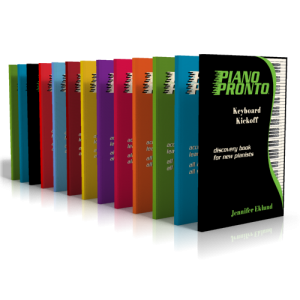
Some of you have noticed that I am switching your students (or yourself!) over to Piano Pronto and may have wondered why.

It was one of the first “method book series” to be integrated into Piano Maestro, so some of the songs have already been worked on using this iPad app.

I am in a Facebook group with the author/composer and many other participants have said that once their students have started in Piano Pronto, the students “forget” the other books at home or in the music bag.

So, a simple experiment was started here and the same thing happened.  Only the Piano Pronto book (Keyboard Kickoff) came out of the bag.

Then, another student got hooked, and another…

Even the young boys seem to love the duets, which are excellent at helping with counting and listening to other musicians.

A minor point but one that makes life easier for the teacher.  All books are $10.00 (plus shipping)  Other method books have varying prices in hard to find locations, some hidden in codes on the back.

Piano Pronto books can be ordered online at https://www.pianopronto.com/ and they are available at our local Music and Arts store in Oakton.  If something is needed fast, digital copies are available to print (or add to the iPad)

If you would like to look through any of the books, just ask!

From the composer, Jennifer Eklund, on Facebook:

Let me give you my fast 5 “things that makes us different from everyone else”:

#1 – On the staff reading day one (I take what I call a “total immersion” approach to note-reading/learning – watch the webinar for the full scoop)

#2 – Aurally pleasing music from very early on. I challenge you to find better and/or more consistently solid arranging in another method series. I don’t wait 2 years to introduce 8th notes. The tunes used in the series are strong and familiar and therefore we can get to more of the fundamentals earlier in the lesson process. Students practice with confidence at home because they recognize the melodies and therefore progress faster.

#3 – All-in-one integrated books (i.e. there aren’t 4 separate books per level the most you ever need is the method and maybe one supplement book)

#4 – The material is age and gender neutral. Clean layout with no illustrations to distract.

#5 – We start teaching how to *effectively* practice from the get-go with our “Pronto Prep” sections that pull out the difficult portions of pieces *before* a student learns the piece.

Other less important stuff:

#6 – The supplements are rooted in my “pop/jazz” background so while the method books are very “classically-based” the supplements are full of pop-style stuff that really creates well-rounded students

#7 – I challenge you to find more varied/interesting teacher duet parts.

#8 – I’m actively writing/creating new items constantly. I really listen to my customers and am writing to suit the needs of the market. If you need something and I don’t have it odds are I’ll probably end up filling your request.

#9 – I stay out of your way as a teacher. The material is extremely flexible. I wanted to give you a solid curriculum that is paced thoughtfully and you can augment the series with all the tools available in your toolbox. You will not feel restricted in any way by the material.

#10 – You can SEE and HEAR everything before you buy. There is NO guesswork involved with shopping with Piano Pronto.

March 21 ~ Today in Music History

today


. 1685 ~ Johann Sebastian Bach, German composer
Bach’s Toccata and Fugue in d minor (listen to it in the Listening Center) was featured in the Walt Disney movie Fantasia and the new Fantasia 2000
Listen to Bach’s music
Read quotes by and about Bach
More information about Bach
Grammy winner

. 1839 ~ Modeste Mussorgsky, Russian composer
More information about Mussorgsky

. 1869 ~ Florenz Ziegfeld, Producer, Ziegfeld Follies ~ annual variety shows famous for the Ziegfeld Girls from 1907 to the 1930s
More information about Ziegfeld

. 1882 ~ Bascom (Lamar) Lunsford, Appalachian folk song writer, started first folk music festival in 1928 ~ annual Mountain Dance and Folk Festival at Asheville, N.C. He was responsible for formation of the National Clogging and Hoedown Council.

. 1921 ~ Arthur Grumiaux, Belgian violinist

. 1934 ~ Franz Schreker, Austrian composer and conductor, died

. 1935 ~ Erich Kunzel, American orchestra conductor. Called the “Prince of Pops” by the Chicago Tribune, he performed with a number of leading pops and symphony orchestras, especially the Cincinnati Pops Orchestra, which he led for 32 years.

. 1936 ~ Alexander Glazunov died.  He was a Russian composer of the late Russian Romantic period, music teacher and conductor.

. 1939 ~ God Bless America, written by Irving Berlin back in 1918 as a tribute by a successful immigrant to his adopted country, was recorded by Kate Smith for Victor Records on this day in 1939. Ms. Smith first introduced the song on Armistice Day, November 11, 1938, at the New York World’s Fair. It was a fitting tribute to its composer, who gave all royalties from the very popular and emotional song to the Boy Scouts. The song became Kate Smith’s second signature after When the Moon Comes Over the Mountain and the second national anthem of the United States of America. On several occasions, it has even been suggested that the U.S. Congress enact a bill changing the national anthem to God Bless America.

. 1941 ~ Singer Paula Kelly joined Glenn Miller’s band. Her husband, also a part of the Miller organization, was one of the four singing Modernaires.

. 1955 ~ NBC-TV presented the first “Colgate Comedy Hour”. The show was designed to stop the Sunday popularity of Ed Sullivan’s “Toast of the Town” on CBS.  Gordon MacRae, the Gabor sisters and Mama Gabor, in addition to a host of singers and dancers were in the opening program with the gangway of the nation’s biggest ship, the “S.S. United States” as the stage. In addition to MacRae, other hosts of the “Colgate Comedy Hour” included: Fred Allen, Donald O’Connor, Bob Hope, Eddie Cantor and Jimmy Durante.

. 1961 ~ The Beatles made their debut in an appearance at Liverpool’s Cavern Club, where they became regulars in a matter of months.

. 1963 ~ A year after opening in the Broadway show, I Can Get It for You Wholesale, Elliott Gould and Barbra Streisand tied the matrimonial knot.

. 1964 ~ Singer Judy Collins made her debut at Carnegie Hall in New York City and established herself “in the front rank of American balladeers.” She would first hit the Top 40 in 1968 with Both Sides Now, a Joni Mitchell song. Her versions of Amazing Grace and Send In the Clowns also became classics.

. 1970 ~ The Beatles established a new record. Let It Be entered the Billboard chart at number six. This was the highest debuting position ever for a record. Let It Be reached number two a week later and made it to the top spot on April 11, overshadowing Simon & Garfunkel’s Bridge over Troubled Water.

. 1998 ~ Galina Ulanova, the leading ballerina at the Bolshoi Theater for nearly two decades, died aged 88.

. 2000 ~ Jean Howard, a Ziegfeld girl-turned-starlet who became known as a legendary Hollywood hostess and photographer, died at the age of 89. She wasn’t interested in becoming a film star. Instead, she came to wield power as favorite Hollywood hostess and photographer, turning her portraits into the books “Jean Howard’s Hollywood” in 1989 and “Travels With Cole Porter” in 1991.

. 2005 ~ Legendary cabaret singer Bobby Short, an icon of old-world style who played for more than three decades at New York’s Carlyle Hotel, died at the age of 80.

March 20 ~ Today in Music History

today


. 1812 ~ Jan Ladislav Dussek died.  He was a Czech composer and pianist.

https://youtu.be/ngp93wD6b3Q

. 1828 ~ Henrik Ibsen, Norwegian playwright. He wrote Peer Gynt, which Grieg later set to music.

. 1890 ~ Lauritz Melchior, Danish-born American tenor
More information about Melchior

. 1890 ~ Beniamino Gigli, Italian operatic tenor, born; with a repertory of over 60 roles, he retired in 1955 after over 40 years singing.

. 1907 ~ Ozzie Nelson, Bandleader, actor in The Adventures of Ozzie and Harriet. He was married to actress, Harriet Nelson and they were the parents of David and Ricky Nelson.

. 1915 ~ Sviatoslav Richter, Russian pianist
More information about Richter

. 1917 ~ Dame Vera Lynn, English singer and sweetheart of British forces during World War Two

. 1920 ~ Marian McPartland, British jazz pianist
More information about McPartland

. 1936 ~ Benny Goodman and his orchestra recorded Christopher Columbus on Victor Records in Chicago, IL.

https://youtu.be/HxyZurbZMKE

. 1948 ~ Eugene Ormandy and the Philadelphia Symphony Orchestra were featured in the first televised symphonic concert. CBS-TV, with help from its then Philadelphia television station, WCAU-TV 10, carried the program from the Philadelphia Academy of Music, the home of the world- famous orchestra. The concert was televised live, at 5 p.m.

Ninety minutes later, NBC-TV carried TV’s second symphonic concert. This one was from Carnegie Hall in New York City. Arturo Toscanini and the NBC Symphony Orchestra was featured in a presentation of Wagner compositions.

. 1969 ~ Beatle John Lennon married Yoko Ono at the Rock of Gibraltar on this day. Lennon called the location, “quiet, friendly and British.” He was the second Beatle to marry in eight days. Paul McCartney and Linda Eastman were wed a week earlier.

From the Web: The Piano Guys rock in a multi-century mash-up : The Ticket

What’s the difference between music of the 1770s and music of the 1970s? According to The Piano Guys, just enough to create a really fantastic mash-up. And so they did.

The group’s latest music video, released on YouTube Tuesday, is the most psychedelic throwback yet to grace the interweb.

Titled “What if the 1770s collided with the 1970s? – ‘I Want You Bach,’” the four-minute video features the alter-egos of musicians Jon Schmidt (“Duke Johann van Keymeister” and “Phil”) and Steven Sharp Nelson (“Sir Reginald von Sharp” and “Scooby”) in a Bach and Jackson 5 mash-up that will make you wonder why the two centuries never met before.

Here’s what The Piano Guys had to say about their inspiration:

“What if the harpsichord from the 1770s hit headlong into the talk box from 1970s? What if J.S. Bach and Jackson 5 met up and just jammed? Would they jive? Can you dig it? These are the kind of far out questions we asked ourselves as we laid down these licks and cut this film. We decided to put together a gig with two wigs in dandy attire and two hep-cats in some funkadelic threads to see if it would fly. … Presenting … ‘I Want You Bach’ – Jackson 5’s funky ‘I Want You Back’ mashed-up with 5 illustrious themes written by J.S. Bach.”

via From the Web: The Piano Guys rock in a multi-century mash-up : The Ticket.

March 19 ~ Today in Music History

today

. 1872 ~ Sergei Diaghilev, Russian impresario; founder of the Ballets Russes
More information about Diaghilev

. 1873 ~ Max Reger, German composer
Read quotes by and about Reger
More information about Reger

. 1917 ~ Dinu Lipatti, Rumanian pianist and composer
More information about Lipatti

. 1930 ~ Ornette Coleman, American jazz alto saxophonist and composer
More information about Coleman

. 1941 ~ Jimmy Dorsey and his orchestra recorded one of their biggest musical successes. It became one of Decca Records’ all-time greats. Green Eyes featured vocalists Helen O’Connell and Bob Eberly.

. 1946 ~ Ruth Pointer, Singer from The Pointer Sisters

. 2001 ~ Cuba-born entertainer Tony Alvarez of “El Show de Olga y Tony” died at age 85. Alvarez was best known for the television and radio programs he hosted with his wife, singer Olga Chorens. He began his career in Cuba in the 1940s as a singer and model, starring in a tango program on Channel Azul. In the 1960s, Alvarez and Chorens moved to Puerto Rico, where they began “El Show de Olga y Tony.” They later moved to New York, where they performed on WABC-TV, WPIX-TV and WNJU-TV from 1965 to 1972.

. 2001 ~ Elena Del Rubio, whose 60-year singing career with her sisters as the Del Rubio Triplets got a boost with campy covers of 1980s tunes, died of cancer. She was believed to be in her 70s. “It was a terrible blow to me,” said Milly, the only surviving sister. “Now I’m left alone.” Another triplet, Eadie, died in 1996. The sisters lived together in a mobile home overlooking the ocean. The trio that promoted itself as “3 Gals 3 Guitars 1 Birthday” performed for six decades in showcases ranging from television comedy to retirement homes. The three were in their 60s when they hit the Hollywood scene, dressed in identical miniskirts, go-go boots and big blonde hairdos. Calling themselves “song stylists,” the sisters’ diverse acts included mariachi strolling, country western music, Hawaiian-Calypso and holiday theme music.

. 2001 ~ Randall Hylton, a bluegrass performer who wrote Room at the Top of the Stairs, died in St. Thomas Hospital after suffering an aneurysm. He was 55. Hylton, who played guitar in the fingerpicking style of Chet Atkins and Merle Travis, was known for his ability to instantly write songs to fit any occasion. The 6-foot-6-inch performer also told jokes, did impersonations and could do guitar tricks, such as playing a song backward or two songs at once. Hylton’s songs were performed by more than 150 singers, including Ralph Stanley, Vern Gosdin, Mac Wiseman, Leo Kottke and Lester Flatt.

. 2001 ~ Herbie Jones, a jazz musician who worked with Duke Ellington and Billy Strayhorn, died of complications from diabetes. He was 74. Jones, a jazz trumpeter, composer, arranger and educator, toured five continents with the Ellington band. His recorded arrangements for the band were El Busto, Cootie’s Caravan, The Prowling Cat and The Opener, and he contributed to Ellington’s first and second Sacred Concerts. After leaving the Ellington band, Jones became the first director of Arts and Culture Inc., a New York City alternative school, and as a volunteer directed the Bugle Corps of the Police Athletic League in Harlem. In Ellington’s 1973 memoir, “Music Is My Mistress,” he called Jones “a great asset” to his orchestra in the 1960s. Jones often played first trumpet but rarely soloed.

. 2015 ~ Peter Katin died.  He was a British classical pianist and pedagogue.

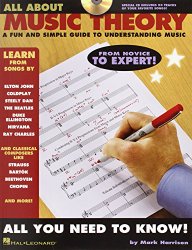
All About Music Theory: A Fun and Simple Guide to Understanding Music

theory


As all my students know, I teach theory with all piano and organ lessons.  Sometimes, it’s from a theory book that matches a lesson book, sometimes on the fly on an “as needed” basis.

This book looks like it would be interesting to use as a review or to look ahead and see what’s coming.  I have just ordered a copy for the studio if you want to check it out at the next lesson.

From amazon.com:

 If you wish there was a fun and engaging way to help you understand the fundamentals of music, then this is it. Whether it’s learning to read music, understanding chords and scales, musical forms, or improvising and composing, this enjoyable guide will help you to finally start understanding the structure and design of music.

This fun-filled, easy-to-use guide includes:
* Music notation
* Scales and modes
* Melody harmonization and counterpoint
* Chord progressions
* Song form and structure

Listen and learn with the CD that has 90 tracks, including over 50 popular songs such as:
* Beauty and the Beast
* Candle in the Wind
* Imagine
* In the Air Tonight
* Killing Me Softly with His Song
* Let It Be
* Message in a Bottle
* Misty
* Satin Doll
* Take the ‘A’ Train
* Unchained Melody
* What’d I Say
* and more!

maryOivoryandroses

March 18 ~ Today in Music History

today


1842 ~ Stephane Mallarme, French Symbolist poet, born. His “L’Apres-midi d’un Faune” inspired composer Claude Debussy to write an orchestral prelude of the same name.

https://youtu.be/Rpw4-J49auQ

. 1844 ~ Nicolai Rimsky-Korsakov, Russian composer
More information about Rimsky-Korsakov

. 1882 ~ Gian Francesco Malipiero, Italian composer and musicologist

. 1902 ~ Enrico Caruso recorded 10 arias for the Gramophone Company. The recording session took place in Milan, Italy and Caruso walked away with $500 for his effort.

. 1910 ~ Hold on to your hats! The opera, Pipe of Desire, was first performed this day at the Metropolitan Opera House in New York City. Frederick Sheperd Converse wrote the work that turned out to be the first opera by an American composer to be performed at the Met.

. 1940 ~ Glen Gray and his orchestra recorded No Name Jive on Decca Records.

. 1941 ~ Wilson Pickett, American soul singer and songwriter; the Rock and Roll Hall of Fame

. 1959 ~ Irene Cara, Singer and actress

. 1963 ~ Vanessa Williams, Singer and actress

. 1967 ~ The day The Beatles, Penny Lane went gold

. 1970 ~ Brook Benton received a gold record for the hit single, Rainy Night in Georgia. It was Benton’s first hit since 1963’s Hotel Happiness.

. 1978 ~ The Bee Gees started an eight-week stay at the top of the pop music charts with Night Fever from the Saturday Night Fever soundtrack.

. 2001 ~ John Phillips died at the age of 65. He was the singer-songwriter who founded the 1960s pop act the Mamas the Papas.

March 17 ~ Today in Music History

Happy Saint Patrick’s Day


https://youtu.be/w8EXDtoGfrs

. 1901 ~ Alfred Newman, Conductor
More information about Newman

. 1917 ~ Nat “King” Cole, American jazz singer and pianist
More information about Cole

. 1930 ~ Paul Horn, American jazz flutist, saxophonist, clarinetist and composer
More information about Horn

. 1938 ~ Rudolf Nureyev, Dancer
More information about Nureyev

. 1944 ~ John Lill CBE, English classical pianist

. 1944 ~ John Sebastian, American pop-rock singer songwriter and guitarist, His group, The Lovin’ Spoonful performed Do You Believe In Magic, Summer In The CityDaydream, You Didn’t Have to be So Nice, Nashville Cats His solos include Darling Be Home Soon and Welcome Back