Today would probably have been a better day for the Music Man post since it’s about marching forth on March Fourth.
In honor of dedicated musicians and performers of many diverse styles and backgrounds, Marching Music Day celebrates all varieties of the art forms bringing us “music on the move.”
For centuries, the beat of a drum has kept military units moving in unison. From the training field to the battlefield, the football stadium to the Broadway stage, small gyms, auditoriums and grand arena spectacles, fifers, pipers, buglers, drum corps, marching bands, parade groups, drill teams and color guards bring music to life to the delight of millions of performers and spectators.
The military roots of the drum corps have evolved into an art form which moves us during somber memorials and thrills us with their ability to perform delightful music while executing intricate routines with exact precision. Drill squads, marching bands, drum lines, and drum corps name but a few of the many styles of marching music which have developed over the years, engaging hundreds of thousands of performers of all ages, abilities and experience levels.
We see marching music in schools, military units, community celebrations and local auxiliaries. The music is as varied as the ensembles themselves. Instruments may be limited to brass in some settings or may include woodwinds and electric guitars in others. Dance teams, baton twirlers and color guards perform to soundtracks ranging from traditional, standard marches to rock and roll, jazz, contemporary and electronic dance music.
And marching music keeps changing! Spectacular string bands incorporate their own unique sound and elaborate costuming. Technology has brought about the production of lighter, electronic and digital instruments making it possible for musicians to march with violins, cellos, basses and synthesizers to entertain crowds in unique and creative new ways.
Today, March 4 (“March Forth”) is also National Grammar Day. In past years, the National Grammar Day organization promoted the annual date as follows: “Language is something to be celebrated, and March 4 is the perfect day to do it. It’s not only a date, it’s an imperative: March forth on March 4 to speak well, write well, and help others do the same!”
Can it be that not much happened in the world of music today? I’ll be editing this post as I find items!
In the meantime, please enjoy this video:
.1869 ~ Sir Henry Joseph Wood was an English conductor and the creator of the Henry Wood Promenade Concerts, currently called the “BBC Proms”. He was a student at the Royal Academy of Music conservatoire and the oldest degree-granting music school in Britain. The Proms are an eight-week summer season of daily orchestral classical music concerts and other events held annually, predominantly in the Royal Albert Hall. The object of the concerts in broad terms is to bring classical music to all and includes concerts in the Royal Albert Hall, chamber concerts at Cadogan Hall and Proms in the Park events across the United Kingdom on the last night.
.1875 ~ The Georges Bizet opera Carmen premiered in Paris.
.1931 ~ The “Star Spangled Banner” was adopted as the American national anthem. The song was originally known as “Defense of Fort McHenry.”
.1931 ~ The first jazz album to sell a million copies was recorded. It was “Minnie The Moocher” by Cab Calloway.
.1940 ~ Artie Shaw and his orchestra recorded “Frenesi”.
.1945 ~ Bing Crosby recorded “Temptation” with John Scott Trotter’s Orchestra. He had recorded it before on October 22, 1933, with Lennie Hayton’s orchestra.
.1957 ~ Samuel Cardinal Stritch banned rock ‘n’ roll from Chicago archdiocese Roman Catholic schools.
1824 ~ Bedrich Smetana, Bohemian (Czech) composer who pioneered the development of a musical style that became closely identified with his people’s aspirations to a cultural and political “revival.” He has been regarded in his homeland as the father of Czech music. Internationally he is best known for his opera The Bartered Bride and for the symphonic cycle Má vlast (“My Fatherland”), which portrays the history, legends and landscape of the composer’s native Bohemia. It contains the famous symphonic poem “Vltava”, also popularly known by its German name “Die Moldau” (in English, “The Moldau”).
More information about Smetana
. 1900 ~ Kurt Weill, German-born American composer of operas and other music
More information about Weill
. 1917 ~ Desi Arnaz (Desiderio Alberto Arnez y De Acha III), Bandleader, singer, actor, married to Lucille Ball, co-owner of Desilu Productions, introduced 3-camera sitcom technique
. 1921 ~ Robert Simpson, English composer and long-serving BBC producer and broadcaster
. 1934 ~ Doug Watkins, Jazz musician, bass with these groups: Pepper-Knepper Quintet, Hank Mobley Quartet, Horace Silver and the Jazz Messengers
. 1938 ~ Ben Harney, American composer and pianist died (b. 1871)
. 1942 ~ Lou Reed (Lewis Alan Reed), Singer, songwriter, guitarist with Velvet Underground
. 1949 ~ Eddie Money (Mahoney), Singer
. 1950 ~ Karen Carpenter, Drummer, singer with Grammy Award-winning group, The Carpenters. Their hits included “(They Long to Be) Close to You”, Top Of The World and “We’ve Only Just Begun.”
. 1955 ~ Jay Osmond, Singer with The Osmond Brothers
. 1956 ~ John Cowsill, Singer with The Cowsills
. 1956 ~ Mark Evans, Bass with AC/DC
. 1962 ~ Jon Bon Jovi (John Francis Bongiovi), American rock singer, songwriter. Best known as a musician, songwriter and actor and the lead singer and founder of band Bon Jovi. He has great commercial success including multiple number 1’s in the US and around the world and collected a number of awards including Academy Award, American Music Award, Golden Globe and a Grammy. His hits include “You Give Love a Bad Name”, “Livin’ on a Prayer”, “Bad Medicine” and “I’ll Be There for You”. Bon Jovi has sold more than 120 million records worldwide. He has appeared in multiple movies and was cast as a plumber who was the boyfriend in the TV Series Ally McBeal.
. 1963 ~ Cowboy (Lloyd) Copas and singer, Patsy Cline, killed in a plane crash
. 1974 ~ Stevie Wonder got five Grammy Awards for his album, Innervisions and his hit songs, You Are The Sunshine of My Life and Superstition.
. 1985 ~ Country singer Gary Morris hit #1 on the country charts for the first time with Baby Bye Bye, from his album, Faded Blue.
. 2003 ~ Hank Ballard, 75, the singer and songwriter whose hit The Twist ushered in a nationwide dance craze in the 1960s, died. He wrote and recorded The Twist in 1958, but it was released only on the B-side of a record. In 1959, Chubby Checker debuted his own version of the song on Dick Clark’s Philadelphia television show. It soon topped the charts and launched a dance craze that prompted the creation of other Twist songs, including Twist and Shout by the Isley Brothers and Twistin’ the Night Away by Sam Cooke. Mr. Ballard was inducted into the Rock and Roll Hall of Fame in 1990. Mr. Ballard was discovered in the early 1950s by writer-producer Johnny Otis. He was lead singer for the Royals, which changed its name to the Midnighters. Mr. Ballard, who was born John H. Kendricks in Detroit, grew up singing in church in Bessemer, Ala. At 15, he returned to Detroit and set out to form a doo-wop group while working on a Ford Motor Co. assembly line.
. 2018 ~ Van McLain [McElvain], American rock guitarist (Shooting Star), died at the age of 62 from West Nile virus
A few years ago TCM was doing 31 Days of Oscars. I first sort of noticed this when I looked ahead in the scheduling and noticed that all TCM shows were alphabetized. At first, I thought maybe that this scheme was some sort of placeholder before I realized what they were doing. Personally, I preferred when 31 Days grouped films by nomination category, by studio or by actor. Alphabetical is easy for them but hard on me, looking through every entry to see what to record.
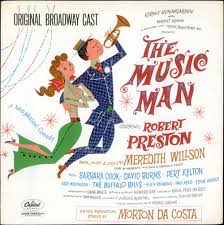
Saturday, we were up to the M’s and Tivo faithfully recorded (The) Music Man. When I watched it on Sunday, I was most pleased to realize that I remembered all the words.
Remembering all the words is no small feat.
I first started collecting records (yes, records!) of musicals when I was in high school in Springfield, MA. Our library had an outstanding record collection, but I could only check out one (or 2?) at a time.
I would bring my record(s) home, and listen to them like crazy. Then I’d save my allowance and any work money I had and go to the local department store to buy my favorites. I always bought musicals and they were nearly Original Broadway Cast. Years later, I still have all these records, even though I usually listen on Spotify or on one of my carefully curated playlists. (I also can’t listen to any of the music out of order.)
As the years roll by, many of these musicals, like The Music Man, have gone on to become films. I am not usually a happy camper when the music is changed from what I remember of the OBCs and the film, but The Music Man film made the cut for me 🙂
. 1643 ~ Girolamo Frescobaldi, Italian composer/organist, died at the age of 59 More about Frescobaldi
. 1810 ~ Frédéric Chopin, Polish composer and pianist Read quotes by and about Chopin More information about Chopin Grammy winner
. 1826 ~ John Thomas, Welsh composer and harpist
. 1904 ~ Glenn Miller, American trombonist and bandleader. Some of his memorable songs included In the Mood, Chattanooga Choo Choo, Tuxedo Junction, Moonlight Serenade and Pennsylvania 6-5000. The Glenn Miller Orchestra sound was a mix between jazz and swing and now more than 60 years later his music is unique and recognized by young and old the world over. More information about Miller
. 1907 ~ Albert Clifton Ammons was born in Chicago, Illinois. He developed an interest in boogie-woogie and his 1936 recording of “Boogie Woogie Stomp” has been described as “the first 12-bar piano-based boogie-woogie.”
. 1922 ~ Michael Flanders, Songwriter, comedian with the duo: Flanders and [Donald] Swann, made humorous mockery of English and American failings, died in 1975
. 1927 ~ Harry Belafonte, American calypso and folk singer, UNICEF goodwill ambassador, father of Shari Belafonte
. 1928 ~ Paul Whiteman and his orchestra recorded Ol´ Man River for Victor Records. The featured vocalist on the track was 29-year-old Paul Robeson. The song became an American classic.
. 1930 ~ Benny Powell, Jazz musician, trombone with the Ernie Fields band, Lionel Hampton, a Count Basie veteran
. 1941 ~ FM Radio began in the U.S. when station W47NV in Nashville, TN started operations on this day. W47NV was the first commercial FM radio station to receive a license, some 20 years after its AM radio counterpart, KDKA in Pittsburgh. FM stands for ‘frequency modulation´ as opposed to ‘amplitude modulation´.
. 1941 ~ Downbeat magazine scooped the entertainment world with news that Glenn Miller’s renewed contract with Chesterfield Cigarettes was worth $4,850 a week (for three 15-minute programs).
. 1944 ~ Roger Daltrey, Singer with The Who
. 1968 ~ Country music stars Johnny Cash and June Carter got married on this day. Johnny walked down the aisle knowing that his 1956 hit, Folsom Prison Blues, was about to be redone for a June release. Cash has a daughter, Rosanne, (previous marriage) who became a country star in her own right in the 1980s.
. 1968 ~ Elton John’s first record, I’ve Been Loving You, was released by Philips Records in England. Philips, not realizing the potential of the soon-to-be superstar, released him in 1969, just prior to his teaming with lyricist Bernie Taupin. Elton then signed a contract with Uni Records and began to turn out what would become a string of more than 50 hits over the next 25 years.
. 1973 ~ The Robert Joffrey Dance Company opened with a unique presentation in New York City. The show featured music of the Beach Boys in “Deuce Coupe Ballet”. A clever show, even if it didn’t do much to bring the masses to ballet.
. 1985 ~ A Beatles song was used for the first time in a U.S. TV commercial. The rights for Lincoln-Mercury to use the song, HELP!, cost $100,000, helping boost the fortunes of the Ford Motor Company.
. 1985 ~ Eugene List, American concert pianist and teacher (Eastman School of Music), died at the age of 66. List performed internationally during the mid-to-late 1900s. He championed the works of the American pianist and composer Louis Moreau Gottschalk (1829-1869). Gottschalk played this piece, with all its fanfares and flourishes reminiscent of an imaginary band concert, at all his concerts.
. 2003 ~ Nadine Conner, a soprano who performed for nearly two decades at the Metropolitan Opera after singing on national radio, died. She was 96. Conner debuted at the Met in 1941 as Pamina in Mozart’s “The Magic Flute,” conducted by Bruno Walter. She performed there 249 times over 18 seasons. She won acclaim not only for her Mozart roles, including Zerlina in “Don Giovanni” and Susanna in “The Marriage of Figaro,” but also for her portrayals of Violetta in Verdi’s “La Traviata,” Mimi in Puccini’s “La Boheme,” Gilda in Verdi’s “Rigoletto,” and Rosina in Rossini’s “The Barber of Seville.” Conner began her career singing on national radio from Los Angeles, and appeared with such stars as Bing Crosby and Gordon MacRae and toured with film star Nelson Eddy. She joined a fledgling opera troupe in Los Angeles, making her debut as Marguerite in Gounod’s “Faust.” Her Met farewell, in 1960, also was in “Faust.”
. 1903 ~ Vincente Minnelli (Lester Anthony Minnelli), Director, Judy Garland’s husband and Liza Minnelli’s father
. 1915 ~ Lee Castle (Castaldo), Trumpet, bandleader, led Jimmy Dorsey’s band during time of smash hit, So Rare
. 1926 ~ Seymour Shifrin, American composer
. 1930 ~ Ted Lewis and his orchestra recorded On the Sunny Side of the Street for Columbia Records on this day. Mr. Lewis was heard as the featured vocalist as well, on the tune that has been recorded hundreds of times and is an American music standard.
. 1939 ~ Tommy Tune, Tony Award-winning dancer, actor, director of musical theater
. 1942 ~ Brian Jones (Lewis Hopkin-Jones), Singer, rhythm guitar with The Rolling Stones
. 1948 ~ Bernadette Peters, Singer and actress
. 1959 ~ Cash Box magazine, a trade publication for the music/radio industry, began using a red ‘bullet’ on its record charts to indicate those records that have the strongest upward movement each week. The phrase, “Number one with a bullet” designates those hits that have reached the pinnacle of statistical chartdom. To be so means to be at the top of the list and still climbing higher.
. 1960 ~ Dmitri Capyrin, Russian composer of contemporary classical music.
. 1966 ~ The famous Cavern Club in Liverpool, England closed because of financial difficulties. During its peak of success, the club was best known as the home of The Beatles.
. 1968 ~ Frankie Lymon passed away. He was an American rock and roll/rhythm and blues singer and songwriter.
. 1984 ~ It was Michael Jackson Night at the Grammy Awards in Los Angeles. He set a record for most wins by taking home eight of the gramophone statuette honors. He broke the previous record of six awards set by Roger Miller in 1965. The reason: the biggest selling album of all time, Thriller, which sold more than 35-million copies around the world soon after its release in 1983.
. 1993 ~ Ruby Keeler passed away. She was a Canadian-born American actress, dancer and singer most famous for her on-screen coupling with Dick Powell in a string of successful early musicals at Warner Brothers, particularly 42nd Street.
. 2019 ~ André Previn, German-American pianist, conductor, and composer died at the age of 89. Previn won four Academy Awards for his film work and ten Grammy Awards for his recordings (and one more for his Lifetime Achievement).
It will be fun watching your child improve their piano skills all while having fun using Piano Maestro in lessons each week!
As your child’s teacher (or YOUR teacher!), I’m looking forward to seeing the progress they will make when they start using it at home each day. This guide will help you understand how this app will benefit your child and how to get it set up on your own iPad.
Overview What is Piano Maestro?
Piano Maestro is the ultimate piano practice tool that will have students quickly playing their favorite classical, pop, rock, TV and video game songs and themes. It is available in the App Store and works on the iPad.
What skills does it improve?
• Note reading
• Sight reading
• Rhythm
• Inner pulse
• Confidence
What makes it so fun?
• Upbeat background tracks
• Stunning graphics
• Instant rewards and feedback
• Satisfaction of playing REAL music
It works with an acoustic piano?
Yes! Your child practices on your real acoustic or digital piano. Piano Maestro listens from the iPad’s built-in microphone. No wires needed.
I’m already paying for lessons. What value does this add?
Sometimes I wish I could be there with your child to encourage them to keep practicing daily. I’m sure it’s not always easy, as unforeseen challenges will arise.
Since our time each week is just too short, this app will give me eyes on the ground and it will keep them practicing longer and improving more quickly.
How will it be used in lessons?
I will spend a few minutes of each lesson helping your child master a couple of new songs all while having fun! I will also teach them how to use the practice options at home.
At the end of the lesson, we will choose Home Challenge assignments within the app that will show up in your account at home. I’ll get updates when progress is made.
Getting Started
Wow, this sounds awesome. Now, how do I get started?
1) Download Piano Maestro on your iPad from the AppStore
2) Create a JoyTunes account with a parent’s email, under which, you can have multiple profiles for each member of the family.
3) Create a profile for each family member (that means you too Mom and Dad!) inside the Parent/Teacher zone (top right-hand corner of the main screen)
4) Connect to your teacher, me! After creating a profile in the “profiles” tab of the parent/teacher zone, select the student’s profile and click “connect to teacher.” Once I approve the connection to your child, they will receive full access to all content for FREE! I will then also begin receiving weekly progress reports.
5) Start Playing – I will now start assigning you homework, meanwhile, get started on Journey Mode.
When you connect to the O’Connor Music Studio, Piano Maestro is free for as long as you study here.
. 1848 ~ Hubert Parry, English composer, teacher and historian of music.
. 1873 ~ Enrico Caruso, Italian tenor, sang nearly 70 roles; appeared in nearly every country of Europe and North and South America
Read quotes by and about Caruso
More information about Caruso
. 1883 ~ Oscar Hammerstein of New York City patented the first practical cigar-rolling machine. If Oscar’s name sounds familiar, it should. Hammerstein’s grandson later made his mark by writing some of the best- known music in the world, teaming up frequently with Richard Rodgers.
. 1887 ~ Alexander Borodin, Russian composer, died at the age of 53
Read more about Borodin
. 1887 ~ Lotte Lehman, Singer
. 1897 ~ Marian Anderson, Opera diva
. 1923 ~ Dexter Gordon, American jazz tenor saxophonist
. 1927 ~ Guy Mitchell (Al Cernick), Singer, actor
. 1935 ~ Mirella Freni, Italian soprano
. 1936 ~ Chuck Glaser, Singer with Glaser Brothers
. 1948 ~ Eddie Gray, Guitarist with Tommy James & The Shondells
. 1951 ~ Steve Harley (Nice), Singer with Steve Harley & Cockney Rebel
. 1954 ~ Neal Schon, Guitarist with Santana; Journey
. 1955 ~ Garry Christian, Singer with The Christians
. 1970 ~ Simon and Garfunkel received a gold record for the single, Bridge Over Troubled Water.
. 2003 ~ Tom Glazer, 88, the balladeer, guitarist and songwriter who, along with Burl Ives, Josh White, Pete Seeger and others, helped spark national interest in folk music in the 1940s, died. Mr. Glazer wrote songs for children, including a hit 1963 parody, On Top of Spaghetti, that won him National Critics’ and Parent Magazine awards. He also acted, sang and wrote for movies and TV. He was singer-narrator for the film, Sweet Land of Liberty, and composed the score for the Andy Griffith film A Face in the Crowd. Mr. Glazer was a native of Philadelphia who attended the City College of New York. As a young man, he played tuba and bass in military and jazz bands and worked at the Library of Congress. He began singing with a group while living in Washington, and was invited by Eleanor Roosevelt to perform at the White House. Mr. Glazer became a full-time musician in 1943 and, over the years, hosted three radio series. He also wrote books about music, including a number of songbooks. His song Because All Men Are Brothers, based on the Passion Chorale by J. S. Bach, was recorded by the Weavers and Peter, Paul and Mary. Other hits included, Old Soldiers Never Die for Vaughn Monroe, More for Perry Como, Til We Two Are One for Georgie Shaw, and A Worried Man, recorded by the Kingston Trio. His song, The Musicians was used on the “Barney” television show for children; Bob Dylan recorded his Talking Inflation Blues.
. 2003 ~ Fred Rogers, who gently invited millions of children to be his neighbor as host of the public television show Mister Rogers’ Neighborhood for more than 30 years, died. He was 74. From 1968 to 2000, Rogers, an ordained Presbyterian minister, produced the show at Pittsburgh public television station WQED. The final new episode, which was taped in December 2000, aired in August 2001, though PBS affiliates continued to air back episodes. Rogers composed his own songs for the show and began each episode in a set made to look like a comfortable living room, singing “It’s a beautiful day in the neighborhood…”, as he donned sneakers and a zip-up cardigan. His message remained simple: telling his viewers to love themselves and others. On each show, he would take his audience on a magical trolley ride into the Neighborhood of Make-Believe, where his puppet creations would interact with each other and adults. Rogers did much of the puppet work and voices himself. He also studied early childhood development at the University of Pittsburgh and consulted with an expert there over the years. Rogers’ show won four Emmy Awards, plus one for lifetime achievement. He was given a George Foster Peabody Award in 1993, “in recognition of 25 years of beautiful days in the neighborhood.” One of Rogers’ red sweaters hangs in the Smithsonian Institution.
. 2003 ~ Jean Sullivan, a musician, dancer and actress who starred opposite Errol Flynn in the 1944 film “Uncertain Glory,” died of cardiac arrest. She was 79. Sullivan was the leading lady Marianne in “Uncertain Glory” and also has a starring role in the 1945 movie “Escape in the Desert.” The young actress also played the daughter of Rosalind Russell and Jack Carson in the motion picture comedy “Roughly Speaking.” Despite a budding acting career, Sullivan relocated to New York and began studying ballet and dancing professionally. While practicing flamenco steps during a Carnegie Hall rehearsal, Sullivan was discovered by choreographer Anthony Tudor and was a dancer with the American Ballet Theatre. She enhanced her flamenco by playing Spanish guitar and became a popular entertainer at Latin nightclubs throughout New York City. Sullivan also played cello and piano. Despite her career change, Sullivan performed flamenco on TV variety shows, including “The Steve Allen Show” and “The Jackie Gleason Show.” She also was a meteorologist on local New York television stations.
. 2013 ~ Van Cliburn died. He was an American pianist who achieved worldwide recognition in 1958 at the age of 23, when he won the first quadrennial International Tchaikovsky Piano Competition in Moscow at the height of the Cold War.
. 1770 ~ Anton Reicha, Czech-born, later naturalized French composer of music very much in the German style
. 1802 ~ Victor Hugo, author of Les Miserables and many other works
. 1879 ~ Frank Bridge, English composer, violist and conductor
. 1922 ~ Dancing to jazz music and tango bands was criticized in Paris. It seems that dancing was detracting the French from their postwar reconstruction, according to “La Revue Mondiale”.
. 1928 ~ “Fats” (Antoine) Domino, American rock-and-roll pianist and singer. His works include: Ain’t That a Shame, Goin’ Home, I’m in Love Again, Blue Monday, I’m Walkin’ and Blueberry Hill
. 1930 ~ Lazar Berman, Soviet pianist
. 1932 ~ Johnny Cash was an American country music, singer-songwriter. Although he is known as a country singer his music spanned other styles including rockabilly, rock and roll, blues, folk, and gospel. He had a distinct style both in music and life and partly due to his always wearing dark clothes, but also because of melancholy music was known as “The Man in Black”, his signature line on opening a concert consisted of “Hello, I’m Johnny Cash”. He was known as a heavy drinker and addicted to amphetamines and barbiturates but in 1968 he quit and soon after married his long time sweetheart June Carter who had always refused to marry him till he was clean. His hits during his career included “Folsom Prison Blues”, “I Walk the Line”, “A Boy Named Sue”, “Man in Black”, “Don’t Take Your Guns to Town”, “Ring of Fire” and “Jackson” ( with June Carter ) which won a Grammy Award in 1968. Although he never did Prison time he felt great compassion for prisoners and made two of his most popular albums in front of Prison audiences, Johnny Cash at Folsom Prison (1968) and Johnny Cash at San Quentin (1969).
. 1945 ~ Mitch Ryder (William Levise), Singer with Mitch Ryder & the Detroit Wheels
. 1947 ~ Sandie Shaw (Goodrich), Singer
. 1950 ~ Jonathan Cain, Keyboard with Babys
. 1954 ~ Michael Bolton, Grammy Award-winning singer. Some of his songs are: When a Man Loves a Woman and How Am I Supposed to Live Without You
. 1961 ~ John-Jon (John Andrew Foster), Musician with Bronski Beat
. 1965 ~ Juan Trigos, Mexican composer and conductor
. 1972 ~ Harry Nilsson started his second week at number one with that toe-tapping ditty, Without You. The whiny love song stayed at the top for a total of four weeks.
. 1977 ~ The Eagles’ New Kid in Town landed in the top spot on the pop music charts for one week beginning this day.
. 1981 ~ Howard Hanson died. He was an American composer, conductor, educator, music theorist, and champion of American classical music.
. 1983 ~ Charley Pride’s Why Baby Why topped the country charts. The song was written by George Jones (who found national fame with his own version in 1955) and Darrell Edwards. Legend has it that inspiration for the song came when Edwards overheard a couple squabbling in their car in Orange, TX.
. 2003 ~ Otha Turner, 94, who created his own niche in blues music with an ethereal mix of early American colonial drums and West African flute, died in Como, Miss. His recording Everybody Hollerin’ Goat was rated among the Top 10 blues releases in 1997 by Rolling Stone magazine. Members of a Senegalese drum troupe performed with Mr. Turner on the album. Mr. Turner was presented with a National Endowment for the Arts Heritage Award, the Smithsonian Lifetime Achievement Award and the Charlie Patton Lifetime Achievement Award from the Mississippi Delta Blues and Heritage Festival.
. 2011 ~ Eugene Fodor, American classical violinist (1974 Tchaikovsky Award), died at the age of 60



 Grammy winner
 MaryO'Studio