August 14 ~ Today in Music History

today


1778 ~ Augustus Toplady, English hymn-writer who wrote Rock of Ages, died.

• 1868 ~ Leone Sinigaglia, Italian composer

• 1926 ~ Buddy (Armando) Greco, Singer and pianist

• 1937 ~ Brian Fennelly, American composer, pianist and conductor

• 1940 ~ Dash Crofts, Drums, mandolin and keyboard with Champs; singer is a duo with Seals and Crofts

• 1941 ~ David Crosby (Van Cortland), American rock singer, guitarist and songwriter. Performed with The Byrds as well as Crosby, Stills, Nash and Young

• 1941 ~ Connie Smith (Meadows), Singer

• 1946 ~ Larry Graham, Bassist and singer with Sly and the Family Stone as well as Graham Central Station

• 1971 ~ Elton John put the finishing touches to his Madman Across the Water LP at Trident Studios, London. Since the album’s release on Feb 2, 1972, it has sold over two million copies in the U.S. alone.

• 1981 ~ The BBC recording of the Royal Wedding of Prince Charles and Lady Diana reached number one on the album charts in Britain.

• 2000 ~ Leonard Kwan, a master of slack key guitar whose composition Opihi Moemoe is considered a classic of the genre, died at the age of 69.
Kwan began recording in 1957 and most recently recorded two albums for George Winston’s Dancing Cat Records. The second will be released in September.
Kwan also was the first slack key guitarist to publicly share his instrument tunings in an instruction book.
Hawaiian slack key, or ki ho`alu, is a unique musical style dating to the 1830s, when Spanish and Mexican cowboys arrived in the islands. Some of the guitar strings are slacked from the standard tuning and songs are played in a finger-picking style, with the thumb playing bass.
In 1960, he recorded, Slack Key, the world’s first all-instrumental slack key album.

• 2001 ~ Nicholas Orloff, a dancer and ballet teacher, died at the age of 86.
Orloff was known for his performance of the Drummer, a character he originated in David Lichine’s 1940 “Graduation Ball.”
He was a popular teacher with the Ballet Theater and other schools. He continued to teach in Manhattan schools even after suffering from a stroke three years ago.
Orloff appeared in the 1950 French film “Dream Ballerina” and on Broadway in the musical “Pipe Dream.”
He also was the ballet master of the Denver Civic Ballet in the mid- 1970s.
Born in Moscow, Orloff trained in Paris. He performed with the Ballet Russe de Monte Carlo, the Original Ballet Russe, Ballet Theater, as the American Ballet Theater was known, and the Grand Ballet du Marquis de Ceuvas.

• 2001 ~ Daniel Adrian Carlin, an Emmy-winning music editor who worked with soundtrack composers Lalo Schifrin and Ennio Morricone, died of complications from lung cancer and pulmonary fibrosis. He was 73.
Carlin edited the music for “Scorpio,” “The Outlaw Josey Wales,” “Ghost,” “Gorillas in  the Mist,” “Dead Poets Society” and “Cliffhanger.” He won a music-editing Emmy in 1987 for his work on the miniseries “Unnatural Causes.”
He was founder in 1972 of La Da Music. Now known as Segue Music, it is considered the leading film and television editing company.

August 13 ~ Today in Music History

today


• 1820 ~ Sir George Grove, British musicographer and educator.  Grove was editor of the Dictionary of Music and Musicians, the latest revised editions of which still carry his name

• 1860 ~ Annie Oakley born as Phoebe Anne Oakley Moses. She was a markswoman and member of Buffalo Bill Cody’s “Wild West Show” which toured America. The Irving Berlin musical, Annie Get Your Gun, was based on her life.

• 1912 ~ Jules Massenet, French composer of the operas Werther and Manon died.
More information about Massenet

• 1919 ~ George Shearing, British-born American jazz pianist and composer

• 1924 ~ The first country music record to sell one million copies reached that point on this day. It was The Prisoner’s Song, recorded by Vernon Dalhart. He became a Country Music Hall of Famer in 1981.

• 1930 ~ Don Ho, Singer

• 1930 ~ Guy Lombardo and his orchestra recorded Go Home and Tell Your Mother, on Columbia Records.

• 1948 ~ Kathleen Battle, American soprano, Metropolitan Opera diva, performed with the NY Philharmonic, Chicago Symphony, Boston Symphony, Berlin Philharmonic, Vienna Philharmonic, Orchestre de Paris

• 1949 ~ Cliff Fish, Musician, bassist with Paper Lace

• 1951 ~ Dan Fogelberg, Singer

• 1958 ~ Feargal Sharkey, Singer with The Undertones

• 2001 ~ Neil Cooper, the founder of the ROIR rock and reggae record label, died of cancer. He was 71.
Cooper started Reach Out International Records in 1979 and put out his first release – on cassette only – in 1981 by James Chance and the Contortions.
He then produced a catalog of cassettes by rock groups such as Bad Brains, Glenn Branca, Television, MC5, G.G. Allin, Johnny Thunders, and New York Dolls. ROIR’s reggae releases included Lee “Scratch” Perry, the Skatalites, Prince Far I, and Big Youth among others.
The cassette releases were a way to sidestep the artists’ exclusive contracts with other record labels. Vinyl album and compact disc versions were later issued.
Cooper also worked as an agent for MCA and Famous Artists before starting his label.

• 2003 ~ Ed Townsend, who wrote hit songs including 1958’s “For Your Love” and Marvin Gaye’s controversial “Let’s Get It On,” died at the age of 74.   Townsend had written more than 200 songs.    Nat King Cole and Etta James were among the stars who recorded Townsend’s songs. One of his first hits was “For Your Love” – which Townsend recorded himself.
Townsend also wrote and produced the Impressions’ 1974 No. 1 R&B hit “Finally Got Myself Together (I’m A Changed Man).”

Play Corvallis, Play


Play Corvallis, Play pianos are about to hit the streets, but first a giant gift to the community must be unwrapped at 6 p.m. Friday by the riverfront downtown.

“On Friday, we want to celebrate Corvallis and the citizens for being involved in music,” said Lee Eckroth, who came up with the street piano program last year. “Our reveal that day is a gift to the community and it’s pretty special.”

After the gift is opened, theme-painted pianos will start being available for free playing in various locations around town.

Eckroth was inspired to start the event after a family vacation in Boston a few years ago. He said the city had a street pianos program and his daughter, Morgan, thought it would be cool to bring that idea to Corvallis.

A mutual friend introduced Eckroth to Dave Lundahl, organizer of the Corvallis Imagination Music and Arts Festival, and the two decided to collaborate. The idea was to use both events to generate money for art and music programs in area K-12 public schools.

Eckroth said, “I put out a message to the community in February of 2014 that there was a guy looking to collect pianos. All of sudden I had 10 pianos in my garage.”

From June until the beginning of last August, Eckroth invited local residents and volunteers to use his driveway as a studio to paint whatever theme they wanted on the pianos. Themes included an all-orange piano called the Beaver Believer, or fruits and veggies, and more. One, called Happy Hands, featured a painted handprint of every volunteer. The pianos appeared outside locations such as the public library, the Oregon State University Valley Library and the downtown American Dream Pizza on Second Street.

“Last year we were amazed with what happened with the pianos,” Lundahl says. People were planning parties around the pianos, and impromptu concerts emerged from players of all different ages.

“We were giving people the opportunity to come out of their shells and express themselves,” Eckroth says.

The pianos, each with its own sponsor, will be re-released one by one between 7 a.m. and 10 p.m. every day in various locations until August 16. And like last year, when the pianos go away for the winter, they will be sent to different families to enjoy in their homes until next summer.

From http://www.gazettetimes.com/news/local/play-corvallis-play/article_694381ef-4c10-5570-9fab-490469eb4c2b.html

August 12 ~ Today in Music History

today


• 1644 ~ Heinrich Biber, Bohemian violinist and composer

OCMS   1859 ~ Katharine Lee Bates
Listen to Katharine Lee Bates’s music, America the Beautiful
Read about Katharine Lee Bates
More information about Bates


• 1919 ~ Michael Kidd (Milton Greenwald), Choreographer, dancer

• 1926 ~ Joe Jones, Singer, pianist for B.B. King

• 1927 ~ Porter Wagoner, Singer, songwriter

• 1929 ~ “Buck” (Alvis Edgar) Owens, American country-music guitarist, singer and songwriter

• 1941 ~ Jennifer Warnes, Singer

• 1944 ~ Peter Hofmann, German tenor and rock singer

• 1949 ~ Mark Knopfler, Musician, guitar, songwriter, singer with Dire Straits

• 1954 ~ Pat Metheny, Musician, jazz-guitar

• 1959 ~ Suzanne Vega, Musician, folk-guitar, singer, songwriter

• 1961 ~ Roy Hay, Musician, guitar with Culture Club

• 1966 ~ The last tour for The Beatles began at the International Amphitheater in Chicago; and John Lennon apologized for boasting that the Beatles were more popular than Jesus Christ. London’s Catholic Herald said Lennon’s comment was “arrogant … but probably true.”

• 1967 ~ Fleetwood Mac made their stage debut at the National Blues and Jazz Festival in Great Britain.

The Evolution of Music Clefs

When my students are first working with the Grand Staff, they are often confused about the placement of the various clefs.

In piano music, we generally use only the G-clef (Treble clef – not “trouble clef” as some think!) and the F-clef (Bass clef)  I try to show students how the curvy part of the G-clef wraps around the G above middle C and the F-clef looks sort of like an F marking the F below middle C.  I draw out G and F on the staff to show how these could have looked.

Originally, instead of a special clef symbol, the reference line of the staff was simply labeled with the name of the note it was intended to bear: F and C and, more rarely, G. These were the most often-used ‘clefs’ in Gregorian chant notation.  Gregorian chant developed mainly in western and central Europe during the 9th and 10th centuries, with later additions and redactions.

Over time the shapes of these letters became stylized, leading to their current versions.


August 11 ~ Today in Music History

today


• 1862 ~ Carrie Jacobs Bond, American composer

• 1919 ~ Ginette Neveu, French violinist

• 1925 ~ Mike Douglas (Dowd), TV host of The Mike Douglas Show; singer, The Music Show, Kay Kyser’s Kollege of Musical Knowledge

• 1927 ~ Raymond Leppard, British conductor and harpsichordist

• 1941 ~ Glenn Miller and his Orchestra recorded Elmer’s Tune on Bluebird Records.

• 1942 ~ Mike Hugg, Musician, drums with Chapter Three, Manfred Mann

• 1943 ~ Jim Kale, Musician, bass with The Guess Who

• 1943 ~ Guy Vallari, Singer with Regents

• 1949 ~ Eric Carmen, Musician, bass, keyboards, songwriter, singer with The Raspberries

• 1950 ~ Erik Braunn, Musician, guitar, singer with Iron Butterfly

• 1955 ~ Joe Jackson, Singer

• 1958 ~ Elvis Presley received a gold record for the hit, Hard Headed Woman. The song was featured in the movie King Creole.

• 1987 ~ Sgt. Pepper’s Lonely Hearts Club Band by The Beatles was called “the best album made during the last 20 years” by the respected music publication, Rolling Stone magazine.

• 1996 ~ Rafael Kubelik, Czech conductor, died aged 82. He made his debut with the Czech Philharmonic Orchestra in 1934 and went into exile in 1948 and made an emotional return when he conducted the opening concert of the 1990 Prague Spring music festival.

August 10 ~ Today in Music History

today


1865 ~ Alexander Konstantinovich Glazunov, Russian symphonic composer, conductor and educator. He wrote eight completed symphonies and two piano concertos. One of his last works (1934) was a concerto for saxophone.

• 1893 ~ Douglas Stuart Moore, American composer and educator

• 1895 ~ The first Promenade concert under conductor Henry Wood took place at Queen’s Hall in London. He remained in sole charge of the “Proms”, the annual British classical music festival, until 1940.

• 1928 ~ Jimmy Dean (Seth Ward), Grammy Award-winning singer, TV host of The Jimmy Dean Show, sausage mogul

• 1928 ~ Eddie Fisher, Singer, TV host of Coke Time with Eddie Fisher, father of Carrie Fisher and Tricia Leigh Fisher

• 1940 ~ Bobby Hatfield, Singer with The Righteous Brothers

• 1943 ~ Veronica ‘Ronnie’ Spector (Bennett), Singer with The Ronettes

• 1947 ~ Ian Anderson, Musician: flute, singer with Jethro Tull

• 1954 ~ Eliot Fisk, American guitarist

• 1954 ~ Elvis Presley made one of his first professional appearances, at Overton Park, in his hometown of Memphis, TN. He used the occasion to debut his new record,That’s All Right (Mama), and was a big crowd pleaser.

• 1961 ~ Jon Farriss, Musician, drums, singer with INXS

• 1967 ~ Lorraine Pearson, Singer with Five Star

• 1968 ~ Michael Bivins, Singer with New Edition, Bell Biv DeVoe

• 1985 ~ Madonna’s album Like a Virgin became the first solo album by a female artist to be certified for sales of five million copies.

• 1987 ~ A Chorus Line celebrated its 5,000th performance. It was estimated that 25 million theatre goers had seen the musical since it opened in 1975. An estimated 16.7 million people had seen the show on Broadway, with another 8.3 million taking in the touring production. A Chorus Line became the longest-running show on The Great White Way on September 29, 1983 and ended its Broadway run in 1990.

• 2003 ~ Gregory Hines, Tony Award winner tap-dancing actor who started on Broadway and in movies including “White Nights” and “Running Scared,” died at the age of 57.
The dancer, among the best in his generation, won a 1993 Tony for the musical  “Jelly’s Last Jam.”
Hines became internationally known as part of a jazz tap due with his brother, Maurice, and the two danced together in the musical revue “Eubie!” in 1978. The brothers later performed together in Broadway’s “Sophisticated Ladies” and on film in 1984’s “The Cotton Club.”
In “The Cotton Club,” Hines also had a lead acting role, which led to more work in film. He starred with Mikhail Baryshnikov in 1985’s “White Nights” and with Billy Crystal in 1986’s “Running Scared,” and he appeared with Whitney Houston and Angela Bassett in 1995’s “Waiting to Exhale,” among other movies.
On television, he had his own sitcom in 1997 called “The Gregory Hines Show,” as well as a recurring role on “Will and Grace.” March 2003, he appeared in the spring television series “Lost at Home.”


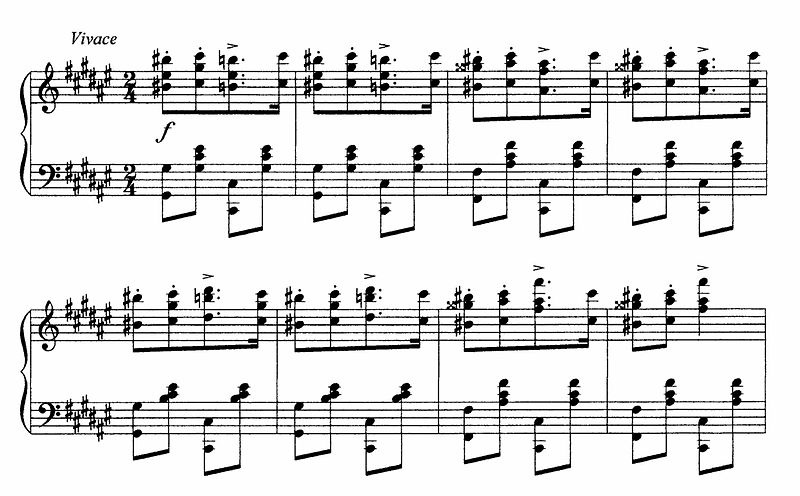
Franz Liszt’s “Hungarian Rhapsody no. 2 in c-sharp minor”

liszt

Hungarian Rhapsody No. 2, S.244/2, is the second in a set of 19 Hungarian Rhapsodies by composer Franz Liszt, and is by far the most famous of the set. Few other piano solos have achieved such widespread popularity, offering the pianist the opportunity to reveal exceptional skill as a virtuoso, while providing the listener with an immediate and irresistible musical appeal.

In both the original piano solo form and in the orchestrated version this composition has enjoyed widespread use in animated cartoons. Its themes have also served as the basis of several popular songs.

It is probable that you have heard this piece of music somewhere at one time or another because it is perhaps the most prominent piece of classical (romantic, actually) music featured in animated cartoons across the years.

Now, let the anvils fall and dynamite explode!

And, in real life, Valentina Lisitsa plays Liszt’s Hungarian Rhapsody No. 2

August 9 ~ Today in Music History

today


• 1874 ~ Reynaldo Hahn, Venezuelan-born French composer, conductor and music critic

• 1902 ~ Solomon Cutner, Classical pianist. A virtuoso performer, he played Tchaikovsky’s First Concerto at the age of 10. His career was stopped after a stroke in 1965.

https://youtu.be/4Vi0DwX6MEg

• 1902 ~ Zino (Rene) Francescatti, French concert violinist; passed away in 1991

• 1910 ~ A.J. Fisher of Chicago, IL received a patent for an invention that moms, grandmas and single guys certainly came to appreciate: the electric washing machine. Previous to Mr. Fisher’s invention, washing machines were cranked by hand (not easily done) – or you used a washboard (also sometimes used as a musical instrument).

• 1919 ~ Ruggiero Leoncavallo, Italian composer and librettist, died. He is famous for the single opera “Pagliacci” but never repeated the success with his other works.
More information about Leoncavallo

• 1932 ~ Helen Morgan joined the Victor Young orchestra to record Bill, a popular tune from Broadway’s Showboat.

• 1934 ~ Merle Kilgore, Songwriter Hall of Famer

• 1939 ~ Billy Henderson, Singer with Spinners

• 1955 ~ Benjamin Orr (Orzechowski), Musician, bass guitar, singer with The Cars

• 1963 ~ Whitney Houston, Grammy Award-winning singer

https://youtu.be/N_lCmBvYMRs

• 1963 ~ The TV program Ready, Set, Go! premiered on the BBC in London, England. The show gave exposure to such music luminaries as Bob Dylan and The Rolling Stones.

• 1964 ~ Joan Baez and Bob Dylan shared the stage for the first time when the singers performed in a concert in Forest Hills, NY.

• 1969 ~ Hot Fun in The Summertime, by Sly and the Family Stone, and Easy to Be Hard, from the Broadway production Hair, were released on this day. Hot Fun made it to number two on the music charts and Easy to Be Hard climbed to number four.

• 1975 ~ Dmitri Shostakovitch, Russian composer, died. He wrote 15 symphonies as well as operas, ballets and film and theater scores.
More information about Shostakovitch

https://youtu.be/tAL50lkWI8g

• 1995 ~ Jerry Garcia passed away

• 2003 ~ Chester Ludgin, a baritone in the New York City Opera for more than 30 years, died at the age of 78.
Ludgin sang a host of lead baritone parts, but was most recognizable in operas including “The Ballad of Baby Doe,” “The Devil and Daniel Webster” and “Susannah.” He debuted at the City Opera in 1957 in Johann Strauss II’s “Fledermaus.”
He also portrayed the part of Sam for Leonard Bernstein’s “A Quiet Place” at the Houston Grand Opera in 1983. He also sang for the San Francisco Opera and other North American companies.
His last appearance at City Opera was in 1991, but he remained on the stage, singing in musical comedies. His most recent lead was in “The Most Happy Fella.”

• 2005 ~ News Item:  New Vivaldi work heard for first time in 250 years.

August 8 ~ Today in Music History

today


• 1886 ~ Pietro Yon, Italian composer
More information about Yon

• 1899 ~ Russell Markert, Choreographer, founded and directed the Radio City Music Hall Rockettes

• 1905 ~ André Jovilet, French composer and conductor

• 1907 ~ Benny Carter, American jazz solo saxophonist, trumpeter, composer and arranger

• 1921 ~ Roger Nixon, American composer

• 1921 ~ Webb Pierce, Singer

• 1923 ~ Jimmy Witherspoon, Singer

• 1923 ~ Benny Goodman was 14 years old as he began his professional career as a clarinet player. He took a job in a band on a Chicago-based excursion boat on Lake Michigan.

• 1926 ~ Urbie (Urban) Green, Musician, trombonist who played with Cab Calloway

• 1932 ~ Mel Tillis, Singer, songwriter

• 1933 ~ Joe Tex (Arrington, Jr.), Singer

• 1934 ~ Bing Crosby became the first singer to record for the newly created Decca Records. His songs, Just A-Wearyin’ For You and I Love You Truly, were recorded as Decca number D-100.

• 1938 ~ Connie Stevens (Concetta Ingolia), Singer

• 1939 ~ Philip Balsley, Singer with The Statler Brothers

• 1941 ~ Les Brown and His Band of Renown paid tribute to baseball’s “Yankee Clipper”, Joe DiMaggio of the New York Yankees, with the recording of Joltin’ JoeDiMaggio on Okeh Records. From that time on, DiMaggio adopted the nickname, Joltin’ Joe.

• 1949 ~ Keith Carradine, Actor and composer, whose recording of I’m Easy reached No. 17 on the U.S. charts in 1976.

• 1950 ~ Andy Fairweather-Low, Musician, guitar, singer with Amen Corner

• 1958 ~ Harry (Harry Lillis III) Crosby, Singer and actor, son of Bing Crosby and Kathryn Grant

• 1958 ~ Chris Foreman, Musician, guitar with Madness

• 1960 ~ Tell Laura I Love Her, by Ray Peterson, wasn’t a big hit in Great Britain. Decca Records in England said the song was “too tasteless and vulgar for the English sensibility.” They destroyed 25,000 of the platters this day.

• 1961 ~ The Edge (David Evans), Musician, guitar with U2

• 1974 ~ Roberta Flack received a gold record for the single, Feel Like Makin’ Love. Flack, born in Asheville, NC and raised in Arlington, VA, was awarded a music scholarship to Howard University in Washington, DC at the age of 15. One of her classmates became a singing partner on several hit songs. Donny Hathaway joined Flack on You’ve Got a Friend, Where is the Love and The Closer I Get to You. She had 10 hits on the pop charts in the 1970s and 1980s.

• 1975 ~ Julian ‘Cannonball’ Adderly passed away