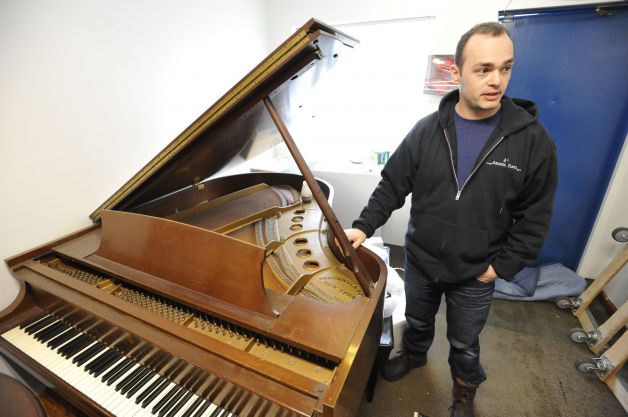
Yury Feygin, owner of Amadeus Piano, shows off a Steinway piano on display at his business in Stamford, Conn., on Wednesday, Feb. 4, 2015. The piano company mainly deals with tuning, repairs, moving, storage, restoration and antique piano sales with locations in Westport and Long Island, NY.Photo: Jason Rearick
Yury Feygin likes playing with pianos — so much, in fact, that he occasionally forgets to eat and sleep.
Like his father, Mikhail, and grandfather, Semyon, Feygin is an expert at restoring, tuning and repairing antique pianos.
Feygin and his workers have built a first-of-its-kind double-decker storage system at their Lenox Avenue warehouse. They have stashed dozens of pianos in the racks, legs removed, filed side-by-side like massive dominos as they await restoration.
“Getting pianos off the ground isn’t a comfortable thing — you’ve got to worry about it falling when you’re handling it, but we have it down to a science,” said Feygin. “People were saying, my dad was saying, `Don’t do this, let me store your stuff.'”
The making of a Steinway piano is a time-honored process involving the hands of many skilled craftspeople over the course of almost a full year. Steinway & Sons pianos are built in just two factories worldwide – one in Astoria, NY and one in Hamburg, Germany. Both factories have been building pianos for well over a century, and although Steinway has always been at the cutting edge in utilizing and perfecting the latest technology where it could make the piano better, we have found that certain things are simply better when done by skilled craftspeople than by a machine. For that reason, many parts of the process in building a Steinway have remained essentially unchanged for generations. So much so, that we were able to take decades-old audio from a narrated factory tour by the late John H. Steinway (great-grandson of Henry E. Steinway, who founded our great company in 1853) and use it as the narration for footage shot at the Steinway NY factory in 2011 by Ben Niles, producer of the documentary film “Note by Note” (http://www.notebynotethemovie.com).
We hope you enjoy this look inside the Steinway New York factory, narrated in detail by the late, great John Steinway.
Cassidy Turley and The Durst Organization announced that they secured a 15-year, 40,000 s/f lease for renowned piano manufacturer and retailer, Steinway & Son, at 1133 Avenue of the Americas.
…
Given Steinway’s time pressure to move out of its existing location by the end of 2014, the team secured a temporary location at 1155 Avenue of the Americas, also with The Durst Organization.
This short-term “pop-up store” will allow Steinway to remain open as the new headquarters is being constructed, allowing for continuous service to its customers.
Steinway, well-known for handcrafting the world’s finest pianos, will now have a gallery space that encompasses approximately 18,000 s/for both retail and showroom, and a small concert hall that caters to the world’s most prominent pianists.
The space will be designed by architect Annabelle Selldorf. There will also be a private space that can be used by concert pianists looking to sample Steinway’s collection of instruments.
• 1726 ~ The first performance of J. S. Bach‘s Sacred Cantata No. 55 Ich armer Mensch, ich Sündenknecht on the 22nd Sunday following Trinity. Was part of Bach’s third annual Sacred Cantata cycle in Leipzig 1725-27
• 1876~ The first performance of Peter Ilyich Tchaikovsky‘s March Slav in Moscow.
• 1877 ~ The first production of Gilbert and Sullivan’s opera, The Sorcerer, was presented, in London.
• 1888~ The first production of Tchaikovsky‘s Fifth Symphony in St. Petersburg.
• 1891 ~ Poland’s premier and premier ivory tickler, Ignace Jan Paderewski, made his American debut at Carnegie Hall in New York City. In later years, Paderewski, who suffered from arthritis, settled in Paso Robles, CA. The hot mineral baths located there eased his pain. He played only Steinway grand pianos custom-built to his specifications. In fact, five were made just for his use.
• 1925 ~ Sir Charles Mackerras, Australian conductor
• 1930 ~ David Amram, American composer and French-horn player
• 1938 ~ Gordon Lightfoot, Canadian folk singer, songwriter and guitarist
• 1938 ~ Orchestra leader Kay Kyser, speaking to an audience at the College of the City of New York (CCNY) told of the “inner workings and artistic features of swing music.” It marked the first of a series of lectures on swing music presented by Kyser, who went on to presentThe Kollege of Musical Knowledge on radio.
• 1941 ~ Gene Clark, Singer, guitar with The Byrds
• 1942 ~ Bob Gaudio, Singer with The Royal Teens; The Four Seasons
• 1946 ~ Martin Barre, Guitarist with Jethro Tull
• 1950 ~ Roberta Peters filled in for the lead in Mozart’s Don Giovanni, making her debut at the Metropolitan Opera in New York City. She would become one of the Met’s most famous stars.
• 1962 ~ The 4 Seasons, with Frankie Valli as lead singer, began a five-week run at the top of the tunedex with Big Girls Don’t Cry.
• 1967 ~ Ronald DeVoe, Singer with New Edition
• 1970 ~ Elton John recorded an album live, on what was WABC-FM in New York City. It marked the first time that a concert was aired live and recorded for release as aired. The LP was titled, 11/17/70.
• 2001 ~ Jerry Jerome, a tenor sax player who was a featured soloist with the bands of Glenn Miller and Benny Goodman, died of leukemia. He was 89. One of the big names in the Big Band era, Jerome was a featured soloist with the Glenn Miller, Benny Goodman, Red Norvo and Artie Shaw orchestras. He then became a successful musical director and conductor on radio and television. Jerome also established a music business, scoring and arranging commercial jingles. Three years ago, Arbors Records released Jerome’s “Something Old, Something New.” The sequel recording, “Something Borrowed, Something Blue,” will be released in December. Born in Brooklyn, N.Y., Jerome started playing the sax while in high school. He attended the University of Alabama and went on the medical school, playing gigs at jazz clubs to earn tuition money. He joined Goodman’s orchestra at the height of its popularity in 1938. When Goodman broke up his band in 1940, Jerome joined Shaw. While with Shaw, he appeared in the film “Second Chorus,” with Fred Astaire and Burgess Meredith.
• 2003 ~ Arthur Conley, a 1960s soul singer and protege of Otis Redding’s, died at his home in the town of Ruurlo, in the eastern Netherlands. He was 57. Conley was born in Atlanta and started his recording career in 1959 as leader of the group Arthur and the Corvets. He was best known for his 1967 hit, Sweet Soul Music, which he co-wrote with Redding based on a number by Sam Cooke. Conley had several minor hits in the following two years. He moved to Europe in the early 1970s after several tours of the continent, deciding that he was “fed up with the pressure” in the United States, said Giesen. In the Netherlands, Conley appeared on television and radio, and ran an independent record label. In the last five years he was an adviser to The Original Sixties R&B and Soul Show, which sought to reproduce the sound and look of the heyday of soul.
Even these days, when cheap secondhand pianos are in plentiful supply, having been tossed aside to make way for compact, sophisticated keyboards, not many people can brag about owning a Steinway. Fewer own one that’s not worth bragging about. And then there’s the guy who actually went out of his way to buy one that’s not worth bragging about.
So gather ’round my 133-year-old Steinway upright, and hear a little ditty about a man with a laptop, a rental van and impulse-spending issues.
My tune is not quite a dirge, I suppose, since this piano is actually an improvement on the troll it displaced from my living room. But I’d have endured far less angst, and gotten more piano for my money, if I had listened to the experts before leaping at my “bargain” discovery…
I found this article from the New York Times very interesting about the Steinway Store moving.
The little room where Rachmaninoff practiced, the famous basement where up-and-coming virtuosos catnapped under the pianos, the palatial rotunda conceived by the architecture firm that designed Grand Central Terminal — Steinway & Sons is saying goodbye to all that and moving to a corner of a 1970s office building 14 blocks away.
Steinway sold its 1920s building on West 57th Street in 2012, with a deadline to leave by the end of December. Executives of the piano company are now close to signing a 15-year lease for 40,000 square feet of space at 1133 Avenue of the Americas, at West 43rd Street.





 MaryO'Studio