February 7: On This Day in Music

today

. 1710 ~ William Boyce, English organist/composer (Cathedral Music), born in London (d. 1779)

. 1818 ~ Henry Charles Litolff, piano virtuoso, composer of Romantic music and music publisher

. 1871 ~ Wilhelm Stenhammar [Carl Wilhelm Eugen Stenhammar], Swedish composer considered the finest Swedish pianist of his time, born in Stockholm, Sweden (d. 1927)

. 1883 ~ Herbert “Eubie” Blake, American jazz pianist, vaudevillian, songwriter and composer
More information about Blake

. 1920 ~ Oscar Brand, Folk singer, composer, music director of NBC-TV Sunday, host of Let’s Sing Out

. 1921 ~ Wilma Lee Cooper (Leary), Country singer with husband, Stoney and the group, Clinch Mountain Clan with her daughter, Carol Lee

. 1931 ~ The American opera, “Peter Ibbetson”, by Deems Taylor premiered at the Metropolitan Opera House in New York City.

. 1941 ~ The Tommy Dorsey Orchestra and Frank Sinatra teamed to record Everything Happens to Me for Victor Records in New York City.

. 1948 ~ Jimmy Greenspoon, Organist with Three Dog Night

. 1949 ~ Alan Lancaster, Bass with Status Quo

. 1959 ~ Brian Travers, Saxophone with UB40

. 1962 ~ (Troyal) Garth Brooks, American Grammy Award-winning singer: In Another’s Eyes (1998 with Trisha Yearwood), Friends in Low Places and The Thunder Rolls. His LP Ropin’ the Wind was the first LP in history to debut at #1 on Billboard’s pop and country charts, The Chase, In Pieces, Fresh Horses, Sevens, Double Live has sold over 80 million albums — second only to The Beatles.

. 1962 ~ David Bryan, Keyboards with Bon Jovi

. 1964 ~ 3,000+ fans crowded the JFK airport in New York to receive the four stars of the music sensation, The Beatles. One word summarizes the reaction to The Beatles on their first US tour: hysteria.

. 1969 ~ Tom Jones, ‘The Prince of Wales’, premiered on ABC-TV after the network acquired the rights to the singing sensation’s popular United Kingdom show. The network paid a British production company an estimated $20 million for those rights. And they cried in one of Tom’s hankies all the way to the bank.

. 1974 ~ Barry White’s Love Unlimited Orchestra received a gold record for the disco hit Love’s Theme.

. 1985 ~ New York, New York became the official anthem of the Big Apple. The announcement was made by then New York mayor, Ed “How’m I Doin’?” Koch. Frank Sinatra fans rejoiced at the honor.

. 2001 ~ Dale Evans died at the age of 88. She was an actress-singer who became “Queen of the West” by starring with husband Roy Rogers in 27 cowboy films and writing their theme song, Happy Trails.

. 2002 ~ Bert Conway, an actor and director whose 60-year career included theater, movies and television, died of heart failure. He was 87. The son of vaudeville performers, Conway was born in Orange, N.J. He had a walk-on part in the original 1937 Group Theater staging of Clifford Odets’ “Golden Boy” and later had the lead as a reform school youth in Lee Strasberg’s production of “Dance Night.” After serving in the Army in World War II, Conway went to Hollywood. He began directing plays in 1947. His work included the first interracial production of “Golden Boy” for the Negro Art Theater in Los Angeles. In 1950, he returned to New York to act in and direct plays. His work included an off-Broadway revival of “Deep Are the Roots” and appearances with Joseph Papp’s New York Shakespeare Festival. He also appeared in several road company productions, had small roles in the movies “The Three Musketeers,” “Little Big Man” and “The Arrangement,” and on TV’s “St. Elsewhere.”

. 2009 ~ Blossom Dearie, American jazz singer and pianist, died of natural causes at the age of 84
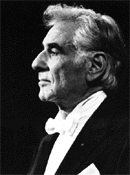
Leonard Bernstein: What Does Music Mean?

On January 18, 1958 Leonard Bernstein began presenting his television series What does music mean?  The series ran for 53 programs.  Some of the episodes can be found below:

Part 1 What is Classical Music?

Plot: Bernstein conducts Handel’s Water Music and cites it as an indisputable example of classical music. “Exact” is the word that best defines classical music, Bernstein says and he demonstrates with musical illustrations from Bach’s Fourth Brandenburg Concerto, Mozart’s Concerto No. 21 in C Major and The Marriage of Figaro, and Haydn’s Symphony No. 102.

The decline of classical music at the end of the eighteenth century is tied to Beethoven’s innovations and the Romantic movement, and Bernstein conducts Beethoven’s Egmont Overture.


Part 2 What is Melody?

Plot: Bernstein discusses the different forms melody can take, including tune, theme, motive, melodic line and musical phrase. He illustrates by conducting the orchestra in excerpts from Tchaikovsky, Wagner, Hindemith, and Brahms.


Part 3 What is a Mode?

Plot: Bernstein discusses scales, intervals, and tones, and analyzes several pieces, including Debussy’s Fêtes, Rimsky-Korsakov’s Scheherazade, and music from the Kinks and the Beatles, to illustrate different modes.

An excerpt from Bernstein’s ballet Fancy Free is also performed.

Composers – V


Varèse

Edgard Varèse was born in Paris, December 22, 1885 and died in New York, November 6, 1965. Although born in France, Varèse lived and worked most of his life in the United States. A pioneer of the avant-garde movement in music, Varèse experimented with electronic music, musique concréte;, and some highly original experimentation in the uses and organization of rhythm. The works for which he is best known are those in which he completely rejects traditional melody and harmony, instead building these compositions from blocks of sounds, relying on tone color, texture and rhythm. Varèse’s most original work exemplifying this technique is probably Ionisation, which is scored for a huge percussion ensemble, piano, and sirens.

Vaughan Williams

Ralph Vaughan Williams lived between 1872 and 1958. He is considered to be a romantic composer. His works include Fantasia on Greensleeves, The Pilgrim’s Progress, Fantasia on a Theme of Tallis and Mass in G Minor.

Verdi

Giuseppe Verdi lived between 1813 and 1901. He is considered to be a romantic composer. He was an Italian operatic composer who achieved his first major success with Nabucco (1842). He was the leading figure of Italian music in the nineteenth century and made important contributions to the development of opera.

The singing melodies of his popular operas, like Rigoletto, La Traviata, Il Trovatore, Aida, have come to represent Italian opera to much of the world. The late operas Otello and Falstaff crowned his achievement.

de Victoria

One of the works of Tomás Luis de Victoria was chosen in Best 100 Classical Pieces of the Millenium.

Vivaldi

Antonio Vivaldi lived from 1678 until 1741 and was considered to be a baroque composer. He was an Italian composer of instrumental music and opera. He was important in the development of the concerto. Vivaldi was ordained as a priest in 1703, but gave up saying Mass due to a chest illness. From 1704 until 1740, he taught violin at an orphanage, gave recitals, played the violin in operatic performances and produced some operas of his own.

The concertos that Vivaldi wrote helped define the genre in the Baroque and into the Classical era. These normally comprised three movements (fast, slow, fast); the fast movement regularly employed a ritornello form. In this form, an orchestral melody alternates with the freer sections that feature the soloist or soloists. The repetition of the ritornello provides a point of reference for the listener, allowing the soloist to stand out. It also allows the composer a greater degree of freedom in how the soloist’s material is treated.

Vivaldi’s concertos also stand out for the degree of inventiveness that he brought to them. While challenging the player, they also engage the listener. One of his most famous groups of concertos, The Four Seasons, demonstrates this well, and shows the more dramatic and colorful potential of the genre. Each concerto represents a different season, and the music illustrates in sound a picture created by an accompanying poem. Vivaldi uses his ingenuity to take the mundane sounds of daily life (the barking of a dog, the buzzing of flies), along with more dramatic sounds (a violent spring storm), and portray them in purely musical language that stands on its own merit. These early examples of program music well deserve their place in the popular canon of classical music.

Works:
Orchestral music, including over 239 violin concertos, including Le quattro stagioni (The Four Seasons), Op.8, Nos.1-4, c.1725), other solo concertos (bassoon, cello, oboe, flute, recorder), double concertos, ensemble concertos, sinfonias

Chamber music, including sonatas for violin, cello and flute, trio sonatas
Vocal music, including oratorios (Juditha triumphans, 1716), Mass movements (Gloria), Magnificat, psalms, hymns and motets
Secular vocal music, including solo cantatas and operas

His most famous work, The Four Seasons, was written in 1725.

Vivaldi was a contemporary of Johann Sebastian Bach.

February 7: On This Day in Music

today

. 1710 ~ William Boyce, English organist/composer (Cathedral Music), born in London (d. 1779)

. 1818 ~ Henry Charles Litolff, piano virtuoso, composer of Romantic music and music publisher

. 1871 ~ Wilhelm Stenhammar [Carl Wilhelm Eugen Stenhammar], Swedish composer considered the finest Swedish pianist of his time, born in Stockholm, Sweden (d. 1927)

. 1883 ~ Herbert “Eubie” Blake, American jazz pianist, vaudevillian, songwriter and composer
More information about Blake

. 1920 ~ Oscar Brand, Folk singer, composer, music director of NBC-TV Sunday, host of Let’s Sing Out

. 1921 ~ Wilma Lee Cooper (Leary), Country singer with husband, Stoney and the group, Clinch Mountain Clan with her daughter, Carol Lee

. 1931 ~ The American opera, “Peter Ibbetson”, by Deems Taylor premiered at the Metropolitan Opera House in New York City.

. 1941 ~ The Tommy Dorsey Orchestra and Frank Sinatra teamed to record Everything Happens to Me for Victor Records in New York City.

. 1948 ~ Jimmy Greenspoon, Organist with Three Dog Night

. 1949 ~ Alan Lancaster, Bass with Status Quo

. 1959 ~ Brian Travers, Saxophone with UB40

. 1962 ~ (Troyal) Garth Brooks, American Grammy Award-winning singer: In Another’s Eyes (1998 with Trisha Yearwood), Friends in Low Places and The Thunder Rolls. His LP Ropin’ the Wind was the first LP in history to debut at #1 on Billboard’s pop and country charts, The Chase, In Pieces, Fresh Horses, Sevens, Double Live has sold over 80 million albums — second only to The Beatles.

. 1962 ~ David Bryan, Keyboards with Bon Jovi

. 1964 ~ 3,000+ fans crowded the JFK airport in New York to receive the four stars of the music sensation, The Beatles. One word summarizes the reaction to The Beatles on their first US tour: hysteria.

. 1969 ~ Tom Jones, ‘The Prince of Wales’, premiered on ABC-TV after the network acquired the rights to the singing sensation’s popular United Kingdom show. The network paid a British production company an estimated $20 million for those rights. And they cried in one of Tom’s hankies all the way to the bank.

. 1974 ~ Barry White’s Love Unlimited Orchestra received a gold record for the disco hit Love’s Theme.

. 1985 ~ New York, New York became the official anthem of the Big Apple. The announcement was made by then New York mayor, Ed “How’m I Doin’?” Koch. Frank Sinatra fans rejoiced at the honor.

. 2001 ~ Dale Evans died at the age of 88. She was an actress-singer who became “Queen of the West” by starring with husband Roy Rogers in 27 cowboy films and writing their theme song, Happy Trails.

. 2002 ~ Bert Conway, an actor and director whose 60-year career included theater, movies and television, died of heart failure. He was 87. The son of vaudeville performers, Conway was born in Orange, N.J. He had a walk-on part in the original 1937 Group Theater staging of Clifford Odets’ “Golden Boy” and later had the lead as a reform school youth in Lee Strasberg’s production of “Dance Night.” After serving in the Army in World War II, Conway went to Hollywood. He began directing plays in 1947. His work included the first interracial production of “Golden Boy” for the Negro Art Theater in Los Angeles. In 1950, he returned to New York to act in and direct plays. His work included an off-Broadway revival of “Deep Are the Roots” and appearances with Joseph Papp’s New York Shakespeare Festival. He also appeared in several road company productions, had small roles in the movies “The Three Musketeers,” “Little Big Man” and “The Arrangement,” and on TV’s “St. Elsewhere.”

. 2009 ~ Blossom Dearie, American jazz singer and pianist, died of natural causes at the age of 84

What Does Music Mean? ~ Leonard Bernstein

On January 18, 1958 Leonard Bernstein began presenting his television series What does music mean?  The series ran for 53 programs.  Some of the episodes can be found below:

Part 1 What is Classical Music?

Plot: Bernstein conducts Handel’s Water Music and cites it as an indisputable example of classical music. “Exact” is the word that best defines classical music, Bernstein says and he demonstrates with musical illustrations from Bach’s Fourth Brandenburg Concerto, Mozart’s Concerto No. 21 in C Major and The Marriage of Figaro, and Haydn’s Symphony No. 102.

The decline of classical music at the end of the eighteenth century is tied to Beethoven’s innovations and the Romantic movement, and Bernstein conducts Beethoven’s Egmont Overture.

https://youtu.be/rxwWlQNGeKE


Part 2 What is Melody?

Plot: Bernstein discusses the different forms melody can take, including tune, theme, motive, melodic line and musical phrase. He illustrates by conducting the orchestra in excerpts from Tchaikovsky, Wagner, Hindemith, and Brahms.

https://youtu.be/O09V4NQkOKI


Part 3 What is a Mode?

Plot: Bernstein discusses scales, intervals, and tones, and analyzes several pieces, including Debussy’s Fêtes, Rimsky-Korsakov’s Scheherazade, and music from the Kinks and the Beatles, to illustrate different modes.

An excerpt from Bernstein’s ballet Fancy Free is also performed.

https://youtu.be/k5dWEPXF_ZU


Franz Liszt: Hungarian Rhapsody no. 2 in c-sharp minor

liszt

Hungarian Rhapsody No. 2, S.244/2, is the second in a set of 19 Hungarian Rhapsodies by composer Franz Liszt, and is by far the most famous of the set. Few other piano solos have achieved such widespread popularity, offering the pianist the opportunity to reveal exceptional skill as a virtuoso, while providing the listener with an immediate and irresistible musical appeal.

In both the original piano solo form and in the orchestrated version this composition has enjoyed widespread use in animated cartoons. Its themes have also served as the basis of several popular songs.

It is probable that you have heard this piece of music somewhere at one time or another because it is perhaps the most prominent piece of classical (romantic, actually) music featured in animated cartoons across the years.

Now, let the anvils fall and dynamite explode!

And, in real life, Valentina Lisitsa plays Liszt’s Hungarian Rhapsody No. 2

This piece is available in Piano Pronto Movement 5 and several anthologies of classical music.

On February 7 in Music History

today

. 1710 ~ William Boyce, English organist/composer (Cathedral Music), born in London (d. 1779)

. 1818 ~ Henry Charles Litolff, piano virtuoso, composer of Romantic music and music publisher

. 1871 ~ Wilhelm Stenhammar [Carl Wilhelm Eugen Stenhammar], Swedish composer considered the finest Swedish pianist of his time, born in Stockholm, Sweden (d. 1927)

. 1883 ~ Herbert “Eubie” Blake, American jazz pianist, vaudevillian, songwriter and composer
More information about Blake

. 1920 ~ Oscar Brand, Folk singer, composer, music director of NBC-TV Sunday, host of Let’s Sing Out

. 1921 ~ Wilma Lee Cooper (Leary), Country singer with husband, Stoney and the group, Clinch Mountain Clan with her daughter, Carol Lee

. 1931 ~ The American opera, “Peter Ibbetson”, by Deems Taylor premiered at the Metropolitan Opera House in New York City.

. 1941 ~ The Tommy Dorsey Orchestra and Frank Sinatra teamed to record Everything Happens to Me for Victor Records in New York City.

. 1948 ~ Jimmy Greenspoon, Organist with Three Dog Night

. 1949 ~ Alan Lancaster, Bass with Status Quo

. 1959 ~ Brian Travers, Saxophone with UB40

. 1962 ~ (Troyal) Garth Brooks, American Grammy Award-winning singer: In Another’s Eyes (1998 with Trisha Yearwood), Friends in Low Places and The Thunder Rolls. His LP Ropin’ the Wind was the first LP in history to debut at #1 on Billboard’s pop and country charts, The Chase, In Pieces, Fresh Horses, Sevens, Double Live has sold over 80 million albums — second only to The Beatles.

. 1962 ~ David Bryan, Keyboards with Bon Jovi

. 1964 ~ 3,000+ fans crowded the JFK airport in New York to receive the four stars of the music sensation, The Beatles. One word summarizes the reaction to The Beatles on their first US tour: hysteria.

. 1969 ~ Tom Jones, ‘The Prince of Wales’, premiered on ABC-TV after the network acquired the rights to the singing sensation’s popular United Kingdom show. The network paid a British production company an estimated $20 million for those rights. And they cried in one of Tom’s hankies all the way to the bank.

. 1974 ~ Barry White’s Love Unlimited Orchestra received a gold record for the disco hit Love’s Theme.

. 1985 ~ New York, New York became the official anthem of the Big Apple. The announcement was made by then New York mayor, Ed “How’m I Doin’?” Koch. Frank Sinatra fans rejoiced at the honor.

. 2001 ~ Dale Evans died at the age of 88. She was an actress-singer who became “Queen of the West” by starring with husband Roy Rogers in 27 cowboy films and writing their theme song, Happy Trails.

. 2002 ~ Bert Conway, an actor and director whose 60-year career included theater, movies and television, died of heart failure. He was 87. The son of vaudeville performers, Conway was born in Orange, N.J. He had a walk-on part in the original 1937 Group Theater staging of Clifford Odets’ “Golden Boy” and later had the lead as a reform school youth in Lee Strasberg’s production of “Dance Night.” After serving in the Army in World War II, Conway went to Hollywood. He began directing plays in 1947. His work included the first interracial production of “Golden Boy” for the Negro Art Theater in Los Angeles. In 1950, he returned to New York to act in and direct plays. His work included an off-Broadway revival of “Deep Are the Roots” and appearances with Joseph Papp’s New York Shakespeare Festival. He also appeared in several road company productions, had small roles in the movies “The Three Musketeers,” “Little Big Man” and “The Arrangement,” and on TV’s “St. Elsewhere.”

. 2009 ~ Blossom Dearie, American jazz singer and pianist, died of natural causes at the age of 84
What Does Music Mean? ~ Bernstein

On January 18, 1958 Leonard Bernstein began presenting his television series What does music mean?  The series ran for 53 programs.  Some of the episodes can be found below:

Part 1 What is Classical Music?

Plot: Bernstein conducts Handel’s Water Music and cites it as an indisputable example of classical music. “Exact” is the word that best defines classical music, Bernstein says and he demonstrates with musical illustrations from Bach’s Fourth Brandenburg Concerto, Mozart’s Concerto No. 21 in C Major and The Marriage of Figaro, and Haydn’s Symphony No. 102.

The decline of classical music at the end of the eighteenth century is tied to Beethoven’s innovations and the Romantic movement, and Bernstein conducts Beethoven’s Egmont Overture.

https://youtu.be/rxwWlQNGeKE


Part 2 What is Melody?

Plot: Bernstein discusses the different forms melody can take, including tune, theme, motive, melodic line and musical phrase. He illustrates by conducting the orchestra in excerpts from Tchaikovsky, Wagner, Hindemith, and Brahms.

https://youtu.be/O09V4NQkOKI


Part 3 What is a Mode?

Plot: Bernstein discusses scales, intervals, and tones, and analyzes several pieces, including Debussy’s Fêtes, Rimsky-Korsakov’s Scheherazade, and music from the Kinks and the Beatles, to illustrate different modes.

An excerpt from Bernstein’s ballet Fancy Free is also performed.

https://youtu.be/k5dWEPXF_ZU


Liszt: Hungarian Rhapsody no. 2 in c-sharp minor

liszt

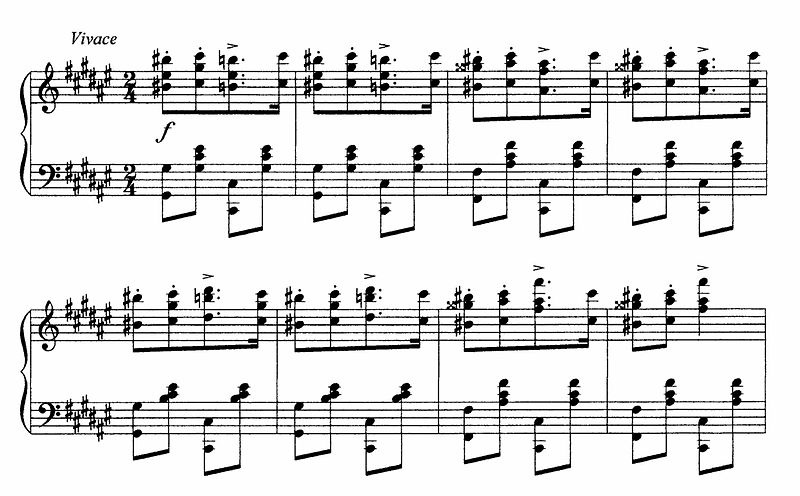
Hungarian Rhapsody No. 2, S.244/2, is the second in a set of 19 Hungarian Rhapsodies by composer Franz Liszt, and is by far the most famous of the set. Few other piano solos have achieved such widespread popularity, offering the pianist the opportunity to reveal exceptional skill as a virtuoso, while providing the listener with an immediate and irresistible musical appeal.

In both the original piano solo form and in the orchestrated version this composition has enjoyed widespread use in animated cartoons. Its themes have also served as the basis of several popular songs.

It is probable that you have heard this piece of music somewhere at one time or another because it is perhaps the most prominent piece of classical (romantic, actually) music featured in animated cartoons across the years.

Now, let the anvils fall and dynamite explode!

And, in real life, Valentina Lisitsa plays Liszt’s Hungarian Rhapsody No. 2

This piece is available in Piano Pronto Movement 5 and several anthologies of classical music.

February 7 in Music History

today

. 1710 ~ William Boyce, English organist/composer (Cathedral Music), born in London (d. 1779)

. 1818 ~ Henry Charles Litolff, piano virtuoso, composer of Romantic music and music publisher

. 1871 ~ Wilhelm Stenhammar [Carl Wilhelm Eugen Stenhammar], Swedish composer considered the finest Swedish pianist of his time, born in Stockholm, Sweden (d. 1927)

. 1883 ~ Herbert “Eubie” Blake, American jazz pianist, vaudevillian, songwriter and composer
More information about Blake

. 1920 ~ Oscar Brand, Folk singer, composer, music director of NBC-TV Sunday, host of Let’s Sing Out

. 1921 ~ Wilma Lee Cooper (Leary), Country singer with husband, Stoney and the group, Clinch Mountain Clan with her daughter, Carol Lee

. 1931 ~ The American opera, “Peter Ibbetson”, by Deems Taylor premiered at the Metropolitan Opera House in New York City.

. 1941 ~ The Tommy Dorsey Orchestra and Frank Sinatra teamed to record Everything Happens to Me for Victor Records in New York City.

. 1948 ~ Jimmy Greenspoon, Organist with Three Dog Night

. 1949 ~ Alan Lancaster, Bass with Status Quo

. 1959 ~ Brian Travers, Saxophone with UB40

. 1962 ~ (Troyal) Garth Brooks, American Grammy Award-winning singer: In Another’s Eyes (1998 with Trisha Yearwood), Friends in Low Places and The Thunder Rolls. His LP Ropin’ the Wind was the first LP in history to debut at #1 on Billboard’s pop and country charts, The Chase, In Pieces, Fresh Horses, Sevens, Double Live has sold over 80 million albums — second only to The Beatles.

. 1962 ~ David Bryan, Keyboards with Bon Jovi

. 1964 ~ 3,000+ fans crowded the JFK airport in New York to receive the four stars of the music sensation, The Beatles. One word summarizes the reaction to The Beatles on their first US tour: hysteria.

. 1969 ~ Tom Jones, ‘The Prince of Wales’, premiered on ABC-TV after the network acquired the rights to the singing sensation’s popular United Kingdom show. The network paid a British production company an estimated $20 million for those rights. And they cried in one of Tom’s hankies all the way to the bank.

. 1974 ~ Barry White’s Love Unlimited Orchestra received a gold record for the disco hit Love’s Theme.

. 1985 ~ New York, New York became the official anthem of the Big Apple. The announcement was made by then New York mayor, Ed “How’m I Doin’?” Koch. Frank Sinatra fans rejoiced at the honor.

. 2001 ~ Dale Evans died at the age of 88. She was an actress-singer who became “Queen of the West” by starring with husband Roy Rogers in 27 cowboy films and writing their theme song, Happy Trails.

. 2002 ~ Bert Conway, an actor and director whose 60-year career included theater, movies and television, died of heart failure. He was 87. The son of vaudeville performers, Conway was born in Orange, N.J. He had a walk- on part in the original 1937 Group Theater staging of Clifford Odets’ “Golden Boy” and later had the lead as a reform school youth in Lee Strasberg’s production of “Dance Night.” After serving in the Army in World War II, Conway went to Hollywood. He began directing plays in 1947. His work included the first interracial production of “Golden Boy” for the Negro Art Theater in Los Angeles. In 1950, he returned to New York to act in and direct plays. His work included an off-Broadway revival of “Deep Are the Roots” and appearances with Joseph Papp’s New York Shakespeare Festival. He also appeared in several road company productions, had small roles in the movies “The Three Musketeers,” “Little Big Man” and “The Arrangement,” and on TV’s “St. Elsewhere.”