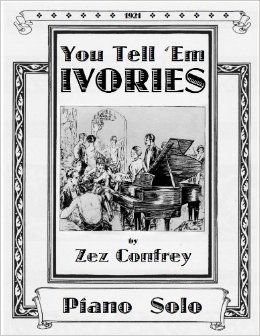
This is a more advanced piece but I really like it. Some students may have heard this since it’s an alarm tone on my phone. My dog, Mimi, recognized this music as her signal to go out for a walk!
I just love Zez Confrey’s music. It’s not overplayed like some of Scott Joplin’s works but it’s just as much fun.
This is a piece I have often played in recitals and just for fun.
If any of my students are interested in tackling this piece, just let me know and we’ll start learning!
In 1921 Confrey wrote his novelty piano solo “Kitten on the Keys”, inspired by hearing his grandmother’s cat walk on the keyboard of her piano. It became a hit, and he went on to compose many other pieces in the genre.
Considered to be one of the fastest and most challenging of all “novelty” piano solos, “Dizzy Fingers” was composed in 1923. and was Confrey’s other biggest seller.
He left behind more than a hundred piano works, songs and miniature operas, and numerous piano rolls, music publications and sound recordings.
Not surprisingly, this piece is not available on Piano Maestro!
“This collection represents a cross-section of Confrey’s works and encompasses the broad range of his styles. Besides his famous 1920s novelty works (including Kitten on the Keys), there are many wonderful, lesser-known gems of remarkable quality included here from later in his career. Appearing for the first time in print are transcriptions of one of his disc recordings (Poor Buttermilk) and two of his player piano roll arrangements (My Pet and Humorestless). Many of Confrey’s later works have long been out of print and are included here for the first time in decades.”
What can I say about John Cage’s 4′33″? Pretty much anyone can play this anytime.
It consists of the pianist going to the piano, and not hitting any keys for four minutes and thirty-three seconds. (He uses a stopwatch to time this.) In other words, the entire piece consists of silence or rests.
On the one hand, as a musical piece, 4’33” leaves almost no room for the pianist’s interpretation: as long as he watches the stopwatch, he can’t play it too fast or too slow; he can’t hit the wrong keys; he can’t play it too loud, or too melodramatically, or too subduedly.
On the other hand, what you hear when you listen to 4’33” is more a matter of chance than with any other piece of music — nothing of what you hear is anything the composer wrote.
With orchestra and soloist
Next time you come to a lesson and haven’t practiced, just tell me you’re playing Cage’s 4’33”!
• 1638 ~ Nicolas Forme, Composer, died at the age of 71
• 1652 ~ Jacques Huyn, Composer, died at the age of 39
• 1690 ~ Giovanni Legrenzi, Italian Composer, died at the age of 63
• 1708 ~ Jacques Danican Philidor, Composer, died at the age of 51
• 1738 ~ Bonaventura Furlanetto, Composer
• 1796 ~ James S McLean patented his piano
• 1799 ~ Jacques-François-Fromental-Elie Halévy, French composer whose five-act grand opera La Juive (1835) was, with Giacomo Meyerbeer’s Les Huguenots, the prototype of early French grand opera.
• 1822 ~ Joseph Joachim Raff, German composer and teacher, greatly celebrated in his lifetime but nearly forgotten in the late 20th century.
• 1822 ~ Henry Wylde, Composer
• 1840 ~ Niccolò Paganini Composer and violinist died at the age of 57. He wrote six concertos for violin.
Read quotes by and about Paganini
More information about Paganini
• 1849 ~ “Blind” Tom Bethune, Pianist and composer
• 1878 ~ Isadora Duncan, Dancer
• 1878 ~ Carlo Marsili, Composer, died at the age of 49
• 1884 ~ Bax Brod, Composer
• 1888 ~ Louis Durey, Composer
• 1891 ~ Claude Adonai Champagne, Composer
• 1900 ~ Leopold Godowsky, Jr., American musician and photographic technician primarily known as a co-developer of Kodachrome film (1935).
• 1915 ~ Mario del Monaco, Italian opera singer famed for Verdi and Puccini
• 1928 ~ Thea Musgrave, Scottish composer, best known for her concertos operas and choral and other vocal works.
• 1929 ~ Donald Howard Keats, Composer
• 1930 ~ Eino Tamberg, Composer
• 1931 ~ Veroslav Neumann, Composer
• 1932 ~ Jeffrey Bernard, Singer
• 1935 ~ Ramsey Lewis, American jazz pianist, composer and bandleader
• 1935 ~ Elias Gistelinck, Flemish Composer
• 1939 ~ Don Williams, Country singer
• 1940 ~ Rene Koering, Composer
• 1942 ~ Priscilla Anne McLean, Composer
• 1947 ~ Liana Alexandra, Composer
• 1950 ~ Frank Sinatra made his TV debut as he appeared on NBC’s “Star-Spangled Review” with show biz legend, Bob Hope.
• 1957 ~ Siouxsie Sioux (Susan Dallion), Singer with Siouxsie and the Banshees
• 1957 ~ That’ll be the Day, by The Crickets and featuring Buddy Holly, was released by Brunswick Records. On September 14th, the tune became the most popular record in the U.S. It was the first hit for Holly and his group after two previous releases went nowhere on Decca Records in 1956.
• 1961 ~ Singer Johnny Cash turned TV actor. He appeared on the NBC drama, “The Deputy”.
• 1972 ~ “Applause” closed at the Palace Theater in New York City after 900 performances
• 1975 ~ Andre 3000. One half of the famous hip hop duo Outkast, Andre 3000 (born Andre Lauren Benjamin), began his music career in the 1990s. He and Big Boi (Antwan Andre Patton) formed the hip hop group Outkast in 1992 and released their debut album in 1994. Andre 3000 had continued success with Outkast, becoming one of the most well-regarded rappers of the 1990s and 2000s and has won 7 Grammys.
• 1983 ~ Arnoldus Christian Vlok van Wyk, Composer, died at the age of 67
• 1988 ~ Melvin J “Cy” Oliver, American jazz composer and orchestra leader died at the age of 77
• 1994 ~ Red Rodney, Bebop-trumpeter died at the age of 66
• 1995 ~ C W Stubblefield, Music Promoter died at the age of 64
• 1995 ~ Ulysses Simpson Kay, Composer, died at the age of 78
• 1996 ~ Albert “Pud” Brown, Clarinetist and saxophonist died at the age of 79
• 1996 ~ Ivan Sutton, Concert Promoter died at the age of 82
• 2017 ~ Gregg Allman, the soulful singer-songwriter and rock n’ blues pioneer who founded The Allman Brothers Band with his late brother, Duane, and composed such classics as “Midnight Rider,” “Melissa” and the epic concert jam “Whipping Post,” died at age 69
• 1813 ~ (Wilhelm) Richard Wagner, German composer
Read quotes by and about Wagner
More information about Wagner
Happy Birthday Wagner-Style
• 1820 ~ Alexander Ernst Fesca, Composer
• 1850 ~ Johann Schrammel, Composer
• 1852 ~ Emile Sauret, Composer
• 1865 ~ Enrique Morera, Composer
• 1879 ~ Eastwood Lane, Composer
• 1879 ~ Jean Emile Paul Cras, Composer
• 1884 ~ Alceo Toni, Composer
• 1885 ~ Julio Fonseca, Composer
• 1900 ~ Edwin S. Votey of Detroit, MI patented his pianola, a pneumatic piano player. The device could be attached to any piano. Batteries not included.
• 1914 ~ Sun Ra (Herman Blount), American jazz composer and keyboard player who led a free jazz big band known for its innovative instrumentation and the theatricality of its performances. He passed away in 1993.
• 1916 ~ Gordon Binkerd, Composer
• 1924 ~ Charles Aznavour, French chanteur and composer
• 1924 ~ Claude Andre Francois Ballif, French composer
• 1926 ~ Elaine Leighton, Drummer, played with Billie Holiday
• 1966 ~ Iva Davies (1955) Guitarist, singer with Icehouse
• 1958 ~ Wedding vows were taken by rock ’n’ roll star, Jerry Lee Lewis and his thirteen-year-old cousin, Myra.
• 1965 ~ The Beatles got their eighth consecutive number one hit as Ticket to Ride rode to the top of the singles list. The song topped the charts for one week and became their eighth consecutive number one hit.
• 1966 ~ Bruce Springsteen recorded his very first song at the age of 16, along with his band, The Castilles. It was titled, That’s What You’ll Get. The song was never released.
• 2003 ~ The final manuscript of Beethoven’s Ninth Symphony, which was annotated by the composer, sold at auction for $3.47 million.
Each year on May 22 we observe National Buy a Musical Instrument Day. The day is all about playing music. If you are a musician, it might be time for a new instrument. Maybe you can learn to play a second or third one. If you have never played an instrument before, National Buy A Musical Instrument Day might be the motivation you need to start.
Naturally, here at the O’Connor Music Studio, a piano, keyboard with weighted keys (and 88 of them!) or organ is recommended but this day is for all types of instruments and is for people of all ages. Grandpa can play his ukulele while the grandkids play the drums, trombone, and flute. Together they can all make terrific music!
• 1655 ~ Bartolomeo Cristofori, Italian instrument maker, inventor of the piano. He was credited with designing the first pianoforte, which he called “the harpsichord that plays soft and loud”.
More information about Cristofori
• 1886 ~ The first practical phonograph, better known as the gramophone, was patented.
• 1920 ~ The Symphony Society of New York presented a concert at the Paris Opera House. It was the first American orchestra to make a European tour.
• 1928 ~ Maynard Ferguson, Canadian jazz trumpeter and bandleader
• 1930 ~ Roberta Peters (Peterman), American soprano, Metropolitan Opera, Jewish Cultural Achievement Awards in Performing Arts in 1997.
• 1931 ~ Ed Cassidy, Drummer
• 1945 ~ June Christy sang with the Stan Kenton band on one of the most famous of all big band hits, Tampico.
• 1951 ~ Jackie (Sigmund) Jackson, Singer with The Jackson Five
• 1956 ~ Gene Vincent and his group, The Blue Caps, recorded Be-Bop-A Lula for Capitol Records in Los Angeles. Interesting note: Vincent had written the tune only three days before he auditioned in a record company talent search that won him first place. The record was rush-released just two days later and became a rock and roll classic.
• 1959 ~ Randy Travis (Traywick), Singer
. 1979 ~ Lance Bass, member of American pop boy band NSYNC (Justin Timberlake, JC Chasez, Chris Kirkpatrick, Joey Fatone, and Lance Bass) who had hits from late nineties to early 2000’s including top hit Singles “Bye Bye Bye”, “This I Promise You”, “Girlfriend”, “Pop” and “It’s Gonna Be Me” NSYNC and has sold over 70 million records, becoming one of the best-selling boy bands in history.
• 1996 ~ Alanis Morissette started a six-week run at No.1 on the UK album chart with Jagged Little Pill. The record produced six successful singles, including ‘You Oughta Know’, ‘Ironic’, ‘You Learn’, ‘Hand in My Pocket’, and ‘Head over Feet’. Do you have a favorite track from the album?
. 1900 ~ Train engineer Casey Jones was killed when trying to save the Cannonball Express as it highballed its way through Vaughn, MS. The famous song about Jones is based on this train accident.
. 1903 ~ Victor Records made its first Red Seal recording this day. The premiere disk featured Ada Crossley, an opera contralto.
. 1916 ~ Robert Shaw, American conductor, Robert Shaw Chorale; music director of Atlanta Symphony Orchestra and Chorus
. 1923 ~ Percy Heath, Jazz musician: bass: founder of Modern Jazz Quartet, The Heath Brothers
. 1933 ~ Willie Nelson, American country music singer, songwriter and guitarist
. 1940 ~ Jimmy Dorsey and his band recorded the bandleader’s signature song, Contrasts, for Decca Records. The song went on to become one of the most familiar big band themes of the era.
. 1941 ~ Johnny Farina, Musician: rhythm guitar with Santo & Johnny
. 1943 ~ Bobby Vee (Velline), Singer
. 1944 ~ Richard Schoff, Singer with The Sandpipers
. 1953 ~ Frank Sinatra and Nelson Riddle became a team this day at Capitol Records in Hollywood. Sinatra’s new musical style, under Riddle’s direction, brought the crooner to the top of the record world for the second time in his illustrious career.
. 1953 ~ Merrill Osmond, Singer with The Osmonds: Alan, Donny, Jay, Marie, Wayne, Jimmy
. 1954 ~ Darius Milhaud’s Fourth Concerto for piano and orchestra premiered in Haifa
. 1956 ~ Richard Farina, folk singer: Reflections in a Crystal Wind
. 1983 ~ Muddy Waters (McKinley Morganfield) passed away. He was an American blues musician.
. 1987 ~ Three more compact discs of music by The Beatles went on sale for the first time. The discs were Help!, Rubber Soul and Revolver. All became hits again for the Fab Four.
. 2000 ~ Bill Woods, a bandleader who helped Buck Owens, Merle Haggard and other country music stars launch their careers, died. He was 76. In the 1950s, Woods ran The Blackboard country music club in Bakersfield. The club attracted many country music stars and helped develop what became known as the Bakersfield Sound. Woods also could play many instruments, including piano, guitar, fiddle, drums, and the banjo.
. 2000 ~ Jonah Jones, a Grammy award-winningjazz trumpet player who began his career on a Mississippi riverboat and became a star playing with Cab Calloway, died at the age of 90.
. 2001 ~ Herman “Rock” Johnston, a musician known for his innovative work on steel drums, died of prostate cancer. He was 63. Johnston gained acclaim in the early 1960s with an innovation that stretched the musical range of the instrument from 24 to 36 notes. During his career, the Trinidad native appeared at the United Nations, Lincoln Center and Radio City Musical Hall in New York City, and with the Boston Symphony at its summer festival in Tanglewood. His repertoire spanned rock, spiritual, classical, show tunes and Caribbean folk music.
. 2003 ~ Bill Napier, a clarinetist who rose to prominence with the premier San Francisco jazz bands of the 1940s and 50s, died. He was 76. Napier helped create a catchy West Coast style with a Dixieland sound and a San Francisco vibe. He played with jazz stars including trombonist Turk Murphy, Lu Watters and Bob Scobey’s Frisco Jazz Band. Though he took some lessons, Napier essentially taught himself to play. His talent, and his love of music brought him to an eclectic mix of venues – from cable car turnabouts to halftime of Harlem Globetrotters’ games to Silicon Valley soirees at the height of the dot-com boom. His last show was December 30, 2002.
. 2015 ~ Ben E. King [Benjamin Earl Nelson], American soul singer (Stand by Me), died at the age of 76
.2016 ~ Phil Ryan, Welsh keyboardist and composer (Man, Pete Brown), died at the age of 69
. 1886 ~ Enrique Granados, Spanish pianist and composer, performed his debut piano concert in Barcelona.
. 1888 ~ Sol Hurok, Impresario
1890 ~ Efram Zimbalist, Russian-born American violinist and composer
More information about Zimbalist
. 1898 ~ Paul Robeson, American bass. Known for his sympathy for Russia he had his passport revoked for many years. The song Ole Man River, whose words he changed to fit his views, became his signature song.
. 1906 ~ Antal Dorati, Hungarian-born American conductor and composer. He was the first conductor to record all of Haydn’s symphonies.
. 1932 ~ Carl Perkins, early American rock ‘n’ roll figure who originally recorded Blue Suede Shoes. Inducted into the Rock and Roll Hall of Fame in 1987
. 1940 ~ Jimmy Dorsey and his orchestra, along with singer Helen O’Connell, recorded Six Lessons from Madame La Zonga for Decca Records.
. 1950 ~ Bob Hope hosted a Star-Spangled Review on NBC-TV. Hope became the highest- paid performer for a single show on TV. The Star-Spangled Review was a musical special.
. 1970 ~ Paul McCartney sought a High Court writ to wind up the Beatles business partnership, effectively ending the group’s career.
. 1977 ~ The Swedish pop group Abba made its debut at number one on the American pop charts, as Dancing Queen became the most popular record in the U.S.
. 1988 ~ Brook Benton passed away. He was an American singer and songwriter who was popular with rock and roll, rhythm and blues, and pop music audiences.
. 2001 ~ Graziella Sciutti, an Italian soprano and opera director best known for her interpretations of Mozart, died at the age of 68. Born in Turin, northern Italy, in 1932, Sciutti made her first operatic appearance at the Aix-en-Provence Festival in France in 1951. She went on to perform under Herbert von Karajan at Milan’s La Scala. She was lead soprano at a smaller theater at La Scala called La Piccola Scala for eight years from its inception in 1955. She became a member of the Vienna State Opera in 1960 and the following year made her debut in San Francisco in one of her most celebrated roles, as Susanna in The Marriage of Figaro. She began her directing career at Covent Garden in London and at the Glyndebourne Festival in England, where she directed and performed in Poulenc’s La Voix Humaine in 1977. She then went on to direct in Canada and for the opera companies in San Francisco, Chicago, New York, Dallas and Miami, as well as in Britain, Germany and Italy. She joined London’s Royal College of Music in the mid 1980s and continued to teach there until shortly before her death.
. 1850 ~ Vaclav Jan Krtitel Tomasek, organist/pianist/composer, died at the age of 75
. 1859 ~ Reginald De Koven, Composer
. 1895 ~ Mario Castelnuovo-Tedesco, Italian-born American composer
. 1897 ~ Johannes Brahms, German composer and pianist, died. He wrote four symphonies as well as concerti for piano and violin and highly-esteemed chamber works.
. 1924 ~ Doris Day, Singer
. 1942 ~ Wayne Newton, American singer of popular music
. 1944 ~ Tony Orlando, Singer, Tony Orlando and Dawn
. 1948 ~ Garrick Ohlsson, American pianist, winner of Poland’s Frederic Chopin piano competition in 1970. More about this competition.
. 1949 ~ Dean Martin and Jerry Lewis debuted on radio in an NBC program that ran until 1952.
. 1950 ~ Kurt Weil, German composer, died, best known for his “Threepenny Opera” and for his collaboration with actress and singer Lotte Lenya whom he married in 1926.
. 1952 ~ Harry Belafonte recorded his first songs for RCA Victor at Manhattan Center in New York City.
. 1952 ~ Hugo Winterhalter backed up the singer with an 18-piece orchestra. Among the sides recorded were Dogs A-Roving and Chimney Smoke.
. 1955 ~ Fred Astaire appeared on television for the first time on The Toast of the Town, with host, Ed Sullivan. Already an established dancer in films, Astaire was quick to become a TV sensation as well.
. 1965 ~ Bob Dylan appeared on the pop music charts for the first time. Subterranean Homesick Blues entered the Top 40 at number 39. The song stayed on the charts for eight weeks. Dylan would chart a total of 12 singles on the pop charts between 1965 and 1979. He appeared in the films Don’t Look Back, Eat the Document and Pat Garrett and Billy the Kid. He made the film Renaldo and Clara in 1978. Dylan co-starred in the film Hearts of Fire in 1987. He became a member of the Traveling Wilburys and was inducted into the Rock and Roll Hall of Fame in 1988. Dylan won the Grammy’s Lifetime Achievement Award in 1991.
. 1972 ~ Ferde Grofe, US composer (Grand Canyon Suite), died at the age of 80
More about Grofe
. 1986 ~ For the first time in six years, major record companies decided to raise prices – between three and five percent.
. 1986 ~ Peter Pears, British operatic tenor, died. He was a collaborator with composer Benjamin Britten and first interpreter of many of Britten’s works, notably “Peter Grimes.”
. 1990 ~ Sarah Vaughan passed away
. 1999 ~ Lionel Bart, British composer of the musical “Oliver!,” died aged 68.
. 2001 ~ Lester “Big Daddy” Kinsey, a blues singer-guitarist known for his croaky voice, died of prostate cancer. He was 74. Kinsey and his sons, Kenneth, Donald and Ralph, became known as “Big Daddy” Kinsey and His Fabulous Sons. The sons now form the Gary-based Kinsey Report and record for Alligator Records, a Chicago blues label. The Kinsey Report has toured with the likes of the Allman Brothers Band. In the early ’90s, the elder Kinsey experienced one of his career highlights with I Am the Blues, a major-label release on Polygram. The album boasted a host of blues standouts backing up Kinsey, including Buddy Guy, James Cotton, Sugar Blue and Pinetop Perkins.
. 2015 ~ Andrew Porter died. He was a renowned music critic and scholar and translator of opera.


“This collection represents a cross-section of Confrey’s works and encompasses the broad range of his styles. Besides his famous 1920s novelty works (including Kitten on the Keys), there are many wonderful, lesser-known gems of remarkable quality included here from later in his career. Appearing for the first time in print are transcriptions of one of his disc recordings (Poor Buttermilk) and two of his player piano roll arrangements (My Pet and Humorestless). Many of Confrey’s later works have long been out of print and are included here for the first time in decades.”



 1890 ~ Efram Zimbalist, Russian-born American violinist and composer
 MaryO'Studio