Celebrate the piano this month!

Celebrate the piano this month!

Piano Lessons at the O’Connor Music Studio resume September 14, 2015.
If you haven’t reserved your time for the fall, please register here.
See you then!

The piano that featured on many of ABBA’s greatest hits is going under the hammer next month in London, auctioneers Sotheby’s said.
The piano is estimated to fetch between £600,000 (R12.1-million) and £800,000 when it goes on sale on September 29.
Swedish pop foursome ABBA dominated the 1970s disco scene.
“The opening piano glissando from Dancing Queen is one of the most distinctive sounds of the 1970s and we are delighted to offer the actual instrument used by the legendary ABBA in their major recordings,” said Sotheby’s expert Philip W Errington.
“The piano itself is an instrument of real importance and with the added ABBA provenance we expect it will have worldwide appeal.”
It was built by Swedish musical instrument designer Georg Bolin for the US jazz pianist Bill Evans.
The New York Times described it in 1964 as a “space-age piano”.
It was bought by Stockholm’s Metronome Studios in 1967 and appeared on nearly all of ABBA’s recordings between 1973 and 1977.
“The Bolin Grand is one of a kind and was a great source of inspiration while working in the recording studio during the ABBA sessions,” said the group’s pianist Benny Andersson.
ABBA disbanded in 1983.
Famous pianos have earned huge sums at previous auctions.
In 2000, John Lennon’s Steinway upright piano, on which he composed Imagine, was bought for £1.67-million by the singer George Michael. The upright piano which featured in Rick’s Café Americain in the 1942 film Casablanca was sold in 2014 for $3.4-million (R44.6-million).
From http://www.timeslive.co.za/thetimes/2015/08/28/ABBA-piano-to-make-money-money-money

Wanted: Temporary space for the world’s largest piano. Must have flat access, as requires forklift.
A piano handcrafted in a garage near Timaru, weighing in at 1.4 tonnes and with a length of 5.7 metres, is rolling through Wellington next month and its maker is hunting for a place to show it off.
It took Adrian Mann, 25, four years to build the piano, and he has spent the past few years giving people around New Zealand a chance to play it – he even tried, unsuccessfully, to get Elton John to give it a tinkle.
It all started when, as a curious 15-year-old, he wanted to see how long a piece of piano wire would be if it were not wrapped in copper.
The answer, according to his garden experiment, was about six metres, but it was the tone of the string that had him captivated.
“The sound I heard from that string was so clear and unique and different that I really, really had to do it. I got it in my mind that I had to build a piano.”
The following year, a neighbour offered a garage and some timber and he got stuck in – despite knowing next to nothing about piano-building.
“I had to learn everything – none of the technicians wanted to be involved because they said it wouldn’t work, so I had to learn how to do everything, from carpentry, welding, right up to the geometry of the action and the string layout.”
As the piano started to take shape, the community got on board with donations of wood, tools, books and cash, and he won a scholarship after he finished high school to allow for a final push.
As well as being the world’s largest piano, it also had the “lowest percentage of inharmonicity”, according to an Australian piano maker, Mann said.
The piano is in Auckland at present, has dates in Hamilton next month, and will be travelling through Wellington about October 22 – but it will stop only if the right venue can be found.
Positively Wellington Venues chief executive Glenys Coughlan said it would be the first time Wellington would have hosted an instrument of that size, but did not see it as an obstacle.
“We would be spoiled for choice here. We could do it on a grand scale, putting it centre court in TSB Bank Arena or inside our newly refurbished Shed 6, which would be fun.
“Or we could have a choice of stages: on stage at the Michael Fowler Centre, the St James Theatre or the Opera House. Or the lobby of the Michael Fowler Centre.”

It will be fun watching your child improve their piano skills all while having fun using Piano Maestro in lessons each week!
As your child’s teacher (or YOUR teacher!), I’m looking forward to seeing the progress they will make when they start using it at home each day. This guide will help you understand how this app will benefit your child and how to get it set up on your own iPad.
Overview
What is Piano Maestro?
Piano Maestro is the ultimate piano practice tool that will have students quickly playing their favorite classical, pop, rock, TV and video game songs and themes. It is available in the App Store and works on the iPad.
What skills does it improve?
• Note reading
• Sight reading
• Rhythm
• Inner pulse
• Confidence
What makes it so fun?
• Upbeat background tracks
• Stunning graphics
• Instant rewards and feed back
• Satisfaction of playing REAL music
It works with an acoustic piano?
Yes! Your child practices on your real acoustic or digital piano. Piano Maestro listens from the iPad’s built in microphone. No wires needed.
I’m already paying for lessons and books. What value does this add?
Sometimes I wish I could be there with your child to encourage them to keep practicing daily. I’m sure it’s not always easy, as unforeseen challenges will arise.
Since our time each week is just too short, this app will give me eyes on the ground and it will keep them practicing longer and improving more quickly.
How will it be used in lessons?
I will spend a few minutes of each lesson helping your child master a couple of new songs all while having fun! I will also teach them how to use the practice options at home.
At the end of the lesson, we will choose Home Challenge assignments within the app that will show up in your account at home. I’ll get updates when progress is made.
Getting Started
Wow, this sounds awesome. Now, how do I get started?
1) Download Piano Maestro on your iPad from the AppStore
2) Create a JoyTunes account with a parent’s email, under which, you can have multiple profiles for each member of the family.
3) Create a profile for each family member (that means you too Mom and Dad!) inside the Parent/Teacher zone (top right hand corner of main screen)
4) Connect to your teacher, me! After creating a profile in the “profiles” tab of the parent/teacher zone, select the student’s profile and click “connect to teacher.” Once I approve connection to your child, they will receive full access to all content for FREE! I will then also begin receiving weekly progress reports.
5) Start Playing – I will now start assigning you homework, meanwhile get started on Journey Mode.
When you connect to the O’Connor Music Studio, Piano Maestro is free for as long as you study here.
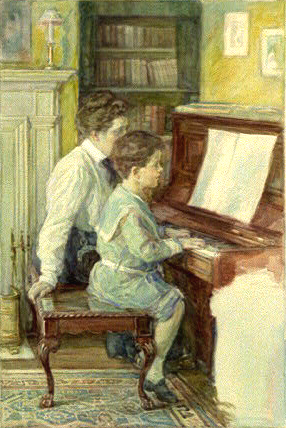
It’s been more than 80 years, but Dollie McKenzie still remembers her first piano lessons.
It was about 1933, and an 8-year-old McKenzie would trek — usually by herself — each week to her piano teacher’s Ucon home, more than a mile down the road.
“We didn’t have a car, so I’d walk — winter and summer,” McKenzie said. “In the wintertime, it was pretty cold. (My teacher) would have me warm up my hands in warm water so I could play. She was very kind and loving.”
Since then, McKenzie has come a long way. Now 90, she’s conducted, accompanied, sang and performed piano and organ at hundreds — if not thousands — of local concerts, musicals, weddings, funerals, festivals and gatherings. She’s taught hundreds of students over the years and is the oldest performing member of the longstanding Idaho Falls Music Club.
In February, McKenzie chose to celebrate the start of her next decade of life fittingly — with a public music program featuring a performance from McKenzie herself along with her daughter, Rexburg-based musician Beverly Solomon, and her granddaughter, Jenny Solomon.
“There’s a song I used to sing (with local women’s chorale group Idaho Falls Choralaires) called ‘Let All My Life Be Music,’ and that’s what I’ve been,” McKenzie said. “My whole life has been music.”
Technically, music first entered McKenzie’s life at age 8. But she said age 15 was the point at which she finally “took hold” of the art form. It was also in those later teen years, she said she started teaching piano.
After high school, she bought her first upright piano with cash, for about $300. McKenzie attended Ricks College and studied music education. At Ricks, she took piano and organ lessons under a renowned local music instructor named Ruth Barrus.
McKenzie’s professional career took off after college. In 1946, she took a music teaching position in Burley public schools. She also joined the music club and served in numerous positions over the years including president, and chairs of several committees. She said she was even chosen by the club as Music Woman of the Year in the 1940s.
“She’s one of the most talented, musical people I’ve ever met,” said Bonita Higley, McKenzie’s longtime friend and fellow member of the Idaho Falls Music Club. “She could play the piano like nobody else could. We just became really good friends and I respected her so much.”
“Dollie is a very dedicated person to music,” added music club member Elaine Jensen. “She is a very, very tremendous lady in music — a very fine musician.”
McKenzie stopped teaching at age 70, though she continues playing locally. She was the driving force behind getting a sing-along started at her current residence, MorningStar Senior Living of Idaho Falls, where she lives with her husband, Dan.
“When we moved here in 2009, about the only activity for old folks was bingo,” McKenzie said. “I said, ‘There’s more to life than bingo.’ So I started the sing-along and it’s one of the most popular things here, now … it gets people involved, gets them thinking and using their faculties. Compared with doing bingo, it’s just an important thing in their life.”
McKenzie said she lives by several different mottos — among them, a quote by Jim Elliot: “When the time comes to die, make sure that’s all you have to do.” And McKenzie said she has a lot left to do. On that list is continuing to fill her life with music — McKenzie still plays every day.
“Of course there are people who don’t have a lot of music in their life, and I guess the only reason why is they’ve never been exposed to it,” McKenzie said. “Of course not everyone’s going to be a musician. But I do think it’s been very important for me. I think it’s just been an (activity that’s helped) round me out, and (given me) purpose.”

Baby kicks. Music plays. And that’s just the beginning. Movable toys on the overhead gym encourage baby to bat and grasp. Move the arch down for tummy-time play, or let baby sit and entertain you with a piano concert! And now with a removable piano, you can take the musical fun wherever you and baby go!
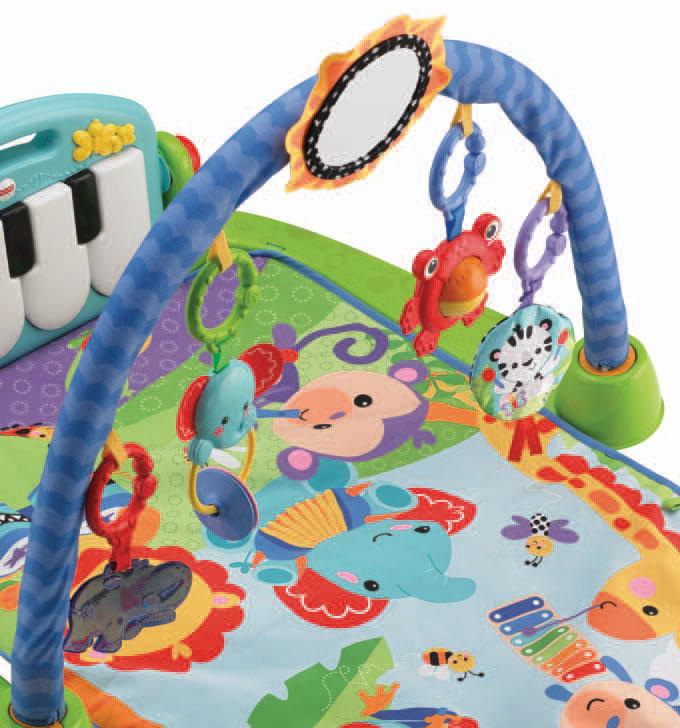
Toys overhead encourage batting and grasping, including a hippo teether, elephant clackers, rollerball frog and more!
With four ways to play, this musical toy grows with your little one! From laying and playing, to tummy time and sitting up, busy activities at each stage are just the beginning of the fun. Baby’s in charge of the action as her little kicky feet activate music. Moveable toys overhead encourage batting and grasping, including a hippo teether, elephant clackers, rollerball frog and more.
When it’s time to change modes, move the arch down for tummy time or let baby sit up and entertain you with a piano concert. Remove the piano and take the fun on-the-go. Includes long and short play modes with up to 15 minutes of music. Power and volume control for quiet play.
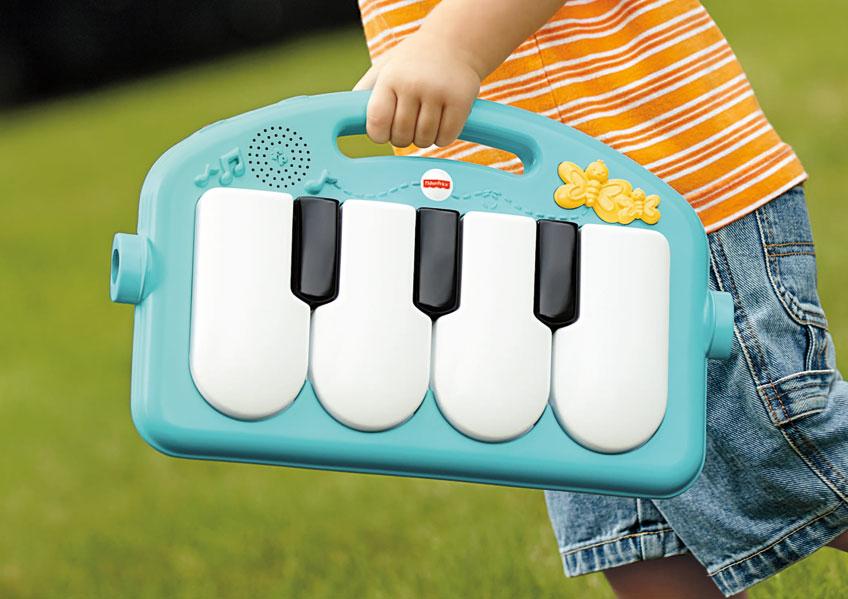
Removable piano provides musical fun wherever you and baby go!
As baby plays, new discoveries are made and key developmental skills get stronger and stronger. As baby stretches and kicks at the piano keys or bats at and reaches for the busy activity toys, gross motor skills are enhanced. Music, lights and bright colors stimulate baby’s senses.
Help baby learn the connection between actions and reactions. Put baby’s foot within reach of the piano. From there, it’s bound to happen: baby’s foot will connect and activate a fun and rewarding response from the gym!

Louise Schwartzkoff
From October 5, 2010
There will be $1.6 million worth of piano on stage at the City Recital Hall on Friday night. With their legs and lids removed for transport, eight Steinway grand pianos will be trucked to the venue.
There they will be reassembled on stage and tuned, ready for eight of Australia’s finest classical pianists.
In The Steinway Spectacular 16 hands and 80 fingers will play some of classical music’s greatest hits.
Conducted by Guy Noble, the pianists will work as an ensemble to perform works by composers such as Ravel, Saint-Saens and George Gershwin. ”It’s a very large affair,” says Noble. ”Logistically, it’s a nightmare.” The piano technician Ara Vartoukian will spend hours tuning the instruments.
For past concerts in Melbourne the process sometimes took all night. ”The pianos all, in essence, sound the same, so they have to be absolutely in tune with each other.”
Even after the most careful tuning, things can go awry.
The pianists – Anthony Halliday, Roger Heagney, Clemens Leske, Tamara Smolyar, Mikhail Solovei, Evgeny Ukhanov, Gerard Willems and Alexey Yemtsov – usually perform as soloists. Every now and again, Noble says, one of them ”goes rogue”.
”One will suddenly break out and play their own thing,” he says. ”I have to herd them back into the pride, glaring at them with eyes of death. It’s one of the hardest things I’ve ever had to conduct. It’s like herding cats.”
There is no repertoire for an ensemble of pianists, so Noble has created new arrangements.
His favourite is a rendition of the children’s staple Chopsticks. ”That just goes wild,” he says.
The segment titled So You Think You Can Play Scales is also a crowd pleaser. ”It’s like Piano Idol. People get voted off if they go off the rails.”
Other pieces will feature the organist Calvin Bowman and the soprano Shu-Cheen Yu. Bowman, who usually plays above the stage in a loft, will join the other performers on stage on an electronic organ.
”It’s a relief for him to be down on stage because he suffers terribly from vertigo,” Noble says. ”He’s been terrified in organ lofts all over Australia.”
More boisterous extravaganza than a recital for purists, the performance will appeal to an eclectic crowd.
”We get classical music lovers, as well as people who are just curious. It’s pure fun and enjoyment.”
The Steinway Spectacular is at the City Recital Hall on Friday.
From http://www.smh.com.au/entertainment/music/a-piano-spectacular-for-80-fingers-20101004-164ac.html

• 1881 ~ Georges Enesco, Rumanian composer, violinist and conductor
• 1918 ~ Sgt. Irving Berlin’s musical about army life in World War I opened at the Century Theatre in New York City. Yip Yip Yaphank included songs, such as Mandy and Oh, How I Hate to Get Up in the Morning.
• 1939 ~ Ginger (Peter) Baker, Trumpeter, drummer with Cream
• 1939 ~ The Dick Jurgens Orchestra recorded Day Dreams Come True at Night on Okeh Records. Eddy Howard was the vocalist on the piece. It became Jurgens’ theme song.
• 1940 ~ Johnny Nash, American pop-reggae singer, songwriter and guitarist
• 1943 ~ Billy J. Kramer (William Ashton), Singer with The Dakotas
• 1945 ~ Ian Gillan, Singer with Deep Purple
• 1947 ~ Gerard Schwarz, American trumpeter and conductor
• 1951 ~ John Deacon, Bass with Queen, score of Flash Gordon
• 1964 ~ The Beatles began their first North American concert tour. They would visit 26 cities.
• 1972 ~ NBC-TV presented The Midnight Special for the first time. John Denver was the host for the first show. Wolfman Jack was the show’s announcer. The Midnight Special proved to be a ratings success.
• 1991 ~ Richard Maltby passed away. He was an American musician, conductor, arranger and bandleader.
• 2001 ~ Singer Betty Everett, whose recording of The Shoop Shoop Song (It’s In His Kiss) made Billboard’s Top 10 in 1964, died Sunday. She was 61.
Everett is remembered primarily for one huge hit song in the 1960s, but she also recorded many other songs and was recognized as one of the top soul singers of her time.
Starting at age 9, Everett played the piano and sang in church. She continued to sing in gospel choirs before moving to Chicago in 1957, where she recorded a string of hits on local record labels such as C.J. Cobra and OneDerful that included I’ll Be There and I’ve Got a Claim On You.
Everett signed a contract in the early 1960s with VeeJay, a record label that was then issuing recordings by The Beatles.
Everett recorded The Shoop Shoop Song in the spring of 1964, and it soared to Billboard’s Top 10.
The song was later recorded by Cher in the soundtrack for the 1990 movie Mermaids and more recently by Vonda Shepard of the Fox television show Ally McBeal.

By Stephen Hough
A concert pianist is someone who plays the piano in concerts. So far so good, although it may be worth adding the adverb ‘regularly’ to that description. Someone did once tell me that his Aunt Ada was a concert pianist. “She had a lovely touch and played to great acclaim in a concert in our church hall – ‘Rustle of Spring’ I think.”
To avoid any confusion the clip above was played by Semprini, not Aunt Ada.
I’ve written before on this blog about how much more time is spent practising secretly at home or backstage than in front of an audience. It’s the training leading up to the Wimbledon Final, the solitary punchbag months before the blood flies into the roaring crowds at the World Heavyweight Boxing Championship.
But between home and the stage there are many hours when I want to work and I can’t. It’s one of the greatest frustrations of my touring life that, unlike other instrumentalists, I arrive at a hotel without my instrument. There’s that hour before dinner or the time spent twiddling thumbs before doing an interview when I would love to twiddle all ten fingers and check through a passage in my concerto or just get loosened up after a long flight … and I can’t.
Or at least the effort involved in doing so can be enormous. A piano somewhere in the hotel is the best solution, as long as it’s far away from prying ears. It has been suggested to me in the past that I play in the atrium lobby, amidst the mingling guests, the palm trees, the pile-up of Samsonite suitcases. Not even ‘Rustle of Spring’ is thinkable in those circumstances, I’m afraid. If the hotel is a mere walk from the hall then that’s the next best scenario although, later in the evening, there’s unlikely to be someone waiting just for me at the stage door. It has to be planned in advance and it’s often hard to know my plans in advance.
Then the options start to get worse, a taxi ride to a distant hall in heavy traffic, for instance. Finding the venue itself is the first hurdle but then, how to find the stage door? I’ve spent many occasions circling the building, rattling rusty handles, banging my fists against flaking doors, pressing antique buzzers, shouting through glass walls, leaving voicemail messages … to no avail.
Sometimes a generous patron will invite me to use his or her piano. Now I don’t want to sound like I don’t appreciate such kind offers (and sometimes it’s been the beginning of a wonderful friendship) but in my experience pianos in strange homes often come with cats … or rattling photo frames perilously balanced on piano lids, or a vase of trembling flowers on the same, or an impossibly high bench, or a squeaky pedal. And worst of all is the person who, leaving the door open, says to me: “Oh, I love the piano. Don’t mind me. I’ll just be in the next room if you need anything. What are you going to practise?” Then I freeze. I simply can’t work if I know someone is listening to me. It’s a bit like writing when someone is looking over your shoulder. Self-consciousness makes self-expression (and self-criticism) impossible.
So for a long time I oscillated between these various unsatisfactory formats until in more recent years I just stopped trying to practise on the road at all. But then a few seasons ago I started renting an electric keyboard if I was going to stay in a city for more than a couple of days. It was wonderful, saving time and making time so much more fruitful. I’d turn the volume down very low and work away at any time of the day or night.
I’m just beginning a two-month tour, starting in Hobart this week with the Tasmanian Symphony Orchestra and Marko Letonja, playing all five Beethoven concertos for the first time. And, also for the first time, I’ve brought along my own electric piano. It’s an experiment and so far (during a short stop at a beach in Thailand last week) it’s been invaluable. A full length keyboard of 88 keys is no good because, as well as being just that bit too heavy to maneuver, it won’t fit into a regular taxi.
But then I discovered the Nord 76-key Piano 2 with Hammer Action. Hand-made in Sweden (yes, I did a second take too) it’s the perfect tool for the job. There are lots of pieces of course which you can’t play from start to finish with a reduced keyboard (although only one note, occurring just three times, in all five Beethoven concertos is missing) but, like a ballet dancer at the barre, in just thirty minutes I can warm up, stretch the muscles, work at a few problem passages here and there and generally keep in shape without having to leave my room. Now when I don’t play the piano I don’t want to.
By Stephen Hough
Concert pianist, writer of words and music, governor of royal ballet companies, theology, art, poetry, perfume, puddings. Website: www.stephenhough.com Twitter: @houghhough
 MaryO'Studio