May 8 in Music History

mothers-day-38


OCMS  1829 ~ Louis Moreau Gottschalk, American pianist and composer
Listen to Gottschalk’s music
More information on Gottschalk

• 1948 ~ Oscar Hammerstein I, Playwright, producer

• 1910 ~ Mary Lou Williams, American jazz pianist, composer and arranger

• 1911 ~ Robert Johnson, Blues Hall of Fame, singer, songwriter, guitarist, inducted into Rock and Roll Hall of Fame in 1986

• 1941 ~ Anita O’Day recorded Let Me Off Uptown on Okeh Records with Gene Krupa and his band.

• 1943 ~ Toni Tennille, Singer

• 1944 ~ Gary Glitter (Paul Gadd), Singer

• 1945 ~ Keith Jarrett, American jazz pianist and composer


Valentine Contest!

valentine-pm


Love is in the air!

To celebrate Valentine’s Day this year, students who play any version of John Legend’s “All of Me” using Piano Maestro and get 3 stars will have a chance to win an Amazon gift card!

The winner will be announced on February 15th!

NOTE: This is a contest through JoyTunes/Piano Maestro so the winner may not be from the O’Connor Music Studio.

MaryOOneRose

If Only I lived in San Diego!

Piano 6


Come January, thanks to the San Diego Symphony, it’s going to be all pianos, all the time in San Diego. The orchestra is collaborating with a host of community partners in an ambitious, month-long Upright & Grand Festival.

With the assistance of its collaborators, the orchestra aims to show as many aspects of the piano as possible during the course of festival, which includes more than a dozen concerts plus community events.

“Pianos can be found in concert halls, night clubs, homes, schools, libraries and department stores,” said symphony CEO Martha Gilmer in a statement. “A pianist can play entire symphonies or a solo sonata. The piano can play the role of the orchestra in rehearsals of great opera and ballet scores, and it is a partner to instrumentalists and singers. The piano is both a solitary and partner instrument.”

Among the orchestra’s partners are the La Jolla Music Society, the Poway Center for the Performing Arts and the California Center for the Arts, Escondido.

The Music Society will bring Garrick Ohlsson (Jan. 14) to Sherwood Auditorium and Emanuel Ax (Jan. 20) to the Jacobs Music Center. The Poway Center will showcase the orchestra and pianist Jeremy Denk on Jan. 15 (he’ll also perform with the orchestra on Jan. 16-17 and with orchestra musicians in a chamber music concert on Jan. 19 at Jacobs Music Center). The California Center for the Arts, Escondido, will host a performance by Ben Folds and the orchestra on Feb. 5 (Folds will also perform in Jacobs Music Center Feb. 6).

In addition, Combat Arts; PATH — Connections Housing; Urban Discovery Academy; the New Children’s Museum and ARTS: A Reason to Survive will participate in a piano painting endeavor; as will artists Anna Stoa, Grace Gray Adams and Grace Matthews, Christie Beniston, and Sheena Dowling.

Once painted, the pianos will be placed in at least 10 public spaces including Horton Plaza, Liberty Station, the Courtyard at East Village, the New Children’s Museum and the California Center for the Arts as part of the “Play Me: Pianos in Public Spaces” element of the festival.

“Upright & Grand offers the public the opportunity to get involved by performing outdoors at any number of the ‘Play Me’ pianos in public spaces throughout San Diego,” said Tommy Phillips, the orchestra’s director of artistic planning, in a statement. “This collaborative component of Upright & Grand has both a celebratory and accessibility element as we bring the piano festival to the people via the Jacobs Music Center, Poway Center for the Performing Arts and California Center for the Arts, Escondido.”

In addition to nine programs at Jacobs Music Center, ranging from Marc-Andre Hamelin performing Gershwin’s “Rhapsody in Blue” with the orchestra (Jan. 8-10) to a Jazz Piano Masters: A Tribute to Thelonious Monk, Art Tatum and Bud Powell concert (Jan. 23) to Ben Folds performing his own piano concerto with the orchestra (Feb. 6), the symphony is offering a community day on Jan. 16 from noon to 5 p.m..

The Jan. 16 “Hands On: Play a Little, Learn a Lot” event will will present a range of keyboard-centric activities including free piano lessons, demonstrations (including a music app session with Apple Store representatives) and the chance to play a short piece on stage.

The community day ends with a “Monster Piano” performance on the Jacobs Music Center stage: 10 pianists will play on five pianos.

More information and tickets: sandiegosymphony.org or (619) 235-0804.

From http://www.sandiegouniontribune.com/news/2015/nov/17/san-diego-symphony-piano-festival/

November 13 ~ Today in Music

today


.1817 ~ Louis Lefébure-Wély, French organist and composer

.1854 ~ George Whitefield Chadwick, American composer and conductor

.1921 ~ Loonas Kokkonen, Finnish composer

.1943 ~ Leonard Bernstein replaced an indisposed Bruno Walter as conductor of the New York Philharmonic Orchestra. Thus began a legendary career and worldwide appreciation for Bernstein’s many compositions with the orchestra.

.1951 ~ Nicolai Karlovich Medtner died.  He was a Russian composer and pianist.

.1965 ~ Julie Harris starred in “Skyscraper”, which opened on Broadway in New York City. The musical ran for seven months.

.1968 ~ This was a good day for The Beatles. Their movie, “Yellow Submarine”, premiered in the U.S. and the single, Hey Jude, topped the pop music charts (it was in its 7th of 9 weeks at #1).

.1975 ~ Whoa Whoa Whoa, Feeeelings. One of the great lounge-lizard songs of all time, Feelings by Morris Albert, went gold.

.1999 ~ Donald Mills passed away.  He had been one of the Mills Brothers.

.2000 ~ Cecil Blackwood, a gospel singer who was a member of the Blackwood Brothers and crooned with Elvis Presley, of cancer at the age of 66. The Blackwood Brothers, who have won nine Grammys and 20 Dove awards, were a favorite of Elvis Presley, who briefly sang with Cecil Blackwood in a group named the Songfellows. The Blackwood Brothers were formed in 1934, the same year Blackwood was born in Ackerman, Miss. He became the group’s baritone in 1954. The Blackwood Brothers have recorded 300 albums, backed country stars Porter Wagoner and Barbara Mandrell, and are members of the Southern Gospel Music Hall of Fame.

.2000 ~ Jimmy Payne Sr., a tap dancer whose rhythm and technique as well as a mastery of precise steps attracted Bob Fosse, June Allyson, Gregory Hines, Lena Horne and others to his Chicago studio, died Nov. 13 at the age of 95. The son of a Cuban mother and Barbadian father, Payne grew up in the Panama Canal Zone before moving to New York in 1917. After traveling from New York to Chicago in 1947, Payne helped introduce African and Afro-Cuban rhythms to the dance scene. He taught in a number of Chicago dance studios from the 1950s into the 1970s. He continued to teach some of the city’s top dancers until his regimen was slowed by a number of strokes in his early 90s.

.2000 ~ New York entertainment lawyer and tax expert Joseph Taubman, who wrote how- to books for people working in the business side of show business, died at the age of 81. Taubman’s clients included Lionel Richie, Pete Seeger, Joan Baez and Arlo Guthrie. He also served as counsel to the National Film Board of Canada. Taubman wrote “Financing a Theatrical Production,” and his treatises on various aspects of the entertainment business published in the 1970s remain in print.

.2000 ~ The site, thebeatles.com, went live and is the band’s only official presence on the Internet among a flood of unofficial fan sites.

.2002 ~ Mieke van Hoek, a dance choreographer and teacher, died. She was 56. The Dutch-born van Hoek taught modern-dance choreography and dance improvisation at the Rotterdamse Dansacademie. After emigrating to the United States in 1977, van Hoek worked as a teaching assistant at the American Dance Festival in Durham, N.C., and studied at the Laban/Bartenieff Institute in New York. She founded a center for meditation, healing and the arts in Canones in 2000.

Excellent Local Musical Concert

Chris has been my best friend since 1973.

hagan-piano

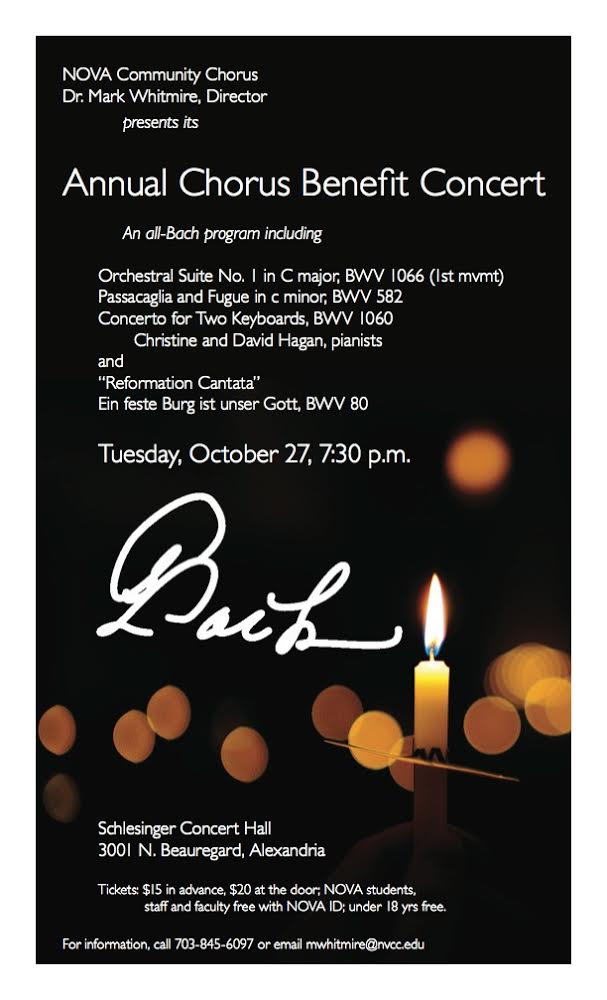
NOVA Community Chorus (Dr. Mark Whitmire, Director) will present it’s Annual Chorus Benefit Concert on Tuesday, October 27, at 7:30 pm in Schlesinger Concert Hall on the Alexandria Campus. It will be an all-Bach program including Cantata 80: Eine feste Burg ist unser Gott (A mighty fortress in our God), accompanied by orchestra.

Acclaimed duo pianists Christine and David Hagan will perform Passacaglia and Fugue in C minor and the Concerto for Two Keyboards in C Major. 

NOVA students, staff and faculty are free with NOVA ID. Donations are requested. For information, call 703-845-6097 or email mwhitmire@nvcc.edu.

Don’t miss this chance for you and your students to hear the music of one of the greatest composers of all time.


Liszt is dead, long live the piano recital

On Monday, Google’s homepage ran a picture to celebrate the 360th birthday of Bartolomeo Cristofori, inventor of the piano and keeper of instruments for the Medicis in Florence. The instrument Cristofori invented was originally called a “harpsichord with soft and loud” even though the distinction between the two is large (the harpsichord produces sound by plucking strings, the piano by striking them with a hammer). Only three of the newfangled instruments he made – all of them dating from the 1720s – survive.

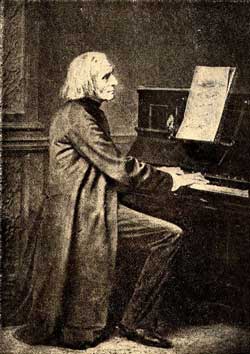
liszt-recitalMore than a century later the piano recital was devised. It was Liszt who first decided to have the whole stage to himself, and set the fashion for dispensing with the mixture of celebrities and supporting acts that had prevailed up to that time. As he wrote about his audacity to a friend: “Le concert, c’est moi!” And he called his appearance at the Hanover Square Rooms in London in June 1840 not a concert but a recital.

The composer-pianists of the day concentrated on their own works. Liszt set a marker in this regard, too, choosing music that ranged from Bach through Beethoven and up to Chopin. He set the pattern for playing from memory, and cemented the platform layout we know today by turning the then-conventional position of the instrument on the stage through 90 degrees. He was what we would now call a sex symbol as well as a star musician, and the new arrangement allowed the audience to see his impressive profile as well as to hear the instrument more clearly. The standards he set have survived without significant alteration right up to the present.

via Liszt is dead, long live the piano recital.

Rare film: A lesson with the greatest piano teacher of all – Slipped Disc

Rare 1945 film from the Central Music School of the Moscow Conservatory shows a pupil (Margarita Fodorova?) taking lessons with Heinrich Neuhaus and Alexander Goldenweiser.

Neuhaus, a pupil of Scriabin, was Sviatoslav Richter’s teacher.

Goldenweiser’s students included Lazar Berman, Tatiana Nikolayeva and Dimitri Bashkirov.

What’s remarkable is how gentle they both seem – in contrast with the prevailing image of brutal Russian teaching methods.

View the entire film here:

via Rare film: A lesson with the greatest piano teacher of all – Slipped Disc.

What George Gershwin’s Piano Teaches Us About Technology

gershwinpiano

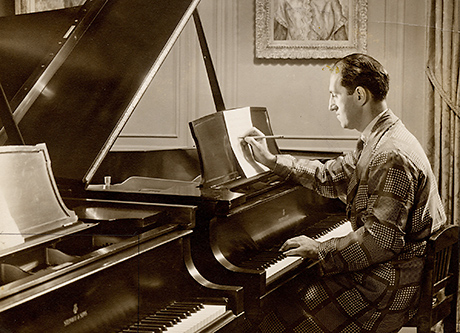
The Gershwin family donated the Steinway to the University as part of the George and Ira Gershwin initiative that is focused on research and study of the brothers’ music.

According to Marc Gershwin, George and Ira’s nephew, “I wanted the instrument to be accessible to the students and faculty who would be preserving the legacy of George and Ira Gershwin’s music… I’m delighted that the piano will once again be in regular use [by students and faculty], and am thrilled that it has been restored to performance condition.” [Two other Gershwin Steinways are in museums.]

From what I know of George he would have wanted it this way. Unlike some composers George was a gifted pianist. He had a rich social life and enjoyed playing his music for anyone who would listen.

There’s a lesson in that thought. If you have something valuable, sometimes it becomes more valuable – or at least more appreciated – when people can see it and use it. If you look at the piano as an instrument of technology that is it, then it makes sense that organizations give people access to technology – as well as resources – to do their work.

Adapted from  What George Gershwin’s Piano Teaches Us About Technology.