March 26 ~ Today in Music History

today

. 1827 ~ German composer Ludwig van Beethoven died in Vienna. Beethoven is considered one of the greatest western composers ever. He composed many of his finest works after he had become totally deaf.

. 1828 ~ Franz Schubert, Austrian composer, performed his one and only public concert in the capital city of Vienna.

. 1871 ~ François-Joseph Fetis died.  He was a Belgian musicologist, composer, teacher, and influential music critic.

. 1918 ~ Cesar Cui, Russian composer, died
More information about Cui

. 1921 ~ Joe Loco (Jose Esteves, Jr.), Jazz musician, arranger, credited with introducing the mambo (1951) and cha-cha-cha (1953) to the US

. 1925 ~ Pierre Boulez, French composer and conductor. His later work, notably “Le Marteau sans maitre,” gained him a worldwide reputation.
More information on Boulez
Grammy winner

. 1929 ~ Maurice Simon, Jazz musician, tenor sax

. 1940 ~ Rod Lauren, Singer

. 1941 ~ Jimmy Lunceford and his orchestra recorded the tune, Battle Axe, for Decca Records. Lunceford began with the Chickasaw Syncopaters, a 10-piece band, in the late 1920s. By 1934, he would add names like Sy Oliver, Willie Smith, Earl Caruthers, Joe Thomas, Al Norris, Moses Allen, and James Crawford to form orchestras that would entertain through the mid-1940s.

. 1944 ~ Diana Ross (Diane Earle), American pop soul singer with The Supremes

. 1948 ~ Richard Tandy, Bass with Electric Light Orchestra

. 1948 ~ Steven Tyler (Tallarico), Singer with Aerosmith

. 1949 ~ Vicki Lawrence, Emmy Award-winning actress, singer

. 1949 ~ Fran Sheehan, Bass with Boston

. 1950 ~ Teddy Pendergrass, American soul singer, songwriter and drummer

. 1974 ~ David Essex received a gold record for the hit, Rock On. Though a million seller, Rock On never made it to number one on the pop-rock charts – stalling at number five. It was on the charts for a total of 14 weeks. Essex portrayed the role of Christ in the London production of Godspell. He starred in several British films in 1970. 1975 ~ Tommy, the film based on the rock opera by the group, The Who, premiered in London.

. 2000 ~ John Corigliano won an Oscar for the score to the movie The Red Violin

. 2015 ~ Joseph Smith died.  He was a well-liked, modest and warmly adventurous New York pianist.

Benita Meshulam, a close friend, wrote: “Joe was the most curious musician I have ever known, always looking for forgotten works, studying them thoroughly. He was interested not only in the works but the composers and investigated everything. He was a pianist who didn’t care about the condition of the pianos he performed on. It was his message that he wanted to get across–a real musician’s musician who lived and breathed his art. He was also the kindest and most generous colleague.”

What’s better than one piano? Eight of them at University of Akron MonsterPianos! concert – Local – Ohio

monster

One piano is grand.

Eight being played in unison?

Well, that’s much, much grander.

The University of Akron School of Music hosted its sixth MonsterPianos! concert Sunday at E.J. Thomas Hall.

The special show featured eight grand pianos arranged in a semicircle, 39 pianists dressed in tuxedos and black gowns — not all playing at the same time, mind you — a conductor, and a giant video screen broadcasting all the action.

“It’s an adventure,” admitted conductor Galen Karriker, UA director of bands and associate professor of music.

It’s also immensely popular in the community, as evidenced by the audience of nearly 1,300 people.

UA music professor Philip Thomson founded MonsterPianos! in 2006, borrowing the concept from the late pianist Eugene List.

The concert, organized by Thomson and fellow faculty member Mayumi Kikuchi, is a treat for the musicians as well as the audience, because it’s rare to have so many pianists playing together at the same time.

The piano is typically a solo instrument, after all, and pianists aren’t used to watching a conductor for direction.

The concert poses several challenges for the musicians.

One of the biggest is just the fact that they aren’t used to playing together as a group. They had practiced only six times before the final dress rehearsal Sunday.

Another challenge is that pianists are familiar with hearing themselves play. With so many other pianos, the sound blends together — of course, it’d be weird if it didn’t.

“You have to trust your eyes and not your ears,” said Ann Usher, UA professor of music and director of the School of Music, who performed at the event.

The concert, which lasted about an hour and a half, included Valse Brilliante by Moritz Moszkowski, Rondo a capriccio by Ludwig van Beethoven and the Battle Hymn of the Republic.

There also were some moments of levity such as when Zippy, the UA kangaroo mascot, led a piano-arrangement of the school fight song Win For Akron.

The concert featured faculty, students, alumni and invited guests. Some of those folks traveled from as far away as Massachusetts, Pennsylvania, New York and Texas just to perform.

One of the guests was Juliette Streeter, 14, of Akron, a student at the Miller South School for the Visual and Performing Arts.

She was excited to be chosen to participate.

“It’s not what I’m used to,” Streeter said. “It’s very fun getting used to all the different people and different styles and the ways they play.”

Karriker, who has conducted all six of the MonsterPianos!, said the concert sets UA apart.

“It truly makes us distinctive as far as a School of Music to have this kind of event,” he said. “There’s a lot of folks who love piano music in this community and they are fascinated by seeing that many pianos on stage and hearing what it sounds like.”

via What’s better than one piano? Eight of them at University of Akron MonsterPianos! concert – Local – Ohio.

March 15 ~ Today in Music History

today

.1897 ~ First performance of Ludwig van Beethoven‘s Symphony No. 4 in B-flat major, Op. 60.  It is a symphony in four movements.

. 1835 ~ Eduard Strauss, Austrian composer who, together with brothers Johann Strauss II and Josef Strauss made up the Strauss musical dynasty. He was the son of Johann Strauss I and Maria Anna Streim.

. 1873 ~ Lee Shubert, Broadway producer. Theaters in NY and LA named after him. He died in 1953

. 1907 ~ Jimmy McPartland, Jazz musician: cornetist; played for the Wolverine Orchestra, Embassy Four; bandleader; played at Newport Jazz Festival with wife, Marian

. 1916 ~ Harry James, American jazz trumpeter and bandleader, married to Betty Grable (second of four wives)

. 1933 ~ Cecil Taylor, American jazz pianist and composer

. 1944 ~ Sly Stone, American soul-rock singer and instrumentalist

. 1959 ~ The musical, No Strings, opened on Broadway at the 54th Street Theatre. Richard Kiley and Diahann Carroll starred in the show. Also featured was the show’s composer in an acting role, singing his own lyrics. The composer was Richard Rodgers.

. 1968 ~ LIFE magazine called Jimi Hendrix, “the most spectacular guitarist in the world.”

. 1987 ~ Andrew Lloyd Webber’s “Starlight Express” opened on Broadway. This was the first ever roller-skating musical.

. 1964 ~ My Fair Lady, by Lerner and Loewe, opened on Broadway. It ran for 6-1/2 years before 2,717 audiences. It became, thanks to Rex Harrison and an outstanding cast, the longest-running musical to that time.

. 1970 ~ The musical, Purlie, opened a run of 680 continuous performances on Broadway.

. 2001 ~ Ann Sothern died at the age of 92. She was an actress who starred as the saucy, liberated showgirl in MGM’s “Masie” movies during the 1940s and played single working women on TV in “Private Secretary” and “The Ann Southern Show.”

San Diego 9-year-old boy dubbed piano prodigy

A 9-year-old boy is receiving international acclaim for being one of the youngest and most talented piano players.

“I just love piano and I don’t think about it; I just play,” said Malvyn Lai.  “I just move my fingers and it works.”

The fourth grader plays everything from Chopin to Beethoven, but said Mozart is his favorite because of how the music makes him feel.

Lai first fell in love with the piano at age four during his older sister’s music recital.

“I really liked the way the piano sounded like really grand so I asked my mom if I could play at age four but they said I was too young,” said Lai.

Within a year Lai began playing, his instructor Irina Bendetsky said that at the time, he couldn’t even reach the pedals but he was already playing the classics.

“Melvin is very special. As a boy and as a musician; he is a musician already I can name him that,” said Bendetsky.

The young pianist has already performed at the renowned Carnegie Hall in New York City five times and has received countless awards.

Read the entire article at  http://fox5sandiego.com/2015/03/02/local-9-year-old-boy-dubbed-piano-prodigy/

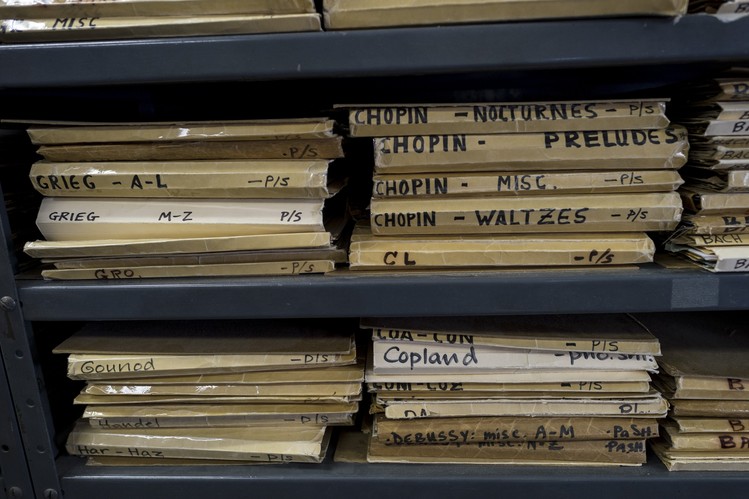
NYC’s Last Classical Sheet Music Store to Close

music-store

The store, on West 54th Street between Broadway and Eighth Avenue, opened in 1937 and provided the city’s musicians scores from the standard— Bach, Beethoven —to the arcane. Ms. Rogers bought it in 1978.

Frank Music is the last store in the city dedicated to selling classical sheet music, Ms. Rogers said, although other places such as the Juilliard School’s bookstore at Lincoln Center have it on their shelves.

Frank Music’s stock, which Ms. Rogers counts as hundreds of thousands of scores, was purchased by an anonymous donor as a gift for the Colburn School, a music conservatory in Los Angeles.

The school and Ms. Rogers declined to comment on financial details.

Colburn School’s president and chief executive, Sel Kardan, called Frank Music’s scores “an invaluable resource for our students and faculty for years to come.”

To the 63-year-old Ms. Rogers, nothing is more important than the arts.

“The idea that classical music is irrelevant is ridiculous,” she said, bemoaning the comparative salaries of tubists and stockbrokers. “People should be paid in terms of what they contribute to people’s well being.”

The store’s celebrity clients over the years have included pianists Emanuel Ax and Jeremy Denk, violinist Pamela Frank and cellist David Finckel.

One of Ms. Rogers’s favorite memories is a telephone call from the violinist Itzhak Perlman, asking for Kreisler scores.

The composer Bruce Adolphe, who is resident lecturer at the Chamber Music Society of Lincoln Center, described the store as a musical meeting ground.

“Frank’s Music was not just a store but a crucible,” he said, “a nexus where musicians from Suzuki beginners and their parents, to Joshua Bell, or the Brentano’s Mark Steinberg, would meet by chance.”

Read the entire article at NYC’s Last Classical Sheet Music Store to Close – WSJ.

Exploring Beethoven’s Piano Sonatas is now On-Demand

beethoven-piano


A note from the Curtis Teaching Staff:

The wait is over… Exploring Beethoven’s Piano Sonatas is once again open! You can instantly Start Learning in this On-Demand course if you missed our last offering in the Spring of 2014 (or if you’re ready for another round).

We’ll explore Beethoven’s sonatas from the point of view of performer Jonathan Biss. You’ll learn from approximately 5 hours of videos and quizzes in this self-paced course.

Jonathan is busy recording new lectures on new sonatas that will be added to the course this Spring. Even if you took the course last time, you may want to re-watch the first series to refresh your knowledge. Then you’ll be ready to dive in as he covers NEW sonatas in detail.

Thanks for your interest in Exploring Beethoven’s Piano Sonatas.

It’s Never Too Late to… Take Up Piano – Telegraph

Schubert took piano lessons aged six, but don't let that put you off

Lionel Kelly, 78, may have come late to the piano – he took it up at the age of 73 – but it’s changed his life. “I first heard Mahler performed in London in the mid-50s, when he became very popular over here,” he says. “I’m currently working on a piano transcription of the Adagietta from his Symphony No. 5. It’s a beautiful piece of music, slow and passionate, and was used in Luchino Visconti’s 1971 film of Thomas Mann’s novella, Death in Venice. To be able to play Mahler now, all these years later, is a real treat.”

Kelly, formerly director of American Studies at Reading University, practises up to four hours a day. He has lessons in Reading with Janet Sherbourne, whom he describes as “an excellent, if strict, teacher”, and is not taking grades. “Janet reckons I’m somewhere between grade four and five level, but I’m just doing it for pleasure, because I want to learn and play,” he says.

Bach, Beethoven and Mozart are among other composers tackled by Kelly…

Read the entire article at It’s Never Too Late to… Take Up Piano – Telegraph.

January 29 ~ Today in Music History

today

. 1715 ~ Georg Christoph Wagenseil, Austrian composer

. 1782 ~ Daniel François Esprit Auber, French composer, primarily of comic operas

. 1784 ~ Ferdinand Ries, German composer. Ries was a friend, pupil and secretary of Ludwig van Beethoven.

. 1862 ~ Frederick (Fritz) Theodor Albert Delius, British composer Read quotes by and about Delius
More information about Delius

. 1876 ~ Havergal Brian, British classical composer

. 1889 ~ Huddie Ledbetter, Blues singer

. 1924 ~ Luigi Nono, Italian composer

. 1937 ~ Tommy Dorsey and his orchestra waxed the famous Song of India on Victor Records.

. 1942 ~ Claudine Longet, Singer, formerly married to Andy Williams

. 1947 ~ David Byron, Singer

. 1949 ~ Tommy Ramone (Erdelyi), Drummer with The Ramones

. 1953 ~ Teresa Teng, Chinese singer

. 1954 ~ Oprah Winfrey, Entertainer, Emmy Award-winning talk show host

. 1962 ~ Fritz Kreisler died.  He was an Austrian-born violinist and composer

. 1966 ~ “Sweet Charity”, with Gwen Verdon, opened at the Palace Theatre in New York City. The musical, by Neil Simon, was an adaptation of the Federico Fellini film, “Notti di Cabiria”. The play ran for 608 performances. In

. 1969, Hollywood produced a big-budget version of the Broadway musical starring Shirley MacLaine.

. 1973 ~ Johnny Rivers received a gold record for the hit single, Rockin’ Pneumonia and the Boogie Woogie Flu. As is tradition, Rivers removed the fragile gold disk from the wooden frame and, as he was putting it on his stereo, had a ferocious sneezing fit and never did find out how his song sounded in solid gold.

. 1977 ~ From the One-Hit Wonder File, this note: Rose Royce earned the #1 spot on the music charts with Car Wash, from the movie of the same name. The song stayed at the peak of the pop charts for one week, then faded away.

. 1981 ~ Cozy (William Randolph) Cole passed away

. 2001 ~ Suzanne Bloch, a concert chamber musician and teacher at the Juilliard School, died at her home. She was 94. Bloch played and taught ancient instruments, in particular the lute, a guitar- like instrument common in 18th-century Europe. Mostly self-taught, she also played the recorder and the virginal, a tiny relative of the harpsichord. Beginning in the late 1930s, she performed frequently in concert, often dressed in Renaissance costume. She taught classes at Juilliard from 1942 to 1985. After marrying Paul Smith, a mathematician who became chairman of Columbia University’s mathematics department, Bloch played chamber music with well-known scientists, including Albert Einstein. Born in Geneva, Bloch moved to New York with her family in 1916, when her musician father, Ernest Bloch, began teaching and conducting in the United States. Bloch promoted her father’s music throughout her life, collecting clippings, writing program notes and founding the Ernest Bloch Society in 1967.

November 19 ~ Today in Music History

today


• 1724 ~ First Performance of J. S. Bach’s Sacred Cantata No. 26 Ach wie flüchtig, ach wie nichtig performed on the 24th Sunday following Trinity. A portion of Bach’s second annual Sacred Cantata cycle in Leipzig, 1724-25.

• 1736 ~ J. S. Bach named court composer by Poland’s King Agustus III.

• 1739 ~ First Performance of Jean-Philippe Rameau‘s opera Dardanus in Paris.

• 1826 ~ Composer Felix Mendelssohn and his sister Fanny performed his overture to “A Midsummer Night’s Dream” for the first time.

• 1828 ~ Death of Austrian composer Franz Schubert in Vienna, at the age of 31 from typhus.   He is buried near Beethoven.

• 1859 ~ Mikhail Ippolitov-Ivanov, Russian composer and conductor
More information about Ippolitov-Ivanov

• 1874 ~ Birth of composer Karl Adrian Wohlfahrt.

• 1875 ~ First Performance of Tchaikovsky‘s Third Symphony, in Moscow.

• 1888 ~ Piano Debut in Boston of composer Edward MacDowell with the Kneisel Quartet.

• 1905 ~ Tommy Dorsey, American trombonist and bandleader

• 1923 ~ First Performances of Béla Bartók‘s Five Dances and Zoltán Kodály‘s Psalums Hungaricus in Budapest, marking the 50th anniversary of the union of cities Buda and Pest.

• 1936 ~ Birth of classical music commentator (Detroit Symphony broadcasts) Dick Cavett, in Kearney, Nebraska. ABC-TV talk show host (Dick Cavett Show).

• 1936 ~ First concert recorded on magnetic tape with the London Philharmonic orchestra conducted by Sir Thomas Beecham at BASF’s own concert hall in Ludwigshaven, Germany.

• 1937 ~ Ray Collins, Songwriter

• 1938 ~ Hank Medress, Singer with The Tokens, record producer

• 1943 ~ Fred Lipsius, Piano, sax with Blood Sweat & Tears

• 1943 ~ Stan Kenton and his orchestra recorded Artistry in Rhythm, the song that later become the Kenton theme. It was Capitol record number 159. The other side of the disk was titled, Eager Beaver.

• 1944 ~ Agnes Baltsa, Greek mezzo-soprano

• 1954 ~ Sammy Davis, Jr. was involved in a serious auto accident in San Bernardino, CA. Three days later, Davis lost the sight in his left eye. He later referred to the accident as the turning point of his career.

• 1957 ~ American conductor Leonard Bernstein named Music Director of the New York Philharmonic. First American-born and educated conductor named to head an important American Orchestra.

• 1961 ~ A year after Chubby Checker reached the #1 spot with The Twist, the singer appeared on The Ed Sullivan Show to sing the song again. The Twist became the first record to reach #1 a second time around, on January 13, 1962.

• 1962 ~ For the first time, a jazz concert was presented at the White House. Jazz had previously been served as background music only.

• 2000 ~ First Performance of Philip Glass‘ Double Concerto for Timpani and Orchestra, by the American Composers Orchestra. Lincoln Center in New York.

2004 ~ Composer Cy Coleman, who wrote the musical “Sweet Charity” and whose songs included such Frank Sinatra classics as WitchcraftBig Spender and The Best is Yet to Come, died at the age 75
More information about Cy Coleman

Adapted from http://www.oconnormusic.org/month-nov.htm

Ludwig Van Beethoven Piano Trios Opus 70 No. 2, Opus 97 “Archduke” | World Music Report

beethoven

Beethoven’s first published works—his Opus No.1—were three trios for piano, violin and cello and already they show a marked advance on Haydn’s trios in the comparative interdependence of the three parts. Their freedom from Haydn’s oppressive formality looks forward to the first mature trios, the pair that comprises Opus 70, displaying all sorts of harmonic twists, thematic innovations and structural idiosyncrasies, these trios make much of the piano part and contain plenty of dramatic outbursts that are typical of Beethoven’s middle period.

Even more arresting is the first of the Opus 70 trios (1808) nicknamed ”The Ghost” because of its mysterious and haunting Largo. Its sibling boasts a cheerful bombastic finale that is the most entertaining music that Beethoven composed for this combination of instruments.

The “Archduke” Trio Opus 97 (1811) was Beethoven’s last full – scale work for piano trio and is typically conclusive. The third movement is its centre of gravity, a highly moving set of variations with the cello dominating the thematic content. It opens with a hymn-like theme and progresses to a coda which magnificently sums up the movements ideas. The finale might be less powerful than that of Opus 70 No. 2, but it nevertheless has a sweeping rhythmic power. Again, it is beyond the shadow of a doubt that Beethoven defined the piano trio form that it retained throughout the 19th century by allowing the string instruments the status of genuinely equal partners in this superlative performance.


Read more at Ludwig Van Beethoven Piano Trios Opus 70 No. 2, Opus 97 “Archduke” | World Music Report.