Alfred Brendel was born in 1931 in Wiesenberg, Czech Republic.
After World War II, Brendel composed music, as well as continuing to play the piano, to write and to paint. However, he never had more formal piano lessons and, although he attended master classes with Edwin Fischer and Eduard Steuermann, he was largely self-taught after the age of six.
He made his debut in Graz (1948), and has since performed widely throughout Austria, where he lives.
He is known for his interpretations of Mozart, Beethoven, Schubert, Liszt, and Schoenberg. He tours internationally, and has written many essays on music.
A short insight from Alfred Brendel on his recording career:
Victor Borge was born in 1909 in Copenhagen, Denmark. He was an entertainer and pianist – a deliciously funny performer. He studied at the Royal Danish Academy of Music, Copenhagen, and in Vienna and Berlin.
He made his debut as a pianist in 1926, and as a revue actor in 1933. From 1940 until his death in 2000 he worked in the USA for radio, television, and theatre, and has performed with leading symphony orchestras on worldwide tours since 1956.
He was best known for his comedy sketches combining music and narrative. He used his classical training to skew serious music and performers.
From his obituary:
Pianist Victor Borge, died in his sleep Dec 23, 2000 at his Greenwich, Connecticut home, was known as the unmelancholy Dane of international show business. He would have turned 92 on Jan. 3, 2001.
“The cause of death was heart failure,” his daughter, Sanna Feirstein, told Reuters.
“He had just returned from a wonderfully successful trip to Copenhagen … and it was really heartwarming to see the love he experienced in his home country,” she said.
Borge was one of five performers selected for the Kennedy Center Honors in 1999.
“He went to sleep, and they went to wake him up this morning, and he was gone,” said his agent, Bernard Gurtman.
“He had so much on the table, and to the day he died he was creative, and practicing piano several hours a day,” Gurtman told Reuters. “He was just a great inspiration.”
Funeral services will be private, his daughter said.
Borge made a career of falling off piano stools, missing the keys with his hands and getting tangled up in the sheet music.
One of his inspirations was a pianist who played the first notes of the GriegA Minor Concerto and then fell on the keys dead.
He said that the only time he got nervous on stage was when he had to play seriously and adds that if it had not been for Adolf Hitler he probably would never have pursued a career as a concert-hall comedian.
Until he was forced to flee Denmark in 1940 he was a stage and screen idol in his native country.
Lampooned Hitler
But as a Jew who had lampooned Hitler, Borge — his real name was Boerge Rosenbaum — was in danger and fled first to Sweden and then to the United States, where he arrived penniless and unknown and by a fluke got booked on the Bing Crosby radio show. He was an instant success.
He became an American citizen in 1948, but thought of himself as Danish. It was obvious from the numerous affectionate tributes and standing ovations at his 80th birthday concert in Copenhagen in 1989 that Danes felt the same way.
In the concert at Copenhagen’s Tivoli gardens, Borge played variations on the theme of “Happy Birthday to You” in the styles of Mozart, Brahms, Wagner and Beethoven — all executed with such wit that the orchestra was convulsed with laughter that a woman performing a piccolo solo was unable to draw breath to play.
“Playing music and making jokes are as natural to me as breathing,” Borge told Reuters in an interview after that concert.
“That’s why I’ve never thought of retiring because I do it all the time whether on the stage or off. I found that in a precarious situation, a smile is the shortest distance between people. When one needs to reach out for sympathy or a link with people, what better way is there?
“If I have to play something straight, without deviation in any respect, I still get very nervous. It’s the fact that you want to do your best, but you are not at your best because you are nervous and knowing that makes you even more nervous.”
His varied career included acting, composing for films and plays and writing but he was best known for his comic sketches based on musical quirks and oddities.
Unpredictable Routine
His routines were unpredictable, often improvised on stage as his quick wit responded to an unplanned event — a noise, a latecomer in the audience — or fixed on an unlikely prop — a fly, a shaky piano stool.
Borge was born in Denmark on January 3, 1909, son of a violinist in the Danish Royal Orchestra.
His parents encouraged him to become a concert pianist, arranging his first public recital when he was 10. In 1927 he made his official debut at the Tivoli Gardens.
Borge’s mischievous sense of humor was manifest from an early age. Asked as a child to play for his parent’s friends he would announce “a piece by the 85-year-old Mozart” and improvise something himself.
When his mother was dying in Denmark during the occupation, Borge visited her, disguised as a sailor.
“Churchill and I were the only ones who saw what was happening,” he said in later years. “He saved Europe and I saved myself.”
From 1953 to 1956, he appeared in New York in his own production “Comedy in Music,” a prelude to world tours that often took him to his native Scandinavia.
On radio and television, Borge developed the comedy techniques of the bungling pianist that won him worldwide fame.
Many of his skits were based on real-life events. One of his classics evolved from seeing a pianist playing a Tchaikovsky concerto fall off his seat.
Borge’s dog joined the show after it wandered on stage while he was at the keyboard — an entrance nobody would believe had been unplanned.
One incident could not be repeated. A large fly flew on to Borge’s nose while he was playing. “How did you get that fly to come on at the right time?” people asked. “Well, we train them,” Borge explained.
Borge’s book, “My Favorite Intervals”, published in 1974, detailed little-known facts of the private lives of composers describing Wagner’s pink underwear and the time Borodin left home in full military regalia but forgot his trousers.
In 1975, Borge was honored in recognition of the 35th anniversary of his arrival in the United States and his work as unofficial goodwill ambassador from Denmark to the United States. He celebrated his 75th birthday in 1984 with a series of concerts at Carnegie Hall and in Copenhagen.
Borge received a host of honors from all four Scandinavian countries for his contributions to music, humor and worthy causes.
Borge, who had lived in Greenwich since 1964, is survived by five children, nine grandchildren, and one great grandchild. His wife of many years, Sanna, died earlier that year.
1882 ~ Zoltán Kodály, Hungarian composer and collector of folk songs
More information on Kodály
• 1893 ~ Antonin Dvorák attended the first performance of his New World Symphony at Carnegie Hall in New York City.
• 1899 ~ Sir Noel Coward, British composer of musical comedies, actor and producer
• 1905 ~ Sime Silverman published the first issue of Variety, the weekly showbiz magazine. The first issue was 16 pages in length and sold for a nickel. Variety and Daily Variety are still going strong.
• 1907 ~ Eugene H. Farrar became the first singer to broadcast on radio. He sang from the Brooklyn Navy Yard in New York. The song was Do You Really Want to Hurt Me?
• 1940 ~ Bob Crosby and his Bobcats backed up brother Bing as San Antonio Rose was recorded on Decca Records.
• 1960 ~ Lucille Ball took a respite from her weekly TV series to star in the Broadway production of Wildcat, which opened at the Alvin Theatre in New York City. The show ran for 171 performances.
• 1967 ~ The Lemon Pipers released Green Tambourine on an unsuspecting psychedelic world this day. The tune made #1 on February 3, 1968.
• 1971 ~ Melanie (Safka) received a gold record for the single, Brand New Key, about roller skates and love and stuff like that. This one made it to #1 on Christmas Day, 1971.
• 1971 ~ Don McLean’s eight-minute-plus (8:32) version of American Pie was released. It became one of the longest songs with some of the most confusing (pick your favorite interpretation) lyrics to ever hit the pop charts. American Pie hit #1 on January 15, 1972.
• 1972 ~ Paul McCartney’s single, Hi, Hi, Hi, was released. It peaked at #10 on the top tune tabulation (February 3, 1973).
• 2003 ~ Singer and guitarist Gary Stewart, who had a No. 1 country hit in 1975 with She’s Actin’ Single (I’m Drinkin’ Doubles), died of an apparently self-inflicted gunshot wound. He was 58. A native of Letcher County, Ky., Stewart was a compelling songwriter and performer of guitar-driven, honky-tonk country. His last album, Live at Billy Bob’s Texas, was released in 2003. Besides the 1975 chart-topper, his hits included Drinkin’ Thing and Out of Hand. He worked with Southern rock greats Dickie Betts and Gregg Allman of The Allman Brothers Band on the 1980 album Cactus and a Rose.
• 2017 ~ Z’ev, a percussionist, performer, composer, instrument builder, visual artist, poet and theorist who explored visceral and mystical dimensions of sound — becoming a pioneer of industrial music along the way — died in Chicago, where he lived. He was 66.
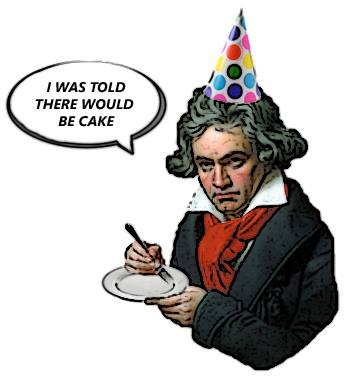
He used the # in unusual places before Twitter… but how would Beethoven have used Facebook? And what would his profile look like? From his likes and dislikes to his friends and love interests, we’ve imagined what the composer might have posted online throughout his life.
• 1842 ~ The Philharmonic Society of New York, the first permanent orchestra in the U.S., held its first concert. Despite uncomfortable seating, the event was a huge success. They performed works of Beethoven.
1863 ~ Pietro Mascagni, Italian composer and conductor
More information about Mascagni
• 1887 ~ Ernst Toch, Austrian-born American composer
• 1911 ~ Louis Prima, Trumpeter, bandleader with Louis Prima and His New Orleans Gang, Gleeby Rhythm Orchestra; songwriter, singer, married to Keely Smith
• 1931 ~ Bobby Osborne, Musician, mandolin, singer with the duo – Osborne Brothers
• 1942 ~ Harry Chapin, American folk-rock singer and songwriter, Recipient of Special Congressional Gold Medal, Worldwide Humanitarian for the Hungry, Needy and Homeless
• 1948 ~ NBC presented Horace Heidt’s Youth Opportunity Program for the first time. The talent show earned Dick Contino, an accordionist, the $5,000 prize as the program’s first national winner.
• 1949 ~ Tom Waits, Singer, songwriter, playwright, married to Kathleen Brennan
• 1954 ~ Mike Nolan, Singer with Bucks Fizz
• 1957 ~ Pat Boone was at the top of the pop charts for the first of six weeks withApril Love. His other number one hits included Ain’t That a Shame, I Almost Lost My Mind, Don’t Forbid Me and Love Letters in the Sand.
• 1984 ~ Michael Jackson was in Chicago to testify that the song, The Girl is Mine, was exclusively his and he didn’t swipe the song, Please Love Me Now. It was a copyright infringement case worth five million dollars. He won.
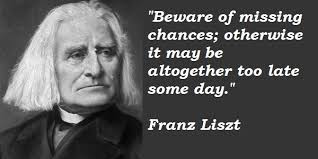
Franz Liszt was born in Raiding, near Ödenburg, October 22, 1811 and died in Bayreuth, July 31, 1886. He was a Hungarian composer and pianist who was a major influence during the romantic period. Liszt was an outstanding pianist at seven, composed at eight and made concert appearances at nine. In addition to being a piano virtuoso, he was also a critic, conductor, city music director, literary writer and transcriber of the works of other composers. He transcribed Beethoven’s Symphonies for the piano.
Franz Liszt began his career as the outstanding concert pianist of the century, who, along with the prodigious violinist Niccoló Paganini (1782-1840), created the cult of the modern instrumental virtuoso. To show off his phenomenal and unprecedented technique, Liszt composed a great deal of music designed specifically for this purpose, resulting in a vast amount of piano literature laden with dazzling, and other technical marvels. In this vein, Liszt composed a series of virtuosic rhapsodies on Hungarian gypsy melodies, the best-known being the all too familiar Hungarian Rhapsody no. 2. Liszt developed the rhapsody as a form of serious music. This kind of music is worlds apart from the generally more introspective, poetic music of pianist-composer Frédéric Chopin.
Liszt was wildly handsome and hugely talented. He was extremely popular in Paris during the 1830’s. It is said that women actually fainted at his piano recitals. He was the first to position the piano so that its lid reflected the sound and the audience could see his profile as he performed.
Liszt was the first to write a tone poem, which is an extended, single-movement work for orchestra, inspired by paintings, plays, poems or other literary or visual works, and attempting to convey the ideas expressed in those media through music. Such a work is Les Préludes, based on a poem in which life is expressed as a series of struggles, passions, and mysteries, all serving as a mere prelude to . . .what? The Romantic genre of the symphonic poem, as well as its cousin the concert overture, became very attractive to many later composers, including Saint-Saëns, Tchaikovsky, Dvorák, Sibelius, and Richard Strauss.
Listen to Liszt’s transcription of Meyerbeer’s Hellish Waltz from Robert du Diable, which probably caused more public commotion than any other piano piece in history.
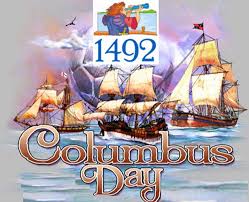
The day signifies Christopher Columbus’ arrival to America on October 12, 1492
1813 ~ Giuseppe Verdi, Italian composer
Read quotes by and about Verdi
More information about Verdi
1835 ~ Camille Saint-Saëns, French composer, organist and conductor Saint-Saëns’ Carnival of the Animals is featured in Disney’s Fantasia and Fantasia 2000.
Read quotes by and about Saint-Saëns
More information about Saint-Saëns
• 1931 ~ Russ Columbo’s Prisoner of Love was recorded on Victor Records.
1940 ~ John Lennon, British rock singer, songwriter and guitarist
More information about Lennon
• 1935 ~ Cavalcade of America was first broadcast on radio this very day. The CBS show featured some of Hollywood and Broadway’s most famous stars in leading roles in the half-hour radio dramas. Thomas Chalmers narrated the stories about obscure incidents and people in American history. The orchestra (yes, radio shows had live orchestras back then) was led by Donald Voorhees. The show aired from 1935 to 1953, changing from CBS to NBC in 1939; with one sponsor for its entire duration. The DuPont Company introduced its slogan on Cavalcade of America …”Better things for better living through chemistry…”
• 1947 ~ “High Button Shoes”, opened on Broadway in New York City with an entertainer named Phil Silvers in the lead. The popular show ran for 727 performances.
• 1948 ~ Jackson Browne, Songwriter, singer
• 1967 ~ “And now…heeeeeeeeerrrree’s the Doctor!” Coming out of the NBC Tonight Show Orchestra to become musical director of The Tonight Show Starring Johnny Carson, Doc Severinsen replaced Skitch Henderson on this night. Doc became famous for an eccentric wardrobe, quick wit, great trumpet solos and fabulous charts. Tommy Newsome became Doc’s backup arranger for many of the tunes the band played. Later, Doc and the band would move to solo albums, group CDs and incredibly successful concert tours. Doc went on to play with various symphony orchestras and even became the owner of a custom trumpet company in the San Francisco Bay Area.
• 1973 ~ Priscilla Presley, was divorced from Elvis in Santa Monica, CA. Ms. Presley got $1.5 million in cash, $4,200 per month in alimony, half interest in a $750,000 home plus about 5% interest in two of Elvis’ publishing companies.
• 1973 ~ Paul Simon got a gold record this day for his hit, Loves Me like a Rock.
• 1975 ~ John Lennon turned 35. To celebrate, Yoko Ono Ono presented John with a newborn son, Sean Ono Lennon.
• 1976 ~ Ludwig van Beethoven’s “Symphony number 5 in c minor” landed for a twenty-two-week stop in the first spot on the Top 5. Beethoven is dead and this isn’t a ghost story. It’s simply a case of Beethoven being updated with a disco-rock beat and a catchy new title: A Fifth of Beethoven.
• 1985 ~ A 2½ acre garden memorial was dedicated to John Lennon by his widow,Yoko Ono, this day. The memorial in New York City’s Central Park is named Strawberry Fields.
• 2001 ~ Herbert Ross died at the age of 76. He was a director and choreographer whose credits include the hit movies “The Goodbye Girl,” “The Sunshine Boys” and “The Turning Point.”
• 2003 ~ Don Lanphere, a saxophone player who came on strong at the dawn of bebop, nearly succumbed to drugs and drinking, then recovered to become the city’s jazz “grandpop,” died of hepatitis C. He was 75. As lead tenor in the Seattle Repertory Jazz Orchestra and in smaller groups, Lanphere’s versatility and virtuosity ranged from blazing riffs on the tenor to a solo jazz rendition of the Lord’s Prayer on the soprano sax. Many who were born long after Lanphere’s boyhood gigs with such legends as Charlie Parker, Fats Navarro and Max Roach hailed him as a jazz patriarch or, as his Web site proclaimed, “Seattle jazz grandpop.” Born in the apple country of central Washington about 95 miles east of Seattle, Lanphere played as a teenager with touring bands in Seattle, then studied music briefly at Northwestern University in Evanston, Ill. By the time he got to New York, captivated by the post-World War II bebop revolution, he was hooked on heroin. By his early 20s he had recorded with Navarro and Roach and played gigs with Parker, Woody Herman and top big bands, including one led by Artie Shaw. He could write a chart, the chord arrangement on which jazz improvisation is based, from the sound of water dripping in a tub. Battling alcohol and narcotics addictions that resulted in at least one arrest, he was back at his father’s store in Wenatchee – “from the Big Apple to the little apple,” he once said – by 1960. Only after he and his wife Midge became born-again Christians in 1969 did he dust off his horn. In an interview in 1998, he said that without the conversion, “I would be dead by now.”
The Piano Puzzlers book is available in the O’Connor Music Studio library if you’d like to give any a try. Piano Puzzlers as heard on American Public Media’s “Performance Today.” Includes 32 tunes with songs by Gershwin, Berlin, Arlen, Porter, Rodgers, Fats Waller, Lennon & McCartney, and others disguised in the styles of Bach, Handel, Haydn, Mozart, Beethoven, Brahms, Schubert, Schumann, Chopin, Janacek, Debussy, Ravel, Rachmaninoff, Stravinsky, Prokofiev, Bartok, and Copland.
Includes an introduction by Fred Child, host of “Performance Today” as well as background info by Bruce Adolphe. “Bruce Adolphe has taken a common musician’s party game and elevated it to high art and truly funny musical slapsticks. The Piano Puzzlers are a unique combination of extraordinary insight into the styles of many composers subtle, expert workmanship and great, great fun!”
If you’re a music geek (like me), I have a program for you. Now, let me be clear, to fully qualify as a music geek…you must have a fond appreciation for classical music (no, Poison, Quiet Riot, and Zepplin do not count as classical music). So, if you’re a “music geek” without an appreciation for classical music…well, I hate to burst your bubble…but, you’re not truly a music geek. Instead, you’re a music appreciator, but not a geek. So, if you just listen to indie music and scowl at anything on a label larger than Matador…don’t bother following the link I’ll provide…the fun will be lost on you…And, you probably won’t have a chance.
Every Wednesday night, on my way home from WNL, I turn on my local NPR station to listen to Piano Puzzlers on Performance Today. It’s absolutely incredible. A pianist/composer (Bruce Adolphe) takes a familiar folk or pop tune and sets it inside a classical masterpiece (or in the style of a particular composer). Sometimes it’s easy…sometimes it’s ridiculously difficult. There are days when I say, “got it” on the first pass. Then there are days when I say, “what the heck?” And, more often than not, I’m able to get either the popular/folk tune or the composer.
This is sad to admit, but there are nights when I’ll slow down on the drive home or sit in the car in the driveway to finish an episode. In fact, I get a little worked up if someone stops me after WNL…as I might miss the beginning of Piano Puzzlers (it usually hits around 8:20pm on our local station).
Take a listen to some of the archives and see if you can figure it out! It’s really cool…but probably only appreciated by music geeks (the kind of people that listen to NPR for their musical programs and not just the snipets of cool indie rock between segments on All Things Considered…which is a great show too).
Beethoven’s first published works—his Opus No.1—were three trios for piano, violin and cello and already they show a marked advance on Haydn’s trios in the comparative interdependence of the three parts. Their freedom from Haydn’s oppressive formality looks forward to the first mature trios, the pair that comprises Opus 70, displaying all sorts of harmonic twists, thematic innovations and structural idiosyncrasies, these trios make much of the piano part and contain plenty of dramatic outbursts that are typical of Beethoven’s middle period.
Even more arresting is the first of the Opus 70 trios (1808) nicknamed ”The Ghost” because of its mysterious and haunting Largo. Its sibling boasts a cheerful bombastic finale that is the most entertaining music that Beethoven composed for this combination of instruments.
The “Archduke” Trio Opus 97 (1811) was Beethoven’s last full-scale work for piano trio and is typically conclusive. The third movement is its center of gravity, a highly moving set of variations with the cello dominating the thematic content. It opens with a hymn-like theme and progresses to a coda which magnificently sums up the movements ideas. The finale might be less powerful than that of Opus 70 No. 2, but it nevertheless has a sweeping rhythmic power. Again, it is beyond the shadow of a doubt that Beethoven defined the piano trio form that it retained throughout the 19th century by allowing the string instruments the status of genuinely equal partners in this superlative performance.
• 1915 ~ Laverne Andrews, Pop Singer
More information about The Andrews Sisters
• 1915 ~ Dorothy Kirsten, Opera Singer
• 1925 ~ Merv Griffin, Entertainer
• 1925 ~ Bill Haley, American rock-and-roll singer, songwriter and guitarist with Bill Haley and His Comets
• 1932 ~ Della Reese (Delloreese Patricia Early), Pop Singer
• 1937 ~ Vladimir Ashkenazy, Russian-born Icelandic pianist and conductor
More information about Ashkenazy Grammy winner
• 1937 ~ Gene Chandler (Eugene Dixon), Singer
• 1937 ~ The big band classic, Sing, Sing, Sing was recorded by Benny Goodman and his band. Sitting in on this famous Victor Records session was Gene Krupa, Ziggy Elman and Harry James.
• 1945 ~ Rik Elswit, Musician, guitarist and singer with Dr. Hook and the Medicine Show
• 1954 ~ Nanci Griffith, Grammy Award-winning singer, songwriter
• 1957 ~ John Lennon and Paul McCartney met for the first time at The Woolton Church Parish Fete where The Quarry Men were appearing. As The Quarry Men were setting up for their evening performance, McCartney eager to impress Lennon picked up a guitar and played ‘Twenty Flight Rock’ (Eddie Cochran) and ‘Be-Bop-A-Lula’ (Gene Vincent). Lennon was impressed, and even more so when McCartney showed Lennon and Eric Griffiths how to tune their guitars, something they’d been paying someone else to do for them.
• 1959 ~ Jon Keeble, Musician, drummer with Spandau Balle
• 1971 ~ Louis Armstrong, Jazz musician, died. His groups, the Hot Five and Hot Seven, from 1925 to 1927, had a revolutionary impact on jazz.
• 1971 ~ Karen and Richard Carpenter hosted the summer series, Make Your Own Kind of Music, on NBC-TV.
• 1973 ~ Otto Klemperer, German conductor particularly known for his interpretations of Beethoven, died.
• 1984 ~ Michael Jackson and his brothers started their Victory Tour in Kansas City, Missouri’s Arrowhead Stadium. The tour turned out to be a victory for the Jacksons when the nationwide concert tour concluded months later.
• 1998 ~ Roy Rogers, U.S. film actor known as “the singing cowboy”, died.