. 1925 ~ Russian composer, Igor Stravinsky, appeared in his first American concert, as he conducted the New York Philharmonic Orchestra in a program of his own compositions.
. 1935 ~ Elvis Presley, American rock-and-roll singer and guitarist. He had 90 top-20 hits.
. 1937 ~ Shirley Bassey, Singer
. 1940 ~ Anthony Gourdine, Singer with Little Anthony and The Imperials
. 1940 ~ Vincent Lopez and his orchestra recorded the third version of Lopez’ theme song titled Nola. This version, recorded in Hollywood on Bluebird Records, is recognized as his best rendition of the classic song.
. 1946 ~ Robbie Krieger, Guitarist with The Doors
. 1947 ~ David Bowie, British rock singer and actor
. 1947 ~ Terry Sylvester, Musician with the groups Swinging Blue Jeans and the Hollies
. 1952 ~ Vladimir Feltsman, Pianist
. 1961 ~ Robert Goulet made his national TV debut this night on “The Ed SullivanShow” on CBS.
. 1965 ~ The TV dance show, “Hullabaloo”, debuted on NBC~TV. The show, a weekly trip into the world of rock and roll, featured plenty of mini-skirted go~go girls; which didn’t hurt ratings any. ABC countered with “Shindig”, a similar show, similar concept, similar everything.
. 1966 ~ The Beatles LP, “Rubber Soul”, began a 6-week reign at the top of the album chart. This was the seventh Beatles LP to reach the #1 position since February, 1964. “Rubber Soul” stayed on the charts for 56 weeks. The other #1 albums for the Fab Four to that date were: “Meet The Beatles“, “The Beatles Second Album”, “A Hard Day’s Night”,“Beatles ’65”, “Beatles VI” and “Help!”.
. 1973 ~ Carly Simon received a gold record for the single, You’re So Vain.
. 1997 ~ George Handy died. Handy was a jazz music arranger, composer and pianist whose musical beginnings were fostered under the tutelage of pianist Aaron Copland.
. 1998 ~ Sir Michael Tippett, British Composer and librettist, died
More information about Tippett
. 2000 ~ Pianist Jeffrey Biegel appeared on Good Morning America. He discussed his performance of the New York Premiere with Maestro Vakhtang Jordania and the American Symphony Orchestra and performed selections from the manuscript edition of Rhapsody in Blue, with more than 50 bars restored that hadn’t been heard in New York since the famous 1924 premiere concert at Aeolian Hall.
The concert that evening was at Lincoln Center’s Avery Fisher Hall. The Rhapsody was be the feature piece in an evening of premieres by American composers and Russian orchestral masterpieces. Works on the program included Variations on The Wayfaring Stranger (New York Premiere) by James Cohn; Peanuts Gallery for Piano and Orchestra by Ellen Taaffe Zwilich; the Rhapsody in Blue by Gershwin; Islamey by Balakirev (World Premiere-transcription for piano and orchestra by Jeffrey Biegel), and Mussorgsky’sPictures at an Exhibition.
During the holiday period, the entire Company is immersed in activities surrounding George Balanchine’s The Nutcracker™. All 90 dancers, 62 musicians, 32 stagehands and two casts of 50 young students each from the School of American Ballet join forces to make each performance as magical as possible. Children of all ages from New York City and the nation fill the David H. Koch Theater to be captivated by the lure of Tschaikovsky’s music, Balanchine’s choreography, Karinska’s sumptuous costumes, and Rouben Ter-Arutunian’s magical sets. George Balanchine’s The Nutcracker™, based on the Alexandre Dumas pere version of E.T.A. Hoffmann’s tale, The Nutcracker and the Mouse King (1816), demands a full-scale production.
The elaborate stage elements and intricate lighting unleash the viewers’ imagination by providing visual effects that are extraordinarily grand. The most famous example is the one-ton Christmas tree that grows from a height of 12 feet to 40 feet, evoking audible gasps of disbelief from the audience at each performance. Other notable feats include the comic figure of Mother Ginger — 85 pounds and nine feet wide, the costume requires handling by three people once it is lowered by pulley over the dancer’s head — as well as the continuous flutter of the purest, crystal-shaped snowflakes (which are swept up and conserved after each performance for reuse).
While these technical achievements are wonderful fun, it is Balanchine’s choreography that sustains the ballet through two acts. Act I introduces the characters — the Stahlbaum children, Marie and Fritz, Herr Drosselmeier and his Nephew — and also begins the transition from reality into fantasy with the concluding Snowflake Waltz. Act II offers the complete transformation. We have entered the “Kingdom of the Sugarplum Fairy” and there is no turning back.
George Balanchine’s The Nutcracker™ is one of the most complex theatrical, staged ballets in the Company’s active repertory. The popularity of the ballet is immense and it provides an unforgettable spark to everyone’s holiday season.
Although the original production was not a success, the 20-minute suite that Tchaikovsky extracted from the ballet was. However, the complete Nutcracker has enjoyed enormous popularity since the late 1960s and is now performed by countless ballet companies, primarily during the Christmas season, especially in North America. Major American ballet companies generate around 40 percent of their annual ticket revenues from performances of The Nutcracker.
Tchaikovsky’s score has become one of his most famous compositions, in particular the pieces featured in the suite.
Back on the subway to the Lincoln Center for the Big Apple Circus. We’d seen them a couple times here but Michael had never seen them. On the grounds of the Lincoln Center, everything is under the tents where here, much is outside.
We found that Michael had bought tickets in the VIP Seating & Lounge. This included:
The best seats in the tent! First row, center ringside
Private Concierge
Complimentary Circus Meal – includes hot dog, soda and choice of popcorn or cotton candy
Cheese, vegetable and fruit crudite
Juice, water, wine, and beer
Dessert
Souvenir Book (We didn’t get this!)
Private restrooms (They called this the Golden Restroom)
Coat rack
Photo opps as you try on our circus costumes and hats
Close-up magician who did card tricks with us
THE GRAND TOUR is a circus extravaganza set in the 1920s and featuring acts from the four corners of the globe. Ships, trains, automobiles, and airplanes will serve as the backdrop for breathtaking acts of wonder, accompanied by the seven-piece Big Apple Circus Band playing live at each of more than 100 performances. Acts will include clowns, jugglers, acrobats, and aerialists, from Africa, Asia, Australia, Europe, and North and South America, as well as domestic and rescue animals, all creating performances that will leave audiences smiling and cheering. The show runs 1 hour and 50 minutes including a 20-minute intermission.
I was glad to see the ringmaster, John Kennedy Kane, was back. The last time we went here at home, there had been a female ringmaster.
There were so many neat acts and we were right there, front and center, to see them. Some of the acts seemed like they would land in our laps.
This is one of the clown acts:
A sample of some of the other acts. I loved the Wheel of Wonder, about 1:20:
And, a short TV interview:
This video is so cool – “Our performers give a bird’s eye view of what it’s like to perform under the Big Top! Get your tickets today and see the joy and wonder of this season’s show for yourself!”
WINDJAMMERS
Circus marches are called “screamers” because they are traditionally so high, loud & fast!! Circus Band members are often called “windjammers” because they jam so much wind into their instruments in the process of playing these screamers. Playing the circus requires incredible endurance & skills on your instrument. The windjammers play almost none stop and much of the music is really difficult!
The greatest circus bands were about 100 years ago in the heyday of the circus. At that time the big top band could be 25 or so, plus there were often sideshow musicians as well. Cowboy bands, women’s bands and bands of Blacks were often part of the sideshows.
Contemporary circuses are much smaller all the way around, and some don’t use live musicians at all, just “canned” music (recordings). Others carry 3 musicians, a drummer, a trumpet player and a keyboard (synthesizer) player. A few, like the Big Apple Circus, still have bands. The Big Apple Circus has 8 musicians on its band stand: a conductor/trumpet, a person who plays alto sax and clarinet, one who plays tenor sax and flute, a violin, a trombone, a bass player, a keyboard player and a drummer.
In the “old days,” being a circus musician was one of the most strenuous jobs a musician could have. In the days before musicians’ unions, the windjammer would be expected to play for the circus parade, play a pre-show free concert for the townspeople, ballyhoo around the grounds before the big top show, play the show itself (nonstop for two or three hours!), play post show concerts on the grounds or play sideshows. Then after everyone left, they helped take down the tents or do other chores around the grounds. It was a busy day and the pay was not very good, but it was an exciting life with lots of great music, and many musicians loved it!
THE MUSIC
Entry of the Gladiators (Thunder and Blazes) was written in 1897 by, the Czechoslovakian composer, Julius Fucik (1872-1916). This march is a classic circus march & one that just about everyone will think, “Ah, circus!” when they hear it. Thunder and Blazes (as it is most frequently called) and Fucik’s Florentiner March are probably his most well known marches.
Most circus marches follow the standard American military march form, but often abbreviated (no repeats in the second half):
Introduction (a bit longer than military marches)
First strain (repeated)
Second strain (repeated)
Trio (more mellow and the key changes)
Breakup strain (often called the dogfight in military marches)
Last strain
In a circus march, the last strain is often the same as the trio, but louder, and often the trio, breakup strain and last strain are not repeated like they are in a military march (in military marches, the trio and breakup strain are often reversed & the way they repeat may vary).
The music sets the scene for the performer’s act. Different music is needed for different kinds of acts: the bareback riders galloping around the hippodrome need a lively tune, the trapeze artists want something more peaceful, and of course the clowns need music that sounds humorous (like trombone smears!).
In the early days of the circus, the band masters would take some of the European classical music and arrange it for the circus band. “The most obvious example would be the beautiful, flowing waltz music that is essential to the trapeze artists (‘flyers’ and ‘catchers’). The bandmaster and musicians must be precise in coordinating the music and the timing of the artists, requiring rehearsal with the artists and the musicians. Similarly, it may be interesting to note that the bareback riders perform in a smaller ring because of the gait of the horses. The centrifugal effect requires a ring of a certain diameter for timing. Thus, the conductor must follow the gait of the horses, whereas the aerialists depend on the tempo of the music for timing their act.”
Modern circuses also play a lot of popular tunes, jazz and other songs that people will recognize. You will likely hear fewer of the standard circus marches at a circus today.
The drummer has a particularly challenging and important role in the circus music. He/she must “play the tricks.” Usually the drummer is situated so that he can see the ring because it is his job to accent and intensify what is happening in the ring. This was true 100 years ago, and it is true today. If the act is getting tense, the drummer will get intense. If someone slides down a rope or vaults off the trampoline, there will be a cymbal crash or drum hit when the performer reaches the floor. Sometimes the cues come from the conductor or from the ring master, but sometimes it is the drummer who is really in charge!
Circus bands occasionally play a John Philip Sousa composition during the traditional Center Ring Concert, but his melodic marches are not the right structure for most circus acts.
Sousa’s Stars and Stripes Forever is never part of the regular program. It is reserved for emergency use – sometimes called the “Disaster March”. If a major problems happens — an animal gets loose, a high wind threatens the tent, or a fire breaks out — the band plays the march as warning signal to every worker on the circus lot that something is wrong.
For lesser problems, the 12th Street Rag was played to alert the clowns to come out and divert attention during the more common mishaps.
Edward F. Shevlin describes what goes on in the cirus band as follows:
“Our music is usually by Karl King, Alexander, Fred Jewell, C. E. Duble and other old time circus bandmasters and musicians. Much of the music by these circus musician-composers is amenable to quick cut-offs and tempo changes as necessary to fit particular acts. Hence, Windjammers usually play two musicians to a stand so that when the conductor cuts to a new piece and tempo, one musician can quickly move the music to expose the next piece while the other continues without skipping a beat! We might quickly go from a march to a Samba or rhumba or galop; or from a waltz to an up-tempo march or galop for the “come down” when the aerialists quickly descend into the net or slide down a rope at the conclusion of their act . . .followed by that ubiquitous B-flat chord! The old circus bands would play anything from Ragtime to a Polonaise or a tone poem!”
*Information from an email from Edward F. Shevlin, a Windjammer who happened upon this page! Many thanks, Mr. Shevlin!
THE BANDWAGON
When the circus came to town, there was always a circus parade — the parade served to get the wagons filled with people, equipment, baggage, tents and animals to the location of the circus, but it also provided some free advertisement. The wagons were very elaborate & were intended to get people interested in the circus so they would come and see the acts. The band road on top of a bandwagon and inside the band wagon was luggage, tents and other necessities.
Hey, have you ever heard the term, “jump on the bandwagon”? Here’s the story. In 1848, when Zachary Taylor won the Whig party nomination for president, Dan Rice, a famous clown whose attire inspired the image of Uncle Sam, invited Mr. Taylor to ride on the bandwagon that Dan Rice had. When the bandwagon arrived at the center of town, Dan Rice stopped his parade and made a very emotional speech supporting Zachary Taylor’s candidacy. Someone noted that Dan Rice was on Mr. Taylor’s bandwagon and the term stuck, so that to jump on the bandwagon means to get involved with whatever the issue is. “He jumped on the ecology bandwagon.” “She is definitely on the civil rights bandwagon.”
Below you will find some links to pictures of bandwagons.
The Columbia Bandwagon– purchased by James Bailey for the Barnum & Bailey Circus — and see this wagon hitched to FORTY horses!!! The picture including the wagon & the band is at the bottom of the page.
Most people pronounce this instrument “cal eye’ o pee”. Circus people pronounce it “cal’ ee ope” (last syllable like “rope”). What is a calliope?? It is a huge instrument made of whistles with a steam engine that blows steam through the whistles when you press the key. Most calliopes are played with a keyboard like a piano keyboard & each key controls one whistle. It is LOUD!!!! Some can be heard up to 3 – 5 miles! Don’t stand too close to one!
The calliope traditionally brought up the rear in a circus parade.
Most performing entities have some superstitions. One of the superstition in circus bands is that you can not play Franz von Suppe’sLight Cavalry March. Quoting from Mr. Beal’s book:
“To play it on the circus lot means disaster and sudden death.”You may not believe this but most circus folks do, at least those who know the facts. Played once in Oklahoma, a train wreck followed and sixteen were killed. Played again, this time while [Merle] Evans was on tour with Miller Bros. 101 Ranch Wild West, a blowdown followed and 38 fatalities resulted. [A blow down is a wind that destroys all or part of the tents.]
“And the last time Merle played it a cornet player died immediately after the performance. That was enough for Evans. He collected the parts, tied them up in a neat bundle, and dropped them over the nearest bridge…
“From that day to this the music of Suppe’s Light Cavalry march is taboo. Even its presence in the music trunk would be considered a serious menace to the life and safety of the circus musicians.”
A second superstition about the music played, is that the only time you can play Home Sweet Home is during the very last performance of the season, the very last song. Otherwise it could mean the immediate closing of the show.
Information from:
Beal, George Brinton. Through the Back Door of the Circus with George Brinton Beal. Springfield, Massachusetts: McLoughlin Bros., Inc., 1938. p. 1-20.
Some important Windjammers and composers of circus music
Karl King — Karl King was the band master for the Barnum and Bailey Circus. He was one of the first composers to write for student bands. Learn about his music and his life.
The Great Circus Parade — here is a section of the Circus World Museum website dedicated to the circus parade that they put on every summer. (WMS students: The video we watched in Circus 2 was of this parade). http://www.circusparade.com/cwm.htm
Sounds of the Circus — This is the site of the South Shore Circus Concert Band which is ” one of the few bands in the country dedicated to preserving authentic music from the golden age of the American Circus.” The site includes pictures, CDs to purchase and a few RealAudio files for circus music. http://world.std.com/~tsh/circus.html
Definitions & ExplanationsScreamers – Circus marches are called screamers because they are so loud, fast & often very high!
Windjammers – Circus musicians are often called windjammers because they jam so much wind into their instruments in the process of playing these screamers.
Ballyhooing – The dictionary defines the verb “ballyhoo” as a vigorous attempt to win customers. When not playing, the musicians went around the grounds & the town shouting about the circus & trying to get people to come see it. Ex: “Come to the circus tonight! See flying trapeze artists and the ….”
Hippodrome – The hippodrome is the track around the inside of the ring where the horses were run.
Trombone Smears – Smear refers both to a trombone technique and to a type of music. The technique (officially called a glissando) where the trombonist pulls the slide in or out without tonguing and you get a smearing sound as the notes move up or down, rather than a distinct set of individual notes. Smear also refers a type of music that includes and features these smear techniques. These pieces are often used as clown music. Henry Fillmore wrote many trombone smears and they had an African-American minstrel sound to them.
. 1710 ~ Bernardo Pasquini died. He was an Italian composer of operas, oratorios, cantatas and keyboard music. A renowned virtuoso keyboard player in his day, he was one of the most important Italian composers for harpsichord between Girolamo Frescobaldi and Domenico Scarlatti, having also made substantial contributions to the opera and oratorio.
. 1877 ~ Thomas A. Edison, who really enjoyed the jazz he heard coming from his newest invention, told those gathered that he just invented the ‘talking machine’ (phonograph). On February 19, 1878, Edison received a patent for the device.
. 1904 ~ Coleman Hawkins, American jazz tenor saxophonist, solo with the Fletcher Henderson band, jazz bandleader
. 1931 ~ Malcolm Williamson, Australian composer
. 1933 ~ Jean Shepard, Country singer
. 1934 ~ Cole Porter’s Anything Goes opened at the Alvin Theatre in New York City. The show ran for 420 performances.
. 1936 ~ James DePreist, Orchestra leader with the Oregon Symphony
1937 ~ Following Carnegie Hall performances in both 1906 and 1919, Arthur Rubinstein presented another historic and highly acclaimed performance at the arts center this day.
More information about Rubinstein
. 1940 ~ Dr. John (‘Mac’ Malcolm John Rebennack), Organ, guitar, singer, songwriter
. 1940 ~ Natalia Makarova, Ballerina with the Kirov Ballet (now Saint Petersburg Ballet) from 1959 until 1970
. 1944 ~ Happy trails to you, until we meet again….The Roy Rogers Show was first heard on the Mutual Broadcasting System. Singing along with Roy (‘The King of the Cowboys’), were the Whippoorwills and The Sons of the Pioneers.
. 1944 ~ I’m Beginning to See the Light, the song that would become the theme song for Harry James and his orchestra, was recorded this day. The song featured the lovely voice of Kitty Kallen (Little Things Mean a Lot).
. 1948 ~ Lonnie (LeRoy) Jordan, Keyboards, singer
. 1950 ~ Livingston Taylor, American folk singer, songwriter and guitarist, brother of singer James Taylor
. 1952 ~ Lorna Luft, Singer, actress, daughter of singer-actress Judy Garland and producer Sid Luft; sister of singer-actress Liza Minnelli
. 1955 ~ The first lady of the American stage, Helen Hayes, was honored for her many remarkable years in show business, as the Fulton Theatre in New York City was renamed the Helen Hayes Theatre.
. 1959 ~ Following his firing from WABC Radio in New York the day before, Alan Freed refused “on principle” to sign a statement that he never received money or gifts (payola) for plugging records. Incidentally, few may remember, but Freed left WABC while he was on the air. He was replaced in mid~record by Fred Robbins, who later became a nationally~known entertainment reporter for Mutual Radio.
. 1962 ~ Leonard Bernstein broadcast his Young People’s Concert “Sound of a Hall” from the New York Philharmonic’s new home at Lincoln Center (now David Geffen Hall). He spoke about the science of sound; acoustics, vibration, sound waves, echo and reverberation. ÒWell, the best test of dynamic range I can think of is that great piece of fireworks – Tchaikovsky’s Overture 1812, because it begins as softly as possible with only 6 solo strings, and runs the whole dynamic range to a full orchestra, plus at the end, an extra brass band…plus the deafening roar of cannon plus the jangle of church bells…” We share with you this excerpt of Bernstein and the New York Philharmonic performing the 1812 Overture.
. 1981 ~ Olivia Newton-John started the first of 10 weeks at the top of the pop music charts when Physical became the music world’s top tune.
. 1990 ~ Instrument lovers have paid some pretty awesome prices for violins made byAntonio Stradivari. But a red Strad owned by the family of composer Felix Mendelssohn sold on this day for an all-time high of $1,700,00.
. 2001 ~ Ralph Burns, who won Academy Awards, an Emmy and a Tony as a music arranger after making a name for himself in jazz as a piano player in the Woody Herman band, died at the age of 79. Burns collected his first Academy Award for adapting the musical score of the
. 1972 movie “Cabaret.” He won another Oscar for adapting the musical score for “All That Jazz,” an Emmy for television’s “Baryshnikov on Broadway” and a Tony in 1999 for the Broadway musical “Fosse.” His other film credits included “Lenny,” “In The Mood,” “Urban Cowboy,” “Annie,” “My Favorite Year” and “The Muppets Take Manhattan.” He also collaborated with Jule Styne on “Funny Girl” and Richard Rodgers on “No Strings.” The Massachusetts native, who took up piano as a child, was playing in dance bands in Boston when he was 12, graduating to jazz orchestras by his teens. He worked with Herman band’s for 15 years as both a writer and piano player, composing some of the group’s biggest hits. Among them were “Apple Honey,” “Bijou” and the three-part “Summer Sequence.” “Early Autumn,” written later as a fourth movement for “Summer Sequence,” became a hit with singers after Johnny Mercer supplied words for it. Later, Burns worked in the studio with such popular singers as Tony Bennett, Johnny Mathis, Ray Charles, Aretha Franklin and Natalie Cole.
. 2003 ~ Teddy Randazzo, co-author of more than 600 songs for acts including TheTemptations and Frank Sinatra, died at the age of 68. With co-author Bobby Weinstein and others, Randazzo wrote hits such as Goin’ Out of My Head,Hurt So Bad and It’s Gonna Take a Miracle for acts such as Little Anthony and the Imperials, The Lettermen, Linda Ronstadt, The Temptations and Sinatra. Randazzo began his career at age 15 as lead singer of the group The Three Chuckles. The group’s first hit,Runaround, rose to No. 20 on the Billboard charts and sold more than 1 million copies. Randazzo started a solo career in 1957 and found modest success over the next seven years before meeting Weinstein. The duo’s songs have been recorded by more than 350 artists, including Gloria Gaynor, Queen Latifah and Luther Vandross. They parted ways in 1970 and Weinstein became an executive for Broadcast Music Inc. and Randazzo became a producer for Motown Records.
• 1929 ~ Leo Reisman and his orchestra recorded Happy Days are HereAgain for Victor Records. The classic was recorded just three weeks after the stock market crash that plunged the nation into the Great Depression.
• 1937 ~ Ruth Laredo, American pianist
• 1940 ~ Tony Butala, Singer with The Lettermen
• 1942 ~ Norman Greenbaum, Singer
• 1943 ~ Meredith Monk, American composer, dancer, choreographer and singer
• 1946 ~ Duane Allman, Guitarist with The Allman Brothers Band
• 1946 ~ Ray Stiles, Bass, singer with Mud
• 1947 ~ George Grantham, Drummer, singer with Poco
• 1947 ~ Joe Walsh, Guitarist, singer with he Eagles; James Gang
• 1948 ~ Barbara Hendricks, American soprano
• 1957 ~ Jimmy Brown, Drummer with UB40
• 1959 ~ One of America’s great rock jocks was fired from WABC radio in New York. The ‘Moondoggy’ himself, Alan Freed, was axed in the midst of the payola music scandal.
• 1966 ~ Cabaret opened on Broadway for the first of 1,166 stellar performances. JoelGray starred in the hugely successful musical that is an adaptation of both the play, “I Am a Camera”, and the novel, “Goodbye to Berlin”.
• 1971 ~ Isaac Hayes of Memphis, TN got his first #1 hit as the Theme from Shaft began a two-week stay at the top of the charts.
• 1984 ~ The largest crowd to see the unveiling of a Hollywood Walk-of-Fame star turned out as Michael Jackson got his piece of the sidewalk right in front of Mann’s Chinese Theatre in Los Angeles. ‘The Gloved One’ became star number 1,793 on the famed walk.
• 2003 ~ Katherine Bidwell, who supported performing arts programs and held positions at the Metropolitan Opera Guild and Lincoln Center, died. She was 66. A musician herself, Bidwell joined the St. Louis Municipal Opera when she was 18. She became a trustee at Sarah Lawrence College, her alma mater, and sponsored performing arts programs there. In 1966, Bidwell joined the board of the Metropolitan Opera Guild. She was its president and chief executive from 1979 to 1986, and for the next 10 years, she was director of special projects for Lincoln Center. Bidwell founded the Katherine Bidwell Foundation for Young Singers and the patrons’ program of the Chamber Music Society of Lincoln Center. She was a trustee of several other organizations, including Westminster Choir College and the London School of Music and Dramatic Arts.
• 1724 ~ First Performance of J. S. Bach’s Sacred Cantata No. 26 Ach wie flüchtig, ach wie nichtig performed on the 24th Sunday following Trinity. A portion of Bach’s second annual Sacred Cantata cycle in Leipzig, 1724-25.
• 1736 ~ J. S. Bach named court composer by Poland’s King Agustus III.
• 1739 ~ First Performance of Jean-Philippe Rameau‘s opera Dardanus in Paris.
• 1826 ~ Composer Felix Mendelssohn and his sister Fanny performed his overture to “A Midsummer Night’s Dream” for the first time.
• 1828 ~ Death of Austrian composer Franz Schubert in Vienna, at the age of 31 from typhus. He is buried near Beethoven.
• 1859 ~ Mikhail Ippolitov-Ivanov, Russian composer and conductor
More information about Ippolitov-Ivanov
• 1874 ~ Birth of composer Karl Adrian Wohlfahrt.
• 1875 ~ First Performance of Tchaikovsky‘s Third Symphony, in Moscow.
• 1888 ~ Piano Debut in Boston of composer Edward MacDowell with the Kneisel Quartet.
• 1905 ~ Tommy Dorsey, American trombonist and bandleader
• 1923 ~ First Performances of Béla Bartók‘sFive Dances and Zoltán Kodály‘sPsalums Hungaricus in Budapest, marking the 50th anniversary of the union of cities Buda and Pest.
• 1936 ~ Birth of classical music commentator (Detroit Symphony broadcasts) Dick Cavett, in Kearney, Nebraska. ABC-TV talk show host (Dick Cavett Show).
• 1936 ~ First concert recorded on magnetic tape with the London Philharmonic orchestra conducted by Sir Thomas Beecham at BASF’s own concert hall in Ludwigshaven, Germany.
• 1937 ~ Ray Collins, Songwriter
• 1938 ~ Hank Medress, Singer with The Tokens, record producer
• 1943 ~ Fred Lipsius, Piano, sax with Blood Sweat & Tears
• 1943 ~ Stan Kenton and his orchestra recorded Artistry in Rhythm, the song that later become the Kenton theme. It was Capitol record number 159. The other side of the disk was titled, Eager Beaver.
• 1944 ~ Agnes Baltsa, Greek mezzo-soprano
• 1954 ~ Sammy Davis, Jr. was involved in a serious auto accident in San Bernardino, CA. Three days later, Davis lost the sight in his left eye. He later referred to the accident as the turning point of his career.
• 1957 ~ American conductor Leonard Bernstein named Music Director of the New York Philharmonic. First American-born and educated conductor named to head an important American Orchestra.
• 1961 ~ A year after Chubby Checker reached the #1 spot with The Twist, the singer appeared on The Ed Sullivan Show to sing the song again. The Twist became the first record to reach #1 a second time around, on January 13, 1962.
• 1962 ~ For the first time, a jazz concert was presented at the White House. Jazz had previously been served as background music only.
• 2000 ~ First Performance of Philip Glass‘ Double Concerto for Timpani and Orchestra, by the American Composers Orchestra. Lincoln Center in New York.
2004 ~ Composer Cy Coleman, who wrote the musical “Sweet Charity” and whose songs included such Frank Sinatra classics as Witchcraft, Big Spender and The Best is Yet to Come, died at the age 75
More information about Cy Coleman
• 1765 ~ Pierre-Joseph Le Blan, Composer, died at the age of 53
• 1767 ~ Ferdinand Franzl, Composer
• 1767 ~ Friedrich Johann Eck, Composer
• 1821 ~ Diederich Krug, Composer
• 1826 ~ Christian Friedrich Ruppe, Composer, died at the age of 72
• 1847 ~ Alphonse Goovaerts, Composer
• 1878 ~ Bill “Bojangles” (Luther) Robinson, Vaudeville dancer, tap-dancing coach for Sammy Davis, Jr. and Shirley Temple
More information about Robinson
• 1878 ~ Gilbert and Sullivan’s opera “HMS Pinafore” premiered in London
• 1887 ~ Gas lamp at Paris Opera caught fire, 200 died
• 1917 ~ Leon Felix Augustin Joseph Vasseur, Composer, died at the age of 72
• 1919 ~ Gino Negri, Composer
• 1921 ~ Hal David, Oscar-winning songwriter with Burt Bacharach
• 1924 ~ Theodore Morse, Composer, died at the age of 51
• 1925 ~ Aldo Clementi, Composer
• 1926 ~ Miles Davis III, American jazz trumpeter, bandleader, and composer. He combined be-bop, modal chord progressions and rock rhythms to create ‘cool jazz’. He was one of the major influences on the art from the late 1940s. Read quotes by and about Davis
• 1926 ~ Kitty Kallen, Singer
• 1928 ~ Frigyes Hidas, Composer
• 1929 ~ Beverly Sills, American soprano and opera administrator, chairperson of Lincoln Center; National Chair of March of Dimes’ Mothers’ March on Birth Defects
• 1934 ~ Gustav Theodore Holst, English Composer, died at the age of 59
More information about Holst
• 1936 ~ Tom T. Hall, Singer
• 1936 ~ Jan Levoslav Bella, Composer, died at the age of 92
• 1943 ~ Leslie Uggams, Singer
• 1943 ~ John ‘Poli’ Palmer, Musician, sax, flute, keyboard with Family
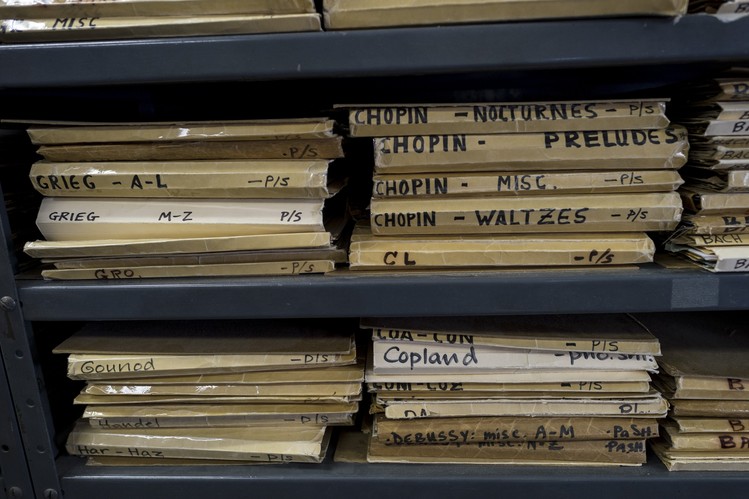
The store, on West 54th Street between Broadway and Eighth Avenue, opened in 1937 and provided the city’s musicians scores from the standard— Bach, Beethoven —to the arcane. Ms. Rogers bought it in 1978.
Frank Music is the last store in the city dedicated to selling classical sheet music, Ms. Rogers said, although other places such as the Juilliard School’s bookstore at Lincoln Center have it on their shelves.
Frank Music’s stock, which Ms. Rogers counts as hundreds of thousands of scores, was purchased by an anonymous donor as a gift for the Colburn School, a music conservatory in Los Angeles.
The school and Ms. Rogers declined to comment on financial details.
Colburn School’s president and chief executive, Sel Kardan, called Frank Music’s scores “an invaluable resource for our students and faculty for years to come.”
To the 63-year-old Ms. Rogers, nothing is more important than the arts.
“The idea that classical music is irrelevant is ridiculous,” she said, bemoaning the comparative salaries of tubists and stockbrokers. “People should be paid in terms of what they contribute to people’s well being.”
The store’s celebrity clients over the years have included pianists Emanuel Ax and Jeremy Denk, violinist Pamela Frank and cellist David Finckel.
One of Ms. Rogers’s favorite memories is a telephone call from the violinist Itzhak Perlman, asking for Kreisler scores.
The composer Bruce Adolphe, who is resident lecturer at the Chamber Music Society of Lincoln Center, described the store as a musical meeting ground.
“Frank’s Music was not just a store but a crucible,” he said, “a nexus where musicians from Suzuki beginners and their parents, to Joshua Bell, or the Brentano’s Mark Steinberg, would meet by chance.”
. 1922 ~ Betty White, Emmy Award-winning actress on The Mary Tyler Moore Show, singer
. 1926 ~ Moira Shearer, Ballerina
. 1927 ~ Eartha Kitt, Singer. Kitt’s birth certificate listing her actual birthdate as 1/17/27 was found in 1997. She has celebrated her birthday as Jan. 26 (1928) all of her life and says, “It’s been the 26th of January since the beginning of time and I’m not going to change it and confuse my fans.”
. 1941 ~ Gene Krupa and his band recorded the standard, Drum Boogie, on Okeh Records. The lady singing with the boys in the band during the song’s chorus was Irene Daye.
. 1944 ~ Chris Montez, Singer
. 1948 ~ Mick Taylor, Singer, rhythm guitar with The Rolling Stones
. 1955 ~ Steve Earle, Songwriter, singer, guitar
. 1956 ~ Paul Young, Singer
. 1959 ~ Susanna Hoffs, Singer, guitar with The Bangles
. 1960 ~ John Crawford, Singer, bass with Berlin
. 1969 ~ Lady Samantha, one of the very first recordings by Reginald Kenneth Dwight (aka Elton John), was released in England on Philips records. The song floundered, then bombed. The rock group, Three Dog Night, however, recorded it for an album.
. 2001 ~ Pianist and singer Emma Kelly, the “Lady of 6,000 Songs” made famous by the book “Midnight in the Garden of Good and Evil,” died from a liver ailment at the age of 82. Kelly’s nightclub act, in which she tapped her vast repertoire of American popular standards five nights a week until she became ill a month ago, was a must-see for Savannah tourists itching to meet a real-life character from author John Berendt’s Southern Gothic best seller. Though the book helped her book performances from New York to Switzerland, Kelly continued to crisscross south Georgia to play church socials and high school graduations, Kiwanis luncheons and wedding receptions. Berendt devoted an entire chapter to Kelly in the 1994 book, describing her as a teetotaling Baptist who would play smoky cocktail lounges Saturday nights and Sunday school classes the next morning. Kelly performed at her own nightclub, Emma’s, in Savannah, for five years in the late 1980s. She then bounced between lounges near the downtown riverfront. She also independently recorded three albums, the last of which were released posthumously, her son said.
. 2001 ~ Jazz musician, composer and conductor Norris Turney, who played alto sax and flute with the Duke Ellington Orchestra and led the Norris Turney Quartet, died of kidney failure at the age of 79. Turney recorded with a number of bands over the years, and toured with BillyEckstine, Ray Charles and others. He was an original member of the LincolnCenterJazz Orchestra directed by Wynton Marsalis. Turney’s lone CD as a band leader, “Big, Sweet ‘N Blue,” was warmly received by jazz critics.
. 2002 ~ Edouard Nies-Berger, the veteran organist and protege of AlbertSchweitzer, died at the age of 98. Nies-Berger, who played with the New York Philharmonic, was a native of Strasbourg in Alsace. His father, a church organist, was an associate of Schweitzer. The doctor, philosopher and Nobel laureate was pastor of a nearby church where the teen- age Nies-Berger played occasionally. Nies-Berger moved to New York in 1922 and for the next 15 years played the organ in houses of worship across the country. By the mid-’30s he settled in Los Angeles and performed in the soundtracks of several films, including “The Bride of Frankenstein” and “San Francisco.” He returned to Europe in 1937 to study conducting with Bruno Walter in Salzburg, Austria. After conducting for two years in Latvia and Belgium he returned to the United States. He was named organist of the New York Philharmonic, where he played under the direction of such conductors as Walter, George Szell and Leonard Bernstein. Nies-Berger was reunited with Schweitzer in 1949, when the humanitarian visited the United States. For six years they collaborated on the completion of Schweitzer’s edition of the organ music of Johann Sebastian Bach. After serving at St. Paul’s in Richmond, Nies-Berger returned to Europe for several years to perform as a recitalist and write several books, including a memoir of Schweitzer. In 1991 he was awarded the gold medal of the Art Institute of Alsace, and in 1993 was named a knight of the arts and letters by the French Ministry of Education and Culture.




 1937 ~ Following Carnegie Hall performances in both 1906 and 1919,
 MaryO'Studio