Music for Halloween: Dreams of a Witches’ Sabbath from Symphonie fantastique

berlioz-symphony-fantastique
The final movement is the best known part of the symphony, thanks to its use in the Julia Roberts movie, Sleeping With The Enemy. It features a four-part structure, which Hector Berlioz described in his own program notes from 1845 as follows:

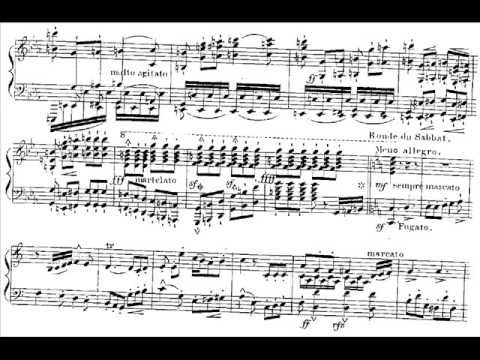
“He sees himself at a witches’ Sabbath, in the midst of a hideous gathering of shades, sorcerers and monsters of every kind who have come together for his funeral. Strange sounds, groans, outbursts of laughter; distant shouts which seem to be answered by more shouts. The beloved melody appears once more, but has now lost its noble and shy character; it is now no more than a vulgar dance tune, trivial and grotesque: it is she who is coming to the Sabbath… Roar of delight at her arrival… She joins the diabolical orgy… The funeral knell tolls, burlesque parody of the Dies irae, the dance of the witches. The dance of the witches combined with the Dies irae.”

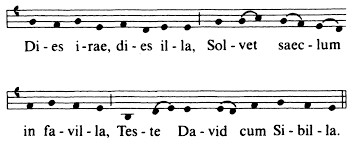
The Dies irae melody is one of the most-quoted in musical literature, appearing in the works of many diverse composers.

The traditional Gregorian melody has also been used as a theme or musical quotation in a number of  classical compositions, notable among them:

Free sheet music from IMSLP for the basic Dies irae

Free sheet music from IMSLP for the basic Symphonie fantastique (look under Arrangements and Transcriptions)

The basic Gregorian Chant

An animated version of the  Dreams of a Witches’ Sabbath from Symphonie fantastique.  Can you hear the Dies irae in this?  It starts around 3:18.

Leonard Bernstein conducts the “Orchestre National de France” in Berlioz’s Symphonie Fantastique
5th Movement

Arranged for piano

A listening guide

Piano Puzzlers!

puzzlers


The Piano Puzzlers book is available in the O’Connor Music Studio library if you’d like to give any a try.  Piano Puzzlers as heard on American Public Media’s “Performance Today.” Includes 32 tunes with songs by Gershwin, Berlin, Arlen, Porter, Rodgers, Fats Waller, Lennon & McCartney, and others disguised in the styles of Bach, Handel, Haydn, Mozart, Beethoven, Brahms, Schubert, Schumann, Chopin, Janacek, Debussy, Ravel, Rachmaninoff, Stravinsky, Prokofiev, Bartok, and Copland.

Includes an introduction by Fred Child, host of “Performance Today” as well as background info by Bruce Adolphe. “Bruce Adolphe has taken a common musician’s party game and elevated it to high art and truly funny musical slapsticks. The Piano Puzzlers are a unique combination of extraordinary insight into the styles of many composers subtle, expert workmanship and great, great fun!”


From http://jasonmorris.blogsome.com/2008/08/08/piano-puzzlers/

If you’re a music geek (like me), I have a program for you. Now, let me be clear, to fully qualify as a music geek…you must have a fond appreciation for classical music (no, Poison, Quiet Riot, and Zepplin do not count as classical music). So, if you’re a “music geek” without an appreciation for classical music…well, I hate to burst your bubble…but, you’re not truly a music geek. Instead, you’re a music appreciator, but not a geek. So, if you just listen to indie music and scowl at anything on a label larger than Matador…don’t bother following the link I’ll provide…the fun will be lost on you…And, you probably won’t have a chance.


Every Wednesday night, on my way home from WNL, I turn on my local NPR station to listen to Piano Puzzlers on Performance Today. It’s absolutely incredible. A pianist/composer (Bruce Adolphe) takes a familiar folk or pop tune and sets it inside a classical masterpiece (or in the style of a particular composer). Sometimes it’s easy…sometimes it’s ridiculously difficult. There are days when I say, “got it” on the first pass. Then there are days when I say, “what the heck?” And, more often than not, I’m able to get either the popular/folk tune or the composer.


This is sad to admit, but there are nights when I’ll slow down on the drive home or sit in the car in the driveway to finish an episode. In fact, I get a little worked up if someone stops me after WNL…as I might miss the beginning of Piano Puzzlers (it usually hits around 8:20pm on our local station).


Take a listen to some of the archives and see if you can figure it out! It’s really cool…but probably only appreciated by music geeks (the kind of people that listen to NPR for their musical programs and not just the snipets of cool indie rock between segments on All Things Considered…which is a great show too).


Play Piano Puzzlers HERE!

Daily Listening Assignments ~ August 6


Today’s piece is Hungarian Dance #5 by Johannes Brahms.  It’s available in Alfred Premier Piano Course Book 4 and many anthologies of classical music.

The Hungarian Dances are a set of 21 lively dance tunes based mostly on Hungarian themes, completed in 1869.

They vary from about a minute to five minutes in length. They are among Brahms’s most popular works and were the most profitable for him. Each dance has been arranged for a wide variety of instruments and ensembles. Brahms originally wrote the version for piano four hands and later arranged the first ten dances for solo piano.

Orchestra


Piano Duo

This has been embellished quite a bit


Violin

Ragtime (Bill Edwards)


May 7: Today’s Music History

today

•  1833 ~ Johannes Brahms, German composer
More information about Brahms

• 1840 ~ Piotr Ilyich Tchaikovsky, Russian composer
Listen to Tchaikovsky’s music
Read about Tchaikovsky
Read quotes by and about Tchaikovsky
More information about Tchaikovsky

• 1919 ~ Eva (Evita) Peron, Argentina’s spiritual leader and wife of Argentina’s President, Juan Peron; actress on stage, film and radio; the subject of the Broadway musical and film Evita

• 1927 ~ Elisabeth Söderström, Swedish soprano

• 1931 ~ Teresa Brewer (Breuer), Singer

• 1941 ~ Glenn Miller and his Orchestra recorded one of the great American music standards, Chattanooga Choo Choo
More information about Chattanooga Choo Choo

• 1942 ~ Felix Weingartner, Austrian conductor and composer, died; best known for his interpretations of Wagner and Beethoven.

• 1958 ~ Pianist Van Cliburn signed an artist’s contract with RCA Victor Records.

• 1966 ~ The Mamas & The Papas made the climb to the top of the Billboard pop music chart with Monday, Monday.

• 1977 ~ The Eagles went to No.1 on the US singles chart with ‘Hotel California’, the group’s fourth US No.1, a No.8 hit in the UK. The Eagles also won the 1977 Grammy Award for Record of the Year for ‘Hotel California’ at the 20th Annual Grammy Awards in 1978. The song’s guitar solo is ranked 8th on Guitar Magazine’s Top 100 Guitar Solos and was voted the best solo of all time by readers of Guitarist magazine.

• 1995 ~ Ray McKinley passed away.  He was an American jazz drummer, singer, and bandleader.

• 2002 ~ Buster Brown, a tap star and choreographer who danced on stage, in films and on television, died. He was 88. Brown was one of the last surviving members of the Copasetics, a legendary group of veteran dancers who performed together. Known for his quick rhythms and charm, Brown was a mentor and teacher for a younger generation of dancers. Brown, who was born James Brown in Baltimore, began his dancing career with a trio called the Three Aces and Speed Kings. He eventually began a solo career, appearing in the Hollywood musical “Something to Shout About” in 1943. Brown toured with the bands of Count Basie, Dizzy Gillespie and Duke Ellington, and was a featured dancer in Ellington’s concerts in the 1960s. He danced in the films “The Cotton Club” and “Tap” and on two public television specials. He also performed with the original casts of the Broadway musicals “Bubbling Brown Sugar” and “Black and Blue.” Brown toured South America with the Cab Calloway Orchestra and was commissioned by the State Department to perform in several African countries. He also taught master classes throughout Europe. Beginning in 1997, Brown was master of ceremonies at a weekly Sunday tap jam at the Manhattan club Swing 46, where young and old dancers stopped by to perform. He recently received an honorary doctorate from Oklahoma City University.

April 3: Today’s Music History

today

. 1850 ~ Vaclav Jan Krtitel Tomasek, organist/pianist/composer, died at the age of 75

. 1859 ~ Reginald De Koven, Composer

. 1895 ~ Mario Castelnuovo-Tedesco, Italian-born American composer

. 1897 ~ Johannes Brahms, German composer and pianist, died. He wrote four symphonies as well as concerti for piano and violin and highly-esteemed chamber works.

. 1924 ~ Doris Day, Singer

. 1942 ~ Wayne Newton, American singer of popular music

. 1944 ~ Tony Orlando, Singer, Tony Orlando and Dawn

. 1948 ~ Garrick Ohlsson, American pianist, winner of Poland’s Frederic Chopin piano competition in 1970. More about this competition.

. 1949 ~ Dean Martin and Jerry Lewis debuted on radio in an NBC program that ran until 1952.

. 1950 ~ Kurt Weil, German composer, died, best known for his “Threepenny Opera” and for his collaboration with actress and singer Lotte Lenya whom he married in 1926.

. 1952 ~ Harry Belafonte recorded his first songs for RCA Victor at Manhattan Center in New York City.

. 1952 ~ Hugo Winterhalter backed up the singer with an 18-piece orchestra. Among the sides recorded were Dogs A-Roving and Chimney Smoke.

. 1955 ~ Fred Astaire appeared on television for the first time on The Toast of the Town, with host, Ed Sullivan. Already an established dancer in films, Astaire was quick to become a TV sensation as well.

. 1965 ~ Bob Dylan appeared on the pop music charts for the first time. Subterranean Homesick Blues entered the Top 40 at number 39. The song stayed on the charts for eight weeks. Dylan would chart a total of 12 singles on the pop charts between 1965 and 1979. He appeared in the films Don’t Look Back, Eat the Document and Pat Garrett and Billy the Kid. He made the film Renaldo and Clara in 1978. Dylan co-starred in the film Hearts of Fire in 1987. He became a member of the Traveling Wilburys and was inducted into the Rock and Roll Hall of Fame in 1988. Dylan won the Grammy’s Lifetime Achievement Award in 1991.

. 1972 ~ Ferde Grofe, US composer (Grand Canyon Suite), died at the age of 80
More about Grofe

. 1986 ~ For the first time in six years, major record companies decided to raise prices – between three and five percent.

. 1986 ~ Peter Pears, British operatic tenor, died. He was a collaborator with composer Benjamin Britten and first interpreter of many of Britten’s works, notably “Peter Grimes.”

. 1990 ~ Sarah Vaughan passed away

. 1999 ~ Lionel Bart, British composer of the musical “Oliver!,” died aged 68.

. 2001 ~ Lester “Big Daddy” Kinsey, a blues singer-guitarist known for his croaky voice, died of prostate cancer. He was 74. Kinsey and his sons, Kenneth, Donald and Ralph, became known as “Big Daddy” Kinsey and His Fabulous Sons. The sons now form the Gary-based Kinsey Report and record for Alligator Records, a Chicago blues label. The Kinsey Report has toured with the likes of the Allman Brothers Band. In the early ’90s, the elder Kinsey experienced one of his career highlights with I Am the Blues, a major-label release on Polygram. The album boasted a host of blues standouts backing up Kinsey, including Buddy Guy, James Cotton, Sugar Blue and Pinetop Perkins.

. 2015 ~ Andrew Porter died.  He was a renowned music critic and scholar and translator of opera.

March 30: Today’s Music History

. 1674 ~ Pietro Antonio Locatelli died.  He was an Italian Baroque composer and violinist.

. 1872 ~ Sergei Vasilenko, Russian composer

. 1900 ~ Ted (Edward) Heath, Musician, trombonist, bandleader: played big band concerts every Sunday at the Palladium in the 1940s and 1950s

. 1913 ~ Frankie Laine (Frank Paul LoVecchio), Singer

. 1923 ~ The Audubon Ballroom in New York City was the scene of the first dance marathon. Alma Cummings danced the foxtrot, one-step and waltz with half a dozen partners.

. 1932 ~ Leonard Bernstein participated in his first piano recital at New England Conservatory, performing Brahms’ Rhapsody in G Minor.  He was 13.

. 1935 ~ Gordon Mumma, American composer of experimental music

. 1941 ~ Graeme Edge, Drummer with The Moody Blues

. 1942 ~ Bobby Wright, Country artist, actor, son of Johnny Wright of Johnnie and Jack country duo

. 1945 ~ Eric Clapton, British rock guitarist with the Yardbirds; songwriter, Grammy Award-winning singer: Bad Love in 1990

. 1959 ~ Sabine Meyer, German clarinetist

. 1963 ~ The Chiffons began a four-week stay at the top of the pop music charts as their hit single, He’s So Fine, became number one. The song stayed at the top of the top tune tabulation until Little Peggy March came along with I Will Follow Him on April 27th.

. 1964 ~ Tracy Chapman, Grammy Award-winning folk singer-songwriter

. 1964 ~ Willem Andriessen, Dutch composer and pianist (Beethoven), died at the age of 76

. 1968 ~ Celine Dion, Canadian and international superstar singer who has had a number of Number 1 singles in Canada, the Unites States and around the world including “The Power of Love” ( 1993 ), “Because You Loved Me” ( 1995 ). She got her big break following her win 1988 Eurovision Song Contest singing in French “Ne partez pas sans moi” for Switzerland. She is the best selling Canadian artist of all time selling 250 million albums, worldwide. She came from a poor area and poverty-stricken Charlemagne one of 14 children, but when asked has always said her childhood a good time in a happy household.

. 1970 ~ Lauren Bacall starred in Applause which opened on Broadway. The show became one of the hardest tickets to get on the Great White Way. Critics called Bacall “a sensation.” The play, at the Palace Theatre, was an adaptation of the film, All About Eve. It continued for 896 performances. A London version of the show, also starring Bacall, opened in 1972.

. 1971 ~ The Bee Gees received a gold record for the single, Lonely Days. When playing it, they heard the song at a faster speed and said, “Hey, this sounds like disco!” and the rest was Saturday Night Fever music history…

. 1974 ~ John Denver reached the top spot on the music charts with his hit, Sunshine on My Shoulders. It was the singer’s first number one song. Three other singles by Denver reached the top of the music world: Annie’s Song, Thank God I’m a Country Boy and I’m Sorry. Take Me Home Country Roads made it to the number two position, while Rocky Mountain High just cracked the Top 10 at number 9. Denver wrote Leaving on a Jet Plane for Peter, Paul and Mary and won an Emmy for the TV special, An Evening With John Denver.

February 12: On This Day in Music

. 1728 ~ Mysterious priest-composer Agostino Steffani died.

. 1760 ~ Jan Ladislav Dussek, Czech composer and pianist.  Along with his friend, famed piano maker John Broadwood, Dussek made important design improvements to the piano, allowing for the more dynamic style of playing that his highly original compositions required. Beethoven himself later used a Broadwood piano with Dussek’s innovations. This helped pave the way for Romanticism and Dussek’s influence on Beethoven’s piano writing has been well documented.

Dussek’s Piano Sonata Op. 77 in F minor (“L’invocation”), from 1812, is the last work he ever composed, and he saved the best for last. This is a neglected masterpiece that foreshadows Schubert, Chopin, Schumann, and Brahms.

. 1881 ~ Anna (Pavlovna) Pavlova, Russia’s premier ballerina

. 1894 ~ Hans von Bülow, German pianist and composer died (b. 1830)
More about von Bulow

. 1898 ~ Roy Harris, American composer

. 1904 ~ Ted Mack (William Maguiness), TV host of The Original Amateur Hour, The Ted Mack Family Hour

. 1914 ~ (Gordon) Tex Beneke, Bandleader, singer, tenor sax in the Glenn Miller Orchestra

, 1915 ~ Charles Emile Waldteufel, composer, died at the age of 77

. 1918 ~ All theatres in New York City were shut down in an effort to conserve coal.

. 1923 ~ Mel Powell, American jazz pianist and composer. One of his works is Mission to Moscow for Benny Goodman. He was also Dean of Music at California Institute of Arts.

. 1923 ~ Franco Zeffirelli, Italian director and producer of opera, theatre, film and television

. 1924 ~ Bandleader Paul Whiteman presented his unique symphonic jazz at the Aeolian Hall in New York City. The concert marked the first public performance of George Gershwin’s Rhapsody in Blue. The composer, himself, was at the piano this night. Distinguished guests included John Philip Sousa and Jascha Heifetz.

. 1935 ~ Gene McDaniels (Eugene Booker McDaniels), Singer

. 1939 ~ Ray Manzarek, Keyboards with The Doors

. 1942 ~ Mildred Bailey recorded More Than You Know on Decca Records.

. 1948 ~ Joe Schermie, Bass with Three Dog Night

. 1949 ~ “Annie Get Your Gun” closed at the Imperial Theater in New York City after 1147 performances

. 1964 ~ The Beatles played two concerts at Carnegie Hall in New York City, concluding a very successful American tour.

. 1968 ~ Singer and famed guitarist, Jimi Hendrix, received an honorary high school diploma from Garfield High School in Seattle, WA, where he had dropped out at the age of 14.

. 1972 ~ Al Green’s Let’s Stay Together knocked American Pie out of the top spot on the music charts. The record stayed at the top for one week, before giving way to Nilsson’s Without You. Green returned to his gospel roots in 1980 and is a minister in Memphis, TN. Green recorded 14 hit songs with six of them making it to the Top 10.

. 1976 ~ Sal Mineo, singer, died

. 1983 ~ Eubie Blake, US ragtime-composer/pianist (Memories of You), died at the age of 96

. 2011 ~ Elizabeth “Betty” Garrett, American actress, comedian, singer and dancer (All in the Family), died of an aortic aneurysm at the age of 91

Composers – J


Jackson

Michael Joe Jackson
A star was born on August 29, 1958 in Gary, Indiana. Singer, songwriter, dancer, actor Michael Joe Jackson started on the road to stardom while at Garnett Elementary School in Gary. Michael performed for his class by singing Climb Every Mountain. Within just a few years, he took his act to the stage joining his brothers as The Jackson Five. They were entertaining at Mr. Lucky’s, also in Gary, Indiana. Michael was only 8. By the time he was 11, Michael, the youngest of the five brothers, was the lead singer of the group.

And their hits were hitting the top of the charts: I Want You Back, ABC, The Love You Save, I’ll Be There. Then young Michael started recording solo hits like Ben, also #1.

And the hits just kept on coming … and the awards came with them: A Grammy for Best Male R&B Vocal in 1979 for Don’t Stop ’Til You Get Enough, 5 Grammy Awards in 1983 — Best Male Pop Vocal and Album of the Year (Thriller), Best Male R & B vocal and Best R & B song (Billie Jean), and Best Recording for Children: E.T., the Extraterrestrial; 2 in 1984 — Record of the Year and Best Male Pop Vocal (Beat It); another in 1985 with Lionel Richie for Song of the Year (We are the World); a Best Music Video/Short Form Grammy in 1989 for Leave Me Alone; and finally, The Legend Award Grammy — for the living legend in the music industry, Michael Jackson.

Whether Michael sings with his brothers, his sisters, alone or in duets with fellow performers, the results are hit, after hit, after hit … The Girl is Mine and Stay, Stay, Stay with Paul McCartney; I Just Can’t Stop Loving You with Siedah Garrett; Rock with You, Bad, Smooth Criminal … Ease on Down the Road with Diana Ross (from Broadway’s The Wiz in which Michael played the scarecrow). Michael, the actor, was also seen as a hologram, Captain Eo in Epcot Center’s multimedia show.

A celebrity for most of his life, he is both magic and tragic … the gloved one’s fame and infamy well-known throughout the world: he made $70 million from Thriller; he paid $50 million for the rights to the Beatles’ 251 songs; his Bad album was number one in 23 countries; he has an amusement park and zoo at his California estate; he married and divorced Lisa Marie Presley, the daughter of the King of Rock.

He remarried, became a father … and the rest of the story is still being written …. To date, Michael Jackson remains the King of Pop.

Janácek

Leos Janácek lived from 1854 until 1928. It was relatively late in life that the Moravian composer Janácek won more than local recognition. He made his early career in the capital of his native province, Brno, coupling an interest in regional folk music with a study of speech intonations, echoed in his instrumental as well as vocal writing. His opera Jenufa was first staged in Brno in 1904, but it was the performance in Prague in 1915 that brought the work of the composer a much wider public. The seven operas that followed have formed a very idiosyncratic part of current operatic repertoire, culminating in From the House of the Dead, completed in 1928, the year of Janácek’s death, and based on the novel by Dostoyevsky.

The best known of Janácek’s music for orchestra is the Sinfonietta, derived from an original festival piece of 1926. To this may be added the rhapsody based on the work of Gogol, Taras Bulba, and the Lachian Dances, based on folk-dances.

Joachim

Joseph Joachim lived from 1831 until 1907. He was a Hungarian violinist, conductor and composer whose exceptional talent was recognized by Mendelssohn. He was also a close friend of Brahms. His music had much in common with the music of Schumann.

John

Elton Dwight John was born in 1947 and is a rock singer and pianist. He was born in Pinner, NW Greater London, England. He played the piano by ear from age four, and studied at the Royal Academy of Music at 11. From 1967, he and Bernie Taupin began writing songs such as “Rocket Man’ (1972), “Honky Cat’ (1972), and “Goodbye Yellow Brick Road’ (1973). Their publisher pressed John to perform them, for which he obscured his short, plump, myopic physique in a clownish garb that included huge glasses, sequined and fringed jump suits, and ermine boots. The top pop star of the 1970s, he later became chairman (1976 to 1990) and then honorary life president in 1990 of the Watford Football Club and a stock-market speculator. Despite health problems in 1993 brought about by his stressful lifestyle he continues to perform live across the world.

Johnson

James Price Johnson, Ragtime composer

Jolivet

André Jolivet lived from 1905 until 1974. Versatile in the arts, André Jolivet was a pupil of Le Flem and later of Varèse and was, with Olivier Messiaen, Daniel Lesur and Yves Baudrier, a member of the composers grouped together as Jeune France. As director of music for the Comédie française he wrote a quantity of incidental music and elsewhere based his work on principles that stemmed from his interest in the magical and incantatory element fundamental to human music.

Jolivet wrote a number of concertos, all demanding considerable virtuosity from the soloist. These include a concerto for the ondes Martenot, an electronic instrument developed in France in the 1920s, and concertos for trumpet and piano, for flute, for piano, for harp, for bassoon and harp, for percussion, for cello and for violin.

In addition to his varied incidental music, whether for Molière, Claudel, Corneille or Plautus, Jolivet wrote music for the ballet and for marionette plays.

Jolivet made an early impression on Messiaen with the six piano pieces that constitute Mana. Chamber music includes music involving the flute, an instrument he particularly favoured for its primitive human associations.

Joplin

Scott Joplin (1868-1919) was the most influential and famous composer of the ragtime era, and one of the most daring pioneers in the history of American music. He was known as the Father of Ragtime. At first, the musical establishment absolutely refused to acknowledge ragtime as a worthy means of musical expression, dismissing it as catastrophic noise that had little musical meaning at all. Only within the last few decades has his work finally been truly appreciated and accepted as a truly great form of art, and as a unique and substantial contribution to music.

Ragtime, which first emerged in the 1890’s, is a style of piano playing with an up-and-down “ragged time” rhythm. Joplin made ragtime an international dance craze with “Maple Leaf Rag”. “The Maple Leaf Rag”, became the first song to sell over one million copies of sheet music.

The remarkable part of his success as a musician was the fact that he was African American. His success paved the way for all black musicians who would come after him, breaking a long-standing race barrier: acceptance as a performer.

Joplin’s music enjoyed renewed popularity with the use of “Solace” in the 1973 movie The Sting. Solace was not a typical rag, although it does have similar rhythmic elements.

Treemonisha was an opera composed by Joplin, although it was not produced until 1975, 58 years after his death.

Some other ragtime composers were Joseph Lamb and James Scott. Eventually, ragtime was replaced by jazz.

January 16 ~ On This Day in Music

. 1864 ~ Anton Schindler, German violinist and Beethoven’s biographer, died at the age of 68

. 1875 ~ First American performance of Johannes Brahms’ “Hungarian Dances”

.

1886 ~ Death of Italian opera composer Amilcare Ponchielli, in Milan. He was 51.

. 1891 ~ French Composer Leo Delibes died at the age of 54

. 1905 ~ Ernesto Halffter, Spanish composer and conductor

. 1908 ~ Ethel Merman (Zimmerman), American singer of popular music, Tony Award-winning actress (musical), Musical Theater Hall of Fame. She is most famous for Call Me Madam in 1951, It’s a Mad, Mad, Mad, Mad World, There’s No Business Like Show Business and Alexander’s Ragtime Band

. 1929 ~ Marilyn Horne, American mezzo-soprano

. 1929 ~ G.T. (Granville) Hogan, Jazz drummer who played with Elmo Hope, Earl Bostic

. 1934 ~ Bob Bogle (Robert Lenard Bogle), Guitarist, bass with The Ventures

. 1938 ~ Béla Bartók and his wife, Ditta performed their first public concert featuring his Sonata for Two Pianos and Percussion

. 1938 ~ Benny Goodman and his band, plus a quartet, brought the sound of jazz to Carnegie Hall in New York City. When asked how long an intermission he wanted, he quipped, “I don’t know. How much does Toscanini get?”

. 1942 ~ Bill Francis, Keyboard, singer with Dr. Hook and the Medicine Show

. 1942 ~ Kay Kyser and the band recorded A Zoot Suit for Columbia Records. The tune is about the problems associated with wearing this garish, exaggerated ‘hep’ fashion.

. 1946 ~ Katia Ricciarelli, Italian soprano

. 1946 ~ Ronnie Milsap, Grammy Award-winning singer in 1976, CMA Male Vocalist of the Year (1974, 1976, 1977), CMA Entertainer of the Year (1977), blind since birth, he learned to play several instruments by age 12

. 1950 ~ Debbie Allen, Dancer, actress, choreographer, sister of actress Phylicia Rashad

. 1957 ~ Conductor Arturo Toscanini died in New York at the age of 89.

. 1957 ~ The Cavern Club opened for business in Liverpool, England. The rock club was just a hangout for commoners. Then, things changed — big time. It all started in the early 1960s when four kids from the neighborhood popped in to jam. They, of course, turned out to be The Beatles.

. 1962 ~ Paul Webb, Bass with Talk Talk

. 1964 ~ “Hello Dolly!” opened at the St. James Theatre in New York City. Carol Channing starred in the role of Mrs. Dolly Levi. The musical was an adaptation of Thornton Wilder’s play, “The Matchmaker”. The show, with an unforgettable title song, was hailed by critics as the “…possible hit of the season.” It was possible, all right. “Hello Dolly!” played for 2,844 performances. And, it returned to Broadway in the 1990s, again starring Carol Channing.

. 1972 ~ David Seville died on this day in Beverly Hills, CA. Born Ross Bagdasarian, the musician was the force, and artist, behind the Alvin and the Chipmunks novelty songs of the 1950s, ’60s and ’70s.

. 1973 ~ Clara Ward passed away. Ward was an American gospel artist who achieved great artistic and commercial success in the 1940s and 1950s.

. 1975 ~ “Mandy” is Barry Manilow’s first #1 pop hit

. 1976 ~ The album, “Frampton Comes Alive”, was released by Herb Alpert’s A&M Records. The double LP soon reached the top spot of the album charts and stayed perched there for 17 weeks. It sold 19 million copies in its first year.

. 1980 ~ Lin Manuel Miranda, American actor, composer, lyricist (Hamilton)

. 1984 ~ Michael Jackson received eight awards at the 11th annual American Music Awards this night.

. 2001 ~ Eleanor Lawrence, a flutist who played often in chamber music performances and with several orchestras in New York City, died of brain cancer at the age of 64. She is credited with transforming a simple newsletter into an important source for flutists. Lawrence studied the flute at the New England Conservatory with the principal flutist of the Boston Symphony Orchestra, James Pappoutsakis. She later studied with flutists from the Philadelphia Orchestra and the Metropolitan Opera orchestra. She joined the American Symphony Orchestra and the Brooklyn Philharmonic after moving to New York in the 1960s. She played periodically with the New York Philharmonic and the Metropolitan Opera. Besides performing, Lawrence taught at the Manhattan School of Music. She served three times as the president of the New York Flute Club. She edited The National Flute Association Newsletter, now The Flutist Quarterly, from the mid-1970s to the early 1980s, expanding it from a brief information sheet to a publication with regular interviews.

Leonard Bernstein: What Does Music Mean?

On January 18, 1958 Leonard Bernstein began presenting his television series What does music mean?  The series ran for 53 programs.  Some of the episodes can be found below:

Part 1 What is Classical Music?

Plot: Bernstein conducts Handel’s Water Music and cites it as an indisputable example of classical music. “Exact” is the word that best defines classical music, Bernstein says and he demonstrates with musical illustrations from Bach’s Fourth Brandenburg Concerto, Mozart’s Concerto No. 21 in C Major and The Marriage of Figaro, and Haydn’s Symphony No. 102.

The decline of classical music at the end of the eighteenth century is tied to Beethoven’s innovations and the Romantic movement, and Bernstein conducts Beethoven’s Egmont Overture.


Part 2 What is Melody?

Plot: Bernstein discusses the different forms melody can take, including tune, theme, motive, melodic line and musical phrase. He illustrates by conducting the orchestra in excerpts from Tchaikovsky, Wagner, Hindemith, and Brahms.


Part 3 What is a Mode?

Plot: Bernstein discusses scales, intervals, and tones, and analyzes several pieces, including Debussy’s Fêtes, Rimsky-Korsakov’s Scheherazade, and music from the Kinks and the Beatles, to illustrate different modes.

An excerpt from Bernstein’s ballet Fancy Free is also performed.