Founded in Manhattan in 1853, Steinway & Sons is widely considered to be one of the greatest piano makers in the world. Its grand pianos grace the world’s grandest stages and are played by the best pianists.
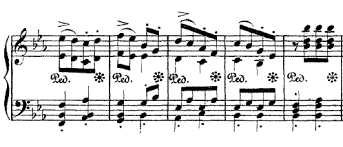
These are some examples of pedal marks in piano music:
An older style of pedalling. The symbols can be between or below the staves.
This type of pedalling is more commonly used today.
Another type of pedalling
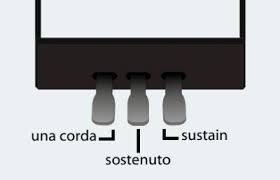
Pedals on a grand piano:
There are two standard foot pedals on the piano: on the left side is the una corda pedal and on the right side is the sustain (damper) pedal.
The middle sostenuto pedal is only standard on the American grand piano, and is very rarely used.
With pedals, the pianist can add resonance and color to the music and thereby bring out its inherent emotion. At the same time, over-pedaling or improper pedaling can drown the listener and the performer in a miasma of overlapping sounds.
This pedal has various names. It is sometimes called the damper pedal (because it lifts all the dampers inside the piano), or the forte pedal (because the result of lifting all the dampers is a fuller sound), or the tre corde pedal (because it allows the three strings of each key to vibrate), or the sustaining pedal (because when you depress it the note will continue to sound even if you take your fingers off the keys).
Damper Pedaling Guidelines
Here are some guidelines pedaling. As with everything in art, they can be ignored under certain circumstances.
Avoid pedaling notes that move in a stepwise or scalar pattern. Adjacent notes are dissonant, and when pedaled, they sound smudged.
Do pedal notes that skip and form a nice harmony.
Change your pedal (i.e., lift it up and put it down again) at each change of harmony.
Avoid pedaling through rests (i.e., silence), at ends of phrases (at which point we would need to breathe and that split second of silence takes care of that), or staccato notes—although this is commonly ignored, because we actually can hear the disconnection through the pedal. This is why we do not depend on the pedal to achieve a beautiful legato.
Keep your heel planted firmly on the floor, and pedal with either toes or the ball of foot, depending on your shoe size.
There are several manipulations possible with the damper pedal, each affecting the sound slightly differently.
Syncopated Pedaling
For the cleanest sound, the syncopated (or legato) pedal will give you the most control. This is an action where the foot is put down immediately after the note is played. This may take some getting used to, but you can practice it by playing a C scale.
Play C, and then lower the damper pedal.
Hold the pedal down until you are just about ready to play the D.
As the D’s finger goes down, the foot goes up, and then down again immediately after the D is struck.
The sound is clean. Continue up the scale the same way.
As an experiment, try putting the pedal down as you play a note, and notice the difference in the sound. Since the damper pedal lifts all the dampers, when you strike the D, not only are the three strings of that note free to vibrate but so do all the other strings vibrate sympathetically. You have a sound that is full of overtones.
There are times when you will want that effect and so will keep your foot down until the accumulated sound needs to breathe.
You can practice the syncopated pedal away from the piano by sitting on the bench or a chair and lifting your right knee at exactly the same time as your right hand goes down to tap the rising knee. This is the same action at the keyboard. The foot goes up when the hand goes down and then returns to the pedal.
Partial Pedals
There are half and quarter pedals too, which are used when you don’t want full vibrato. Rather than depressing the pedal all the way down, you lower your foot halfway so that the dampers are lifted only slightly off the strings, without allowing them to vibrate fully.
The quarter pedal gives even just a hint of pedal. It will take a while to feel these various distances on your piano. Also, you will find that each piano has its own pedal feel, which you must get used to before attempting to perform on that instrument.
Flutter Pedal
Then there are times, usually in scale passages, where touches of pedal can be very appealing and then the foot goes up and down rapidly and shallowly, and that is called the “flutter” pedal.
Choosing the Pedaling
The different types of damper pedaling techniques are for you, the pianist, to decide. But what determines which choice you will make?
Two things will control that: your very important ear, and your understanding of the music—the composer and the era in which the music was composed.
Your pedaling approach following the composer’s style depends on your knowledge of what instruments were available during the composer’s lifetime and how the pedal or lack of pedals would have made the music sound. This way, your interpretation will have authenticity.
Position of the Sustain Pedal:
Right pedal
The Sustain Pedal is Played With:
Right foot
Also Called:
Damper pedal, forte pedal, loud pedal
Effects of the Sustain Pedal:
The sustain pedal allows all of the notes on the piano to resonate after the keys have been lifted, for as long as the pedal is depressed. It creates a legato effect, forcing all of the notes to echo and overlap.
History of the Sustain Pedal:
The sustain pedal was originally operated by hand, and an assistant was required to operate it until the knee lever was created. The creators of the sustain foot pedal are unknown, but it is believed to have been invented around the mid-1700s.
Use of the sustain was uncommon until the Romantic Period, but is now the most commonly used piano pedal.
How the Sustain Pedal Works:
The sustain pedal lifts the dampers off of the strings, allowing them to vibrate until the pedal is released.
Sustain Pedal Marks:
In piano notation, use of the sustain pedal begins with Ped., and ends with a large asterisk.
Variable pedal marks, seen as __/\_/\__, are placed under notes, and define the precise pattern in which the sustain pedal is depressed and released.
Horizontal lines show when the sustain pedal is depressed.
Diagonal lines indicate a quick, temporary release of the sustain pedal.
Position of the Una Corda Pedal:
Left pedal
The Una Corda is Played With:
Left foot
Also Called:
Soft pedal, “piano” pedal
Effects of the Una Corda Pedal:
The una corda pedal is used to enhance the timbre of softly played notes, and exaggerate a low volume. The soft pedal should be used with notes that are already played softly, and will not produce the desired effect on louder notes.
History of the Una Corda Pedal:
The una corda was the first mechanism to modify the piano’s sound, and was originally operated by hand. It was invented in 1722 by Bartolomeo Cristofori, and quickly became a standard addition to the piano.
How the Una Corda Pedal Works:
Most treble keys are attached to two or three strings. The una corda shifts the strings so that the hammers only strike one or two of them, creating a softened sound.
Some bass keys are only attached to one string. In this case, the pedal creates a shift so that the hammer strikes on a lesser-used portion of the string.
Una Corda Pedal Marks:
In piano notation, use of the soft pedal begins with the words una corda (meaning “one string”), and is released by the words tre corde (meaning “three strings”).
Interesting Facts About the Una Corda Pedal:
Most upright pianos use a “piano” pedal instead of a true una corda pedal. The piano pedal moves the hammers closer to the strings, preventing them from striking with full force
Position of the Sostenuto Pedal:
Usually the middle pedal, but is often omitted.
The Sostenuto is Played With:
Right foot
Originally Called:
Tone-sustaining pedal
Effects of the Sostenuto Pedal:
The sostenuto pedal allows certain notes to be sustained while other notes on the keyboard are unaffected. It is used by hitting the desired notes, then depressing the pedal. The selected notes will resonate until the pedal is released. This way, sustained notes can be heard alongside notes played with a staccato effect.
History of the Sostenuto Pedal:
The sostenuto pedal was the last addition to the modern piano. Boisselot & Sons first showcased it in 1844, but the pedal didn’t gain popularity until Steinway patented it in 1874. Today, it’s primarily found on American grand pianos, but is not considered a standard addition since it is very rarely used.
How the Sostenuto Pedal Works:
When the sostenuto pedal is depressed, it keeps the dampers off the selected strings, allowing them to resonate while the rest of the keys’ dampers remain down.
Sostenuto Pedal Marks:
In piano music, use of the sostenuto pedal begins with Sost. Ped., and ends with a large asterisk. Notes meant to be sustained are sometimes marked by hollow, diamond-shaped notes, but there are no strict rules for this pedal since it is hardly ever used.
Interesting Facts About the Sostenuto Pedal:
Sostenuto is Italian for “sustaining,” although this incorrectly describes the pedal’s function.
On some pianos, the sostenuto pedal only affects the bass notes.
The middle pedal is sometimes built as a “practice rail” pedal instead of a sostenuto. A practice rail muffles notes with felt dampers, allowing for quiet play.
Sostenuto pedal markings are rarely seen in sheet music, but can be found in the works of Claude Debussy.
Come January, thanks to the San Diego Symphony, it’s going to be all pianos, all the time in San Diego. The orchestra is collaborating with a host of community partners in an ambitious, month-long Upright & Grand Festival.
With the assistance of its collaborators, the orchestra aims to show as many aspects of the piano as possible during the course of festival, which includes more than a dozen concerts plus community events.
“Pianos can be found in concert halls, night clubs, homes, schools, libraries and department stores,” said symphony CEO Martha Gilmer in a statement. “A pianist can play entire symphonies or a solo sonata. The piano can play the role of the orchestra in rehearsals of great opera and ballet scores, and it is a partner to instrumentalists and singers. The piano is both a solitary and partner instrument.”
Among the orchestra’s partners are the La Jolla Music Society, the Poway Center for the Performing Arts and the California Center for the Arts, Escondido.
The Music Society will bring Garrick Ohlsson (Jan. 14) to Sherwood Auditorium and Emanuel Ax (Jan. 20) to the Jacobs Music Center. The Poway Center will showcase the orchestra and pianist Jeremy Denk on Jan. 15 (he’ll also perform with the orchestra on Jan. 16-17 and with orchestra musicians in a chamber music concert on Jan. 19 at Jacobs Music Center). The California Center for the Arts, Escondido, will host a performance by Ben Folds and the orchestra on Feb. 5 (Folds will also perform in Jacobs Music Center Feb. 6).
In addition, Combat Arts; PATH — Connections Housing; Urban Discovery Academy; the New Children’s Museum and ARTS: A Reason to Survive will participate in a piano painting endeavor; as will artists Anna Stoa, Grace Gray Adams and Grace Matthews, Christie Beniston, and Sheena Dowling.
Once painted, the pianos will be placed in at least 10 public spaces including Horton Plaza, Liberty Station, the Courtyard at East Village, the New Children’s Museum and the California Center for the Arts as part of the “Play Me: Pianos in Public Spaces” element of the festival.
“Upright & Grand offers the public the opportunity to get involved by performing outdoors at any number of the ‘Play Me’ pianos in public spaces throughout San Diego,” said Tommy Phillips, the orchestra’s director of artistic planning, in a statement. “This collaborative component of Upright & Grand has both a celebratory and accessibility element as we bring the piano festival to the people via the Jacobs Music Center, Poway Center for the Performing Arts and California Center for the Arts, Escondido.”
In addition to nine programs at Jacobs Music Center, ranging from Marc-Andre Hamelin performing Gershwin’s “Rhapsody in Blue” with the orchestra (Jan. 8-10) to a Jazz Piano Masters: A Tribute to Thelonious Monk, Art Tatum and Bud Powell concert (Jan. 23) to Ben Folds performing his own piano concerto with the orchestra (Feb. 6), the symphony is offering a community day on Jan. 16 from noon to 5 p.m..
The Jan. 16 “Hands On: Play a Little, Learn a Lot” event will will present a range of keyboard-centric activities including free piano lessons, demonstrations (including a music app session with Apple Store representatives) and the chance to play a short piece on stage.
The community day ends with a “Monster Piano” performance on the Jacobs Music Center stage: 10 pianists will play on five pianos.
More information and tickets: sandiegosymphony.org or (619) 235-0804.
From Singapore: Classical music radio station Symphony 92.4FM is putting up a piano designed by Steinway & Sons for auction, and proceeds will go to the President’s Challenge 2015.
The President’s Challenge supports close to 100 charity organisations such as Boys’ Town, Cerebal Palsy Alliance Singapore, Lions Home for The Elders, and Guide Dogs Association of the Blind.
The Boston GP-163PE Grand Piano is valued at S$44,800, with a minimum bid of S$10,000. The silent auction will end on Sep 30 at 11.59pm.
Corporations are welcome to particpate, and the successful bidder can also choose to donate the piano to a beneficiary.
The pianos in Istanbul’s Dolmabahçe Palace, which hosted some 1 million people last year, draw great interest from local and foreign visitors for their magnificence and harmony with their surroundings.
National Palace guide Osman Nihat Bişgin said Dolmabahçe Palace was a Tanzimat (reform-era) palace, adding, “All features of the reform era are clearly seen in Dolmabahçe Palace. This process, which we call the Europeanization and westernization process, made western music enter Dolmabahçe Palace.”
He said the palace had a total of 12 pianos, and all of them had ornamentations suitable to the style and harmony of the palace.
Bişgin said the palace opened in 1856 and the pianos were brought there nearly at the same time. “The wives of sultans were taking piano education in the palace, particularly in the final years of the Ottomans. There are many pianos and none of them were inactive; all of them were being played,” he said.
He said most of the piano brands in the palace were Hertz, Pleyel, Gaveau and Erard, and that the number of grand pianos was less.
Speaking of a striking green piano in Zülvecheyn Hall on the upper floor of the palace, Bişgin said it was a classical Pleyel-brand palace piano.
“Since the magnificence and glory was dominant in the palace, the pianos draw our attention visually. Their sound is not very famous, but they are very important and famous visually,” he said.
Bişgin said Zülvecheyn Hall had gilded ornamentation on its white and beige ceiling, adding, “We see enormous harmony between the piano and the ceiling.”
He said the furniture in Dolmabahçe Palace was in its original place, and added, “We can say that the pianos belong to these halls. The pianos in the Zülvecheyn and Süfera halls were designed to add visual richness to halls like them. They are not generally played.”
Crystal piano and chair in the Glass Kiosk
As for the rare crystal piano in the Glass Kiosk, Bişgin said the following: “The Glass Kiosk is a big venue hidden behind the walls of the palace. Mustafa Kemal Atatürk greeted the public in this place. It is like a winter garden surrounded with glass. In harmony with this kiosk, there is a crystal piano. It is a Paris-made Gaveau piano. Its chair is crystal, too.”
Another piano in the palace is a plain black German-made Steinway. Bişgin said its sound was very strong and it was very valuable.
“It was produced as a Hamburg Steinway in 1912. Then the factory moved to the U.S. Accordingly, there were only five Steinway pianos made in Germany. This is one of them. Its estimated price is 200,000 euros. It also has the emblem of the sultan Abdulmecid,” Bişgin added.
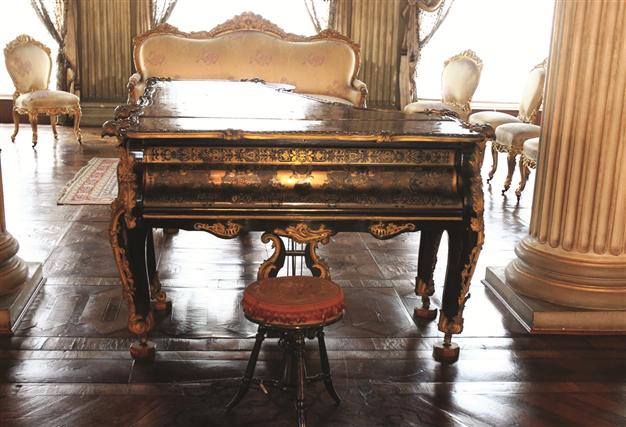
Speaking of the piano, which was used during the acceptance of ambassadors in the Süfera Hall, Bişgin said, “Süfera is the plural of the word sefir [ambassador]. This hall was created to address foreigners. The furniture is gold-plated; the ceiling is the same. There is a boulle-work piano here to show the beauty of metal and gold. This piano is wonderful for decoration.”
The church’s soup kitchen program fills quickly, bringing a din of chitchat and the scraping of chairs on floor tiles and the thud of trays being knocked against the inside of a trash can.
But above it all, each and every weekday, hovers another sound, wholly unexpected: the clear, clean notes of a concert grand piano, there in a far corner.
On a recent Wednesday, like every Wednesday, it is not so much being played as it is being worked over by a man who seems to be warming up for a gig at a candlelit downtown jazz club.





 MaryO'Studio