November 16, 2016 ~ Today in Music History

today

• 1569 ~ Birth of German organist and composer Paul Sartorius in Nuremberg. d-28 February 1609, Innsbruck.

• 1615 ~ Birth of French violinist and composer Guillaume Dumanoir, II. He composed dance music enjoyed by Louis XIV

• 1667 ~ Death of composer Nathaniel Schnittelbach, at 34. b-1633.

• 1715 ~ Birth of composer Girolamo Abos on the island of Malta. Italian opera and church music.

• 1720 ~ Birth of Italian composer Carlo Antonio Campioni.

• 1757 ~ Birth of American composer Daniel Read, of the First New England School, and one of the primary figures in early American classical music. d-4 DEC 1836.

• 1775 ~ Death of German composer Karl Marian Paradeiser, at 28.

• 1780 ~ Birth of English composer Robert Archibald Smith.

• 1840 ~ Birth of composer Frederick Scotson Clark.

• 1848 ~ Frédéric Chopin played his final piano concert at a Polish benefit ball at Guildhall in London.

• 1850 ~ Giuseppe Verdi‘s opera Stifellio was first performed at the Teatro Grande in Trieste despite difficulties with the censors which resulted in cuts and changes.

• 1852 ~ Birth of American soprano Minnie Hauk in NYC. d-near Lucerne, 6 FEB 1929.

• 1854 ~ First Performance of Anton Rubinstein‘s Ocean Symphony in Leipzig.

• 1860 ~ Birth of Viennese harpist Edmund Scheucker.

• 1861 ~ Birth of composer Vaclav Suk.

• 1861 ~ First Performance of Johannes Brahms‘ Piano Quintet No. 1 in g, Op. 25, at a rehearsal in Hamburg, with pianist Clara Schumann.

• 1862 ~ The work noted above received its official premiere with members of the Hellmesberger Quartet; Brahms at the piano, in Vienna.

• 1870 ~ Birth of Australian composer Alfred Hill in Melbourne. d-Sydney, 30 OCT 1960.

• 1873 Birth of Swedish tenor David Karl Björling, in Harmånger parish of northern Sweden’s Hälsingland province. d. Aug. 16, 1926.

• 1873 ~ W.C. Handy, American blues composer and bandleader
More information about Handy

• 1889 ~ George S. (Simon) Kaufman, Playwright: The Cocoanuts, A Night at the Opera, with Moss Hart, The Man Who Came to Dinner, You Can’t Take It with You

• 1894 ~ Debut of opera star Enrico Caruso in Mario Morelli’s L’Amico Francesco at Naples Teatro Nuovo.

1895 ~ Paul Hindemith, German-born American composer and conductor
Read quotes by and about Hindemith
More information about Hindemith

• 1896 ~ Lawrence Mervil Tibbett, American baritone

• 1905 ~ Eddie (Albert) Condon, Guitarist, bandleader, promoter of Dixieland Jazz

• 1908 ~ Conductor Arturo Toscanini made his debut in the United States this day. He appeared at the Metropolitan Opera House in New York, conducting Aida.

• 1931 ~ Bob Gibson, Singer, songwriter, leader of folk music movement in late ’50s, duo of Gibson and (Bob) Camp

• 1932 ~ The Palace in New York City closed its doors. It was the most famous vaudeville theater in America. Later, it became a movie house with live performances preceding the flicks; most notably: the team of Dean Martin and Jerry Lewis in their heyday.

• 1935 ~ The Rodgers and Hart musical, Jumbo, opened in New York City for a run of 233 performances.

• 1937 ~ Bob Crosby and his orchestra recorded South Rampart Street Parade on Decca Records.

• 1945 ~ Martine Van Hammel, Ballet, American Ballet Theatre

• 1955 ~ ‘Tennessee’ Ernie Ford drove to the top spot on the record charts on this day. Sixteen Tons, where he owed his “soul to the company store…”, became the fastest-selling record in history, jumping to #1 in just 3 weeks. The tune, on Capitol Records, stayed at #1 for eight weeks.

• 1970 ~ Anne Murray received a gold record for Snowbird. She was the first Canadian recording artist to receive a gold record.

• 2000 ~ Russ Conway, a British pianist known as the “Prince Charming of Pop” who sold
More than 30 million records in the 1950s and ’60s, died at age 75. He had 17 consecutive hits in the late 1950s and early 1960s, and won a silver disc when his record Roulette topped 250,000 sales – a total rapidly equaled by three other hits, Sidesaddle, China Tea and Snow Coach. Conway’s formal piano education consisted of one lesson at age 4. He left school at 14 and got work in a lawyer’s office. But he was sent to juvenile detention for three years for taking money he found in a package. In a detention center, he found a piano to play. While doing a stint as a pianist in a club, he was discovered by choreographer Irving Davies. He went on to provide piano accompaniment to a string of singers. Soon he was composing the songs that made him famous and won him the nicknames “Prince Charming of Pop” and the “Sheik of the Keyboard.”

• 2001 ~ Blue guitarist and singer Isaac Scott, a major figure in the city’s music scene for more than a quarter century, died of complications from diabetes. He was 56. A stream of musicians paid their respects to Scott, said his ex-wife, Eloise DePoe. He was found in his apartment Nov. 4 and never regained consciousness. Scott recorded several albums, including “The Isaac Scott Band,” “Big Time Blues Man” and “High Class Woman.” He also appeared on the compilation albums “Live at the San Francisco Jazz Festival” and “Live at the Roadhouse.” Primarily a “cover artist,” Scott did not write his own songs, which hindered national recognition. But he received several local honors, including the Washington Blues Society’s Hall of Fame (1991) and lifetime-achievement (2000) awards. He also performed at last year’s opening of the Experience Music Project. Scott taught himself piano and guitar, and started out playing gospel music, once touring the West Coast with the Five Blind Boys of Mississippi. In 1974, he turned his attention to blues, with a sound flavored by his love of Seattle-born guitar legend Jimi Hendrix. Like Albert Collins, an early influence, Scott played electric guitar with his thumb instead of a pick, which contributed to his distinctive sound. He also was known for his stamina, often playing two- and three-hour sets.

• 2001 ~ Tommy Flanagan, a jazz pianist who worked with such artists as Ella Fitzgerald, died of an arterial aneurysm. He was 71. Flanagan, part of his own classic jazz trio, accompanied Fitzgerald for 20 years, also acting as her musical director. He also worked for Tony Bennett. He became a celebrated figure in jazz with such trio albums as “Jazz Poet” (1989) and “Let’s” (1993). Flanagan’s trio included bassists George Mraz and Peter Washington, and drummers Kenny Washington, Lewis Nash and Albert Heath. Flanagan won the distinguished Danish Jazzpar Prize in 1993. Born in Detroit, Flanagan was the youngest of six children. He recorded “Sunset and the Mockingbird: The Birthday Concert,” live at the Vanguard in 1998. He was to appear at Iridium this holiday season.

November 1, 2016 ~ Today in Music History

today


OCMS1830 ~ Frederic Chopin left Warsaw for Paris, never to return. He was presented a cup of Polish soil on this day.
More about Chopin

.1902 ~ Eugen Jochum, German conductor

.1921 ~ Jan Tausinger, Rumanian-born Czech violist, conductor and composer

.1923 ~ Victoria de Los Angeles, Spanish soprano

.1926 ~ Lou Donaldson, Alto saxophone, singer

.1937 ~ ‘Whispering’ Bill (James) Anderson, Songwriter, singer

.1940 ~ Barry Sadler, Songwriter, singer

.1944 ~ Keith Emerson, Keyboards with Emerson, Lake & Powell as well as Emerson, Lake & Palmer

.1944 ~ Chris Morris, Guitarist with Paper Lace

.1945 ~ Rick Grech, Bassist, violinist

.1950 ~ Dan Peek, Guitarist, singer with America

.1951 ~ Ronald Bell, Saxophone with Kool & The Gang

.1957 ~ Lyle Lovett, Grammy Award-winning singer, Best Male Country Vocal in 1989

.1959 ~ Eddie MacDonald, Bass with The Alarm

.1962 ~ Rick Allen, Drummer with Def Leppard

.1962 ~ Mags Furuholmen, Keyboards, singer with a-ha

.1968 ~ George Harrison’s soundtrack LP, “Wonderwall”, was released. It was the first solo album by one of The Beatles. The album was also the first on the new Apple label.

.1969 ~ Warner Brothers Records added Faces, to its roster. They fared OK, but even better when lead singer Rod Stewart stepped out to become a superstar on his own. The group’s former label, Mercury, capitalized on the fact by releasing Maggie Mae and three other Faces tunes before Stewart went solo for Warner exclusively.

.1969 ~ The last album of The Beatles reached #1 on the album chart. “Abbey Road” was the top LP for eleven nonconsecutive weeks.  The final studio recordings from the group featured two songs; ‘Something’ & ‘Here Comes The Sun’. The cover supposedly contained clues adding to the ‘Paul Is Dead’ phenomenon: Paul is barefoot and the car number plate ‘LMW 281F’ supposedly referred to the fact that McCartney would be 28 if he was still alive. ‘LMW’ was said to stand for ‘Linda McCartney Weeps.’

OCMS 1975 ~ Elton John’s Island Girl hit number one on the Billboard Hot 100 chart. The song parked itself at the top of the hit heap for 3 weeks.

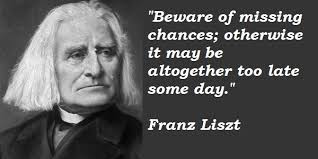
Happy Birthday to Franz Liszt!

liszt-quote

Franz Liszt was born in Raiding, near Ödenburg, October 22, 1811 and died in Bayreuth, July 31, 1886. He was a Hungarian composer and pianist who was a major influence during the romantic period. Liszt was an outstanding pianist at seven, composed at eight and made concert appearances at nine. In addition to being a piano virtuoso, he was also a critic, conductor, city music director, literary writer and transcriber of the works of other composers. He transcribed Beethoven’s Symphonies for the piano.

Franz Liszt began his career as the outstanding concert pianist of the century, who, along with the prodigious violinist Niccoló Paganini (1782-1840), created the cult of the modern instrumental virtuoso. To show off his phenomenal and unprecedented technique, Liszt composed a great deal of music designed specifically for this purpose, resulting in a vast amount of piano literature laden with dazzling, and other technical marvels. In this vein, Liszt composed a series of virtuosic rhapsodies on Hungarian gypsy melodies, the best-known being the all too familiar Hungarian Rhapsody no. 2. Liszt developed the rhapsody as a form of serious music. This kind of music is worlds apart from the generally more introspective, poetic music of pianist-composer Frédéric Chopin.

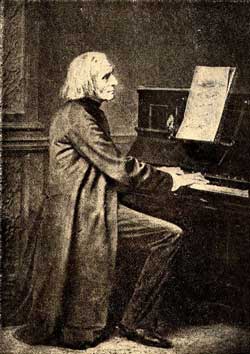
Liszt was wildly handsome and hugely talented. He was extremely popular in Paris during the 1830’s. It is said that women actually fainted at his piano recitals. He was the first to position the piano so that its lid reflected the sound and the audience could see his profile as he performed.

Liszt was the first to write a tone poem, which is an extended, single-movement work for orchestra, inspired by paintings, plays, poems or other literary or visual works, and attempting to convey the ideas expressed in those media through music. Such a work is Les Préludes, based on a poem in which life is expressed as a series of struggles, passions, and mysteries, all serving as a mere prelude to . . .what? The Romantic genre of the symphonic poem, as well as its cousin the concert overture, became very attractive to many later composers, including Saint-Saëns, TchaikovskyDvorák, Sibelius, and Richard Strauss.


     Liszt’s birthday

     anniversary of Liszt’s death

    Listen to Liszt’s transcription of Meyerbeer’s Hellish Waltz from Robert du Diable, which probably caused more public commotion than any other piano piece in history.


     Read quotes by and about Liszt

     Liszt was the first recitalist

     In Praise of Pianos and the Artists Who Play Them

     History of the Piano

     Franz Liszt

Pianists Hands

pianist-hands

Redditor NeokratosRed  had an idea: depict the hands of great composers and pianists, according to the characteristics of their music. He shared it on the social media site, and also punted for suggestions of more. It has since received over 300,000 images views, and lots of further suggestions from fellow Redditors and piano geeks.

Whisks for Chopin’s elegant pianistic souffles, feather dusters for the gentle impressionism of Debussy, instruments of trade for the composer of the thunderous Hammerklavier sonata.

Piano, and the internet – top marks to the both of you.

via This infographic of composers’ hands is painfully (and hilariously) accurate | Classic FM.

Have You Heard the Piano Puzzlers?

puzzlers


The Piano Puzzlers book is available in the O’Connor Music Studio library if you’d like to give any a try.  Piano Puzzlers as heard on American Public Media’s “Performance Today.” Includes 32 tunes with songs by Gershwin, Berlin, Arlen, Porter, Rodgers, Fats Waller, Lennon & McCartney, and others disguised in the styles of Bach, Handel, Haydn, Mozart, Beethoven, Brahms, Schubert, Schumann, Chopin, Janacek, Debussy, Ravel, Rachmaninoff, Stravinsky, Prokofiev, Bartok, and Copland.

Includes an introduction by Fred Child, host of “Performance Today” as well as background info by Bruce Adolphe. “Bruce Adolphe has taken a common musician’s party game and elevated it to high art and truly funny musical slapsticks. The Piano Puzzlers are a unique combination of extraordinary insight into the styles of many composers subtle, expert workmanship and great, great fun!”

From http://jasonmorris.blogsome.com/2008/08/08/piano-puzzlers/

If you’re a music geek (like me), I have a program for you. Now, let me be clear, to fully qualify as a music geek…you must have a fond appreciation for classical music (no, Poison, Quiet Riot, and Zepplin do not count as classical music). So, if you’re a “music geek” without an appreciation for classical music…well, I hate to burst your bubble…but, you’re not truly a music geek. Instead, you’re a music appreciator, but not a geek. So, if you just listen to indie music and scowl at anything on a label larger than Matador…don’t bother following the link I’ll provide…the fun will be lost on you…And, you probably won’t have a chance.

Every Wednesday night, on my way home from WNL, I turn on my local NPR station to listen to Piano Puzzlers on Performance Today. It’s absolutely incredible. A pianist/composer (Bruce Adolphe) takes a familiar folk or pop tune and sets it inside a classical masterpiece (or in the style of a particular composer). Sometimes it’s easy…sometimes it’s ridiculously difficult. There are days when I say, “got it” on the first pass. Then there are days when I say, “what the heck?” And, more often than not, I’m able to get either the popular/folk tune or the composer.

This is sad to admit, but there are nights when I’ll slow down on the drive home or sit in the car in the driveway to finish an episode. In fact, I get a little worked up if someone stops me after WNL…as I might miss the beginning of Piano Puzzlers (it usually hits around 8:20pm on our local station).

Take a listen to some of the archives and see if you can figure it out! It’s really cool…but probably only appreciated by music geeks (the kind of people that listen to NPR for their musical programs and not just the snipets of cool indie rock between segments on All Things Considered…which is a great show too).

Play Piano Puzzlers HERE!

Book: Technology is key to piano

Piano-Maestro-End-Game

Piano teacher Leila Viss isn’t only about Bach, Beethoven and Chopin. For her, it’s also about easing her students into using the iPad application “Piano Maestro.”

Viss, a piano performance and pedagogy graduate of University of Denver, first set up a studio in her home after she graduated in 1990. Ever since, she’s blossomed into a teacher who incorporates a different kind of approach in her lessons.

It all began with her mentor, Elaine Emeigh, who’s a piano teacher in Littleton.

“I wanted to continue her legacy, so I started having labs during my private lessons,” Viss said.

The Centennial resident’s students are now urged to stay for an extra 30 minutes after each lesson to spend time doing something on the computer — whether it be reviewing concepts, studying piano history or reinforcing lessons, she said.

“When I graduated, the Internet was just coming around. Now I have my own website, blog, and my whole idea of how I communicate has completely changed. It was a hassle over the years using technology; you were booting up the computer, putting in a CD-ROM, and then when the iPad came along, it made everything so much easier,” Viss said.

Her book, “The iPad Piano Studios, Keys to Unlocking the Power of Apps,” came out in 2013 and reflects her appetite for using apps to practice note names, inspire creativity and compose with her students. Viss considers herself to be a writer and also contributes to the Clavier Companion, a nationally known premiere piano magazine.

The owners of private applications company, JoyTunes, contacted Viss after reading her blog a year ago.

With more than 4 million users, the company’s apps are a hit, Viss said.

“Joytunes is changing the face of music education by transforming the way people learn music, enabling anyone to play a musical instrument,” JoyTunes head of brand Nadia Hitman said. “By combining music methodologies with the latest in gaming features and instant feedback, the learning process is significantly shortened for millions of children, adults and teachers already using the apps.”

Hitman said all of their applications recently became free for teachers and their students, and many of the apps are still available for purchase to anyone.

“Speaking on their (JoyTunes’) behalf, and mobile technology — Piano Maestro is unbelievably amazing,” Viss said. “You set it up on the piano (doesn’t have to be digital) and choose from like 2,000 songs in the library. You press play and the student follows along with the piano. After that, you get evaluated and receive immediate feedback. You can get up to three gold stars.

via Technology is key to piano | Centennialcitizen.net.

Practice Just 20 Minutes A Day

Here are 8 bits of wisdom from Play It Again that remind us that it is possible to make time for what matters most in the face of life’s demands and stresses.

Own Your Stress

Rusbridger is completely clear-eyed about just how stressful his job is, and by confronting — rather than denying — the reality of his stress, he’s able to seek out ways to reduce it. Being editor of the Guardian is “one of those jobs which expands infinitely to fill the time and then spill beyond it,” he writes. “An editor, particularly within a modern global media company, is never truly off duty.”

A typical day in the life of a newspaper editor, he writes, means “a hum of low-level stress much of the time, with periodic eruptions of great tension.”

Find Your Metaphor

When Rusbridger felt frustration and self-doubt — which was nearly all the time — he found it helpful to think of people who took on great challenges in different fields. This helped put his own project in perspective, and also let him feel solidarity with others who had taken on great challenges. He compares learning Chopin to climbing the Matterhorn, the forbidding mountain in the Alps.

He writes: “Jerry R. Hobbs, an American computational linguistics expert and amateur climber, described the mountain as ‘just about the hardest climb and ordinary person can do’, which, apropos the G minor Ballade, sounds familiar.”

You’re Not Alone

Rusbridger supplements his piano practice with lots of reading. One book in particular, Arnold Bennett’s 1910 How to Live on 24 Hours a Day, reminds him that the sense of having not enough time to do all we want to do is universal, and not exactly new.

As Bennett writes: “We never shall have any more time. We have, and we have always had, all the time there is.”

There’s Power In A Morning Routine

Rusbridger learns quickly that his daily 20 minutes have to happen in the morning, before the unpredictable demands of work kick in. Here is how he describes his routine:

“I get up half an hour earlier. I fit in ten minutes of yoga listening to the Todayprogramme – not exactly meditative. Then breakfast and the papers with more Today programme all at the same time. Then I slip upstairs to the sitting room to play before driving into work.”

Pursuing Your Passion Is An Investment

Even though his morning piano practice is a solitary activity, he undertakes it knowing that it will have social benefits. After all, when he was a child, his mother told him that playing the piano would help him make friends. She’s right, and he finds her message echoed in the pages of Charles Cooke’s book Playing the Piano for Pleasure: “The better you play, the more your circle of friends will expand. You can count on this as confidently as you can count on the sun rising. Music is a powerful magnet which never fails to attract new, congenial, long-term friends.”

Mortality Is A Good Motivator

When Rusbridger’s former girlfriend gets in touch to tell him that her breast cancer has returned, he finds himself reflecting on mortality, and thinking of other friends more or less his age who are undergoing treatment for various serious diseases. Each brush with illness or mortality strengthens his determination to lean the Ballade. “In terms of getting on with life’s ambitions,” he writes, “I’m hit by more than a tinge of carpe diem.”

“Amateur” Is Not An Insult

Rusbridger has no illusions or intentions about becoming a professional pianist. He’s a dedicated amateur from the start, and his conversations and meetings with other music lovers — both professional and amateur — is a reminder that “amateur” isn’t a value judgment (i.e. worse than a professional), but a worthy end in itself. In fact, it’s probably a good deal more enjoyable and less stressful than being a pro.

In conversation with Rusbridger, the New York Times music critic Michael Kimmelman talks about the perks of being an amateur. “You have another life, it’s a full and interesting life, but you decide to add this life as well because music gives you something that you can’t get from this other life. It isn’t about having a career and making a living from it, it’s about something that only music-making will give you.”


It’s Never Too Late

As he improves and comes closer to learning the entire Ballade, no one is as surprised as Rusbridger himself. “It’s a funny thing to discover about yourself in your mid-50s — that you spent the previous forty years not doing something on the assumption that you couldn’t do it, when all along you could.”

He is astonished to learn, after memorizing complex passages of the Ballade, just how powerful his own memory is. “Back in the summer of 2010 I had no idea of just how capable a 56-year-old brain was of learning new tricks,” he writes. “So it’s heartening to know that, quite well into middle age, the brain is plastic enough to blast open hitherto unused neural pathways and adapt to new and complicated tasks. So, no, it’s not too late.”

From http://www.huffingtonpost.com/2013/10/14/how-alan-rusbridger-edito_n_4080735.html

Exam Time?

study-music

Listening to music can help you while you’re studying for your exams.

This is  3.5 Hours of the Best Classical Music – Mozart, Beethoven, Bach, Chopin – Beautiful Piano, Violin & Orchestral Masterpieces by the greatest composers of all time.

Piano Recitals, Thanks to Liszt!

Last year, Google’s homepage ran a picture to celebrate the 360th birthday of Bartolomeo Cristofori, inventor of the piano and keeper of instruments for the Medicis in Florence. The instrument Cristofori invented was originally called a “harpsichord with soft and loud” even though the distinction between the two is large (the harpsichord produces sound by plucking strings, the piano by striking them with a hammer). Only three of the newfangled instruments he made – all of them dating from the 1720s – survive.

liszt-recitalMore than a century later the piano recital was devised. It was Liszt who first decided to have the whole stage to himself, and set the fashion for dispensing with the mixture of celebrities and supporting acts that had prevailed up to that time. As he wrote about his audacity to a friend: “Le concert, c’est moi!” And he called his appearance at the Hanover Square Rooms in London in June 1840 not a concert but a recital.

The composer-pianists of the day concentrated on their own works. Liszt set a marker in this regard, too, choosing music that ranged from Bach through Beethoven and up to Chopin. He set the pattern for playing from memory, and cemented the platform layout we know today by turning the then-conventional position of the instrument on the stage through 90 degrees. He was what we would now call a sex symbol as well as a star musician, and the new arrangement allowed the audience to see his impressive profile as well as to hear the instrument more clearly. The standards he set have survived without significant alteration right up to the present.

via Liszt is dead, long live the piano recital.

May 8 in Music History

mothers-day-38


OCMS  1829 ~ Louis Moreau Gottschalk, American pianist and composer
Listen to Gottschalk’s music
More information on Gottschalk

• 1948 ~ Oscar Hammerstein I, Playwright, producer

• 1910 ~ Mary Lou Williams, American jazz pianist, composer and arranger

• 1911 ~ Robert Johnson, Blues Hall of Fame, singer, songwriter, guitarist, inducted into Rock and Roll Hall of Fame in 1986

• 1941 ~ Anita O’Day recorded Let Me Off Uptown on Okeh Records with Gene Krupa and his band.

• 1943 ~ Toni Tennille, Singer

• 1944 ~ Gary Glitter (Paul Gadd), Singer

• 1945 ~ Keith Jarrett, American jazz pianist and composer