Composers – D


Dallapiccola

Luigi Dallapiccola was an Italian composer known for his lyrical twelve-tone compositions.

Debussy

Claude Debussy lived between 1862 and 1918. He is considered to be a impressionistic composer, because he tried to capture the mood of the action instead of the action itself, and was known as the Father of Impressionistic Music. Debussy’s work influenced another Impressionistic composer, Maurice Ravel.

The French Impressionistic painters like Auguste Renoir were painting at the same time that Debussy was composing and that influenced his music. “Clair de Lune” is a famous example of this as it creates the feeling of rippling water.

Debussy liked to create tonal “impressions” rather than conventional melodies. “Rêverie” was one of his first successes, although the critics of the 1890’s said things like “strangeness”, “dissonance”, “ugliness” and “difficulties” about it, missing the fragile loveliness and vague shimmer which were stylistic innovations.

Debussy was playing piano and composing by the time he was 12.

DeForest

Lee DeForest was born in 1873 in Council Bluffs, Iowa. We’re sure his parents had big plans for him; but they could never have realized how their son, Lee, would change the world.

DeForest seemed to be a born inventor. He held patents for hundreds of different items including the photoelectric cell and the surgical radio knife. But none had as much impact on the world as his invention of the electron tube, specifically the triode, a three element vacuum tube, which later became the audion tube ~~ possibly the most significant invention that made radio possible.

Wireless radio broadcasting was unthinkable in the early 1900s and DeForest was considered a fraud. He was arrested for selling stock to underwrite the development of his invention, which no one believed would work. He was forced into selling the rights to his patent to American Telephone and Telegraph for $500,000; considered by most to be foolish of AT&T. The rest is history.

Lee DeForest’s 1950 autobiography is called “Father of Radio”.

Delius

Frederick Delius was born in Bradford, England. His father owned a wool company and hoped that his son would follow a career in business. Delius, however, wanted to study music. In 1884, he left England for Florida, where he worked on a plantation as an orange grower. Delius proved to be a failure as an orange grower, and began supporting himself as a musician. During 1886 – 1887, he composed Florida Suite.

Des Prez

Josquin Des Prez was born around 1440 and he died: August 27, 1521 in Cond?-sur-l-Escaut, France.

He was a French/Franco-Flemish composer and generally acknowledged as the greatest composer of the High Renaissance.

Martin Luther, who had a good knowledge of music, said of Josquin Desprez, “he alone is the master of the notes, they have to do as he bids them.” Indeed, Josquin was acknowledged by nearly all his contemporaries as the greatest composer of his time. If so, he stands as the first among many great musicians, for the composers of what we often term the Netherlands School created one of the richest periods in Western musical history. His contemporaries — including Antoine Brumel (c.1460-c.1515), Pierre de la Rue (c.1460-1518) and Loyset Comp?re (c.1445-1518) — and the previous generation — led by Johannes Ockeghem (c.1410-1497) — created a style of music that can rightly be compared to the art of Leonardo da Vinci and Michelangelo.

As for Josquin himself, we know surprisingly little of his early life. We know that in the 1470s he began service in the court of Cardinal Ascanio Sforza, and that by 1489 he was a member of the papal choir in Rome. But we know nothing of his early training, or even when he came to Italy (it was believed that he came in 1459 as a choirboy in the Milan cathedral, but it seems that this was a case of mistaken identity). Later in his life he served Duke Ercole d’Este in Ferrara, and possibly King Louis XII of France. The final years of his life were spent in the town of Cond?-sur-l’Escaut in northern France (possibly his birthplace). The rest of his biography is still subject to scholarly speculation.

What we do know is just what Josquin’s contemporaries knew: that he created wonderful music. What stands out most in this music is his care for the words. This is seen in part by the way he uses imitation to allow each voice to present the text before the texture becomes too dense to be clear. He also made use of homophonic textures to give the text an added clarity. Some of his works, especially his Masses, use the older cantus firmus technique. Here he uses the borrowed melody to create a huge scaffolding upon which he constructs the other melodies. Some of these pieces display a high level of technical complexity. At the same time, he could create pieces of marvelous simplicity and elegance, as he did so often in his motets and chansons.

Musical Examples:

  • Inviolata, integra et casta es Maria
  • Miserere mei, Deus
  • Missa “La sol fa re mi” (Agnus Dei II)
  • Tu solus, qui facis mirabilia

Works:

  • Sacred works, including 18 masses (Missa “La sol fa re mi”, 2 L’homme arm?
  • Masses, Missa “Pange lingua”), more than 100 motets
  • Secular works, including nearly 70 French chansons and settings of German,
    Spanish and Italian texts

Diaghilev

Sergei Pavlovich Diaghilev lived from 1872 until 1929. He was a ballet impresario, born in Novgorod, Russia. Diaghilev obtained a law degree, but was preoccupied with the arts. In 1898 he became editor of Mir Iskousstva (World of Art), and during the next few years arranged exhibitions and concerts of Russian art and music. His permanent company was founded in 1911, and remained perilously in existence for 20 years, triumphantly touring Europe. Many of the great dancers, composers, and painters of his period contributed to the success of his Ballets Russes. He also encouraged several major choreographers (eg Fokine, Nijinsky, Balanchine), and gave them opportunities for artistic collaboration.

Dispeker

Thea Dispeker molded operatic talent from Lauritz Melchior to Richard Leech and lived to be 97 years old.

Dispeker owned a classical music artists agency for more than 50 years. In her career, she influenced musicians such as Richard Tucker, Judith Blegen, Roberta Peters and Pablo Casals, among others.

In 1947, she helped found the Little Orchestra Society for children’s concerts and went into business for herself.

Even in her 80s and 90s, Dispeker continued to seek out young singers and musicians to promote. Her portfolio also included the Swedish baritone Hakan Hagegard.

Her agency, Thea Dispeker Inc., received an International Society for the Performing Arts Foundation award of merit in 1997, its 50th anniversary year.

Dittersdorf

Carl Ditters von Dittersdorf lived from 1739 until 1799. He was a composer and violinist. He had composition lessons from Giuseppe Bonno in his native Vienna and served as a violinist in the orchestra of the Prince of Sachsen-Hildburghausen, followed by a position in the imperial theatre. There followed a period as Kapellmeister to the Bishop of Grosswardein, where, in 1762, he succeeded Michael Haydn. In 1769 he became Kapellmeister to the Prince-Bishop of Breslau, at this period acquiring the patent of nobility that added to the name of Ditters the honorific von Dittersdorf. Conditions in Johannisberg, the seat of the Prince-Bishop, deteriorated in the political circumstances of the time, and on the death of his employer in 1795, he moved with his family to join the household of a nobleman in Bohemia.

Dohnányi

Ernő Dohnányi lived from 1877 until 1960. He was born in Poszony (now Bratislava) in 1877 and opted for further musical study in Budapest rather than, more conventionally, in Vienna, setting an example that was followed by his younger contemporary Bartok. He played a leading part in forming the musical culture of Hungary, although there were difficulties with the regime that replaced the first republican government of the country. Due to his overt opposition to the association of Hungary with National Socialist Germany, he found it necessary to spend his final years in America, dying in New York in 1960.

As a composer Dohnányi was versatile, continuing existing traditions of music, while as a pianist he enjoyed international fame.

Domingo

Opera king Plácido Domingo
joins the Global Music Network and serves up an aria for online listeners. Live events and interviews, along with jazz and classical clips.

Donizetti

Gaetano Donizetti was born in in Bergamo, November 29, 1797 and died in Bergamo, April 8, 1848.

Inheriting the bel canto tradition from Rossini, Donizetti’s operas are today mostly admired for their many attractive melodies and fine ensembles. Although he composed over seventy operas, only a handful have remained in the general repertory, but those are generally regarded as outstanding examples of the Italian Bel Canto period. Donizetti’s most famous opera is surely Lucia di Lammermoor, based on a novel by Sir Walter Scott. The plot concerns a young girl who is tricked by her brother into thinking her lover has been unfaithful to her and forces her into a marriage of political convenience. During the wedding scene, Lucia’s lover makes an unexpected entrance, and all the protagonists give vent to their varied emotions in the celebrated Sextet from Lucia di Lammermoor. As was popular in Italian opera of the time, Lucia then goes mad, giving the prima donna an opportunity to display great acting and vocal skill in an extended scena.

The Italian operatic tradition was continued and taken to sublime heights later in the nineteenth century in the works of Giuseppe Verdi.

Dowland

John Dowland lived from 1562 until 1626. He was an English composer, singer and lutenist who wrote about 90 works for the Renaissance lute, several psalm harmonizations and many sacred songs.

Driggo

Riccardo Drigo was born and educated in Padua but he spent most of his life – from 1878 until 1915 – among Russian royalty as conductor ot the Marinsky Theater. He lived from 1846 until 1930.

Du Fay

Guillaume Du Fay was born on August 5, 1397(?) in Cambrai, France and died on November 27, 1474 in Cambrai, France. He was a French composer and was considered the leading composer of the early Renaissance.

The fifteenth century saw the rise of a new musical style, one in which harmonies began to center on full triads and the setting of the text became an important concern to composers. Guillaume Du Fay is one of the most important figures in the transition from the medieval to Renaissance style, which took place mainly among composers associated with the rich court of Burgundy. For this reason, Du Fay and his contemporaries are usually referred to as the “Burgundian School.”

Guillaume Du Fay probably received his early musical training in the cathedral choir at Cambrai, in northern France. But his career took a decidedly international turn early on. By the age of twenty-five he had gone to Italy. During his years there, he worked for courts in Pesaro, Ferrara and sang in the Papal choir in Rome. During that time he also earned a degree in canon law, probably at the University of Bologna. He spent the latter part of his life back at the cathedral in Cambrai. Du Fay wrote both sacred and secular music; he is perhaps best known for his cantus firmus Masses. Before he died, he composed a Requiem Mass (now lost) to be sung at his funeral, and asked that four of the best singers from the cathedral sing his motet Ave regina caelorum (Hail, Queen of Heaven) to him on his deathbed.

Du Fay’s music set the tone for the Renaissance (one scholar credits him with defining the “central style” of the period). His triad-based harmonies and arching melodies create a pleasant balance of melody and harmony. In his sacred music, he changed the overall sound by a more regular use of four-voice textures. At the same time, we can still find the medieval concern with structure and isorhythm in his sacred music, especially his cantus firmus Masses.

Sacred works including at least 7 complete Mass settings, numerous Mass movements and pairs, 30 motets and 60 other sacred works (hymns, etc.)
Secular works including more than 50 rondeaux, 10 ballades, 4 virelais, 15 other works.

Dukas

Paul Dukas’ The Sorcerer’s Apprentice was featured in the Walt Disney movie Fantasia and Fantasia 2000.

Dvorák

Antonín Dvorák’s piece, “Humoresque” became one of the most famous pieces ever written nearly overnight. It was later discovered that this could be played simultaneously with Steven Foster’s “Way Down Upon the Swanee River”.

Dvorák, a native of Bohemia, traveled in the United States in 1892 and found American music to be “magical” and “spacious”. When Dvorák visited the United States, he encouraged American composers to use their native music. He himself incorporated folk melodies into 19th century Romantic music. His compositions include Slavonic Dances, Fifth Symphony, The Water Nymph, Carnival, Gypsy Melodies.

Dvorák lived from 1841 until 1904.

August 18: On This Day in Music

today

• 1750 ~ Antonio Salieri, Italian composer and conductor
More information about Salieri

• 1873 ~ Leo Slezak, Austrian tenor

• 1907 ~ Howard Swanson, American composer

• 1916 ~ Moura Lympany, Saltash England, pianist

• 1937 ~ The first FM radio construction permit was issued. It went to W1X0J (later to become WGTR) in Boston, MA. The station went on the air two years later.

• 1939 ~ Johnny Preston, Singer

• 1944 ~ Carl Wayne, Singer with The Move

• 1949 ~ Ralph Flanagan and his orchestra recorded their first tune on wax, You’re Breaking My Heart.

• 1950 ~ Dennis Elliott, Drummer with Foreigner

• 1957 ~ Ron Strykert, Guitarist with Men at Work

• 1958 ~ Perez Prado, the ‘Mambo King’, received one of the first gold records awarded by the Record Industry Association of America (RIAA). The single, Patricia, was certified as having sold over one million copies.

• 1973 ~ Jazz drummer Gene Krupa played for the final time with members of the original Benny Goodman Quartet. Krupa, a jazz and big band legend, died on October 6, 1973.

• 1981 ~ Robert Russell Bennett passed away

• 1981 ~ Rex Harrison brought the award-winning My Fair Lady back to Broadway as he recreated the role of Henry Higgins. The play had originally opened in 1956.

• 2001 ~ Jack Elliott, a composer and conductor who worked on numerous hit television shows and movies, died of a brain tumor. He was 74.
Elliott came to Los Angeles in the early 1960s to work as a musical arranger on Judy Garland’s television show.
He gained a reputation as one of the top composers and arrangers in Hollywood. If a television show was popular in the 1970s, it most likely had the music of Elliott and his frequent collaborator Allyn Ferguson. They worked on such shows as: “Police Story,” “Barney Miller,” “Starsky and Hutch,” “Charlie’s Angels” and “The Love Boat.”
He also worked in films and teamed with director Carl Reiner on several projects, including: “The Comic,” “The Jerk” and “Oh God.”
Elliott served as music director for the 1984 Summer Olympics in Los Angeles, writing the music for the opening and closing ceremonies as well as conducting the orchestra.

• 2003 ~ Tony Jackson, bass player for The Searchers, a Liverpool band best known for the 1964 song “Needles and Pins,” died at the age of 63.
Jackson sang and played bass for The Searchers, a Liverpool band that briefly rivaled The Beatles for popularity in the early 1960s. “Needles and Pins” made the top 20 in the United States after it was released in 1964.
Jackson was lead singer on the band’s first two British hits, “Sweets for My Sweet” and “Sugar and Spice,” but played bass only on the enduring “Needles and Pins” and “Don’t Throw Your Love Away.”
Feeling sidelined, Jackson quit the group in 1964. His follow-up band, Tony Jackson and the Vibrations, failed to score a hit and he drifted out of the music business.

• 2004 ~ Elmer Bernstein, American movie music composer (The Magnificent Seven, To Kill A Mockingbird, The Age Of innocence, Thoroughly Modern Mille), died at the age of 82

Daily Listening Assignments ~ June 8, 2020


This is a more advanced piece but I really like it.  Some students may have heard this since it’s an alarm tone on my phone. My dog, Mimi, recognizes this music as her signal to go out for a walk!


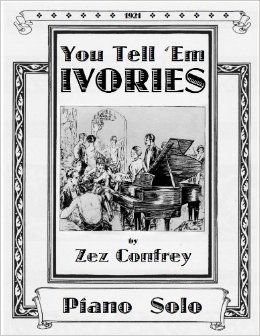
confrey-you

I just love Zez Confrey’s music.  It’s not overplayed like some of Scott Joplin’s works but it’s just as much fun.

This is a piece I have often played in recitals and just for fun.

https://youtu.be/u20Qmv7HdAI

If any of my students are interested in tackling this piece, just let me know and we’ll start learning!

In 1921 Confrey wrote his novelty piano solo “Kitten on the Keys”, inspired by hearing his grandmother’s cat walk on the keyboard of her piano. It became a hit, and he went on to compose many other pieces in the genre.

Considered to be one of the fastest and most challenging of all “novelty” piano solos, “Dizzy Fingers” was composed in 1923. and was Confrey’s other biggest seller.

He left behind more than a hundred piano works, songs and miniature operas, and numerous piano rolls, music publications and sound recordings.

Not surprisingly, this piece is not available on Piano Maestro!

One of the books in my studio is Zez Confrey at the Piano: Piano Solos.

confrey-book“This collection represents a cross-section of Confrey’s works and encompasses the broad range of his styles. Besides his famous 1920s novelty works (including Kitten on the Keys), there are many wonderful, lesser-known gems of remarkable quality included here from later in his career. Appearing for the first time in print are transcriptions of one of his disc recordings (Poor Buttermilk) and two of his player piano roll arrangements (My Pet and Humorestless). Many of Confrey’s later works have long been out of print and are included here for the first time in decades.”

March 5: On This Day in Music

today

. 1807 ~ The first performance of Ludwig von Beethoven’s 4th Symphony in B

. 1853 ~ Arthur William Foote, American composer

. 1887 ~ Heitor Villa-Lobos, Brazilian composer and collector of Brazilian folk songs
More information about Villa-Lobos

. 1917 ~ The first jazz recording for Victor Records was released. The Original Dixieland ‘Jass’ Band performed on the tune The Dixie Jass Band One Step. The word ‘Jass’ was later changed to ‘Jazz‘.

. 1928 ~ Lou Levy, Pianist with Supersax; recorded with Sinatra, Peggy Lee, Nancy Wilson and Anita O’Day

. 1931 ~ Barry Tuckwell, Austrian French-horn player

. 1931 ~ Without a Song was recorded by Lawrence Tibbett for Victor Records. This wonderful melody came from the film, “The Southerner” and has been a hit for many, including Willie Nelson, Frank Sinatra and Tony Bennett.

. 1947 ~ Eddie Hodges, Singer, actor

. 1948 ~ Eddy Grant, Singer, songwriter

. 1950 ~ Eugene Fodor, Violinist, made solo debut at age 10 with the Denver Symphony, won first national competition at age 12, won first prize in International Paganini Competition, won highest prize in International Tchaikovsky Competition
More information about Fodor

. 1952 ~ Alan Clark, Keyboards with Dire Straits

. 1953 ~ Sergei Prokofiev passed away
More information about Prokofiev

. 1958 ~ Andy (Andrew Roy) Gibb, Singer with the Bee Gees, host of TV’s Solid Gold

. 1960 ~ Elvis Presley returned to civilian life after a two-year hitch in the U.S. Army. Not since General Douglas MacArthur returned from battle has a soldier received such publicity. Elvis said he probably would not be growing his famous and long sideburns back, though he did relent in later years.

. 1963 ~ Patsy Cline, Cowboy (Lloyd) Copas and Hankshaw Hawkins were killed in a plane crash at Camden, TN, near Nashville. The famous country music stars were returning from a benefit performance. Cline, the ‘Queen of Country Music’ was elected to the Country Music Hall of Fame in 1973. Jessica Lange played Patsy in the 1985 biographical film, Sweet Dreams, named after one of Cline’s hugely popular songs. Willie Nelson wrote her biggest hit, Crazy, which become a number one country hit and a top 10 pop song in November, 1961.

. 1969 ~ The rock magazine, Creem, was published for the first time this day.

. 1973 ~ Roberta Flack, riding at #1 on the pop music charts with, Killing Me Softly with His Song, could hardly wait to rip into the fancy frame containing her brand new gold record. She flew to the stereo machine and set the needle down on the shiny surface, only to hear Come Softly to Me. She was so impressed by this unexpected turn of the table that she wound up humming the old Fleetwoods song for three days.

. 2016 ~ Nikolaus Harnoncourt, Austrian conductor, particularly known for his historically informed performances of music from the Classical era and earlier, died at the age of 86

On December 3 ~ in Music History

today


Christmas Countdown: Angels We Have Heard On High

• 1596 ~ Nicola Amati, Italian violin maker, teacher of Guarneri and Stradivari

• 1729 ~ Padre Antonio Francisco Javier Jose Soler, Spanish composer whose works span the late Baroque and early Classical music eras. He is best known for his keyboard sonatas, an important contribution to the harpsichord, fortepiano and organ repertoire.

• 1876 ~ Hermann Goetz died.  He was a German composer.

• 1883 ~ Anton Webern, Austrian composer and conductor
Read quotes by and about Webern
More information about Webern

• 1907 ~ Connie (Connee) Boswell, Singer Connie or Connee (a spelling she preferred later in life), who also played several musical instruments, arranged vocals for herself and her two sisters. Although she was stricken with polio and worked from her wheelchair, she never let this get in the way of being part of her jazz-singing trio. The Boswell Sisters’ talent was quickly recognized and by the time Connee was 24 years old, the sisters were doing vaudeville, radio, playing New York’s Paramount Theatre, recording with the Dorsey Brothers: You Oughta Be in Pictures; making films and appearing on the U.S.A.’s first public TV broadcast. One thing led to another and Connie went solo, entertaining World War II troops, making films, appearing on Broadway and recording with big names like Woody Herman’s; even a duet classic with Bing Crosby: Basin Street Blues. Her musical influence spanned many generations and music styles. If you’d have asked Ella Fitzgerald, she would have told you, “They just don’t make ’em like Connee Boswell anymore.”

• 1911 ~ Nino Rota, composer (Torquemada)

•  1923 ~ Maria Callas (Calogeropoulous), American soprano
More information about Callas
Read quotes by and about Callas

• 1925 ~ The first jazz concerto for piano and orchestra was presented at Carnegie Hall in NYC. Commissioned by Walter Damrosch, American composer George Gershwin presented Concerto In F, and was also the featured soloist playing a flugelhorn in a slow, bluesy style as one of his numbers.

• 1927 ~ Phyllis Curtin, Singer: soprano with the New York City OperaMetropolitan Opera, Vienna Staatsoper, La Scala, Teatro Colon; coordinator of Voice Dept and Opera at Yale School of Music, Dean Emerita of Boston Univ School for the Arts

• 1927 ~ Ferlin Husky (aka: Simon Crum, Terry Preston), Singer

• 1930 ~ Andy (Howard Andrew) Williams, American Emmy Award-winning entertainer, singer

• 1931 ~ Jaye P. (Mary Margaret) Morgan, Singer, performer

• 1941 ~ Johann Christian Sinding, Norwegian composer

• 1944 ~ Frank Sinatra was in the Columbia Records studio recording Old Man River.

• 1948 ~ Ozzy (John) Osbourne, Songwriter, singer

• 1949 ~ Mickey Thomas, Singer with Jefferson Starship

• 1953 ~ Kismet opened on Broadway in New York. The show ran for 583 performances.

• 1955 ~ Elvis Presley’s first release on RCA Victor Records was announced. No, it wasn’t Hound Dog or Heartbreak Hotel. The first two sides were actually purchased from Sam Phillips of Sun Records: Mystery Train and I Forgot to Remember to Forget. Elvis was described by his new record company as “The most talked about personality in recorded music in the last 10 years.”

• 1960 ~ Camelot opened at the Majestic Theatre in New York City. Richard Burton and Julie Andrews played the leading roles in the musical written by Lerner and Loewe. Robert Goulet got rave reviews for his songs, If Ever I Would Leave YouThen You May Take Me to the Fair and How to Handle a Woman, among others. Camelot had a run of 873 performances. Broadway went Hollywood in the 1967 film version of Camelot. Its run was not quite as successful.

• 1968 ~ The O’Kaysions received a gold record for Girl Watcher. The song had a promotional reprise in the 1990s as a theme for Merv Griffin’s Wheel of Fortune, with the revamped lyrics, I’m a Wheel Watcher…

• 1977 ~ After 29 weeks in the #1 position on the album charts (a record, literally…), Rumours, by Fleetwood Mac, was replaced at the top spot by the album Simple Dreams, sung by Linda Ronstadt.

• 1999 ~ Handel’s Messiah Gets Modern Makeover in Ireland

• 2000 ~ Kevin Mills, a member of the Christian rock groups Newsboys and White Heart, died after a motorcycle accident in Hollywood. He was 32. Mills, of Louisville, Ky., was a singer and bass player, his family said. He also was a member of the Screen Actors Guild and appeared on TV in “An Inconvenient Woman” in 1991. White Heart started in 1982. Newsboys, an Australian band now based near Nashville, was formed four years later. Newsboys have sold nearly 3 million records and earned three Grammy nominations on the religious rock circuit.

• 2000 ~ Washington Honored Eastwood, Baryshnikov, Others

• 2002 ~ Rich Dangel, credited with creating the opening guitar chords of garage band staple Louie Louie, died of an aneurysm at his home. He was 60. Dangel was a member of the seminal Northwest rock band the Wailers, who introduced the nation to the Northwest sound – raw, unpolished and catchy. He may be best known for coming up with the power chords that opened the Wailers’ 1961 regional hit, Louie, Louie, written by rhythm-and-blues singer Richard Berry and taken to the top of the national charts by another Northwest band, the Kingsmen from Portland, Ore. Dangel co-wrote his first chart hit, “Tall Cool One” with fellow Wailer John Greek when he was still in high school. The song resulted in the group’s first album, “The Fabulous Wailers,” a cross-country tour and a 1959 appearance on Dick Clark’s “American Bandstand.”

On November 17 ~ in Music History

today

• 1726 ~ The first performance of J. S. Bach‘s Sacred Cantata No. 55 Ich armer Mensch, ich Sündenknecht on the 22nd Sunday following Trinity. Was part of Bach’s third annual Sacred Cantata cycle in Leipzig 1725-27

http://youtu.be/o8JudkjHWrM

• 1848 ~ Frederic Chopin played his final piano concert at a Polish benefit ball at Guildhall in London.

• 1850 ~ Giuseppe Verdi‘s opera Stifellio was first performed at the Teatro Grande in Trieste despite difficulties with the censors which resulted in cuts and changes.

• 1861 ~ First Performance of Johannes Brahms Piano Quintet No. 1 in g, Op. 25, at a rehearsal in Hamburg, with pianist Clara Schumann.

• 1862 ~ The work noted above received its official premiere with members of the Hellmesberger Quartet; Brahms at the piano, in Vienna.

• 1870 ~ Alfred Hill, Australian composer

• 1876~ The first performance of Peter Ilyich Tchaikovsky‘s March Slav in Moscow.

• 1877 ~ The first production of Gilbert and Sullivan’s opera, The Sorcerer, was presented, in London.

• 1888~ The first production of Tchaikovsky‘s Fifth Symphony in St. Petersburg.

• 1891 ~ Poland’s premier and premier ivory tickler, Ignace Jan Paderewski, made his American debut at Carnegie Hall in New York City. In later years, Paderewski, who suffered from arthritis, settled in Paso Robles, CA. The hot mineral baths located there eased his pain. He played only Steinway grand pianos custom-built to his specifications. In fact, five were made just for his use.

• 1919 ~ Hershy Kay, composer/arranger (Olympic Hymn)

• 1925 ~ Sir Charles Mackerras, Australian conductor

• 1930 ~ David Amram, American composer and French-horn player

• 1938 ~ Gordon Lightfoot, Canadian folk singer, songwriter and guitarist

• 1938 ~ Orchestra leader Kay Kyser, speaking to an audience at the College of the City of New York (CCNY) told of the “inner workings and artistic features of swing music.” It marked the first of a series of lectures on swing music presented by Kyser, who went on to present The Kollege of Musical Knowledge on radio.

• 1941 ~ Gene Clark, Singer, guitar with The Byrds

• 1942 ~ Bob Gaudio, Singer with The Royal Teens; The Four Seasons

• 1946 ~ Martin Barre, Guitarist with Jethro Tull

• 1950 ~ Roberta Peters filled in for the lead in Mozart’s Don Giovanni, making her debut at the Metropolitan Opera in New York City. She would become one of the Met’s most famous stars.

• 1959 ~ Heitor Villa-Lobos, Brazilian composer/pianist/conductor, died at the age of 72

• 1962 ~ The 4 Seasons, with Frankie Valli as lead singer, began a five-week run at the top of the tunedex with Big Girls Don’t Cry.

• 1967 ~ Ronald DeVoe, Singer with New Edition

• 1970 ~ Elton John recorded an album live, on what was WABC-FM in New York City. It marked the first time that a concert was aired live and recorded for release as aired. The LP was titled, 11/17/70.

• 1981 ~ Bob Eberly died

https://youtu.be/pbAlu3krd4w

• 2001 ~ Jerry Jerome, a tenor sax player who was a featured soloist with the bands of Glenn Miller and Benny Goodman, died of leukemia. He was 89. One of the big names in the Big Band era, Jerome was a featured soloist with the Glenn Miller, Benny Goodman, Red Norvo and Artie Shaw orchestras. He then became a successful musical director and conductor on radio and television. Jerome also established a music business, scoring and arranging commercial jingles. Three years ago, Arbors Records released Jerome’s “Something Old, Something New.” The sequel recording, “Something Borrowed, Something Blue,” will be released in December. Born in Brooklyn, N.Y., Jerome started playing the sax while in high school. He attended the University of Alabama and went on the medical school, playing gigs at jazz clubs to earn tuition money. He joined Goodman’s orchestra at the height of its popularity in 1938. When Goodman broke up his band in 1940, Jerome joined Shaw. While with Shaw, he appeared in the film “Second Chorus,” with Fred Astaire and Burgess Meredith.

• 2003 ~ Arthur Conley, a 1960s soul singer and protege of Otis Redding’s, died at his home in the town of Ruurlo, in the eastern Netherlands. He was 57. Conley was born in Atlanta and started his recording career in 1959 as leader of the group Arthur and the Corvets. He was best known for his 1967 hit, Sweet Soul Music, which he co-wrote with Redding based on a number by Sam Cooke. Conley had several minor hits in the following two years. He moved to Europe in the early 1970s after several tours of the continent, deciding that he was “fed up with the pressure” in the United States, said Giesen. In the Netherlands, Conley appeared on television and radio, and ran an independent record label. In the last five years he was an adviser to The Original Sixties R&B and Soul Show, which sought to reproduce the sound and look of the heyday of soul.

• 2018 ~ Cyril Pahinui, a nationally recognized Hawaiian guitarist and singer who preserved and extended the tradition of slack-key guitar, died at the age of 68

On November 13 ~ in Music History

today

.1817 ~ Louis Lefébure-Wély, French organist and composer

.1854 ~ George Whitefield Chadwick, American composer and conductor

.1868 ~ Gioachino (Antonio) Rossini, Italian composer (Barber of Seville, William Tell), died at the age of 76. “Delight must be the basis and aim of this art,” Rossini wrote. “Simple melody – clear rhythm!” Rossini’s contribution to the development of opera was immense.

.1921 ~ Loonas Kokkonen, Finnish composer

.1943 ~ Leonard Bernstein replaced an indisposed Bruno Walter as conductor of the New York Philharmonic Orchestra. Thus began a legendary career and worldwide appreciation for Bernstein’s many compositions with the orchestra.

.1951 ~ Nicolai Karlovich Medtner died.  He was a Russian composer and pianist.

.1965 ~ Julie Harris starred in “Skyscraper”, which opened on Broadway in New York City. The musical ran for seven months.

.1968 ~ This was a good day for The Beatles. Their movie, “Yellow Submarine”, premiered in the U.S. and the single, Hey Jude, topped the pop music charts (it was in its 7th of 9 weeks at #1).

.1975 ~ Whoa Whoa Whoa, Feeeelings. One of the great lounge-lizard songs of all time, Feelings by Morris Albert, went gold.


.1988 ~ Antal Dorati, Hungarian-American conductor (Dresden Opera 1928-29), died at the age of 82

.1999 ~ Donald Mills passed away.  He had been one of the Mills Brothers.

.2000 ~ Cecil Blackwood, a gospel singer who was a member of the Blackwood Brothers and crooned with Elvis Presley, of cancer at the age of 66. The Blackwood Brothers, who have won nine Grammys and 20 Dove awards, were a favorite of Elvis Presley, who briefly sang with Cecil Blackwood in a group named the Songfellows. The Blackwood Brothers were formed in 1934, the same year Blackwood was born in Ackerman, Miss. He became the group’s baritone in 1954. The Blackwood Brothers have recorded 300 albums, backed country stars Porter Wagoner and Barbara Mandrell, and are members of the Southern Gospel Music Hall of Fame.

.2000 ~ Jimmy Payne Sr., a tap dancer whose rhythm and technique, as well as a mastery of precise steps, attracted Bob Fosse, June Allyson, Gregory Hines, Lena Horne and others to his Chicago studio, died Nov. 13 at the age of 95. The son of a Cuban mother and Barbadian father, Payne grew up in the Panama Canal Zone before moving to New York in 1917. After traveling from New York to Chicago in 1947, Payne helped introduce African and Afro-Cuban rhythms to the dance scene. He taught in a number of Chicago dance studios from the 1950s into the 1970s. He continued to teach some of the city’s top dancers until his regimen was slowed by a number of strokes in his early 90s.

.2000 ~ New York entertainment lawyer and tax expert Joseph Taubman, who wrote how-to books for people working in the business side of show business, died at the age of 81. Taubman’s clients included Lionel Richie, Pete Seeger, Joan Baez and Arlo Guthrie. He also served as counsel to the National Film Board of Canada. Taubman wrote “Financing a Theatrical Production,” and his treatises on various aspects of the entertainment business published in the 1970s remain in print.

.2000 ~ The site, thebeatles.com, went live and is the band’s only official presence on the Internet among a flood of unofficial fan sites.

.2002 ~ Mieke van Hoek, a dance choreographer and teacher, died. She was 56. The Dutch-born van Hoek taught modern-dance choreography and dance improvisation at the Rotterdamse Dansacademie. After emigrating to the United States in 1977, van Hoek worked as a teaching assistant at the American Dance Festival in Durham, N.C., and studied at the Laban/Bartenieff Institute in New York. She founded a center for meditation, healing and the arts in Canones in 2000.

On August 18 ~ in Music History

today

• 1750 ~ Antonio Salieri, Italian composer and conductor
More information about Salieri

• 1873 ~ Leo Slezak, Austrian tenor

• 1907 ~ Howard Swanson, American composer

• 1916 ~ Moura Lympany, Saltash England, pianist

• 1937 ~ The first FM radio construction permit was issued. It went to W1X0J (later to become WGTR) in Boston, MA. The station went on the air two years later.

• 1939 ~ Johnny Preston, Singer

• 1944 ~ Carl Wayne, Singer with The Move

• 1949 ~ Ralph Flanagan and his orchestra recorded their first tune on wax, You’re Breaking My Heart.

• 1950 ~ Dennis Elliott, Drummer with Foreigner

• 1957 ~ Ron Strykert, Guitarist with Men at Work

• 1958 ~ Perez Prado, the ‘Mambo King’, received one of the first gold records awarded by the Record Industry Association of America (RIAA). The single, Patricia, was certified as having sold over one million copies.

• 1973 ~ Jazz drummer Gene Krupa played for the final time with members of the original Benny Goodman Quartet. Krupa, a jazz and big band legend, died on October 6, 1973.

• 1981 ~ Robert Russell Bennett passed away

• 1981 ~ Rex Harrison brought the award-winning My Fair Lady back to Broadway as he recreated the role of Henry Higgins. The play had originally opened in 1956.

• 2001 ~ Jack Elliott, a composer and conductor who worked on numerous hit television shows and movies, died of a brain tumor. He was 74.
Elliott came to Los Angeles in the early 1960s to work as a musical arranger on Judy Garland’s television show.
He gained a reputation as one of the top composers and arrangers in Hollywood. If a television show was popular in the 1970s, it most likely had the music of Elliott and his frequent collaborator Allyn Ferguson. They worked on such shows as: “Police Story,” “Barney Miller,” “Starsky and Hutch,” “Charlie’s Angels” and “The Love Boat.”
He also worked in films and teamed with director Carl Reiner on several projects, including: “The Comic,” “The Jerk” and “Oh God.”
Elliott served as music director for the 1984 Summer Olympics in Los Angeles, writing the music for the opening and closing ceremonies as well as conducting the orchestra.

• 2003 ~ Tony Jackson, bass player for The Searchers, a Liverpool band best known for the 1964 song “Needles and Pins,” died at the age of 63.
Jackson sang and played bass for The Searchers, a Liverpool band that briefly rivaled The Beatles for popularity in the early 1960s. “Needles and Pins” made the top 20 in the United States after it was released in 1964.
Jackson was lead singer on the band’s first two British hits, “Sweets for My Sweet” and “Sugar and Spice,” but played bass only on the enduring “Needles and Pins” and “Don’t Throw Your Love Away.”
Feeling sidelined, Jackson quit the group in 1964. His follow-up band, Tony Jackson and the Vibrations, failed to score a hit and he drifted out of the music business.

• 2004 ~ Elmer Bernstein, American movie music composer (The Magnificent Seven, To Kill A Mockingbird, The Age Of innocence, Thoroughly Modern Mille), died at the age of 82

June 8, 2019 ~ Daily Listening Assignment


This is a more advanced piece but I really like it.  Some students may have heard this since it’s an alarm tone on my phone. My dog, Mimi, recognizes this music as her signal to go out for a walk!


confrey-you

I just love Zez Confrey’s music.  It’s not overplayed like some of Scott Joplin’s works but it’s just as much fun.

This is a piece I have often played in recitals and just for fun.

https://youtu.be/u20Qmv7HdAI

If any of my students are interested in tackling this piece, just let me know and we’ll start learning!

In 1921 Confrey wrote his novelty piano solo “Kitten on the Keys”, inspired by hearing his grandmother’s cat walk on the keyboard of her piano. It became a hit, and he went on to compose many other pieces in the genre.

Considered to be one of the fastest and most challenging of all “novelty” piano solos, “Dizzy Fingers” was composed in 1923. and was Confrey’s other biggest seller.

He left behind more than a hundred piano works, songs and miniature operas, and numerous piano rolls, music publications and sound recordings.

Not surprisingly, this piece is not available on Piano Maestro!

One of the books in my studio is Zez Confrey at the Piano: Piano Solos.

confrey-book“This collection represents a cross-section of Confrey’s works and encompasses the broad range of his styles. Besides his famous 1920s novelty works (including Kitten on the Keys), there are many wonderful, lesser-known gems of remarkable quality included here from later in his career. Appearing for the first time in print are transcriptions of one of his disc recordings (Poor Buttermilk) and two of his player piano roll arrangements (My Pet and Humorestless). Many of Confrey’s later works have long been out of print and are included here for the first time in decades.”