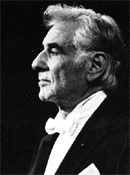
On January 18, 1958 Leonard Bernstein began presenting his television series What does music mean? The series ran for 53 programs. Some of the episodes can be found below:
Part 1 What is Classical Music?
Plot: Bernstein conducts Handel’s Water Music and cites it as an indisputable example of classical music. “Exact” is the word that best defines classical music, Bernstein says and he demonstrates with musical illustrations from Bach’s Fourth Brandenburg Concerto, Mozart’s Concerto No. 21 in C Major and The Marriage of Figaro, and Haydn’s Symphony No. 102.
The decline of classical music at the end of the eighteenth century is tied to Beethoven’s innovations and the Romantic movement, and Bernstein conducts Beethoven’s Egmont Overture.
Part 2 What is Melody?
Plot: Bernstein discusses the different forms melody can take, including tune, theme, motive, melodic line and musical phrase. He illustrates by conducting the orchestra in excerpts from Tchaikovsky, Wagner, Hindemith, and Brahms.
Part 3 What is a Mode?
Plot: Bernstein discusses scales, intervals, and tones, and analyzes several pieces, including Debussy’s Fêtes, Rimsky-Korsakov’s Scheherazade, and music from the Kinks and the Beatles, to illustrate different modes.
An excerpt from Bernstein’s ballet Fancy Free is also performed.
The holiday season at the Company is a spellbinding time, completely enveloped in the enchanting world of George Balanchine’s The Nutcracker™. This production is a grand spectacle of artistry and imagination, a beloved holiday tradition that brings together an extraordinary ensemble of talent. With all 90 dancers, 62 musicians, 32 stagehands, and two casts of 50 young students each from the School of American Ballet, the Company transforms each performance into a mesmerizing experience.
Audiences, including children and adults from New York City and beyond, flock to the David H. Koch Theater, drawn by the irresistible allure of Tschaikovsky’s iconic music, Balanchine’s masterful choreography, Karinska’s lavish costumes, and Rouben Ter-Arutunian’s enchanting sets. This production, a magical adaptation of the Alexandre Dumas pere version of E.T.A. Hoffmann’s tale, “The Nutcracker and the Mouse King,” is a full-scale theatrical marvel.
The production’s visual splendor is nothing short of breathtaking. The stage comes alive with elaborate elements and sophisticated lighting, creating an immersive world that captivates the imagination. One of the most stunning features is the one-ton Christmas tree that astoundingly grows from 12 feet to 40 feet, eliciting gasps of wonder from the audience at each performance. The whimsical Mother Ginger costume, weighing 85 pounds and spanning nine feet, and the delicate snowflakes that dance through the air add to the magic, making the ballet a visual feast.
However, it is Balanchine’s choreography that is the heart of the ballet, guiding the audience through a journey from the familiar to the fantastical. Act I sets the stage with its charming characters – the Stahlbaum children, Marie and Fritz, Herr Drosselmeier and his Nephew – and culminates in the dreamlike Snowflake Waltz. Act II is a complete immersion into the fantastical “Kingdom of the Sugarplum Fairy,” where the line between reality and fantasy beautifully blurs.
George Balanchine’s The Nutcracker™ stands as one of the most complex and captivating staged ballets in the Company’s repertoire. Its immense popularity is a testament to its ability to ignite the holiday spirit in everyone’s heart, making it an integral and unforgettable part of the holiday season.
Despite its humble beginnings, where the original production of Tchaikovsky’s The Nutcracker did not immediately capture the public’s adoration, a remarkable transformation occurred over time. Tchaikovsky, with his masterful touch, crafted a 20-minute suite from the ballet’s music that soared in popularity, showcasing his genius in a new light. This suite became the beacon that eventually led to the ballet’s widespread acclaim.Despite its humble beginnings, where the original production of Tchaikovsky’s The Nutcracker did not immediately capture the public’s adoration, a remarkable transformation occurred over time. Tchaikovsky, with his masterful touch, crafted a 20-minute suite from the ballet’s music that soared in popularity, showcasing his genius in a new light. This suite became the beacon that eventually led to the ballet’s widespread acclaim.
From the late 1960s onwards, The Nutcracker underwent a renaissance, becoming a cherished staple of the holiday season. Its popularity skyrocketed, especially in North America, where it became synonymous with Christmas festivities. Today, The Nutcracker is an essential part of countless ballet companies’ repertoires, celebrated for its enchanting story and exquisite choreography.
The ballet’s commercial success is astounding, with major American ballet companies attributing approximately 40 percent of their annual ticket revenues to performances of The Nutcracker. This statistic alone speaks volumes about the ballet’s enduring appeal and its significant role in the cultural landscape of ballet and Christmas traditions alike.
Tchaikovsky’s score for The Nutcracker, with its lush, evocative melodies and intricate compositions, has risen to become one of his most renowned works. The pieces from the suite, in particular, have captivated audiences worldwide with their beauty and complexity, securing The Nutcracker’s place as not just a seasonal favorite, but a timeless masterpiece of classical music.
On January 18, 1958 Leonard Bernstein began presenting his television series What does music mean? The series ran for 53 programs. Some of the episodes can be found below:
Part 1 What is Classical Music?
Plot: Bernstein conducts Handel’s Water Music and cites it as an indisputable example of classical music. “Exact” is the word that best defines classical music, Bernstein says and he demonstrates with musical illustrations from Bach’s Fourth Brandenburg Concerto, Mozart’s Concerto No. 21 in C Major and The Marriage of Figaro, and Haydn’s Symphony No. 102.
The decline of classical music at the end of the eighteenth century is tied to Beethoven’s innovations and the Romantic movement, and Bernstein conducts Beethoven’s Egmont Overture.
Part 2 What is Melody?
Plot: Bernstein discusses the different forms melody can take, including tune, theme, motive, melodic line and musical phrase. He illustrates by conducting the orchestra in excerpts from Tchaikovsky, Wagner, Hindemith, and Brahms.
Part 3 What is a Mode?
Plot: Bernstein discusses scales, intervals, and tones, and analyzes several pieces, including Debussy’s Fêtes, Rimsky-Korsakov’s Scheherazade, and music from the Kinks and the Beatles, to illustrate different modes.
An excerpt from Bernstein’s ballet Fancy Free is also performed.
During the holiday period, the entire Company is immersed in activities surrounding George Balanchine’s The Nutcracker™. All 90 dancers, 62 musicians, 32 stagehands and two casts of 50 young students each from the School of American Ballet join forces to make each performance as magical as possible. Children of all ages from New York City and the nation fill the David H. Koch Theater to be captivated by the lure of Tschaikovsky’s music, Balanchine’s choreography, Karinska’s sumptuous costumes, and Rouben Ter-Arutunian’s magical sets. George Balanchine’s The Nutcracker™, based on the Alexandre Dumas pere version of E.T.A. Hoffmann’s tale, The Nutcracker and the Mouse King (1816), demands a full-scale production.
The elaborate stage elements and intricate lighting unleash the viewers’ imagination by providing visual effects that are extraordinarily grand. The most famous example is the one-ton Christmas tree that grows from a height of 12 feet to 40 feet, evoking audible gasps of disbelief from the audience at each performance. Other notable feats include the comic figure of Mother Ginger — 85 pounds and nine feet wide, the costume requires handling by three people once it is lowered by pulley over the dancer’s head — as well as the continuous flutter of the purest, crystal-shaped snowflakes (which are swept up and conserved after each performance for reuse).
While these technical achievements are wonderful fun, it is Balanchine’s choreography that sustains the ballet through two acts. Act I introduces the characters — the Stahlbaum children, Marie and Fritz, Herr Drosselmeier and his Nephew — and also begins the transition from reality into fantasy with the concluding Snowflake Waltz. Act II offers the complete transformation. We have entered the “Kingdom of the Sugarplum Fairy” and there is no turning back.
George Balanchine’s The Nutcracker™ is one of the most complex theatrical, staged ballets in the Company’s active repertory. The popularity of the ballet is immense and it provides an unforgettable spark to everyone’s holiday season.
Although the original production was not a success, the 20-minute suite that Tchaikovsky extracted from the ballet was. However, the complete Nutcracker has enjoyed enormous popularity since the late 1960s and is now performed by countless ballet companies, primarily during the Christmas season, especially in North America. Major American ballet companies generate around 40 percent of their annual ticket revenues from performances of The Nutcracker.
Tchaikovsky’s score has become one of his most famous compositions, in particular, the pieces featured in the suite.
On January 18, 1958 Leonard Bernstein began presenting his television series What does music mean? The series ran for 53 programs. Some of the episodes can be found below:
Part 1 What is Classical Music?
Plot: Bernstein conducts Handel’s Water Music and cites it as an indisputable example of classical music. “Exact” is the word that best defines classical music, Bernstein says and he demonstrates with musical illustrations from Bach’s Fourth Brandenburg Concerto, Mozart’s Concerto No. 21 in C Major and The Marriage of Figaro, and Haydn’s Symphony No. 102.
The decline of classical music at the end of the eighteenth century is tied to Beethoven’s innovations and the Romantic movement, and Bernstein conducts Beethoven’s Egmont Overture.
Part 2 What is Melody?
Plot: Bernstein discusses the different forms melody can take, including tune, theme, motive, melodic line and musical phrase. He illustrates by conducting the orchestra in excerpts from Tchaikovsky, Wagner, Hindemith, and Brahms.
Part 3 What is a Mode?
Plot: Bernstein discusses scales, intervals, and tones, and analyzes several pieces, including Debussy’s Fêtes, Rimsky-Korsakov’s Scheherazade, and music from the Kinks and the Beatles, to illustrate different modes.
An excerpt from Bernstein’s ballet Fancy Free is also performed.
Another small break from Christmas music since we went to Bargemusic in December 2015:
Bargemusic is a classical music venue and cultural icon founded in 1977, housed on a converted coffee barge moored at Fulton Ferry Landing on the East River near the Brooklyn Bridge. I took this picture of the NY skyline and Steinway piano from the second row seating.
Founder and director, Olga Bloom was interviewed about the floating concert hall under the Brooklyn Bridge she converted from an old coffee barge. The video includes excerpts from one of the chamber music concerts typical of the Bargemusic programs, and features classical music artists, Ida Levin, violin, Anton Nel, piano, Thomas Hill, clarinet, Ronald Thomas, cello. A Greenpoint Video Project production. Supported through a grant from NYCEF, New York State Council on the Arts.
One of our performers was Mark Peskanov, Bargemusic President, Executive & Artistic Director. He talked a little about the program, about Bargemusic in general, and introduced the pianist and cellist for today. Each played a Bach solo and the 3 played Piano Trio No.4, Op.90 by Antonín Dvořák.
During the holiday period, the entire Company is immersed in activities surrounding George Balanchine’s The Nutcracker™. All 90 dancers, 62 musicians, 32 stagehands and two casts of 50 young students each from the School of American Ballet join forces to make each performance as magical as possible. Children of all ages from New York City and the nation fill the David H. Koch Theater to be captivated by the lure of Tschaikovsky’s music, Balanchine’s choreography, Karinska’s sumptuous costumes, and Rouben Ter-Arutunian’s magical sets. George Balanchine’s The Nutcracker™, based on the Alexandre Dumas pere version of E.T.A. Hoffmann’s tale, The Nutcracker and the Mouse King (1816), demands a full-scale production.
The elaborate stage elements and intricate lighting unleash the viewers’ imagination by providing visual effects that are extraordinarily grand. The most famous example is the one-ton Christmas tree that grows from a height of 12 feet to 40 feet, evoking audible gasps of disbelief from the audience at each performance. Other notable feats include the comic figure of Mother Ginger — 85 pounds and nine feet wide, the costume requires handling by three people once it is lowered by pulley over the dancer’s head — as well as the continuous flutter of the purest, crystal-shaped snowflakes (which are swept up and conserved after each performance for reuse).
While these technical achievements are wonderful fun, it is Balanchine’s choreography that sustains the ballet through two acts. Act I introduces the characters — the Stahlbaum children, Marie and Fritz, Herr Drosselmeier and his Nephew — and also begins the transition from reality into fantasy with the concluding Snowflake Waltz. Act II offers the complete transformation. We have entered the “Kingdom of the Sugarplum Fairy” and there is no turning back.
George Balanchine’s The Nutcracker™ is one of the most complex theatrical, staged ballets in the Company’s active repertory. The popularity of the ballet is immense and it provides an unforgettable spark to everyone’s holiday season.
Although the original production was not a success, the 20-minute suite that Tchaikovsky extracted from the ballet was. However, the complete Nutcracker has enjoyed enormous popularity since the late 1960s and is now performed by countless ballet companies, primarily during the Christmas season, especially in North America. Major American ballet companies generate around 40 percent of their annual ticket revenues from performances of The Nutcracker.
Tchaikovsky’s score has become one of his most famous compositions, in particular, the pieces featured in the suite.
On January 18, 1958 Leonard Bernstein began presenting his television series What does music mean? The series ran for 53 programs. Some of the episodes can be found below:
Part 1 What is Classical Music?
Plot: Bernstein conducts Handel’s Water Music and cites it as an indisputable example of classical music. “Exact” is the word that best defines classical music, Bernstein says and he demonstrates with musical illustrations from Bach’s Fourth Brandenburg Concerto, Mozart’s Concerto No. 21 in C Major and The Marriage of Figaro, and Haydn’s Symphony No. 102.
The decline of classical music at the end of the eighteenth century is tied to Beethoven’s innovations and the Romantic movement, and Bernstein conducts Beethoven’s Egmont Overture.
Part 2 What is Melody?
Plot: Bernstein discusses the different forms melody can take, including tune, theme, motive, melodic line and musical phrase. He illustrates by conducting the orchestra in excerpts from Tchaikovsky, Wagner, Hindemith, and Brahms.
Part 3 What is a Mode?
Plot: Bernstein discusses scales, intervals, and tones, and analyzes several pieces, including Debussy’s Fêtes, Rimsky-Korsakov’s Scheherazade, and music from the Kinks and the Beatles, to illustrate different modes.
An excerpt from Bernstein’s ballet Fancy Free is also performed.
During the holiday period, the entire Company is immersed in activities surrounding George Balanchine’s The Nutcracker™. All 90 dancers, 62 musicians, 32 stagehands and two casts of 50 young students each from the School of American Ballet join forces to make each performance as magical as possible. Children of all ages from New York City and the nation fill the David H. Koch Theater to be captivated by the lure of Tschaikovsky’s music, Balanchine’s choreography, Karinska’s sumptuous costumes, and Rouben Ter-Arutunian’s magical sets. George Balanchine’s The Nutcracker™, based on the Alexandre Dumas pere version of E.T.A. Hoffmann’s tale, The Nutcracker and the Mouse King (1816), demands a full-scale production.
The elaborate stage elements and intricate lighting unleash the viewers’ imagination by providing visual effects that are extraordinarily grand. The most famous example is the one-ton Christmas tree that grows from a height of 12 feet to 40 feet, evoking audible gasps of disbelief from the audience at each performance. Other notable feats include the comic figure of Mother Ginger — 85 pounds and nine feet wide, the costume requires handling by three people once it is lowered by pulley over the dancer’s head — as well as the continuous flutter of the purest, crystal-shaped snowflakes (which are swept up and conserved after each performance for reuse).
While these technical achievements are wonderful fun, it is Balanchine’s choreography that sustains the ballet through two acts. Act I introduces the characters — the Stahlbaum children, Marie and Fritz, Herr Drosselmeier and his Nephew — and also begins the transition from reality into fantasy with the concluding Snowflake Waltz. Act II offers the complete transformation. We have entered the “Kingdom of the Sugarplum Fairy” and there is no turning back.
George Balanchine’s The Nutcracker™ is one of the most complex theatrical, staged ballets in the Company’s active repertory. The popularity of the ballet is immense and it provides an unforgettable spark to everyone’s holiday season.
Although the original production was not a success, the 20-minute suite that Tchaikovsky extracted from the ballet was. However, the complete Nutcracker has enjoyed enormous popularity since the late 1960s and is now performed by countless ballet companies, primarily during the Christmas season, especially in North America. Major American ballet companies generate around 40 percent of their annual ticket revenues from performances of The Nutcracker.
Tchaikovsky’s score has become one of his most famous compositions, in particular the pieces featured in the suite.
January 18, 1958 ~ Leonard Bernstein began presenting his television series What does music mean? The series ran for 53 programs. Some of the episodes can be found below:
Part 1 What is Classical Music?
Plot: Bernstein conducts Handel’s Water Music and cites it as an indisputable example of classical music. “Exact” is the word that best defines classical music, Bernstein says and he demonstrates with musical illustrations from Bach’s Fourth Brandenburg Concerto, Mozart’s Concerto No. 21 in C Major and The Marriage of Figaro, and Haydn’s Symphony No. 102.
The decline of classical music at the end of the eighteenth century is tied to Beethoven’s innovations and the Romantic movement, and Bernstein conducts Beethoven’s Egmont Overture.
Part 2 What is Melody?
Plot: Bernstein discusses the different forms melody can take, including tune, theme, motive, melodic line and musical phrase. He illustrates by conducting the orchestra in excerpts from Tchaikovsky, Wagner, Hindemith, and Brahms.
Part 3 What is a Mode?
Plot: Bernstein discusses scales, intervals, and tones, and analyzes several pieces, including Debussy’s Fêtes, Rimsky-Korsakov’s Scheherazade, and music from the Kinks and the Beatles, to illustrate different modes.
An excerpt from Bernstein’s ballet Fancy Free is also performed.



 MaryO'Studio