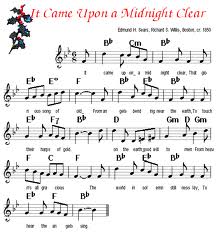
In 1850, Richard Storrs Willis, a composer who trained under Felix Mendelssohn, wrote the melody called “Carol.” This melody is most often set in the key of B-flat major in a six-eight time signature. “Carol” is the most widely known tune to the song in the United States.
It came upon the midnight clear,
That glorious song of old,
From angels bending near the earth,
To touch their harps of gold:
“Peace on the earth, goodwill to men,
From heaven’s all-gracious King.”
The world in solemn stillness lay,
To hear the angels sing.
Still through the cloven skies they come,
With peaceful wings unfurled,
And still their heavenly music floats
O’er all the weary world;
Above its sad and lowly plains,
They bend on hovering wing,
And ever o’er its Babel sounds
The blessèd angels sing.
Yet with the woes of sin and strife
The world has suffered long;
Beneath the angel-strain have rolled
Two thousand years of wrong;
And man, at war with man, hears not
The love-song which they bring;
O hush the noise, ye men of strife,
And hear the angels sing.
And ye, beneath life’s crushing load,
Whose forms are bending low,
Who toil along the climbing way
With painful steps and slow,
Look now! for glad and golden hours
come swiftly on the wing.
O rest beside the weary road,
And hear the angels sing!
For lo!, the days are hastening on,
By prophet bards foretold,
When with the ever-circling years
Comes round the age of gold
When peace shall over all the earth
Its ancient splendors fling,
And the whole world give back the song
Which now the angels sing.
Charles Wesley (1707-1788), the younger brother of John Wesley wrote the words to this Christmas Carol.
Charles was a hymn writer and a poet, also known as one of the people who began the Methodist movement in the Church of England. Hark the Herald Angels Sing appeared in 1739 in a book called Hymns and Sacred Poems.
Wesley envisioned this being sung to the same tune as his hymn, Christ the Lord Is Risen Today, and in some hymnals it is included along with the more popular version.
This hymn was regarded as one of the Great Four Anglican Hymns and published as number 403 in “The Church Hymn Book” (New York and Chicago, USA, 1872).
To celebrate the invention of the printing press, Felix Mendelssohn composed a cantata in 1840 called Festgesang or “Festival Song”. The melody of Mendelssohn’s cantata was then used by William H. Cummings and adapted it to the lyrics of Wesley’s “Hark the Herald Angels Sing”.
Hark the herald angels sing
“Glory to the newborn King!
Peace on earth and mercy mild
God and sinners reconciled”
Joyful, all ye nations rise
Join the triumph of the skies
With the angelic host proclaim:
“Christ is born in Bethlehem”
Hark! The herald angels sing
“Glory to the newborn King!”
And, of course, no one can do it better than The Mormon Tabernacle Choir.
From RevKev, Pender’s Former Associate Pastor – “As it was, so it is, Christmas about Jesus. We are all distracted by the glitz and festivities, but let us hear the sound of Angels and the call to worship our Newborn King. Just in time for Christmas, a gift from God to you: A baby in a manger who would love us through and through.
Just In Time For Christmas, the latest album release by JC Reigns. 100% of the sales from this CD go to Western Fairfax Christian Ministries to support their mission of providing life-essential support to those needing assistance.
CDs available for purchase at the WFCM Thrift Store in Chantilly, Va. Visit www.jcreigns.org for more information and for a link to purchase digital copies.”
Music theory has never sounded so catchy with this witty remake of the holiday classic The Christmas Song (with apologies to Mel Torme) Try not to laugh at the ending.
Though it is a bit humorous, this version titled ‘Intervals Roasting’, with lyrics by David Rakowski, attempts to encapsulate the fundamentals of music theory in just over two minutes.
It does a good job of explaining the intervals and harmonic structure of the song and also gives you an idea of how to use music theory to analyse or compose music.
The O’Connor Music Studio has a copy if anyone wants to learn this 🙂
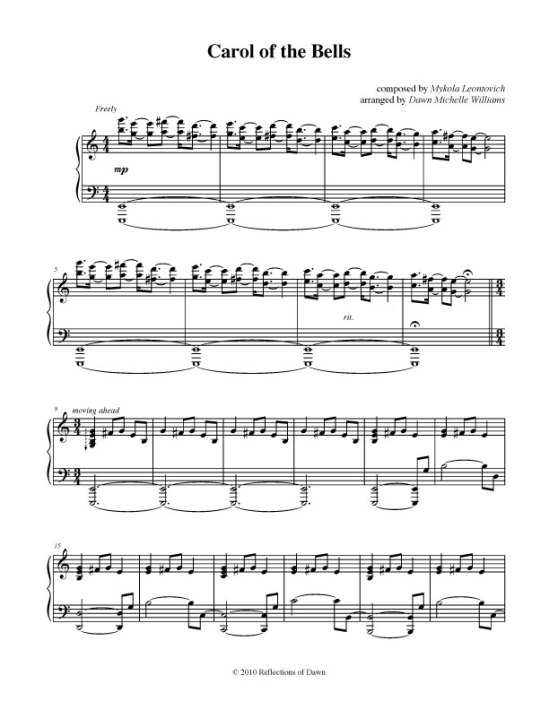
Carol of the Bells was composed by Mykola Dmytrovych Leontovych (1877-1921) in 1916. Originally titled Shchedryk, this Ukrainian folk song is sometimes called Ukrainian Bell Carol. “Shchedryk” which was associated with the coming New Year, originally celebrated in April.
Leontovych used this tune in 1904 along with lyrics by Peter J. Wilhousky to create the version that everyone knows today. It gained popularity during the 1920s and 1930s, and was introduced to an even wider audience when it was used in the movie “Home Alone”.
It was first performed in the Ukraine on the night of January 13, 1916, on the Julian calendar this is considered New Year’s Eve. In the United States the song was first performed on October 5, 1921 at Carnegie Hall.
This video is from the Christmas special of the Mormon Tabernacle Choir, presented at the BYU channel. Very beautiful sound of bells, the orchestra and choir, enjoy the video!
Not the standard version –
The O’Connor Music Studio has several versions of this Christmas Carol available for loan, including this version from the Mannheim Steamroller:
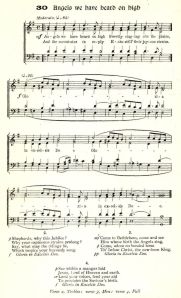
Angels we have heard on high
Sweetly singing o’er the plains
And the mountains in reply
Echoing their joyous strains
CHORUS:
Gloria, in excelsis Deo!
Gloria, in excelsis Deo!
Shepherds, why this jubilee?
Why your joyous strains prolong?
What the gladsome tidings be
Which inspire your heavenly song? ChorusCome to Bethlehem and see
Him Whose birth the angels sing;
Come, adore on bended knee,
Christ the Lord, the newborn King. ChorusSee Him in a manger laid
Jesus Lord of heaven and earth;
Mary, Joseph, lend your aid,
With us sing our Savior’s birth. Chorus
This is a traditional French carol (Les Anges dans nos Campagnes) that was translated into English by Bishop James Chadwick.
This carol commemorates the story of the birth of Jesus Christ found in the Gospel of Luke, in which shepherds outside Bethlehem encounter a multitude of angels singing and praising the newborn child.
In 2009, Andrea Bocelli and David Foster collaborated to produce a Christmas album with a number of other music legends. This is “Angels We Have Heard on High” with choir and orchestra.
The Piano Guys, Peter Hollens, David Archuleta, and The Mormon Tabernacle Choir get together to sing “Angels We Have Heard On High”
Isaac Watts wrote the words to “Joy to the World” in 1719, based on Psalm 98 in the Bible. The hymn originally glorified Christ’s triumphant return at the end of the age, rather than a song celebrating His first coming. Only the second half of Watts’ lyrics are still used today.
The music was adapted and arranged to Watts’ lyrics by Lowell Mason in 1839 from an older melody which was then believed to have originated from Handel. The name “Antioch” is generally used for the hymn tune.
As of the late 20th century, “Joy to the World” was the most-published Christmas hymn in North America.
There are versions of Joy to the World available at the O’Connor Music Studio for any level of playing, starting with Pre-Reading, all the way up through Advanced and duets.
Who: Kids Ages 3 (must be potty-trained)- 6th Grade
What:“Under Wraps: The Gift We Never Expected”
Where: Pender UMC Christmas VBS
Why: Celebrate Christmas and the Gift of Jesus Christ
When: Saturday, Dec. 5th @ 10 am – 2 pm
Cost: $10 per Kid or $20 total per Family
Join us for Christmas VBS on December 5, 2015 while your parents enjoy the gift of time to prepare for Christmas. We will enjoy music, crafts, lunch, recreation, a story and more!
RSVP: Register online on our website by clicking on this link, beginning November 1st & ending November 30th.
• 1741 ~ George Frederick Handel completed his The Messiah. It took the composer just 23 days to complete the timeless musical treasure which is still very popular during the Christmas holiday season.
• 1888 ~ Michael Haydn (1737) Austrian composer
1760 ~ Luigi Cherubini, Italian composer
More information about Cherubini
• 1814 ~ Frances Scott Key, an attorney in Washington, DC, was aboard a warship that was bombarding Fort McHenry (an outpost protecting the city of Baltimore, MD). Key wrote some famous words to express his feelings. Those words became The Star-Spangled Banner, which officially became the U.S. national anthem by an act of Congress in 1931.
• 1910 ~ Lehman Engel, American composer, conductor and writer
• 1927 ~ Gene Austin waxed one of the first million sellers. He recorded his composition, My Blue Heaven, for Victor Records.
• 1941 ~ Priscilla Mitchell, Singer
• 1946 ~ Pete Agnew, Bass, singer with Nazareth
• 1947 ~ Jon ‘Bowzer’ Bauman, Singer with Sha Na Na
• 1950 ~ Paul Kossoff, Guitarist with Free
• 1954 ~ Barry Cowsill, Singer with The Cowsills
• 1959 ~ Morten Harket, Singer with a-ha
• 1973 ~ Donny Osmond received a gold record for his hit single, The Twelfth of Never. The song, released in March of 1973, was one of five which turned gold for the young Osmond. His other solo successes were Sweet & Innocent, Go Away Little Girl, Hey Girl and Puppy Love.
• 1985 ~ The first MTV Video Music Awards were presented at Radio City Music Hall in New York City. The Cars won Best Video honors for You Might Think and MichaelJackson won Best Overall Performance and Choreography for his Thriller video.
• 2002 ~ Jazz saxophonist and band leader Paul Williams, whose 1949 Rhythm and Blues hit, The Huckle-Buck, was covered by Frank Sinatra, died, at the age of 87. Williams scored one of the first big hits of the R&B era in 1949 with The Huckle- Buck, based on Charlie Parker’s “Now’s the Time.” It was the biggest-selling record in the Savoy label’s 60-year history, topping the R&B charts for 14 weeks, and spawned vocal versions by Sinatra and others. The Huckle-Buck was one of three Top 10 and five Top 20 R&B hits Williams scored for Savoy in 1948 and 1949. Other Top 10 hits were 35-30 in 1948 and Walkin’ Around in 1949. Williams was later part of Atlantic Records’ house band in the ’60s and directed the Lloyd Price and James Brown orchestras until 1964. After leaving the music business temporarily, he opened a booking agency in New York in 1968. Born July 13, 1915, in Birmingham, Alabama, Williams played with Clarence Dorsey in 1946, and then made his recording debut with King Porter in 1947 for Paradise before forming his own band later that year. Saxophonists Noble “Thin Man” Watts and Wild Bill Moore, trumpeter Phil Guilbeau, and vocalists Danny Cobb, Jimmy Brown, Joan Shaw, and Connie Allen were among Williams’ band members.
. 1941 ~ Artie Shaw and his orchestra recorded Moonglow on Victor Records. In the band were such sidemen as Johnny Guarnieri, Jack Jenney, Billy Butterfield and Ray Conniff on trombone.
. 1943 ~ Duke Ellington and the band played for a black-tie crowd at Carnegie Hall in New York City. It was the first of what was to become an annual series of concerts featuring the the Duke.
. 1948 ~ Anita Pointer, Singer with The Pointer Sisters
. 1950 ~ Bill Cunningham, Bass, piano with The Box Tops
. 1950 ~ Patrick Simmons, Singer, guitarist with The Doobie Brothers
. 1974 ~ Mike Oldfield’sTubular Bells opened the credits of the movie, “The Exorcist”, based on the book by William Peter Blatty. The song received a gold record this day.
. 1977 ~ Carole King’s landmark album, “Tapestry”, became the longest-running album to hit the charts, as it reached its 302nd week on the album lists.
. 2002 ~ Alfred Glasser, a former director of education for the Lyric Opera of Chicago, died of cancer. He was 70. Glasser held the education post for 30 years before his retirement in 1996. Since 1997, Glasser served as chairman of the board and commentator for Chicago’s concert opera company, da Corneto Opera. For the past decade, he served on the board of Alliance Francaise of Chicago, a French cultural group. Glasser also founded the Lyric Opera Lecture Corps, a community service project.
. 2003 ~ Nell Carter, actress-singer, died at the age of 54. She was best known for her role as the housekeeper in the TV sitcom “Gimme a Break!”. Carter, who was born September 13, 1948, in Birmingham, Alabama, first rose to stardom on the New York stage. After a series of roles on- and off-Broadway — and a short-lived part in the soap opera “Ryan’s Hope” — in 1977 she starred in the show “Ain’t Misbehavin’!”, a revue of the works of composer Fats Waller. She was rewarded for her performance with an Obie Award, and later with a Tony Award when the show moved to Broadway. Several years later, she earned an Emmy for her performance on a television presentation of the musical. Despite her Broadway success, Carter would have preferred to sing opera. “When I was growing up, it was not something you aspired to,” she said in 1988. “I was a weirdo to want to be in show business. Most kids wanted to be teachers or nurses.” “Gimme a Break!” ran from 1981 to 1987. Carter was nominated for two Emmys for her role as housekeeper Nell Harper, who helped run the household of police chief Carl Kanisky, played by Dolph Sweet. She also garnered two Golden Globe nominations for the role.
. 2003 ~ For Sale: One of London’s most famous music venues, which in its heyday in the 1960s played host to The Who, David Bowie and the Rolling Stones, is for sale, its administrators said. The Marquee Club, which in the 1970s was the epicenter of the punk explosion, ran into financial difficulties after its high-profile relaunch last fall, said a spokeswoman for administrator BDO Stoy Hayward. “We’re looking for someone in the music business who can capitalize on the Marquee brand and keep running it as a live venue,” she said. The price tag is at least $200 million. The club opened in London’s Soho district in 1958 and was so cramped and sweaty that, according to legend, Bob Geldof of the Boomtown Rats blacked out on stage. In 1988, it moved to a new location in nearby Charing Cross, but within eight years it had closed down. A high-profile relaunch at a new venue in Islington, north London September 2002 was headlined by the controversial electro-rockers Primal Scream, but according to the club’s administrators, huge start-up costs quickly led to its downfall.





 1760 ~ Luigi Cherubini, Italian composer
 MaryO'Studio