“We Three Kings”, also known as “We Three Kings of Orient Are” or “The Quest of the Magi”, is a Christmas carol written by the Reverend John Henry Hopkins, Jr., who wrote both the lyrics and the music.
We three kings of Orient are
Bearing gifts we traverse afar
Field and fountain, moor and mountain
Following yonder star
O Star of wonder, star of night
Star with royal beauty bright
Westward leading, still proceeding
Guide us to thy Perfect Light
Born a King on Bethlehem’s plain
Gold I bring to crown Him again
King forever, ceasing never
Over us all to reign
O Star of wonder, star of night
Star with royal beauty bright
Westward leading, still proceeding
Guide us to Thy perfect light
Frankincense to offer have I
Incense owns a Deity nigh
Prayer and praising, all men raising
Worship Him, God most high
O Star of wonder, star of night
Star with royal beauty bright
Westward leading, still proceeding
Guide us to Thy perfect light
Myrrh is mine, its bitter perfume
Breathes of life of gathering gloom
Sorrowing, sighing, bleeding, dying
Sealed in the stone-cold tomb
O Star of wonder, star of night
Star with royal beauty bright
Westward leading, still proceeding
Guide us to Thy perfect light
Glorious now behold Him arise
King and God and Sacrifice
Alleluia, Alleluia
Earth to heav’n replies
O Star of wonder, star of night
Star with royal beauty bright
Westward leading, still proceeding
Guide us to Thy perfect light
From Mannheim Steamroller, Chip Davis gives this song an “Arabian Nights” feel. A classic song that tells the story of the Gentiles who were quicker to recognize the significance of Christ’s birth than were His own people. Enjoy, and Merry Christmas!
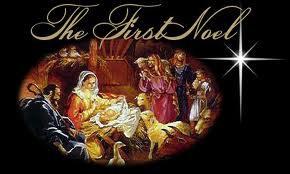
The First Nowell (also written The First Noël) is a traditional classical English carol, most likely from the 18th century, although possibly earlier.
The word Noel comes from the French word Noël meaning “Christmas”, from the Latin word natalis “birthday”.
The melody is unusual among English folk melodies in that it consists of one musical phrase repeated twice, followed by a refrain which is a variation on that phrase. All three phrases end on the third of the scale.
The first Noel the angel did say
Was to certain poor shepherds in fields as they lay;
In fields where they lay tending their sheep,
On a cold winter’s night that was so deep.
Refrain
Noel, Noel, Noel, Noel, Born is the King of Israel.
They lookèd up and saw a star
Shining in the east, beyond them far;
And to the earth it gave great light,
And so it continued both day and night.
Refrain
And by the light of that same star
Three Wise Men came from country far;
To seek for a King was their intent,
And to follow the star wherever it went.
Refrain
This star drew nigh to the northwest,
Over Bethlehem it took its rest;
And there it did both stop and stay,
Right over the place where Jesus lay.
Refrain
Then did they know assuredly
Within that house the King did lie;
One entered it them for to see,
And found the Babe in poverty.
Refrain
Then entered in those Wise Men three,
Full reverently upon the knee,
And offered there, in His presence,
Their gold and myrrh and frankincense.
Refrain
Between an ox stall and an ass,
This Child truly there He was;
For want of clothing they did Him lay
All in a manger, among the hay.
Refrain
Then let us all with one accord
Sing praises to our heavenly Lord;
That hath made Heaven and earth of naught,
And with His blood mankind hath bought.
Refrain
If we in our time shall do well,
We shall be free from death and hell;
For God hath prepared for us all
A resting place in general.
Refrain
The University of Utah Singers perform “The First Noel” arr. by Dan Forrest live in concert, December 11th & 12th, 2009 in Libby Gardner concert hall under the direction of Dr. Brady Allred.
• 1970 ~ George Harrison received a gold record for his single, My Sweet Lord.
• 1983 ~ The musical biography of Peggy Lee opened at the Lunt-Fontanne Theatre in New York City. The show was titled Peg.
• 1984 ~ The Cotton Club opened around the U.S. There were nine classic songs by Duke Ellington on the soundtrack of the movie.
• 1990 ~ Opera lovers were turned into couch potatoes. For four evenings, starting on this day, they watched and listened to an unabridged telecast of Richard Wagner’s marathon-length opera The Ring.
• 2001 ~ Conte Candoli, a Trumpet player and staple of The Tonight Show band during Johnny Carson’s era, died of cancer. He was 74. Candoli was recognized for developing a musical style based on DizzyGillespie’s bebop playing, with a touch of Miles Davis and Clifford Brown. The Indiana-born Candoli, grew up surrounded by musical instruments and influences. His father, a factory worker, played the trumpet and wanted Candoli and his brother Pete to become musicians. At 16, he worked in Woody Herman’s orchestra during summer vacations. While playing in California, Candoli began his association with the then New York-based Tonight Show. In 1972, when Carson moved the show to Burbank, Candoli joined the band. He left when Carson retired in 1992.
I could have turned the Alfred Burt Carols into the next 15 parts of this series but I decided that was a bit too easy on me!
I love this story – it’s a wonderful family tradition from the Burt family.
Starting in 1922, Alfred Burt’s father created a Christmas card for family members and parishioners. On these cards were original Christmas carols, with both the words and music by the Reverend Bates Burt. For the family Christmas card in 1942, Bates asked his son to write the music for that year’s carol, “Christmas Cometh Caroling.”
From then on, Alfred would write the music for the family’s Christmas cards, and the “Alfred Burt carols” were born.
“This Is Christmas” (also known as “Bright, Bright, the Holly Berries”) (1950)
“Some Children See Him” (1951)
“Come, Dear Children” (1952)
“O, Hearken Ye” (1953)
“Caroling Caroling” (1954)
“We’ll Dress the House” (1954)
“The Star Carol” (1954)
Burt finished the last of his carols, “The Star Carol”, on February 5, 1954. He died less than 24 hours later, at the age of 33.
One of the best known of these today is Caroling Caroling (lyrics by the church organist at his father’s church, Wihla Hutson)
The Salt Lake Vocal Artists perform 2 carols; “Caroling, Caroling” and “We’ll Dress the House” by Alfred Burt live in concert on December 17, 2011 in Holy Family Catholic Church, South Ogden, Utah under the direction of Dr. Brady Allred.
• 1949 ~ Paul Rodgers, Piano, vocals with Free, Bad Company, The Firm
• 1959 ~ Sheila E. (Escovedo), Drummer, singer
• 1959 ~ Paul Rutherford, Singer with Frankie Goes to Hollywood
• 1984 ~ The group known as Band Aid, 38 of Britain’s top rock musicians, recorded Do They Know This is Christmas? for Ethiopian famine victims. Despite the best of intentions, much of the food raised never got to the starving Ethiopians. In fact, much of it was found rotting on docks, not fit for human consumption. More than a Band-Aid was needed to fix that political mess.
• 1989 ~ Lindsay Crosby, son of crooner Bing Crosby, died
• 2002 ~ Actor Brad Dexter, who rode with Yul Brynner as one of the “Magnificent Seven” and became a confidant of both Marilyn Monroe and Frank Sinatra, died. He was 85. Burly and handsome, he was often cast as a tough guy in supporting roles, which included 1958’s “Run Silent, Run Deep,” starring Burt Lancaster and Clark Gable, and 1965’s “None but the Brave,” starring Sinatra. He made his film debut in the “The Asphalt Jungle” in 1950, but his most prominent role came in 1960’s “The Magnificent Seven,” in which he starred with Brynner, Steve McQueen, Charles Bronson and James Coburn. Born Boris Milanovich in Goldfield, Nev., Dexter made guest appearances on the 1950s television shows “Zane Gray Theater,” “Death Valley Days” and “Wagon Train.” In January 1953, he married singer Peggy Lee, but they divorced eight months later. Soon after his divorce, Dexter befriended Monroe. In 1954, he tried unsuccessfully to persuade her to stay with her husband, Joe DiMaggio. His friendship with Sinatra took on legendary proportions during the filming of “None but the Brave” in 1964. On location in Hawaii, Sinatra nearly drowned and Dexter saved his life.
• 2002 ~ Marvin O. Herzog, who traveled the world with his for 58 years, died of pancreatic cancer. He was 70. Herzog was a polka celebrity who regularly booked 170 appearances a year. He and his band would travel more than 75,000 miles a year in a converted Greyhound bus. For years, Herzog was the star and co-sponsor of Frankenmuth’s Summer Music Fest, which drew about 25,000 visitors annually to the town known for its Bavarian events and shopping. Born in Frankenmuth, Herzog lived there his entire life. He quit his job at Star of the West Milling in 1973 to concentrate full-time on polka music. He played a Cordovox – a mix of organ and accordion. Herzog recorded 32 albums, including his Schnitzelbank and Octoberfestrecords in German as well as Polish, Italian and English polkas. He had a radio show and co-hosted a television show. Herzog was inducted into the International Polka Association Hall of Fame in 1979.
The holiday season is in full swing. The decorations are up, the presents bought (or in the process of being bought) but there’s no reason why our apps can’t get the same love this holiday.
So, without further ado, I’d like to jump into the updates we’ve made to Piano Maestro for you this holiday season!
Holiday Songs & Graphics
You’ll be able to impress your friends and family with a bunch of FREE holiday songs to play! We also added some new ones to the mix for our veteran Piano Maestro players.
You’ll find 50 free (yes, free!!) songs in this category from Christmas to Hanukkah and even New Year’s too! We just added Mariah Carey’s “All I want for Christmas is You” (because who doesn’t LOVE that Christmas classic).
Also available is the Christmas staple, “Jingle Bell Rock”.
The only thing missing is the ability for our app to make a strong cup of eggnog! We’ll try and work on that for next Christmas
The free holiday songs can be accessed from two places. As mentioned above, you can get there directly from the “Free Holiday Songs” button on the main menu as well as going to Library -> Songs -> and then choosing the “Free Holiday Songs” category.
Make sure to download the latest update of Piano Maestro.
Learning on your own? Don’t forget to download our free iPhone app, Simply Piano, and learn to play “Jingle Bells” in just 30 minutes!
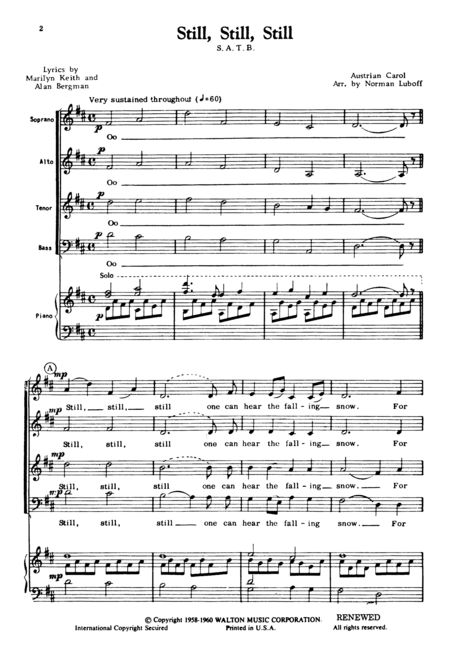
Still, Still, Still is an Austrian Christmas carol and lullaby. In German its first line is “Still, still, still, weil’s Kindlein schlafen will!” (Hush, hush, hush, for the little child wants to sleep!)
The melody is a folk tune (authorship unknown) from the State of Salzburg. The tune appeared for the first time in 1865 in a folksong collection of Maria Vinzenz Süß (1802-1868), founder of the Salzburg Museum; it has changed slightly over the years but remains attributed to G. Götsch.
The words, which run to six verses in German, describe the peace of the infant Jesus and his mother as they sleep. There are various English translations. This is one version:
Still, still, still,
One can hear the falling snow.
For all is hushed,
The world is sleeping,
Holy Star its vigil keeping.
Still, still, still,
One can hear the falling snow.
Sleep, sleep, sleep,
‘Tis the eve of our Saviour’s birth.
The night is peaceful all around you,
Close your eyes,
Let sleep surround you.
Sleep, sleep, sleep,
‘Tis the eve of our Saviour’s birth.
Dream, dream, dream,
Of the joyous day to come.
While guardian angels without number,
Watch you as you sweetly slumber.
Dream, dream, dream,
Of the joyous day to come.
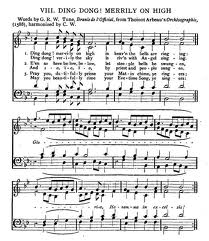
“Ding Dong Merrily on High” first appeared as a secular dance tune known as “le branle de l’Official” in a dance book written by Jehan Tabourot (1519–1593). The lyrics are from English composer George Ratcliffe Woodward (1848–1934), and it was first published in 1924 in his The Cambridge Carol-Book: Being Fifty-two Songs for Christmas, Easter, And Other Seasons. Woodward had an interest in church bell ringing, which no doubt helped inspire this carol
Ding dong! merrily on high
In heav’n the bells are ringing:
Ding dong! verily the sky
Is riv’n with Angel singing.
REFRAIN
Gloria,
Hosanna in excelsis!
Gloria,
Hosanna in excelsis!
E’en so here below, below,
Let steeple bells be swungen,
And “Io, io, io!”
By priest and people sungen.
REFRAIN
Pray you, dutifully prime
Your matin chime, ye ringers;
May you beautifully rime
Your evetime song, ye singers.
REFRAIN
Note: “Swungen” and “Sungen” in the second verse are archaic English verb forms.
O come, O come, Emmanuel is the mid-19th century translation by John Mason Neale and Henry Sloane Coffin of the Ecclesiastical Latin text “Veni, veni, Emmanuel”.
The text is based on the Biblical prophecy from Isaiah 7:14 that states that God will give Israel a sign that will be called Emmanuel (Literally: God with us). Matthew 1:23 states fulfillment of this prophecy in the birth of Jesus of Nazareth.
O come, O come, Emmanuel
And ransom captive Israel
That mourns in lonely exile here
Until the Son of God appear
Rejoice! Rejoice! Emmanuel
Shall come to thee, O Israel.
O come, Thou Rod of Jesse, free
Thine own from Satan’s tyranny
From depths of Hell Thy people save
And give them victory o’er the grave
Rejoice! Rejoice! Emmanuel
Shall come to thee, O Israel.
O come, Thou Day-Spring, come and cheer
Our spirits by Thine advent here
Disperse the gloomy clouds of night
And death’s dark shadows put to flight.
Rejoice! Rejoice! Emmanuel
Shall come to thee, O Israel.
O come, Thou Key of David, come,
And open wide our heavenly home;
Make safe the way that leads on high,
And close the path to misery.
Rejoice! Rejoice! Emmanuel
Shall come to thee, O Israel.
O come, O come, Thou Lord of might,
Who to Thy tribes, on Sinai’s height,
In ancient times did’st give the Law,
In cloud, and majesty and awe.
Rejoice! Rejoice! Emmanuel
Shall come to thee, O Israel.




 Hanukkah



 MaryO'Studio