Dr. Maurice Hinson

hinson


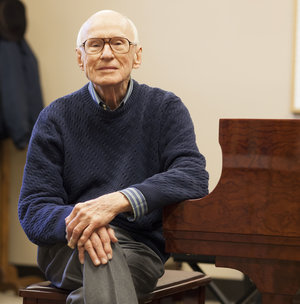
I have always respected Dr. Hinson’s work and his music.  So much so that I went to Connecticut to take a class on Piano Pedagogy with him several years ago.  I have also attended several local piano teacher workshops with him.  At one of them, he claimed to remember me from that Connecticut class.  Whether true or not, I treasure that comment and the signature on a piano book he gave me.

We have several of his books at the O’Connor Music Studio and many are available for loan.  If you are interested in buying any for yourself, amazon.com has a great selection.  In addition to those books he has authored, he has edited the works of many composers.  Amazon lists 270 works edited and annotated by Dr. Hinson.


From his page on alfred.com:

One of America’s most respected authorities on piano literature, Dr. Maurice Hinson received the Lifetime Achievement Award from the Music Teachers National Association at its Washington, D.C. convention in the spring of 1994, the Outstanding Alumni Award from the University of Florida in 1990, and the Outstanding Alumni Award from the University of Michigan in the fall of 1995. Hailed as a specialist in American piano music, some of his articles appear in the New Grove Dictionary of American Music in the United States.

Dr. Hinson received his Bachelor of Arts degree from the University of Florida and his Master of Music and Doctor of Musical Arts degrees from the University of Michigan. He also studied at The Juilliard School and the Conservatoire National in Nancy, France.

While a Senior Professor of Piano in the School of Church Music at the Southern Baptist Theological Seminary in Louisville, Kentucky, Dr. Hinson’s curriculum included teaching piano, piano literature, and piano chamber music. He performed, lectured, and gave masterclasses worldwide. His books and editions have become classic standards in the studios of serious piano teachers and students the world over.


From his obituary at legacy.com:

Hinson, Dr. G. Maurice, age 84 died November 11, 2015 in the company of his family. Dr. Hinson was Professor and Senior Professor of Piano at the Southern Baptist Theological Seminary from 1957 to 2015, and a member of Broadway Baptist Church. He was also organist-choirmaster of churches in Florida, Michigan and Kentucky from 1943 to 1980. Dr. Hinson received his BA degree from the University of Florida and his MM and DMA degrees from the University of Michigan, and also studied at The Julliard School and the University of Nancy, France (Conservatoire National).

He was the first president of the Greater Louisville Music Teachers Association, and president of the Kentucky Music Teachers Association as well as the Southern Division of the MTNA. He also taught “The Dorsey Class,” a group of selected piano teachers from 1963 to 2015.

Dr. Hinson is the author of 14 books mostly published by Indiana University Press, plus over 100 articles for music publications. He was a senior editor for The Alfred Publishing Company of California. He edited more than 300 editions of classical piano music and recorded five DVDs of piano music.

As Professor of Piano at the Southern Baptist Theological Seminary for 58 years, he taught and nurtured many pianists who now hold distinguished positions in churches and universities throughout the world.

Dr. Hinson received many awards in piano pedagogy and performance. He was awarded the Liszt Commemorative Medal by the Hungarian Government and the Medal of Excellence by the American Liszt Society for his research on the music of Franz Liszt. He was hailed as a specialist in American Piano music and some of his most recent articles appeared in the NEW GROVE DICTIONARY OF AMERICAN MUSIC. He gave recitals, lectures, and master classes in five continents and 50 states.

Hinson was the founding editor of the JOURNAL OF THE AMERICAN LISZT SOCIETY, past editor of THE AMERICAN MUSIC TEACHER, and contributing editor of THE PIANO QUARTERLY and PIANO AND KEYBOARD.

Composers ~ H

Halle

Adam de la Halle, also known as Adam le Bossu (“Adam the Hunchback’) lived from around 1237 to around 1286. He was a poet and composer, born in Arras, France. He was court poet and musician to Robert II of Artois, and followed him to Naples in 1283. He was the originator of French comic opera, with Le Jeu de Robin et de Marion, and the partly autobiographical composition Jeu de la fuelle (Play of the Greensward). He also wrote poems in mediaeval verse forms.

Hamlisch

Marvin Hamlisch, American pianist, composer and arranger of popular music. He helped revitalize Ragtime with his musical arrangements in the movie, The Sting.

Hammerstein

1895 – Oscar (Greeley Clendenning) Hammerstein II lived from 1895 until 1960. He was a lyricist and songwriter with Richard Rodgers. Some of their best known musicals are Oklahoma!, Carousel, South Pacific, The King and I, Flower Drum Song and Sound of Music.

Handel

George Frederick Handel lived between 1685 and 1759. He is considered to be an important baroque composer. Handel had a lot in common with Bach. They were both born in Germany, the same year and both were organists and composers. Handel moved to England and spent 40 years there. While he was there he began writing music for the British royal family and he directed and composed operas as director of the Academy of Music.

“Largo” is a musical term for “very slow” and it is also the title of Handel’s most famous single melody. Largo is from an opera called Xerxes about a Persian king with that name and had it’s premiere in London in 1738.

Handel’s nickname was “The Thunderbolt”, given to him by Mozart because he composed so much music.

One of Handel’s most popular works is The Sarabande from Suite Number 11 since it was made popular in the 1975 Stanley Kubrick movie Barry Lyndon, based on the novel by Thackery. This sarabande is part of a dance suite. Suites such as this were very popular with amateur players during Handel’s day.

He is most famous for the Messiah. This oratorio, composed in 1742, brought the entire baroque tradition to its climax. Handel’s enormous work included over 40 operas, about 20 oratorios, cantatas, sacred music, and orchestral, instrumental, and vocal works.

Handy

W. C. Handy was known as the Father of the Blues. His compositions “Memphis Blues” (1912) and “St. Louis Blues” (1914) made the blues popular in the United States.

Hanson, Howard

Howard Hanson lived from 1896 until 1981. He was a composer, conductor, educator; born in Wahoo, Nebraska. He studied and taught in the U.S.A. before winning the Rome Prize in 1921. He returned from Italy in 1924 to become director of the Eastman School of Music in Rochester, N.Y., remaining there until retirement in 1964. His compositions, including seven symphonies and the opera Merry Mount (1934), typically reflect both his Swedish family background and a conservative, Romantic spirit. He was also an important conductor and promoter of American composers, both conservative and innovative.

Hanson, Raymond

Raymond Hanson lived from 1913 until 1976. He was a composer and teacher, born in Sydney, New South Wales, Australia. He studied at the New South Wales Conservatory, to which he returned to lecture from 1948 until his death. His Trumpet Concerto is well known, and was one of the first Australian recordings to be released internationally. Other works include operas, a ballet, a symphony, four concertos, chamber music, and film scores.

Hanson-Dyer, Louise Berta Mosson

Louise Berta Mosson Hanson-Dyer lived from 1884 until 1962. She was a music publisher and patron, born in Melbourne, Victoria, Australia. She studied in Edinburgh and at the Royal College of Music, London, and became the centre of Melbourne’s musical life, helping establish the British Music Society there in 1921. She established Editions du Oiseau-Lyre, a music-publishing business in Paris in 1927, which set a new standard of music printing, and she became a leader in the revival of early music. Later resident in France, she maintained her links with Australia, and published the works of leading Australian composers. Her considerable Australian estate was left to Melbourne University for music research.

Hart

Lorenz Hart was born in New York City and lived from 1895 until 1943. He was a lyricist;. He studied journalism and wrote poetry at Columbia University and translated plays for the Shuberts before meeting composer Richard Rodgers in 1918. They collaborated on four songs for Poor Little Ritz Girl (1920) and did their first complete score for The Garrick Gaities (1925).

During the next 18 years they collaborated on a string of successful Broadway and Hollywood musicals–among them On Your Toes (1936), The Boys from Syracuse (1938), and Pal Joey (1940). Although they created many popular songs, including “With a Song in My Heart” (1929), “Blue Moon” (1934), and “My Funny Valentine” (1937), Hart’s show lyrics were distinguished by their clever wordplay, intricate internal rhymes, and often sardonic attitude.

Haydn

Joseph Haydn lived between 1732 and 1809 and was born in Austria. He is considered to be a classical composer. Haydn was born in Rohrau, Austria and is often called the father of the modern symphony. Most of his career was spent conducting an orchestra and composing music for a rich Hungarian family, the Esterházys, who not only maintained a magnificent palace in Eisenstadt, but kept a string quartet and an entire opera company in residence.

Haydn created the form of the classical symphony and string quartet as we know them today. He became one of the most important figures in the development of Classical music during the eighteenth century.

Haydn wrote 104 symphonies, more than 40 piano sonatas, over 20 operas, many string quartets, trios, masses and songs.

The Creation is one of his oratorios and has been compared to Handel’s Messiah.

Henderson

Roy Henderson was a baritone famed for his performances of Frederick Delius’ works and a teacher of Kathleen Ferrier. When he died Thursday March 11, 2000, he was 100.

Henderson learned to sing while serving with the Artists Rifles during World War I.

He studied at the Royal Academy of Music, and got his first major break in 1925 in a performance of Delius’ “Mass of Life,” which he sang at short notice at a Royal Philharmonic concert.

From then on, Henderson was regarded as the ideal Delius baritone. He sang on the first recording of Delius’ “Sea Drift” and in the premiere of “Idyll.”

He also performed all the Elgar oratorios and choral works, and sang Count Almaviva in “The Marriage of Figaro” at the 1934 opening night of the Glyndebourne summer opera festival.

Henderson’s last singing performance was on March 29, 1952 in the role of Christus in Bach’s “St. Matthew Passion” at Southwark Cathedral, the Anglican cathedral on the south bank of the Thames in London.

Henderson met Ferrier in 1942,and she later asked Henderson to teach her. She went on to become one of Britain’s renowned voices of the century.

Hill

Mildred Hill, born in 1859, American organist and pianist, composer of “Happy Birthday”. When it was granted a copywrite in 1893, it’s original title was “Goodmorning to All”.

Hindemith

Paul Hindemith lived from 1895 until 1963. He was a German composer who used many techniques of composition from the 1700’s therefore, bringing a neoclassical element to contemporary music.

Holst

Gustav Theodore Holst, English Composer, was born in Cheltenham, England in 1874 and died in London in 1934. He was of the same era as Elgar, but, like Pachelbel, is really only famous for one piece, his Planets’ Suite. This is a series of seven “movements”, one for each of the non~Earth planets known in Holst’s day (i.e., all of the planets but Earth and Pluto). The music reflects the character of the Greco-Roman divinity associated with each planet, with the opening Mars, Bringer of War, being a ferocious, menacing portrait indeed.

One of the themes to Jupiter was subsequently used as the basis for rather a patriotic hymn (I vow to thee my country), in much the same way as one of Elgar’s Pomp and Circumstance marches was turned into Land of Hope and Glory.

Horowitz

Destined to become one of the world’s greatest pianists, Vladimir Horowitz was born in 1903 in Kiev, Russia. While most young children were playing games, Vladimir was playing with the ivories. His time was well spent as he was fully capable of performing publicly by the time he was sixteen.

Within four years, the young piano virtuoso was entertaining audiences at recitals throughout Leningrad – 23 performances in one year, where he played over 200 different works of music, never repeating a composition. After Leningrad, Horowitz played in concerts in Berlin, Hamburg and Paris.

In 1928, the Russian pianist traveled to the United States to play with the New York Philharmonic Orchestra at Carnegie Hall. Arturo Toscanini chose Horowitz to perform his first solo with the New York Philharmonic. It was there that Horowitz met his bride-to-be, Toscanini?s daughter, Wanda. The two were wed in Milan in 1933. New York became Horowitz? permanent home in 1940. He became a U.S. citizen a few years later, devoting the rest of his career to benefit performances, and helping young, aspiring artists.

His return to the concert stage in May of 1965 was a triumphant success, as was his television recital, Vladimir Horowitz at Carnegie Hall.

Just three years before his death, Vladimir Horowitz returned to his homeland to perform once again for the Russian people on April 20, 1986. They felt he had been away far too long … close to sixty years.

Horn

Paul Horn was born in 1930. He is a composer, jazz musician, playing reeds. SOme of his most famous works are: Green Jelly Beans, Dancing Children, Inside [recorded in Taj Mahal]. His TV documentary was The Story of a Jazz Musician.

Hovhaness

Alan Hovhaness, (1911 until 2000) was a a prolific composer who melded Western and Asian musical styles.

Hovhaness wrote more than 400 pieces, including at least nine operas, two ballets, more than 60 symphonies, and more than 100 chamber pieces.

His works include “Lousadzak” (1944), for piano and orchestra; “Wind Drum” (1962), a music-dance drama; “And God Created the Great Whales” (1970); and “The Way of Jesus” (1974), a folk mass.

His early compositions were thoroughly Western. But the influences of Eastern musical styles became more evident after he attended Bohuslav Martinu’s master class in composition in 1942 at the Berkshire Music Center at Tanglewood.

Hovhaness was the first Western composer asked to write music for an orchestra comprised entirely of Indian instruments. He served for six months as composer-in-residence at the University of Hawaii and became a composer-in-residence with the Seattle Symphony in 1966.

Howe

Julia Ward Howe was a U.S. author and lecturer best known for her “Battle Hymn of the Republic.” In 1843 she married Samuel Gridley Howe of Boston, reformer and teacher of the blind. The “Battle Hymn”, composed to the rhythm of the folksong “John Brown’s Body”, was first published in The Atlantic Monthly in February 1862.

Huang

Dr. Hao Huang was a Leonard Bernstein Music scholarship recipient at Harvard University (AB cum laude), a piano scholarship Master’s student at the Juilliard School (MM in piano performance), and a Graduate Council Fellow at the State University of New York at Stony Brook (DMA). He has studied with Seymour Bernstein, Leon Fleisher, Claude Frank, Beveridge Webster and Gilbert Kalish. He is currently a piano professor at Scripps College and the Claremont Graduate School, and has taught at the Hochschule fur Musik “Franz Liszt” in Weimar and the School of Music at Converse College.
Bargemusic

Another small break from Christmas music since we went to Bargemusic in December 2015:

Bargemusic is a classical music venue and cultural icon founded in 1977,  housed on a converted coffee barge moored at Fulton Ferry Landing on the East River near the Brooklyn Bridge.  I took this picture of the NY skyline and Steinway piano from the second row seating.

bargemusic

On Saturday afternoons at 4, Bargemusic is free!  Such a deal.  The nighttime performances cost a bit but still reasonable.

Founder and director, Olga Bloom was interviewed about the floating concert hall under the Brooklyn Bridge she converted from an old coffee barge. The video includes excerpts from one of the chamber music concerts typical of the Bargemusic programs, and features classical music artists, Ida Levin, violin, Anton Nel, piano, Thomas Hill, clarinet, Ronald Thomas, cello. A Greenpoint Video Project production. Supported through a grant from NYCEF, New York State Council on the Arts.

One of our performers was Mark Peskanov, Bargemusic President, Executive & Artistic Director.  He talked a little about the program, about Bargemusic in general, and introduced the pianist and cellist for today.  Each played a Bach solo and the 3 played  Piano Trio No.4, Op.90 by Antonín Dvořák.

Here, it’s played by another trio:


A Special Chamber Music Recital

Community Concert Event

featuring
Nikita Fitenko (piano)
Katerina Zaitseva (piano)
Lucia Margherita Marino (clarinet)
& Tamara Bairo (viola)
The Jordan Kitt’s Music Community Concert Series presents another exceptional event featuring internationally acclaimed local pianists Nikita Fitenko and Katerina Zaitseva along with Italian instrumentalists and recording artists Lucia Margherita Marino (clarinet) and Tamara Bairo (viola) in a chamber music recital.
The program includes the beloved Mozart “Kegelstatt” K.488 Trio for Clarinet, Viola, and Piano as well as other chamber music works by Teleman and Poulenc.
Nikita Fitenko, D.M.A., is a Yamaha Artist and Chair of the Music Performance Department at the Rome School of Music, Drama, and Art (Catholic University of America).
Katerina Zaitseva, D.M.A., is on the piano faculty at Levine Music. Lucia Margherita Marino and Tamara Bairo are members of the Turin Philharmonic Orchestra and are currently on tour in the United States.


For more information, call (703) 573-6070
Jordan Kitt’s Music, 8500 Lee Highway, Fairfax, VA 22031

Bargemusic

Another small break from Christmas music since we went to Bargemusic last week:

is a classical music venue and cultural icon founded in 1977,  housed on a converted coffee barge moored at Fulton Ferry Landing on the East River near the Brooklyn Bridge.  I took this picture of the NY skyline and Steinway piano from the second row seating.

bargemusic

On Saturday afternoons at 4, Bargemusic is free!  Such a deal.  The nighttime performances cost a bit but still reasonable.

Founder and director, Olga Bloom was interviewed about the floating concert hall under the Brooklyn Bridge she converted from an old coffee barge. The video includes excerpts from one of the chamber music concerts typical of the Bargemusic programs, and features classical music artists, Ida Levin, violin, Anton Nel, piano, Thomas Hill, clarinet, Ronald Thomas, cello. A Greenpoint Video Project production. Supported through a grant from NYCEF, New York State Council on the Arts.

One of our performers was Mark Peskanov, Bargemusic President, Executive & Artistic Director.  He talked a little about the program, about Bargemusic in general, and introduced the pianist and cellist for today.  Each played a Bach solo and the 3 played  Piano Trio No.4, Op.90 by Antonín Dvořák.  Here, it’s played by another trio:


Dr. Maurice Hinson

hinson


I have always respected Dr. Hinson’s work and his music.  So much so that I went to Connecticut to take a class on Piano Pedagogy with him several years ago.  I have also attended several local piano teacher workshops with him.  At one of them, he claimed to remember me from that Connecticut class.  Whether true or not, I treasure that comment and the signature on a piano book he gave me.

We have several of his books at the O’Connor Music Studio and many are available for loan.  If you are interested in buying any for yourself, amazon.com has a great selection.  In addition to those books he has authored, he has edited the works of many composers.  Amazon lists 270 works edited and annotated by Dr. Hinson.


From his page on alfred.com:

One of America’s most respected authorities on piano literature, Dr. Maurice Hinson received the Lifetime Achievement Award from the Music Teachers National Association at its Washington, D.C. convention in the spring of 1994, the Outstanding Alumni Award from the University of Florida in 1990, and the Outstanding Alumni Award from the University of Michigan in the fall of 1995. Hailed as a specialist in American piano music, some of his articles appear in the New Grove Dictionary of American Music in the United States.

Dr. Hinson received his Bachelor of Arts degree from the University of Florida and his Master of Music and Doctor of Musical Arts degrees from the University of Michigan. He also studied at The Juilliard School and the Conservatoire National in Nancy, France.

While a Senior Professor of Piano in the School of Church Music at the Southern Baptist Theological Seminary in Louisville, Kentucky, Dr. Hinson’s curriculum included teaching piano, piano literature, and piano chamber music. He performed, lectured, and gave masterclasses worldwide. His books and editions have become classic standards in the studios of serious piano teachers and students the world over.


From his obituary at legacy.com:

Hinson, Dr. G. Maurice, age 84 died November 11, 2015 in the company of his family. Dr. Hinson was Professor and Senior Professor of Piano at the Southern Baptist Theological Seminary from 1957 to 2015, and a member of Broadway Baptist Church. He was also organist-choirmaster of churches in Florida, Michigan and Kentucky from 1943 to 1980. Dr. Hinson received his BA degree from the University of Florida and his MM and DMA degrees from the University of Michigan, and also studied at The Julliard School and the University of Nancy, France (Conservatoire National).

He was the first president of the Greater Louisville Music Teachers Association, and president of the Kentucky Music Teachers Association as well as the Southern Division of the MTNA. He also taught “The Dorsey Class,” a group of selected piano teachers from 1963 to 2015.

Dr. Hinson is the author of 14 books mostly published by Indiana University Press, plus over 100 articles for music publications. He was a senior editor for The Alfred Publishing Company of California. He edited more than 300 editions of classical piano music and recorded five DVDs of piano music.

As Professor of Piano at the Southern Baptist Theological Seminary for 58 years, he taught and nurtured many pianists who now hold distinguished positions in churches and universities throughout the world.

Dr. Hinson received many awards in piano pedagogy and performance. He was awarded the Liszt Commemorative Medal by the Hungarian Government and the Medal of Excellence by the American Liszt Society for his research on the music of Franz Liszt. He was hailed as a specialist in American Piano music and some of his most recent articles appeared in the NEW GROVE DICTIONARY OF AMERICAN MUSIC. He gave recitals, lectures, and master classes in five continents and 50 states.

Hinson was the founding editor of the JOURNAL OF THE AMERICAN LISZT SOCIETY, past editor of THE AMERICAN MUSIC TEACHER, and contributing editor of THE PIANO QUARTERLY and PIANO AND KEYBOARD.