When you listen to music, multiple areas of your brain become engaged and active. But when you actually play an instrument, that activity becomes more like a full-body brain workout.
What’s going on? Anita Collins explains the fireworks that go off in musicians’ brains when they play, and examines some of the long-term positive effects of this mental workout.
. 1910 ~ Samuel Barber, Pulitzer Prize-winning American composer
Read quotes by and about Barber
More information about Barber
. 1925 ~ Billy Ford, Singer with Billy & Lillie
. 1927 ~ John Beckwith, Canadian composer and music critic
. 1930 ~ Thomas Schippers, American conductor
. 1932 ~ Keely Smith (Dorothy Keely), Singer, was married to Louis Prima
. 1942 ~ Tommy Dorsey and his orchestra recorded Well, Git It! for Victor Records. Ziggy Elman was featured on the session which was recorded in Hollywood. Sy Oliver arranged the Dorsey classic.
.1950 ~ Howard Gordon Shelley OBE, British pianist and conductor
. 1974 ~ Many new musical faces were on the scene, including Terry Jacks, who was starting week two of a three-week stay at the top of the pop charts with his uplifting ditty, Seasons in the Sun. Other newcomers: Jefferson Starship, Billy Joel, Kiss, Olivia Newton-John, Kool & the Gang and The Steve Miller Band.
. 1985 ~ The most requested movie in history, “Gone With The Wind”, went on sale in video stores across the U.S. for the first time. The tape cost buyers $89.95. The film, starring Clark Gable and Vivien Leigh, cost $4.5 million to produce and has earned over $400 million, making it one of the biggest money-makers in motion picture history. “GWTW” is now the cornerstone of the massive MGM film library owned by Ted Turner.
. 1986 ~ Bill Cosby broke Liberace’s long-standing record and earned the biggest box-office gross in the 54-year history of Radio City Music Hall in New York City.
. 2001 ~ Richard Stone, whose musical compositions for such popular cartoon shows as “Animaniacs” and “Freakazoid” won him more than a half-dozen Emmys, died Friday at the age of 47. Stone grew up watching Warner Bros. “Looney Tunes” cartoons in the 1950s and ’60s before going on to study cello and music composition in college. He not only emulated the style of Carl Stalling, who composed hundreds of musical scores for classic Warner Bros. cartoons in the 1930s, ’40s and ’50s, but also incorporated elements of jazz, Broadway, country and rock music into his work. Stone also carved out his own style on modern-day shows, winning seven Emmys since 1994 for such cartoons as “Animaniacs,” “Freakazoid” and “Histeria!” He also worked on the cartoons “Pinky & the Brain,” “Taz-Mania,” “Road Rovers” and “The Sylvester & Tweety Mysteries” and scored several movies, including the cult classics “Sundown: The Vampire in Retreat” and “Pumpkinhead.”
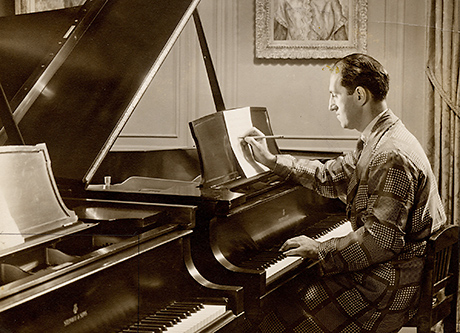
The Gershwin family donated the Steinway to the University as part of the George and Ira Gershwin initiative that is focused on research and study of the brothers’ music.
According to Marc Gershwin, George and Ira’s nephew, “I wanted the instrument to be accessible to the students and faculty who would be preserving the legacy of George and Ira Gershwin’s music… I’m delighted that the piano will once again be in regular use [by students and faculty], and am thrilled that it has been restored to performance condition.” [Two other Gershwin Steinways are in museums.]
From what I know of George he would have wanted it this way. Unlike some composers George was a gifted pianist. He had a rich social life and enjoyed playing his music for anyone who would listen.
There’s a lesson in that thought. If you have something valuable, sometimes it becomes more valuable – or at least more appreciated – when people can see it and use it. If you look at the piano as an instrument of technology that is it, then it makes sense that organizations give people access to technology – as well as resources – to do their work.
. 1714 ~ Carl Phillip Emanuel (C.P.E.) Bach, German composer
More information on C. P. E. Bach
. 1857 ~ Ruggero Leoncavallo, Italian composer
More information about Leoncavallo
. 1866 ~ “It is possible to be as much of a musician as Saint-Saëns; it is impossible to be more of one!” ~ Franz Liszt on meeting fellow composer Camille Saint-Saëns in Paris.
. 1911 ~ Alan Hovhaness, American composer
More information about Hovhaness
. 1923 ~ Cyd Charisse, Dancer
. 1927 ~ Dick Hyman, Pianist and music director for Arthur Godfrey
. 1961 ~ Conductor, Sir Thomas Beecham died at the age of 81.
. 1962 ~ The Beatles performed for the first time on the BBC in Great Britain. John,Paul, George and … Pete Best sang Dream Baby on the show, “Teenager’s Turn” on ‘Auntie Beeb’ (as the BBC was known).
. 2001 ~ Ballet Legend Dame Ninette De Valois died at the age of 102. She was the founder of Britain’s Royal Ballet who launched dancer Margot Fonteyn on the road to stardom. De Valois, a strict and demanding disciplinarian with her pupils, was a gifted and theatrical choreographer who almost single-handedly put British ballet on the international stage. The doyenne of dance helped to nurture the talents of unknowns like Fonteyn and courted controversy in the 1960’s at the height of the Cold War when she invited Russian dancer Rudolph Nureyev to appear with her company. De Valois always gave credit to Russian impresario Sergei Diaghilev for teaching her all she knew. “Everything,” she once said of the Ballet Russe legend. “Diaghilev just managed the whole company. He knew all about the different teachers. He knew the types of teachers he wanted, he knew the type of ballet he wanted. He was a musician.” Born Edris Stannus in 1898 in the Irish county of Wicklow, she graduated from Irish jig to the ballet, worked with the writer W.B. Yeats at Dublin’s Abbey Theater and then, almost single-handedly, brought ballet to the fore in Britain. The famed diva, who adopted her professional name from an ancestor who had married into a French family, was first inspired at the age of 11 when she watched Anna Pavlova dancing The Dying Swan. In 1923, she joined Diaghilev’s troupe in Monte Carlo and began to lay the foundations of her own ballet empire. She gave up dancing herself after discovering that she had been suffering for years from polio. “It was no tragedy. I wasn’t that great,” she once said. In 1926, she opened her own ballet school in London. From the tiniest beginnings, she built up the Sadlers Wells Ballet in less than a decade. At the end of World War II, the company moved triumphantly into the Royal Opera House. A ballet dynasty was born. De Valois retired in 1963 but remained intimately involved in the ballet school, forever the sharp-tongued martinet who could strike terror in tomorrow’s ballet hopefuls.
. 2001 ~ Maude Rutherford, a singer and dancer in the glory days of black theater during the 1920s, died. She was believed to have been 104. Rutherford was billed as the Slim Princess when she worked with entertainers such as Fats Waller, Josephine Baker and Pearl Bailey. She was a featured performer and favorite at Harlem’s Cotton Club. Rutherford’s theater credits include: “Dixie to Broadway,” (1924), “Chocolate Sandals,” (1927), and “Keep Shufflin”‘ (1928). She retired from show business in 1950 and worked as a switchboard operator at an Atlantic City hotel.
. 2003 ~ Adam Faith, a square-jawed British singer who was briefly a Cockney challenger to Elvis Presley’s rock ‘n’ roll crown, died of a heart attack. He was 62. Born Terry Nelhams in west London in 1940, Faith was a handsome teenager who was playing with a skiffle music group – a mixture of jug band, acoustic, folk, blues and country and western styles – when he was spotted by producers of a British Broadcasting Corp. music program. Adopting the stage name Adam Faith, he became – alongside Cliff Richard, Tommy Steele and Billy Fury – a pop star of the pre-Beatles era. Developing a hiccuping delivery reminiscent of Buddy Holly, Faith had more than 20 British hits, including the chart-topping What Do You Want? and Poor Me. Faith also was a versatile actor, appearing in films like Beat Girl,Mix Me A Person and 1975’sStardust opposite David Essex. In the 1970s he played a Cockney ex-con in the TV series Budgie.
In this new campaign by Folksam, one of the largest insurance companies in Sweden, 15 children, aged 2 to 5, were invited to participate in a challenging musical experiment lead by Sweden’s famous conductor, oboist and composer, Jan Risberg.
For a duration of five weeks, these lively and boisterous children would take piano classes in order to learn a 19th-century musical piece by French composer and pianist Erik Satie. The entire experience was intended to be playful and fun for the kids.
Risberg used creative techniques to teach the chords and the melody, like colored keys, sound boxes and simple word associations like “pancake”.
And the result is possibly the most endearing thing we’ve ever seen!
. 1824 ~ “I am convinced that the soul and spirit of Mozart have passed into the body of young Liszt” ~ Review of a concert given on this day by Franz List in Paris.
. 1875 ~ Maurice Ravel, French composer
More information on Ravel
. 1917 ~ In the United States, RCA released the first jazz record ever: The Dixie Jazz Band One Step by Nick LaRocca’s Original Dixieland Jazz Band.
. 1917 ~ Robert Erickson, American composer
. 1939 ~ Guy Lombardo and his Royal Canadians recorded one of the most popular songs of the century. The standard, “Auld Lang Syne”, was recorded for Decca Records.
. 1955 ~ “Peter Pan”, with Mary Martin as Peter and Cyril Richard as Captain Hook, was presented as a television special for the first time.
More about Mary Martin
. 1969 ~ The Apollo astronauts began this day of their space voyage by singing Happy Birthday.
. 1985 ~ The song We Are the World, from the album of the same name, was played on the radio for the first time. Forty-five of pop music’s top stars gathered together to combine their talents to record the music of LionelRichie and Michael Jackson. Richie and Jackson sang, too, while Quincy Jones did the producing of the USA for Africa record. The proceeds of the multimillion-selling recording went to aid African famine victims. The project, coordinated by Ken Kragen, was deemed a huge success.
. 2001 ~ Frankie Carle, a big-band leader best known for Sunrise Serenade, at the age of 97. Carle, who died in Mesa, Ariz., reached the high point of his popularity during World War II, when he was the focus of a bidding war among bands. His repertory was wide, ranging from classics like a revival of StephenFoster’sSwanee River, to a World War II release that anticipated the Allied victory called I’m Going to See My Baby. Although Carle’s music did not rank high on record industry charts after the 1940s, he still toured and played concerts into the 1980s, some 70 years after he began his musical career.
. 2015 ~ Steve Zegree died. He was a legendary jazz educator and former Western Michigan University Gold Company director.
. 1930 ~ Lorin Maazel, American conductor
More information on Maazel
. 1941 ~ Les Hite and his orchestra recorded The World is Waiting for the Sunrise on Bluebird Records. The instrumental became Hite’s most popular work. A decade later, Les Paul and Mary Ford added a vocal to the tune, making it one of their biggest-selling hit songs.
. 1944 ~ Dame Kiri Te Kanawa, New Zealand soprano
More information on Te Kanawa
. 1962 ~ Frank Sinatra recorded his final session for Capitol Records in Hollywood. Sinatra had been recording for his own record label, Reprise, for two years. His final side on Capitol was I Gotta Right to Sing the Blues, with SkipMartin’s orchestra.
. 1985 ~ Yul Brynner played his famous role as the king in “The King and I” in his 4,500th performance in the musical. The actor, age 64, opened the successful production on Broadway in 1951.
. 2001 ~ Michael Smith, the drummer for the 1960s rock band Paul Revere and the Raiders, died in Kona, Hawaii, of natural causes at the age of 58. Smith, who played the part of the madcap jokester on stage, joined the band in 1962. The Raiders were known for their tri-cornered hats, colonial costumes and wild stage act. The Raiders were signed by CBS’ Columbia Records in 1963, and in 1965 they were hired to host “Where the Action Is,” a daily afternoon television show on ABC produced by Dick Clark Productions. The Raiders’ hit singles included Just Like Me,Kicks,Good Thing and Indian Reservation.
The piano market is booming in India. Experts in the music instrument retail business say that the piano market is expected to see further growth over the next decade says NERITA D’CRUZ.
The lobby of a popular luxury hotel in South Mumbai resonates to the sound of melodious piano music, post 7.00 pm every evening. A Steinway boudoir grand piano stands in the middle of the lobby adding a classy look to the place. The pianist plays popular tunes which instantly lights up the ambience of the hotel, while guests at the hotel sit back in the lobby a few minutes longer to enjoy the music. Afterall, the piano is a classy music instrument known for its soothing and relaxing sound.
The hype associated with the piano is such that dealers in the piano retail business say that there has been a huge growth in the piano market in India over the last decade. “Over the last ten years there has been 300 to 400 percent growth in the piano market. The market share for pianos is high and there is expected to be a healthy growth for the next ten years,” says Anthony Gomes, Partner at B.X Furtados and Sons, which operates music instrument retail stores across India.
. 1887 ~ Heitor Villa-Lobos, Brazilian composer and collector of Brazilian folk songs
More information about Villa-Lobos
. 1917 ~ The first jazz recording for Victor Records was released. The Original Dixieland ‘Jass’ Band performed on the tune The Dixie Jass Band One Step. The word ‘Jass’ was later changed to ‘Jazz‘.
. 1931 ~ Barry Tuckwell, Austrian French-horn player
. 1931 ~ Without a Song was recorded by Lawrence Tibbett for Victor Records. This wonderful melody came from the film, “The Southerner” and has been a hit for many, including Willie Nelson, Frank Sinatra and Tony Bennett.
. 1947 ~ Eddie Hodges, Singer, actor
. 1948 ~ Eddy Grant, Singer, songwriter
. 1950 ~ Eugene Fodor, Violinist, made solo debut at age 10 with the Denver Symphony, won first national competition at age 12, won first prize in International Paganini Competition, won highest prize in International Tchaikovsky Competition
More information about Fodor
. 1960 ~ Elvis Presley returned to civilian life after a two-year hitch in the U.S. Army. Not since General Douglas MacArthur returned from battle has a soldier received such publicity. Elvis said he probably would not be growing his famous and long sideburns back, though he did relent in later years.
. 1963 ~ Patsy Cline, Cowboy (Lloyd) Copas and Hankshaw Hawkins were killed in a plane crash at Camden, TN, near Nashville. The famous country music stars were returning from a benefit performance. Cline, the ‘Queen of Country Music’ was elected to the Country Music Hall of Fame in 1973. Jessica Lange played Patsy in the 1985 biographical film, Sweet Dreams, named after one of Cline’s hugely popular songs. Willie Nelson wrote her biggest hit,Crazy, which become a number one country hit and a top 10 pop song in November, 1961.
. 1969 ~ The rock magazine, Creem, was published for the first time this day.
. 1973 ~ Roberta Flack, riding at #1 on the pop music charts with, Killing MeSoftly with His Song, could hardly wait to rip into the fancy frame containing her brand new gold record. She flew to the stereo machine and set the needle down on the shiny surface, only to hear Come Softly to Me. She was so impressed by this unexpected turn of the table that she wound up humming the old Fleetwoods song for three days.