
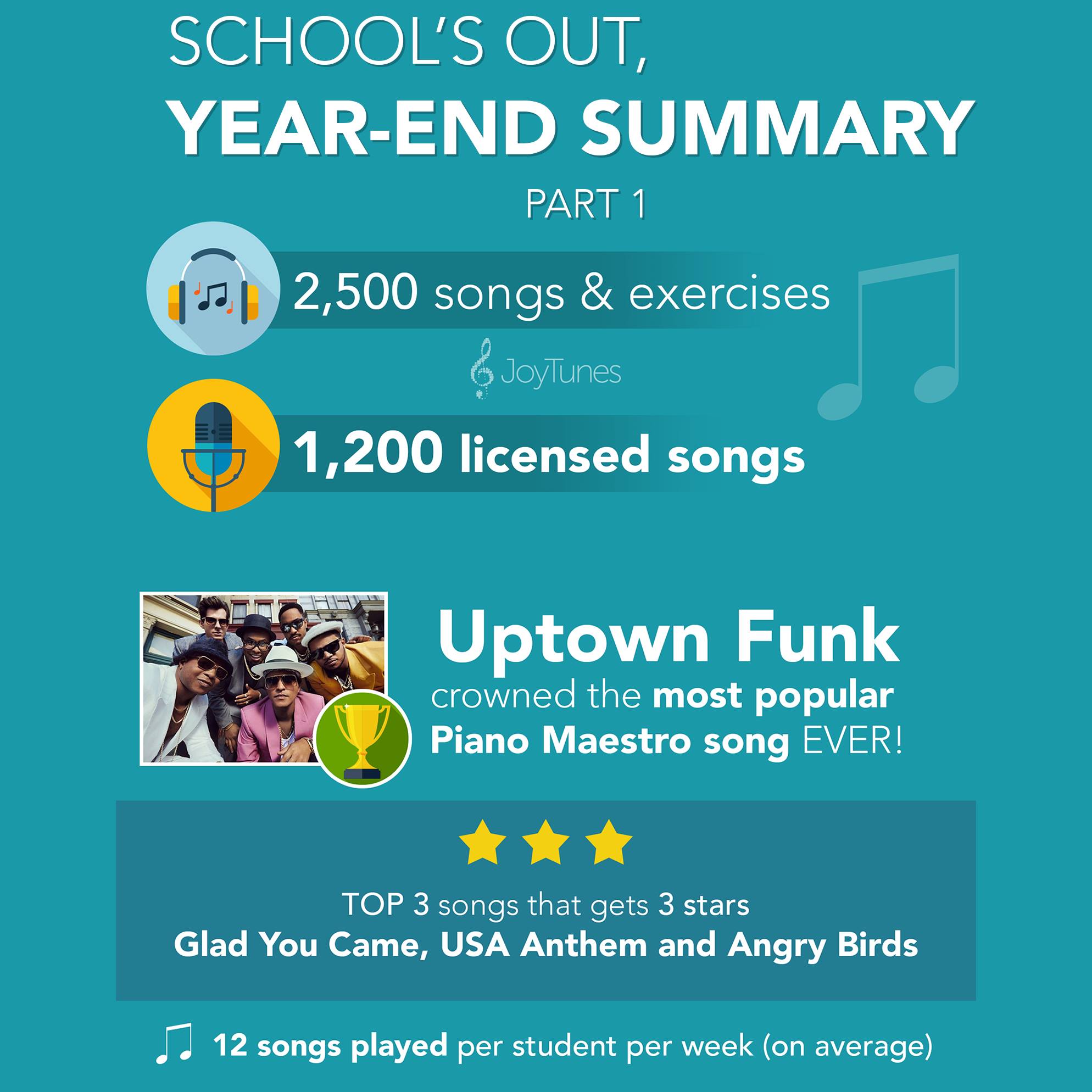
This time the lowdown on what your students are practicing at home in part two of our end-of-year infographic.
“5x more usage with home accounts” means students practice 5 time more at home when using Piano Maestro!
Keep it up, everyone!


This time the lowdown on what your students are practicing at home in part two of our end-of-year infographic.
“5x more usage with home accounts” means students practice 5 time more at home when using Piano Maestro!
Keep it up, everyone!
From JoyTunes:
To celebrate the end of the teaching year, we thought you’d enjoy some very cool Piano Maestro stats that show how students practice more at home, parents are more involved and lots of other revealing info in our end-of-year infographic we’ve prepared for you!
We’ll be rolling it out in stages so without further ado enjoy the first one! Stay tuned for the next part coming soon.
Are there any stats that surprised you? — 
Hi!
I hope summer is going well and everyone is remembering to wear sunscreen! I have some exciting news on the Piano front!
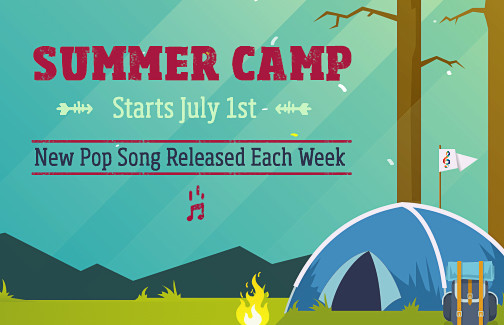
JoyTunes, the app team that created Piano Maestro and Simply Piano is once again starting SUMMER CAMP next week! One lucky winner will receive an Amazon gift card!
Here’s how it works!
Every week for the duration of Summer Camp the JoyTunes Team will release a summer camp song. They will announce the song on social media, email and through me! There will be several versions of the tune so everyone can play. Students who get 3 stars on the song will automatically be registered in the drawing to win.
The more they play the more entries they get! Super easy!
Remember to force quit after each practice session for your entry to count! What a great way to retain those piano skills we worked so hard for this year!
The WINNER will be announced by Facebook, Twitter, Instagram and if it’s you, EMAIL! Don’t worry! JoyTunes won’t post anything without your permission!
Start brushing up by playing last year’s Summer Camp tunes and get ready to PLAY!
Happy Summer!
MaryO and The JoyTunes Team


Student recitals can be lots of fun and create valuable experiences for pianists. Unfortunately, they can also be a source of anxiety or stress if students aren’t ready and/or guidelines aren’t followed.
There are guidelines and rules of behavior all performers and audience members should follow during recitals, concerts or other performances.
Audience members must remember the reason for their visit to the recital hall – to listen quietly, actively and appreciatively to the music being offered by the performers.
For the performer:
1. Dress appropriately. Performers being nicely dressed (or following the recital theme) shows respect for the audience, the teacher and themselves!
Girls in knee-length or longer skirts/dresses or slacks. No spaghetti straps, no platform shoes, flip-flops, bedroom slippers or athletic footwear.
Do not wear dangling, jingling jewelry – especially bracelets. You may need to remove rings if they twist around easily.
Boys in dress pants and buttoned dress shirts with ties preferred, or suits.
IMPORTANT: Remember to practice several times in your outfit, shoes included. You don’t want to get to the recital and find that you can’t use the pedal properly because of your shoes.
2. Clean hands! Dirty, sticky, or oily fingers can hurt your performance and bother the next pianist. If you complete a long piece and notice some keys are slippery with sweat (a very common issue), notify your instructor so they can clean the keyboard before the next performer.
2. When it is your turn, stand quickly and walk up to the stage. Do not run!
Bow before you perform to acknowledge the applause. Audiences used to know that it was appropriate to clap for the musician who was entering the stage to perform. This now isn’t always the case (I will start clapping if it doesn’t happen automatically). Students should bow to their applauding audience before they sit down at the bench (not acknowledging applause is generally considered to be rude).
2. Enter the bench from the side furthest from your audience. This was a biggie for my former piano teacher and I’m reminded of it every time I see a student slink in from the “front side”… or climb over the top. I used to think this was awfully stuffy – but when you see a student do it, it just looks right.
3. Hands in your lap before you begin. I use this with my students to give them a moment to hear the first few measures in their mind before they begin. Once fingers are on the keys it means you’re ready to play. If the bench needs adjusting it should be done first… and then hands should be placed in your lap before beginning to play.
Play the scale of the piece in your head and think over tempo, markings, etc. Then arch your hands onto the piano and position feet on the pedals or flat on the floor–NEVER under the stool. Proceed to play!
3. Should you make a mistake while performing, you should try to continue playing without starting over or repeating. This makes sufficient practice before the recital very Very VERY important!
If playing more than one piece, you should acknowledge applause in between with a nod or smile.
4. Hands in lap after you finish. So many piano students are already lifting themselves off the bench as they play the final note (perhaps really eager to return to their seat in the audience!?) Learning to place your hands in your lap after finishing gives the audience a moment to truly relish what they just heard.
5. Rise and stand at the edge of the piano (with left hand on the wood). Bow from the hips, don’t curtsey. Bowing nicely takes practice! In handbells, we bow towards the table and say silently “I love handbells”. The same can be said in piano recitals – “I LOVE Piano”.
6. Walk calmly off the stage or away from the piano. No running… no matter how badly you want to get back to your seat!
For the audience:
Recitals are a special occasion and so it is customary to dress nicely.
• Please arrive a little early in order to find a comfortable place to sit.
• Make sure all your invited guests understand the importance of arriving on time. If they arrive late, it makes it difficult for those performing.
• Please invite as many friends and family members as you’d like. Our recital hall has lots of room, and can accomodate likely as many as you’d like to invite. And if not, then a standing room only crowd would be a fantastic crowd to have, and a wonderful problem to deal with!
• Turn off all cell phones and any electrical devices that may produce sound.
• Once the recital begins, please listen and be quiet. Crying babies should be taken out. They are not happy, and neither is the audience or the performer!
• If you arrive late, please wait to enter between pieces when you hear applause. Do not enter the recital hall or switch seats while someone is performing.
• The soloist will bow and your response is to applaud politely!
• No whistling, yelling, or other loud methods of congratulation. While boisterous congratulations are meant to show support for the performer, it may actually cause unintended problems instead. The best way to show appreciation for the performance is with thunderous applause, and an occasional “bravo” at the end of an especially great performance.
• Compositions that have movements or suites are, in general, performed without applause in the middle.
• Respect the performers. Unnecessary noise from whispering, talking, candy wrappers, etc. during a program is not acceptable. Reading, studying, and writing letters during a program are also inappropriate.
• Please stay until the performance or event is completely over. Attending a recital so that other families will serve as audience to your student, and then leaving before the other performers have finished is rude, inconsiderate and unacceptable. If you have other obligations or matters to attend to before the recital is over, please do not attend.
• Flash photography is not appropriate during a performance. The flash can disrupt the performer’s concentration.
• Enjoy! Your presence is the greatest affirmation!
For Everyone:
No Perfume! Your perfume or cologne will linger around the piano after you leave the stage (especially under hot lights), and it might give the next pianist some sinus or eye irritation; or, at the very least, create a distraction that can prevent them from getting “in the zone.”
Parts of this article adapted from It’s The Little Things That Count… Piano Etiquette and Your Piano Students | Teach Piano Today

Mrs. O’Connor is one of the handbell ringers 🙂
7 reasons why bi-weekly lessons do not work…
Now and then, our studio gets asked if we offer bi-weekly lessons. I mean, doesn’t it make sense that if you take lessons every other week, you have half the number of trips into the studio, you have double the amount of time to practice, and you can save some money, right?
WRONG.
Aside from the fact that it is a scheduling nightmare for the teacher and studio, I want to outline a few reasons why (in most cases) bi-weekly lessons do not work.
Source: Bi-weekly Lessons – Why they won’t work – The Piano Studio

App Description:
Simply Piano is a fast and fun way to learn piano, no previous knowledge required. Works with any piano or keyboard. Chosen as one of the best iPhone apps for 2015.
– Tons of songs like Imagine, Timber, Counting Stars, Safe and Sound, also J.S.Bach
– Includes courses for different musical tastes and playing levels
– Learn the basics from reading sheet music to playing with both hands
– Daily workouts will help you practice what you learned while not at the piano
– Suitable for all ages, no previous knowledge required
No Piano? Try the Touch Course with 3D Touch!
How it works:
– Place your device (iPhone/iPad/iPod) on your acoustic/MIDI piano or keyboard and play; the app will immediately recognize what you are playing
– Receive instant feedback on your playing to quickly learn and improve your skills
– Discover fun songs and complete courses to really get you going
Simply Piano is developed by JoyTunes, creators of award-winning apps Piano Maestro and Piano Dust Buster. The apps are used by tens of thousands of piano teachers worldwide with over 1 million songs learned every week. JoyTunes are experts in creating educational and fun apps for learning piano quickly and easily.
Awards & Recognition –
– “EMI’s Innovation Challenge”
– “World Summit Award”, by the United Nations
– “Best Tools for Beginners”, NAMM
– “Best Tablet Game”, GameIS
– “Parents’ Choice Award”
– “Golden App”, Apps for Homeschooling
Love is in the air!
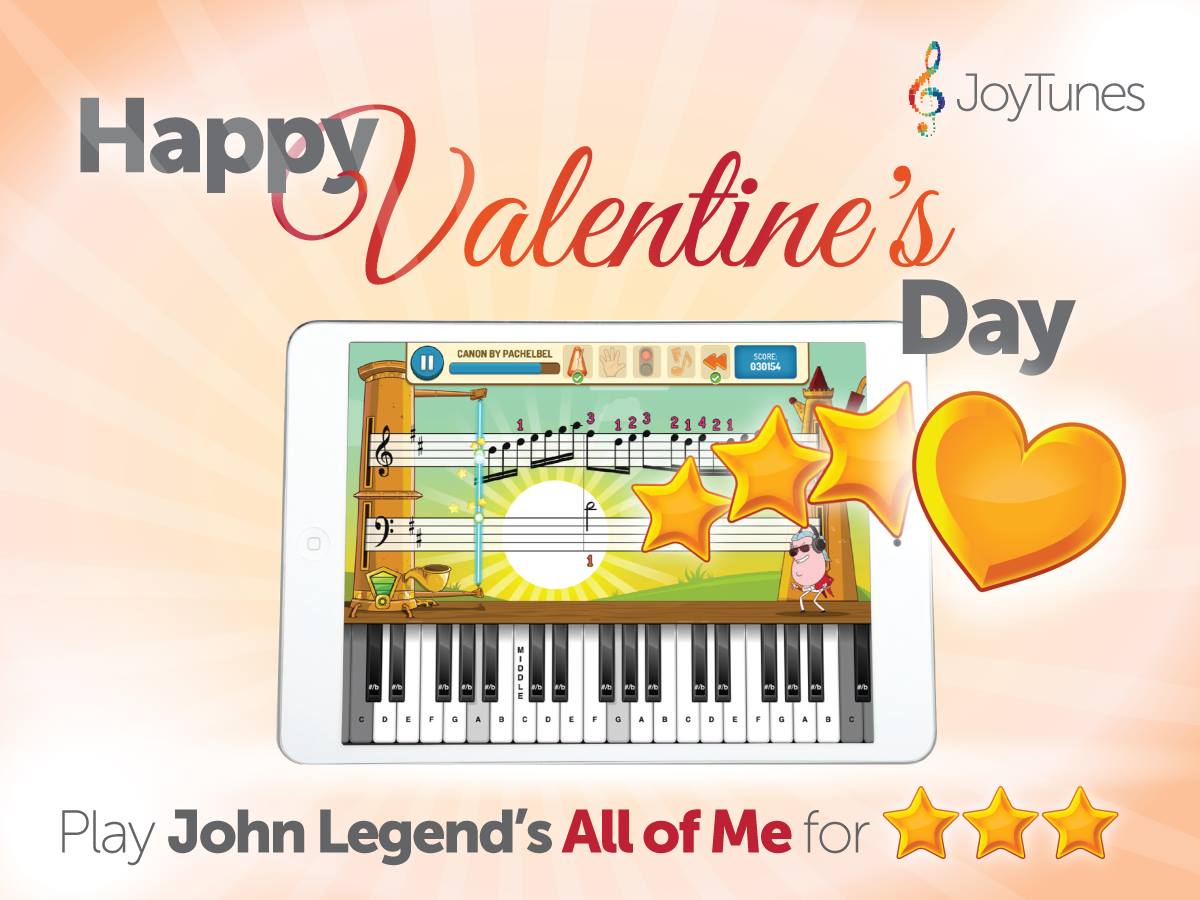
To celebrate Valentine’s Day this year, students who play any version of John Legend’s “All of Me” using Piano Maestro and get 3 stars will have a chance to win an Amazon gift card!
The winner will be announced on February 15th!
NOTE: This is a contest through JoyTunes/Piano Maestro so the winner may not be from the O’Connor Music Studio.


Fairfax County has closed school Monday and Tuesday, January 25-26, 2016 so…no lessons for these days.
Those using Piano Maestro may find a new assignments 🙂

Fairfax County has closed school today so…no lessons today due to the snowy weather.
Keep practicing!
Those using Piano Maestro may find a new assignment for today 🙂
 MaryO'Studio