Picture a seven-foot grand piano in a studio. The lid’s missing, so you can see all the strings. Researchers suspend a rod embedded with 32 microphones over the piano’s body.
“We played this middle C at a very soft level, a medium level, and a very loud level,” says Agnieszka Roginska, a professor in NYU’s music technology program. She says using a pianist to play middle C over and over wouldn’t be scientific. So they’re using a disklavier, a fancy player piano triggered by electronics. “So we could hit the same note, with the same velocity, thousands of times,” she says.
They’d record the piano in one spot. Then move the microphones eight inches. Record the note. Move the mics again. Record the note. Over and over and over, until they reach the back of the piano. At the end, they get “what is basically a very dense acoustical scan of the radiation pattern of the grand piano,” Roginska says.
Play Corvallis, Play pianos are about to hit the streets, but first a giant gift to the community must be unwrapped at 6 p.m. Friday by the riverfront downtown.
“On Friday, we want to celebrate Corvallis and the citizens for being involved in music,” said Lee Eckroth, who came up with the street piano program last year. “Our reveal that day is a gift to the community and it’s pretty special.”
After the gift is opened, theme-painted pianos will start being available for free playing in various locations around town.
Eckroth was inspired to start the event after a family vacation in Boston a few years ago. He said the city had a street pianos program and his daughter, Morgan, thought it would be cool to bring that idea to Corvallis.
A mutual friend introduced Eckroth to Dave Lundahl, organizer of the Corvallis Imagination Music and Arts Festival, and the two decided to collaborate. The idea was to use both events to generate money for art and music programs in area K-12 public schools.
Eckroth said, “I put out a message to the community in February of 2014 that there was a guy looking to collect pianos. All of sudden I had 10 pianos in my garage.”
From June until the beginning of last August, Eckroth invited local residents and volunteers to use his driveway as a studio to paint whatever theme they wanted on the pianos. Themes included an all-orange piano called the Beaver Believer, or fruits and veggies, and more. One, called Happy Hands, featured a painted handprint of every volunteer. The pianos appeared outside locations such as the public library, the Oregon State University Valley Library and the downtown American Dream Pizza on Second Street.
“Last year we were amazed with what happened with the pianos,” Lundahl says. People were planning parties around the pianos, and impromptu concerts emerged from players of all different ages.
“We were giving people the opportunity to come out of their shells and express themselves,” Eckroth says.
The pianos, each with its own sponsor, will be re-released one by one between 7 a.m. and 10 p.m. every day in various locations until August 16. And like last year, when the pianos go away for the winter, they will be sent to different families to enjoy in their homes until next summer.
Many homeowners don’t realize that there are movers available to them who specialize in the transportation and storage of pianos. A piano is a delicate instrument and not something you want to take risks with. By trusting this major job to a piano mover, you can rest easy knowing that one of the most valuable items in your home is being transported with the care it deserves.
But It Weighs 1500 Pounds. How Delicate Can It Be?
This is exactly where many homeowners go wrong. Sure, that piano in your living room is heavy enough to throw out the backs of four or five of your best buddies as you wrestle it out the door and up into the truck, but don’t let that fool you. Despite its bulky appearance, it is also a precision musical instrument with over 1000 moving parts and 200 finely-tuned strings, any number of which can be damaged and require repair if your piano isn’t handled properly in a move.
Your Piano Mover Understands Pianos
These intricate inner workings of a piano are exactly why hiring an expert in piano moving is so important. These professionals understand pianos and moving them, from the safest way to lift and twist a standard upright piano to get it out the door, to how to properly disassemble a grand piano and transport it without causing any damage. And even more importantly, a piano mover understands that when your piano is delivered to your new home, you expect to be able to sit down and play it right away. It’s why many piano movers keep tuners and repairmen on staff, and why the rest will have a trusted list of professionals available on request if you need it.
The Piano Puzzlers book is available in the O’Connor Music Studio library if you’d like to give any a try. Piano Puzzlers as heard on American Public Media’s “Performance Today.” Includes 32 tunes with songs by Gershwin, Berlin, Arlen, Porter, Rodgers, Fats Waller, Lennon & McCartney, and others disguised in the styles of Bach, Handel, Haydn, Mozart, Beethoven, Brahms, Schubert, Schumann, Chopin, Janacek, Debussy, Ravel, Rachmaninoff, Stravinsky, Prokofiev, Bartok, and Copland.
Includes an introduction by Fred Child, host of “Performance Today” as well as background info by Bruce Adolphe. “Bruce Adolphe has taken a common musician’s party game and elevated it to high art and truly funny musical slapsticks. The Piano Puzzlers are a unique combination of extraordinary insight into the styles of many composers subtle, expert workmanship and great, great fun!”
If you’re a music geek (like me), I have a program for you. Now, let me be clear, to fully qualify as a music geek…you must have a fond appreciation for classical music (no, Poison, Quiet Riot, and Zepplin do not count as classical music). So, if you’re a “music geek” without an appreciation for classical music…well, I hate to burst your bubble…but, you’re not truly a music geek. Instead, you’re a music appreciator, but not a geek. So, if you just listen to indie music and scowl at anything on a label larger than Matador…don’t bother following the link I’ll provide…the fun will be lost on you…And, you probably won’t have a chance.
Every Wednesday night, on my way home from WNL, I turn on my local NPR station to listen to Piano Puzzlers on Performance Today. It’s absolutely incredible. A pianist/composer (Bruce Adolphe) takes a familiar folk or pop tune and sets it inside a classical masterpiece (or in the style of a particular composer). Sometimes it’s easy…sometimes it’s ridiculously difficult. There are days when I say, “got it” on the first pass. Then there are days when I say, “what the heck?” And, more often than not, I’m able to get either the popular/folk tune or the composer.
This is sad to admit, but there are nights when I’ll slow down on the drive home or sit in the car in the driveway to finish an episode. In fact, I get a little worked up if someone stops me after WNL…as I might miss the beginning of Piano Puzzlers (it usually hits around 8:20pm on our local station).
Take a listen to some of the archives and see if you can figure it out! It’s really cool…but probably only appreciated by music geeks (the kind of people that listen to NPR for their musical programs and not just the snipets of cool indie rock between segments on All Things Considered…which is a great show too).
American pianist Edmund Battersby, who gave the opening concert of the Dublin International Piano Festival at the Hugh Lane Gallery on Saturday, may well have felt at times that he was in some sort of movie scene rather than in a regular concert.
While he was playing, the piano began to move away from him. It wasn’t a full concert grand, and didn’t have lockable castors. The gallery has a shiny floor, and the instrument didn’t always manage to stay in its place. Battersby coped masterfully, making the necessary adjustments as if he were merely fixing his jacket or making himself more comfortable on the piano stool.
His savoir faire was all the more remarkable given that he was playing one of the most daunting works in the repertoire, Beethoven’s Diabelli Variations.
The story of these variations is well known. The composer and publisher Anton Diabelli decided to create a “patriotic anthology” by sending all the important Austrian composers of the day a simple waltz theme of his own for each to write a variation on.
Beethoven rejected Diabelli’s original idea, and described the theme as a “cobbler’s patch”. But he changed his mind and wrote a set of 33 variations, which Diabelli proudly published as a companion piece to the 50 variations he had received from other hands.
• 1750 ~ Johann Sebastian Bach, German composer and organist, died. Composer of “St Matthew Passion” and “Brandenburg Concertos”, his output covered every musical genre with innovations in format, quality and technical demands.
More information about Bach
• 1796 ~ Ignace Bösendorfer, Italian Pianomaker
More information about Bösendorfer
• 1901 ~ Rudy (Hubert Prior) Valee, Bandleader and singer. Valee was one of the first, before Bing Crosby, to popularise the singing style known as “crooning”.
• 1914 ~ Carmen Dragon, Classical music conductor, bandleader and father of singer, ‘Captain’ Daryl Dragon
• 1933 ~ The singing telegram was introduced on this day. The first person to receive a singing telegram was singer Rudy Vallee, in honor of his 32nd birthday.
• 1934 ~ Jacques d’Amboise, Ballet dancer with the New York City Ballet
• 1937 ~ Peter Duchin, American bandleader, pianist, son of musician, Eddy Duchin
• 1939 ~ Judy Garland sang one of the most famous songs of the century with the Victor Young Orchestra. The tune became her signature song and will forever be associated with the singer-actress. Garland recorded Over the Rainbow for Decca Records. It was the musical highlight of the film, The Wizard of Oz.
• 1941 ~ Riccardo Muti, Italian conductor
• 1945 ~ Rick Wright, Keyboards with Pink Floyd
• 1949 ~ Peter Doyle, Singer with The New Seekers
• 1949 ~ Simon Kirke, Drummer with Free
• 1958 ~ Three years after his Cherry Pink and Apple Blossom White reached number one, Cuban-born bandleader Perez Prado captured the top spot again, with Patricia. Prado was known as the Mambo King for his popular, Latin-flavored instrumentals.
• 2001 ~ Bass guitarist Leon Wilkeson, one of the founding members of legendary rock band Lynyrd Skynyrd, died at the age of 49. The band, best known for songsWhat’s your Name?, Sweet Home Alabama and Freebird, debuted in 1973 and was named after the members’ high school gym teacher, Leonard Skinner. Wilkeson was involved in a 1977 plane crash in Mississippi that killed band members Ronnie Van Zant, Steve Gaines and Cassie Gaines. The group disbanded after the crash, but re-formed with others in 1987 for a reunion tour. The band toured for most of the 1990s and had a concert scheduled for Aug. 23 in Jacksonville.
• 2002~ Thomas Calvin “Tommy” Floyd, whose twangy voice sold Luck’s beans in the 1950s, died. He was 89 and suffered from Alzheimer’s disease. Floyd was one of Asheboro’s best known voices, between his music career and his jobs announcing at radio stations. Floyd organized the Blue Grass Buddy’s in 1942. The group played for radio shows and performed around the Southeast, appearing in concert with bluegrass legends Lester Flatt and Earl Scruggs. In 1950, Luck’s sponsored the band, provided that Floyd plug the product at shows. His jingle went: “Luck’s pinto beans, Luck’s pinto beans. Eat ’em and you’ll never go wrong. Luck’s pinto beans.” Luck’s sponsored him as a host for 15-minute country music spots on television stations in the Southeast. Luck’s discontinued the sponsorship in 1953.
• 2002 ~ Eddy Marouani, who managed the careers of some of the most famous figures in French music, including Edith Piaf and Jacques Brel, died. He was 81. He also steered the careers of singers Michel Sardou, Serge Lama and comedian Michel Boujenah. Marouani headed the agency “Office Parisien du Spectacle” and presided over one the biggest families of French impresarios. Marouani published his memoirs in 1989, entitled “Fishing for Stars, Impresario Profession.”
Classical piano pieces by such composers as Beethoven, Mozart and Chopin likely sounded much different when the masters first performed those works than they do today. Pianos themselves have changed considerably — but so, too, has technique.
Over the past decade, a growing number of musicologists have begun to take a closer look at how technique shapes not just the sound of music, but also the audience’s emotional response to it.
“Music has one foot in physics and one foot in aesthetics,” said Rolf Inge Godoy, a professor of musicology at the University of Oslo. “Body motion is essential for shaping the outcome of the sound, both in terms of what you actually hear and in terms of the visual impact on an audience.”
Dr. Godoy uses optical motion capture — also employed by the animation industry — to study the physics of musical movement. Infrared cameras capture light from reflective markers placed on a cellist’s hands or a percussionist’s body, recording the performer’s motion at up to 500 frames per second and at an accuracy to one-third of a millimeter.
Computer algorithms then make associations between the motion data, what is heard and what listeners say they felt.
Recently Dr. Godoy turned the technology on a fascinating question: How were such classical pieces as Mozart’s Variation K. 500 and Hummel’s Etudes, Opus 125, originally played, and how might that have made a difference in sound and in audience reaction?
To find out, Dr. Godoy struck up a collaboration with Christina Kobb, a doctoral candidate at the Norwegian Academy of Music and head of theory at Barratt Due Institute of Music in Oslo. Ms. Kobb has developed an unusual expertise: She has learned how to play the piano according to techniques described nearly 200 years ago.
As a visiting student at Cornell University in 2010, she researched 19th-century pedagogical piano treatises — essentially, instruction manuals for piano playing. The techniques that they described, she realized, differed drastically from those she had been taught.
“I was not following even the most basic instructions given to beginners at the time,” Ms. Kobb said. “I wondered, ‘Would this make a difference in my playing?’ ”
For the next three years, she gradually replaced her modern way of playing with 19th-century technique, gleaned from around 20 treatises. Most were written in Vienna in the 1820s, while a few were published in France and England. Her primary source, however, was “A Complete Theoretical and Practical Course of Instructions on the Art of Playing the Piano Forte,” the seminal 465-page treatise published in 1827 by Johann Nepomuk Hummel, one of Mozart’s students.
“It’s hard enough learning how to play once,” she said. “I had to become conscious of every motion in my hands and fingers, things that normally I would do automatically, by habit.”
While modern players tend to hunch over the keys and hold their forearms nearly perpendicular to the keyboard, 19th-century style dictated that pianists sit bolt upright. The posture prevented players from bringing their weight to bear on the keyboard, instead forcing them to rely on smaller finger movements. The elbows were held firmly against the body, with forearms sloping down and hands askew.
As Ms. Kobb became more fluent in this approach, she found that certain movements — jumping quickly between disparate chords, for example — became swifter and more fluid. “The elbow against your body serves as a sort of GPS, so you always know where you are,” she said.
Chords and scales sound smoother and can be played faster, Ms. Kobb also found, and dramatic pauses between notes — often a matter of physical necessity rather than of style — are lessened. The old style also allows the performer to be more discriminatory and subtle in choosing which notes to stress, Ms. Kobb learned, producing a performance that is subdued by today’s standards.
“There’s a different physical feeling to playing, as well as a different outcome,” she said.
To identify the sources of those differences, Dr. Godoy and his colleagues recently attached 46 pieces of reflective material to Ms. Kobb’s fingers and arms, and then filmed her playing on an electric piano. After analyzing her movements, the researchers will be able to tell precisely which differences in technique account for each variation in the music as it is played in the old and modern styles.
“The correlation between bodily effort and sound output is really what we’re aiming to find out, but in order to do that we need to perform extensive statistical analysis, which is tremendously time-consuming,” Dr. Godoy said. He expects the results of the data analysis in three to four months.
“We are exploring those connections to get a better understanding of what music is,” Dr. Godoy added. “What is its power, and why do people respond so strongly to it?”
For her part, Ms. Kobb now plans to delve deeper into the repertoire of Romantic composers. “It’s time to restore the early techniques to try to bring us even closer to the way music sounded at the time of Beethoven,” she said.
It’s startling to think of the multitude of objects Leonardo da Vinci conceptualized, and it’s a tad heartbreaking to realize he saw so few of them actualized.
But nearly 500 years after da Vinci sketched his plans for a musical instrument he dubbed the Viola Organista, Polish concert pianist Slawomir Zubrzycki spent more than 5,000 hours making da Vinci’s idea a reality.
In 2013, Zubryzcki debuted the instrument at the Academy of Music in the southern Polish city of Krakow. As reported in the Sydney Morning Herald, Zubryzcki said, “This instrument has the characteristics of three we know: the harpsichord, the organ and the viola da gamba.”
Watch the performance in the YouTube video below; you’ll recognize the pieces. And if you listen to the audio without watching Zubryzcki at the keyboard, you may think you’re hearing a small chamber ensemble rather than one person playing a single instrument.
Did you know that a piano can have up to 12,000 moving parts? It’s true. Not only that, but many of those parts are moving parts. And if you want your piano to stay in good working order, it needs a little bit of maintenance to stay its best.
During the first year of a piano’s life it’s suggested to have it serviced two to four times. Then talk to your piano technician to decide what frequency to continue service at. Usually twice a year after the first year is recommended, but sometimes once a year is enough. Servicing includes having the piano tuned, regulated as needed, voiced as needed, and eventually having worn parts repaired or replaced as needed.
A piano has over 200 strings and when the technician starts tuning a piano, it’s the strings he’s going to work on. The technician wants all the strings to have the correct pitch.
How does a piano go out of tune in the first place? The most common cause is humidity changes. It’s recommended that you don’t get your piano tuned right after the humidity has changed or the tune will only hold a couple months.
When a piano is regulated, that means that mechanical parts of the piano are being worked on. There are no hard and fast rules to how often a piano needs to be regulated as it depends largely on the climate its being kept in.
When it comes to voicing the piano, we’re talking about adjusting the pianos quality of sound or tone. The frequency that voicing needs to be done depends largely on how much you use your piano – 1 to 5 years tends to be the typical range.
You’ll also want to make sure you take good care of the exterior of the piano too. Neglecting the exterior of your piano can, believe it or not, affect the sound quality of your piano. Keeping it clean is a pretty simple job, but one thing to remember is that you don’t want to use furniture polish.
Your piano will also need to be reconditioned occasionally. Some parts will get worn out from use and will need to be replaced.
If your piano has deteriorated severely then reconditioning it won’t be enough. You’ll have to get the piano completely rebuilt which involves completely disassembling the piano. As you might imagine it’s very labor intensive and quite expensive, but in some cases it’s the only way to restore the original performance level of your piano.
Keep in mind that a piano is an investment, and that a well maintained piano can actually increase in value over its life.
About the Author:
Gray Rollins is a featured writer for PianosCentral – a site that helps people learn how to play the piano. Learn more about Rocket Piano review and the Pure Pitch Method at his site.
Piano teacher Leila Viss isn’t only about Bach, Beethoveen and Chopin. For her, it’s also about easing her students into using the iPad application “Piano Maestro.”
Viss, a piano performance and pedagogy graduate of University of Denver, first set up a studio in her home after she graduated in 1990. Ever since, she’s blossomed into a teacher who incorporates a different kind of approach in her lessons.
It all began with her mentor, Elaine Emeigh, who’s a piano teacher in Littleton.
“I wanted to continue her legacy, so I started having labs during my private lessons,” Viss said.
The Centennial resident’s students are now urged to stay for an extra 30 minutes after each lesson to spend time doing something on the computer — whether it be reviewing concepts, studying piano history or reinforcing lessons, she said.
“When I graduated, the Internet was just coming around. Now I have my own website, blog, and my whole idea of how I communicate has completely changed. It was a hassle over the years using technology; you were booting up the computer, putting in a CD-ROM, and then when the iPad came along, it made everything so much easier,” Viss said.
Her book, “The iPad Piano Studios, Keys to Unlocking the Power of Apps,” came out in 2013 and reflects her appetite for using apps to practice note names, inspire creativity and compose with her students. Viss considers herself to be a writer and also contributes to the Clavier Companion, a nationally known premiere piano magazine.
The owners of private applications company, JoyTunes, contacted Viss after reading her blog a year ago.
With more than 4 million users, the company’s apps are a hit, Viss said.
“Joytunes is changing the face of music education by transforming the way people learn music, enabling anyone to play a musical instrument,” JoyTunes head of brand Nadia Hitman said. “By combining music methodologies with the latest in gaming features and instant feedback, the learning process is significantly shortened for millions of children, adults and teachers already using the apps.”
Hitman said all of their applications recently became free for teachers and their students, and many of the apps are still available for purchase to anyone.
“Speaking on their (JoyTunes’) behalf, and mobile technology — Piano Maestro is unbelievably amazing,” Viss said. “You set it up on the piano (doesn’t have to be digital) and choose from like 2,000 songs in the library. You press play and the student follows along with the piano. After that, you get evaluated and receive immediate feedback. You can get up to three gold stars.


 1741 ~ Antonio Vivaldi died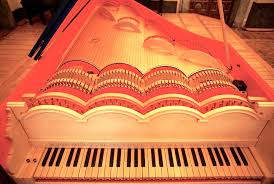


 MaryO'Studio