Have You Heard the Piano Puzzlers?

puzzlers


The Piano Puzzlers book is available in the O’Connor Music Studio library if you’d like to give any a try.  Piano Puzzlers as heard on American Public Media’s “Performance Today.” Includes 32 tunes with songs by Gershwin, Berlin, Arlen, Porter, Rodgers, Fats Waller, Lennon & McCartney, and others disguised in the styles of Bach, Handel, Haydn, Mozart, Beethoven, Brahms, Schubert, Schumann, Chopin, Janacek, Debussy, Ravel, Rachmaninoff, Stravinsky, Prokofiev, Bartok, and Copland.

Includes an introduction by Fred Child, host of “Performance Today” as well as background info by Bruce Adolphe. “Bruce Adolphe has taken a common musician’s party game and elevated it to high art and truly funny musical slapsticks. The Piano Puzzlers are a unique combination of extraordinary insight into the styles of many composers subtle, expert workmanship and great, great fun!”

From http://jasonmorris.blogsome.com/2008/08/08/piano-puzzlers/

If you’re a music geek (like me), I have a program for you. Now, let me be clear, to fully qualify as a music geek…you must have a fond appreciation for classical music (no, Poison, Quiet Riot, and Zepplin do not count as classical music). So, if you’re a “music geek” without an appreciation for classical music…well, I hate to burst your bubble…but, you’re not truly a music geek. Instead, you’re a music appreciator, but not a geek. So, if you just listen to indie music and scowl at anything on a label larger than Matador…don’t bother following the link I’ll provide…the fun will be lost on you…And, you probably won’t have a chance.

Every Wednesday night, on my way home from WNL, I turn on my local NPR station to listen to Piano Puzzlers on Performance Today. It’s absolutely incredible. A pianist/composer (Bruce Adolphe) takes a familiar folk or pop tune and sets it inside a classical masterpiece (or in the style of a particular composer). Sometimes it’s easy…sometimes it’s ridiculously difficult. There are days when I say, “got it” on the first pass. Then there are days when I say, “what the heck?” And, more often than not, I’m able to get either the popular/folk tune or the composer.

This is sad to admit, but there are nights when I’ll slow down on the drive home or sit in the car in the driveway to finish an episode. In fact, I get a little worked up if someone stops me after WNL…as I might miss the beginning of Piano Puzzlers (it usually hits around 8:20pm on our local station).

Take a listen to some of the archives and see if you can figure it out! It’s really cool…but probably only appreciated by music geeks (the kind of people that listen to NPR for their musical programs and not just the snipets of cool indie rock between segments on All Things Considered…which is a great show too).

Play Piano Puzzlers HERE!

Eight-Hour Lullaby

Anyone who’s ever dozed in the middle of a concerto will appreciate the sweet sound of this news: A composer has created a piece for doing just that.

British artist Max Richter has written an eight-hour “lullaby” called “SLEEP.” The piece is not only meant to facilitate slumber, but the premiere audience is set to listen from the comfort of actual beds. The performance will take place in Berlin this September, and will last from midnight until 8 a.m.

For those who can’t make it to Germany, an eight-hour digital version was released on September 4, 2015. It will be the longest piece of classical music ever recorded and the piece itself is the longest single piece of classical music ever written. An hour-long adaptation will also be released, should someone wish to have a conscious experience engaging with the music.

“SLEEP” is scored for piano, strings, vocals and electronics. While writing it, Richter consulted with American neuroscientist David Eagleman to learn about how the brain functions during sleep.

In a teaser for the piece on YouTube, Richter says, “It’s a piece of nighttime music and I’m hoping people will actually sleep through it.” He goes on to describe it as “an eight hour place to rest.”

via Sleep Through this Piece of Classical Music—It’s What the Composer Wants | Mental Floss.

Folks, Please Do NOT Try this!


A high-flying pianist took music to new heights when he played while suspended in the air over Sao Paulo.

Ricardo de Castro Monteiro and his spectacular Flying Piano was a highlight of the Brazilian city’s annual Virada Cultural festival on Sunday.

Both piano and pianist were suspended on wires tens of metres above the enthralled crowds below in an performance that was part concert, part circus act.

via Brazilian pianist Ricardo de Castro Monteiro performs at Sao Paolo festival in the air | Daily Mail Online.

Summer Camp News!

PM-SummerCamp


Hi!
I hope summer is going well and everyone is remembering to wear sunscreen! I have some exciting news on the Piano front!

JoyTunes, the app team that created Piano Maestro and Simply Piano is once again starting SUMMER CAMP next week! One lucky winner will receive an Amazon gift card!

Here’s how it works!

Every week for the duration of Summer Camp the JoyTunes Team will release a summer camp song. They will announce the song on social media, email and through me! There will be several versions of the tune so everyone can play. Students who get 3 stars on the song will automatically be registered in the drawing to win.

The more they play the more entries they get! Super easy!

Remember to force quit after each practice session for your entry to count! What a great way to retain those piano skills we worked so hard for this year!

The WINNER will be announced by Facebook, Twitter, Instagram and if it’s you, EMAIL! Don’t worry! JoyTunes won’t post anything without your permission!

Start brushing up by playing last year’s Summer Camp tunes and get ready to PLAY!

Happy Summer!
MaryO and The JoyTunes Team

maryOivoryandroses

Changing Piano Design

Bosendorfer-290-Imperial


Ferruccio Busoni: 97 Keys

Any piano student can tell you that their instrument has a total of 88 keys, but that isn’t always the case. While working on transcriptions of Bach organ works for the piano, composer and pianist Ferruccio Busoni found that the standard keyboard was unsatisfactory.

In order to mimic the sound of the largest organ pipes, Busoni worked with Ludwig Bösendorfer of the eponymous piano factory to create an instrument with an extended the piano’s lower register. The result was the Model 290 Imperial, a 97-keyed piano that encompasses eight full octaves.

The first prototype was built in 1909.  Its extraordinary sound inspired major composers, including Bartók, Debussy and Ravel. Several music pieces composed require an Imperial to ensure that they are played true to the original.

Garrick Ohlsson once called it the “Rolls Royce of pianos.”

.

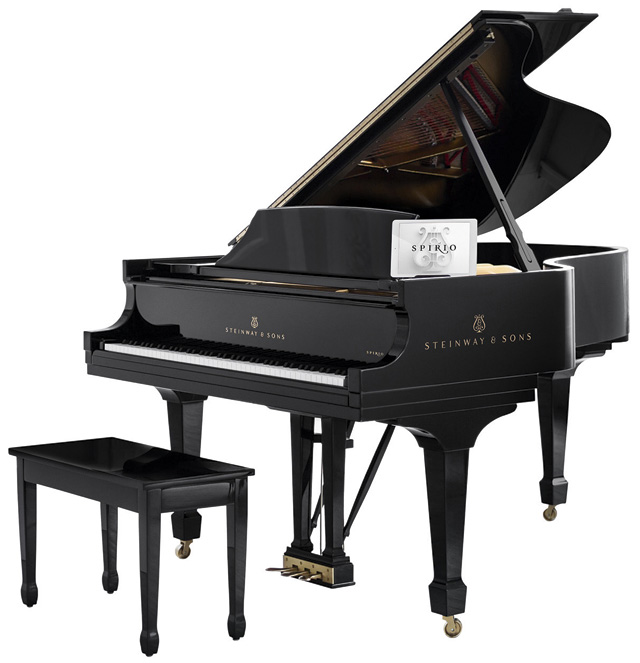
Steinway Spirio

Spirio


We just saw – and played with – this piano Saturday at Steinway Hall in New York.  Very cool, but most expensive!

Apparently, they make new recordings, if that’s the right word, each week and push them to the iPad app.

This can also be played as a stand-alone Steinway.

Renowned piano manufacturer Steinway has launched a self-playing piano. Programmed via its own iPad and linked up to play more than 1,700 different pieces of music, the Spirio high-resolution system will be offered exclusively on select Steinway grands. Able to replicate the virtuosity of the most talented of pianists, this player piano is bound to impress unsuspecting dinner guests. Spirio Model O, £77,150 (020 7487 3391, http://www.steinway.co.uk)

via Luxury news round up – May 2015 – Country Life.

Pianos in Harmony with Palace Halls

pianos-Istanbul

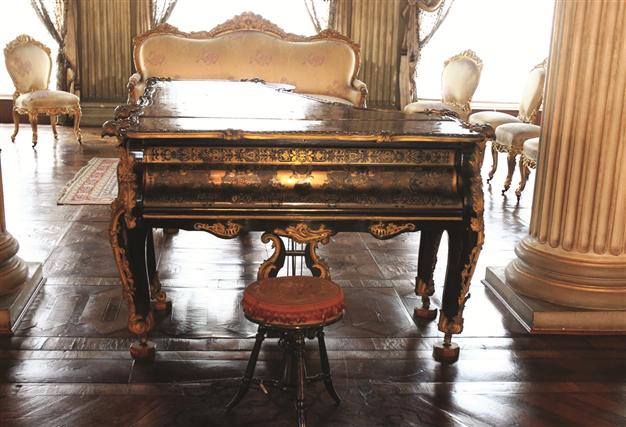
The pianos in Istanbul’s Dolmabahçe Palace, which hosted some 1 million people last year, draw great interest from local and foreign visitors for their magnificence and harmony with their surroundings.

National Palace guide Osman Nihat Bişgin said Dolmabahçe Palace was a Tanzimat (reform-era) palace, adding, “All features of the reform era are clearly seen in Dolmabahçe Palace. This process, which we call the Europeanization and westernization process, made western music enter Dolmabahçe Palace.”

He said the palace had a total of 12 pianos, and all of them had ornamentations suitable to the style and harmony of the palace.

Bişgin said the palace opened in 1856 and the pianos were brought there nearly at the same time. “The wives of sultans were taking piano education in the palace, particularly in the final years of the Ottomans. There are many pianos and none of them were inactive; all of them were being played,” he said.

He said most of the piano brands in the palace were Hertz, Pleyel, Gaveau and Erard, and that the number of grand pianos was less.

Speaking of a striking green piano in Zülvecheyn Hall on the upper floor of the palace, Bişgin said it was a classical Pleyel-brand palace piano.

“Since the magnificence and glory was dominant in the palace, the pianos draw our attention visually. Their sound is not very famous, but they are very important and famous visually,” he said.

Bişgin said Zülvecheyn Hall had gilded ornamentation on its white and beige ceiling, adding, “We see enormous harmony between the piano and the ceiling.”

He said the furniture in Dolmabahçe Palace was in its original place, and added, “We can say that the pianos belong to these halls. The pianos in the Zülvecheyn and Süfera halls were designed to add visual richness to halls like them. They are not generally played.”

Crystal piano and chair in the Glass Kiosk

As for the rare crystal piano in the Glass Kiosk, Bişgin said the following: “The Glass Kiosk is a big venue hidden behind the walls of the palace. Mustafa Kemal Atatürk greeted the public in this place. It is like a winter garden surrounded with glass. In harmony with this kiosk, there is a crystal piano. It is a Paris-made Gaveau piano. Its chair is crystal, too.”

Another piano in the palace is a plain black German-made Steinway. Bişgin said its sound was very strong and it was very valuable.

“It was produced as a Hamburg Steinway in 1912. Then the factory moved to the U.S. Accordingly, there were only five Steinway pianos made in Germany. This is one of them. Its estimated price is 200,000 euros. It also has the emblem of the sultan Abdulmecid,” Bişgin added.

Speaking of the piano, which was used during the acceptance of ambassadors in the Süfera Hall, Bişgin said, “Süfera is the plural of the word sefir [ambassador]. This hall was created to address foreigners. The furniture is gold-plated; the ceiling is the same. There is a boulle-work piano here to show the beauty of metal and gold. This piano is wonderful for decoration.”

More pictures at Pianos in harmony with palace halls – ARTS.

A Different Piano Design

Renowned pianist and conductor Daniel Barenboim has unveiled a new type of piano, which he says is a “sound alternative” to the standard concert grand piano that has not undergone much change over a century.

Barenboim, 72, launched the instrument at the Royal Festival Hall here on Tuesday, in advance of his Schubert recital series.

Declaring the new piano a “sound alternative”, Barenboim said: “I’ve fallen in love with it and I want to spend as much time with it as possible.”

The exterior of the new piano looks much the same as any other modern concert grand piano, but inside, there are some dramatic differences, The Guardian reported.

Designed by the Belgian instrument-maker Chris Maene, the Barenboim has straight parallel strings instead of the diagonal-crossed ones of a contemporary piano. The wooden soundboard veins go in different directions. The bridges, ribs and bracings are specially designed and the hammers and strings have been repositioned.

Barenboim, currently heading Berlin’s flagship opera house, the State Opera, said he intended to perform the entire series on the new piano.

Modern pianos have become highly standardised, with few changes to their fundamental design over the past 100 years.

They are largely cross-strung, with the bass strings crossing over the middle and treble strings in an “X” pattern, allowing the sound to be concentrated on the centre of the soundboard.

He developed his idea with Belgian instrument maker Chris Maene, with support from Steinway & Sons.

via A different music from this piano.

As well as the straight strings, the Barenboim-Maene piano features a double bridge and horizontal soundboard veins.

According to a press release, the piano “combines the touch, stability, and power of a modern piano with the transparent sound quality and distinguishable colour registers of more historic instruments”.

Pianist Gwendolyn Mok, who plays an 1875 straight-strung Erard piano, has said that such instruments possess superior clarity.

“If you look inside your own piano, you will notice that the strings are all crossing each other,” she told the San Francisco Examiner in 2013.

“With the straight strung piano you get distinct registral differences – almost like listening to a choir where you have the bass, tenor, alto, and soprano voices.

“It is very clear and there is no blending or homogenizing of the sound. It therefore gives you huge opportunities in experimenting with colour.”

Via http://www.bbc.com/news/entertainment-arts-32885683

National Buy a Musical Instrument Day

Piano 8


Each year on May 22 we observe National Buy a Musical Instrument Day.  The day is all about playing music.  If you are a musician, it might be time for a new instrument.  Maybe you can learn to play a second or third one.  If you have never played an instrument before, National Buy A Musical Instrument Day might be the motivation you need to start.

Naturally, here at the O’Connor Music Studio, a piano, keyboard or organ is recommended but this day is for all types of instruments and is for people of all ages.  Grandpa can play his ukulele while the grandkids play the drums, trombone, and flute. Together they can all make terrific music!

Adapted from http://www.nationaldaycalendar.com/national-buy-a-musical-instrument-day-may-22/


Piano Recitals, Thanks to Liszt!

Last year, Google’s homepage ran a picture to celebrate the 360th birthday of Bartolomeo Cristofori, inventor of the piano and keeper of instruments for the Medicis in Florence. The instrument Cristofori invented was originally called a “harpsichord with soft and loud” even though the distinction between the two is large (the harpsichord produces sound by plucking strings, the piano by striking them with a hammer). Only three of the newfangled instruments he made – all of them dating from the 1720s – survive.

liszt-recitalMore than a century later the piano recital was devised. It was Liszt who first decided to have the whole stage to himself, and set the fashion for dispensing with the mixture of celebrities and supporting acts that had prevailed up to that time. As he wrote about his audacity to a friend: “Le concert, c’est moi!” And he called his appearance at the Hanover Square Rooms in London in June 1840 not a concert but a recital.

The composer-pianists of the day concentrated on their own works. Liszt set a marker in this regard, too, choosing music that ranged from Bach through Beethoven and up to Chopin. He set the pattern for playing from memory, and cemented the platform layout we know today by turning the then-conventional position of the instrument on the stage through 90 degrees. He was what we would now call a sex symbol as well as a star musician, and the new arrangement allowed the audience to see his impressive profile as well as to hear the instrument more clearly. The standards he set have survived without significant alteration right up to the present.

via Liszt is dead, long live the piano recital.