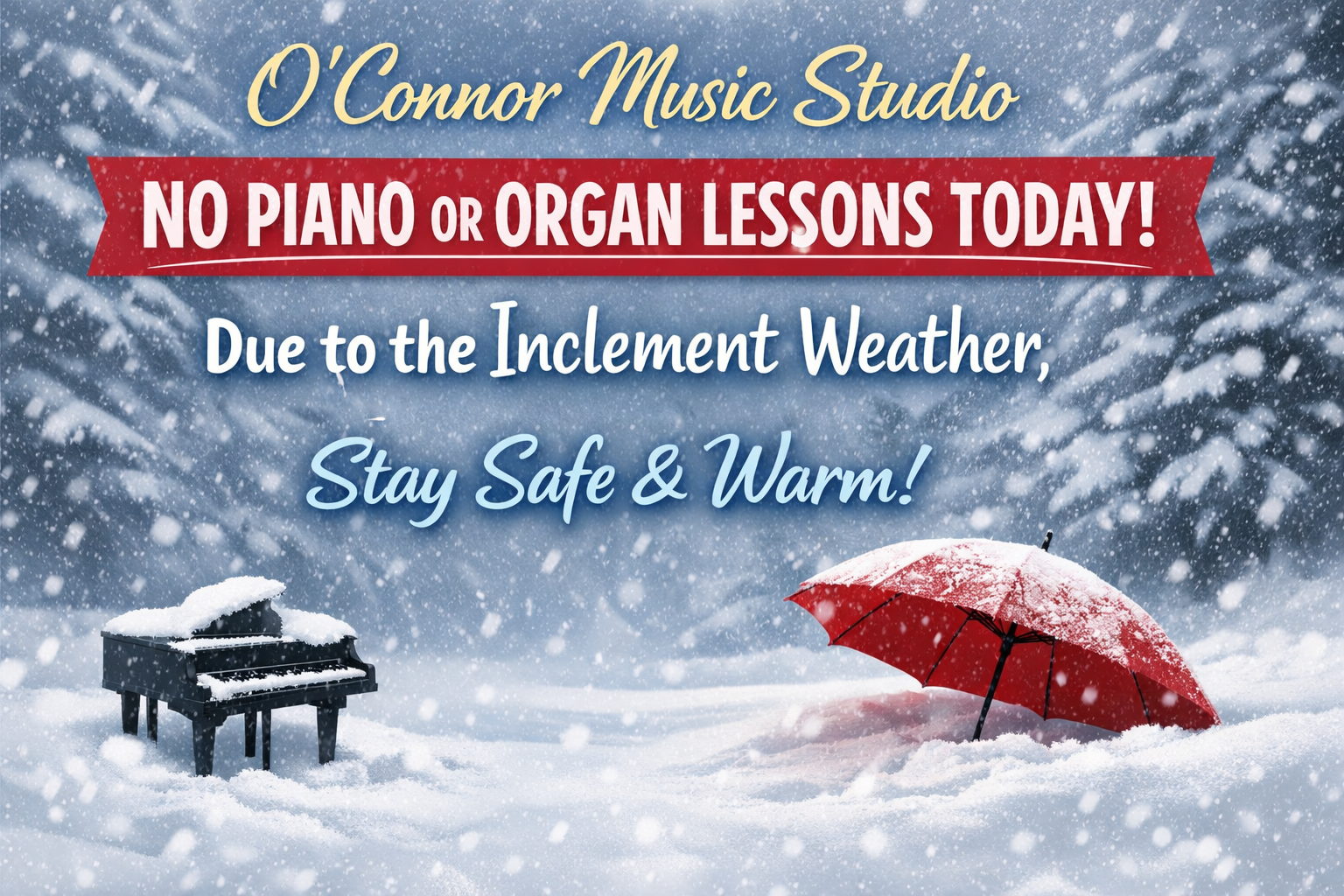
Fairfax County has closed school today so…no lessons today due to the snowy weather.
Keep practicing!
Those using Piano Maestro may find a new assignment for today 🙂


Fairfax County has closed school today so…no lessons today due to the snowy weather.
Keep practicing!
Those using Piano Maestro may find a new assignment for today 🙂
. 1669 ~ Miquel Lopez, composer, born. He died sometime in 1723
. 1671 ~ Francesco Stradivari, Italian violin maker
. 1862 ~ The Battle Hymn of the Republic was first published in “Atlantic Monthly”. The lyric was the work of Julia Ward Howe. The Battle Hymn of the Republic is still being sung and to the tune of a song titled John Brown’s Body.
. 1869 ~ Victor Herbert, Composer, cellist and conductor of the Pittsburgh Symphony. He composed operettas such as Babes in Toyland, Naughty Marietta and songs like Ah Sweet Mystery of Life (At Last I’ve Found You)
. 1877 ~ Thomas Frederick Dunhill, English composer and writer on musical subjects
. 1894 ~ James P. Johnson, American pianist and composer (Charleston), born in New Brunswick, New Jersey
. 1896 ~ Puccini’s “La Bohème” premiered in Turin, Italy. La Bohème is an opera in four acts, composed by Giacomo Puccini between 1893 and 1895 to an Italian libretto by Luigi Illica and Giuseppe Giacosa, based on Scènes de la vie de bohème (1851) by Henri Murger. The story is set in Paris around 1830, and shows the Bohemian lifestyle of a poor seamstress and her artist friends.
. 1904 ~ Enrico Caruso recorded his first sides for Victor Records. He did ten songs in the session and was paid only $4,000.
. 1907 ~ Mozart Camargo Guarnieri, Brazilian composer
. 1934 ~ Bob Shane, Singer with The Kingston Trio
. 1937 ~ Don Everly born, Singer with his brother, Phil, in The Everly Brothers. Some of their hits were: Wake Up Little Susie, Bye Bye Love, Cathy’s Clown and All I Have To Do Is Dream
. 1937 ~ Ray Sawyer, Singer with Dr. Hook and The Medicine Show
. 1939 ~ Benny Goodman and his orchestra recorded And the Angels Sing on Victor Records. The vocalist on that number, who went on to find considerable fame at Capitol Records, was Martha Tilton.
. 1940 ~ Frank Sinatra sang Too Romantic and The Sky Fell Down in his first recording session with the Tommy Dorsey Band. The session was in Chicago, IL. Frankie replaced Jack Leonard as lead singer with the band.
. 1941 ~ “Downbeat” magazine reported this day that Glenn Miller had inked a new three-year contract with RCA Victor Records. The pact guaranteed Miller $750 a side, the fattest record contract signed to that time.
. 1949 ~ RCA Victor countered Columbia Records’ 33-1/3 long play phonograph disk with not only a smaller, 7-inch record (with a big hole in the center), but an entire phonograph playing system as well. The newfangled product, the 45- rpm, which started a revolution (especially with the new rock and roll music), soon made the 78-rpm record a blast from the past.
. 1952 ~ Rick James (James Johnson), Singer
. 1954 ~ Mike Campbell, Guitarist with Tom Petty and The Heartbreakers
. 1968 ~ Elvis Presley celebrated the birth of his daughter, Lisa Marie. Lisa Marie married and divorced the ‘Gloved One’, Michael Jackson, in the ’90s.
. 1971 ~ The soundtrack album from the movie, “Love Story”, starring Ryan O’Neal and Ali McGraw, with music by Frances Lai, was certified as a gold record on this day.
. 1995 ~ Richey Edwards, guitarist with the Manic Street Preachers, vanished leaving no clues to his whereabouts. He left The Embassy Hotel in London at 7am, leaving behind his packed suitcase. His car was found on the Severn Bridge outside Bristol, England sixteen days later. Edwards has never been found, despite constant searching, and in November 2008 he was declared officially dead.
. 2002 ~ Hildegard Knef, a smoky-voiced actress and singer who starred in Germany’s first post-World War II movie and scandalized church officials with a 1951 nude scene, died of a lung infection at a Berlin hospital. She was 76. Knef became a star for her role as a former concentration camp inmate returning home in Wolfgang Staudte’s 1946 “Murderers Are Among Us.” Knef, who sometimes went as Hildegard Neff in the United States, appeared in more than 50 films, most of them made in Europe. She reportedly turned down a Hollywood studio contract after being told she would have to change her name and say she was Austrian, not German. She scandalized Roman Catholic authorities with a brief nude scene in the 1951 German film “The Story Of A Sinner.” Her work in the United States included the role of Ninotchka in Cole Porter’s Broadway musical “Silk Stockings” in the 1950s, and a supporting role in “The Snows of Kilimanjaro.” She launched a career as a singer in the 1960s and wrote a best-selling 1970 autobiography. She continued to act and sing almost until the end of her life, appearing as herself in the 2000 documentary “Marlene Dietrich: Her Own Song” and in the 1999 German comedy, “An Almost Perfect Wedding.”
. 2003 ~ Latin jazz musician Ramon “Mongo” Santamaria, a Cuban-born percussionist and bandleader known for his conga rhythms, died in Miami at age 85. He was best known for his 1963 recording of Herbie Hancock’s song Watermelon Man, which became his first Top 10 hit. In 1959, Santamaria penned Afro Blue, which quickly became a jazz standard covered by stars such as Count Basie and Dizzy Gillespie. Born in Havana, Santamaria performed at Havana’s famed Tropicana Club before moving to New York City in the early 1950s, touring with the Mambo Kings and performing with Tito Puente and Cal Tjader. Santamaria recorded scores of albums in a career that spanned nearly 40 years, mixing rhythm and blues with jazz and hip-swaying conga. In 1977 he was awarded a Grammy for Best Latin Recording for his album “Amancer.” In recent years, he divided his time between Manhattan and Miami.
. 2007 ~ Gian Carlo Menotti, Italian-born composer died
. 2018 ~ Alan Stout, American composer, died at the age of 85
. 2018 ~ Dennis Edwards, who joined the Temptations in 1968 and sang on a string of the group’s hits including “I Can’t Get Next to You,” “Ball of Confusion” and “Papa Was a Rollin’ Stone” in an initial tenure that stretched to 1977, died at the age of 74.

. 1759 ~ François Devienne, French composer and professor of flute
. 1797 ~ Franz Peter Schubert, Austrian composer
Read quotes by and about Schubert
More information about Schubert
. 1798 ~ Carl Gottlieb Reissiger, German Kapellmeister and composer
. 1882 ~ Anna Pavlova, Russian ballerina and choreographer
. 1892 ~ Eddie Cantor (Iskowitz), Entertainer, ‘banjo eyes’ Some of his hits were: If You Knew Susie like I Know Susie, Alabamy Bound, Dinah, Ida, Makin’ Whoopee and Ma He’s Makin’ Eyes at Me
. 1906 ~ Benjamin Frankel, British composer
. 1921 ~ Mario Lanza, Opera singer. Some of his non-operatic songs were Be My Love, The Loveliest Night of the Year and Because You’re Mine
. 1923 ~ Carol Channing, Broadway entertainer and Tony Award-winning actress in shows such as Hello, Dolly! (1964) and Thoroughly Modern Millie
. 1934 ~ Ron Weatherburn, jazz pianist
. 1936 ~ “The Green Hornet” was introduced by its famous theme song, The Flight of the Bumble Bee, originally by Rachmaninoff. The radio show was first heard on WXYZ radio in Detroit, MI on this day. The show stayed on the air for 16 years. “The Green Hornet” originated from the same radio station where “The Lone Ranger” was performed.
. 1937 ~ Phillip Glass, American composer of minimalist music
More information about Glass
. 1946 ~ Terry Kath, Guitarist with Chicago
. 1951 ~ Harry Wayne Casey, Keyboards, singer with KC and the Sunshine Band
. 1951 ~ Phil Collins, British rock drummer, songwriter and singer
. 1951 ~ Phil Manzanera (Targett-Adams), Guitarist with Roxy Music
. 1955 ~ Electronics pioneer RCA demonstrated the first music synthesizer that could electronically play musical sounds.
. 1960 ~ Julie Andrews, Henry Fonda, Rex Harrison and Jackie Gleason, appeared in a two-hour TV special titled, The Fabulous ’50s. 1961 ~ Lloyd Cole, Guitarist, singer with Lloyd Cole and The Commotions Dial Records founder Ross Russell died. He released 78-rpm recordings of Charlie Parker on his small jazz label and wrote a biography of Parker in 1973 called “Bird Lives! The High Life and Hard Times of Charlie (Yardbird) Parker”.
. 1976 ~ ABBA knocked Queen from the UK No.1 position on the UK singles chart with ‘Mamma Mia.’ Queen’s single ‘Bohemian Rhapsody’ had enjoyed a nine-week run at the top of the charts, by coincidence, Queen’s single contains the famous “mamma mia, mamma mia, mamma mia let me go” line.
. 1981~ Justin Timberlake, singer with *NSYNC who had the 2000 US No.1 single ‘It’s Gonna Be Me’ and the 1999 UK No.5 single ‘I Want You Back’. As a solo artist scored the 2003 UK No.2 & US No.3 single ‘Cry Me A River’. His second solo album ‘FutureSex/LoveSounds’ was released in 2006 with the US No.1 hit singles ‘SexyBack’, ‘My Love’ and ‘What Goes Around… Comes Around.’ With his first two albums, Timberlake has sold over fourteen million albums worldwide. Timberlake has his own record label called Tennman Records. He also has an acting career, having starred in films such as The Social Network, Bad Teacher and Friends with Benefits.
. 1982 ~ Sandy Duncan of Tyler, Texas gave her final performance as Peter Pan in Los Angeles, CA. The actress completed 956 performances without missing a show. She flew a total of 261.5 miles while on stage.
. 1985 ~ John Fogerty, former leader of Creedence Clearwater Revival, returned to the A&M recording studios in Hollywood, CA to give his first ‘live’ performance in 14 years. Actually, Fogerty performed in a video called Rock and Roll Girls.
. 1987 ~ Madonna’s record, Open Your Heart, moved to the #2 spot on the pop charts (right behind At This Moment by Billy Vera and The Beaters). A week later, Open Your Heart became Madonna’s fifth #1 hit since 1983. She had 11 consecutive singles in the Top 10, the most for any female artist of the rock era.
. 1995 ~ George Abbott, Director, passed away.
. 2002 ~ Evelyn Scott, the city’s first female disc jockey who later played a tough-talking tavern keeper on the television soap opera “Peyton Place,” died at the age of 86. Born in Brockton, Mass., Scott moved to Los Angeles and landed a job as a disc jockey on radio station KMPC. She later was hired as a singing DJ on KHJ’s “Rise and Shine” morning show. She began acting in theater companies and eventually landed small roles in films such as “Wicked Woman,” “The Green-Eyed Blonde” and “I Want to Live.” She may be best remembered as saloon keeper Ada Jacks in the soap “Peyton Place,” which showed the extramarital affairs and other dark secrets of the residents of a small New England town. Scott played the role from 1965 to 1969, and then reprised the role on “Return to Peyton Place” from 1972 to 1974. She also came back for the 1985 television movie “Peyton Place: The Next Generation.” Scott appeared in episodes of other TV shows including “Bonanza,” “Gunsmoke” and “Perry Mason.” After she retired from acting, she dedicated her time to helping the homeless and served as a board member of Portals House Inc., a center for mentally ill people.
. 2004 ~ Roberto Ocasio, a versatile musician and bandleader of Latin Jazz Project, died in a car accident. He was 49. Ocasio performed more than 250 times last year, mostly in Cleveland. He has shared stages with such other Latino musicians as Eddie Palmieri and Nestor Torres. His band played venues from street festivals to Cleveland’s Severance Hall. Ocasio played the piano and six other instruments. He earned a degree in composition and arranging from the Berklee College of Music in Boston. He formed Latin Jazz Project in 1997. Ocasio composed and arranged the band’s music, a repertoire ranging from original pieces to rock tunes and American standards with his own twist. He performed songs in Spanish and English.
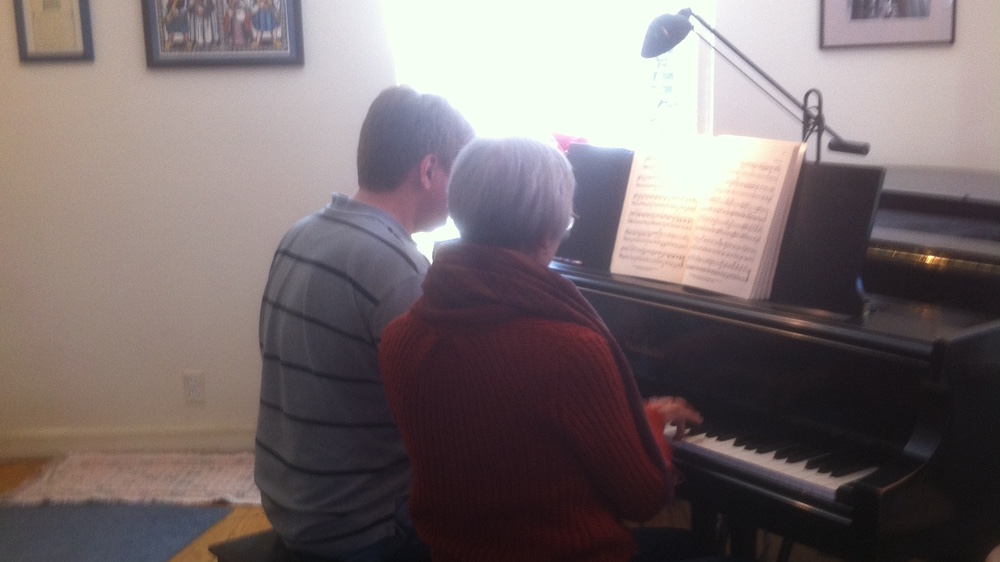
When Paula Fay started taking piano lessons for the first time in her late fifties, it fulfilled a lifelong dream.
“I always wanted to learn how to play as a child, but my parents couldn’t afford it,” she said.
Today, four years later, Paula can play some of her favorite tunes. And she’s loving every minute of it.
Some adults may groan at childhood memories of lesson after lesson, practice after practice and a lot of teacher nagging, but many wish those days were back.
And more and more, these adults are turning wishful thinking into reality. According to the National Piano Foundation, adults ages 25-55 are the fastest-growing segment of people learning piano.
When Ruth Ann Laye started teaching an adult piano class at Mandarin’s Keyboard Connection, there was only one weekday class. Now, she’s up to seven classes. And of her own private practice of 28, 11 are adults.
One of her students is Belinda May from St. Augustine, who is in her 60s and in her second year of piano lessons.
Though her brothers played piano, she was more athletically inclined than musical. Then after years of “picking” at the pianos in her house, she recently resolved to start taking lessons. A beginner when she started, “now I’m playing Christmas carols,” she said.
“It tells me that you’re never too old to learn something new.”
Maureen Rhodes, a piano teacher on the Southside, would likely agree. She has more adults in her practice than she did 20 years ago.
“I think baby boomers are looking for ways to stay active,” she said. “Sometimes, kids come to me for lessons and then when they grow up and leave, their mother starts to take lessons,” says Rhodes. “Other adults have a specific goal in mind, like they want to play in church or accompany their grandson.”
Sandra Stewart, outgoing president of the Jacksonville Music Teachers Association and adjunct professor teaching a non-degree adult piano course at Florida State College, believes technology is a big part of the reason for the greater interest in piano among adults.
“Keyboards are more affordable, and that’s made all the difference,” she says.
But the piano is not always a succession of high notes for the adult student. Says Stewart: “Adults can have problems with finger dexterity. If they never played before, this can be frustrating. People who use computer a lot have an advantage. But if they don’t have this experience, they have to get over that hurdle.”
And some adults expect to transform into Mozart overnight.
“They may be symphony patrons or just love classical music and want to play instantly and do it like the pros,” Rhodes says. “But they have to develop the skills first, and it takes a lot of patience.”
But for adults committed to learning, it can be very satisfying for student and teacher alike.
“Adults are there for their own pleasure,” said Marc Hebda, president of the Florida State Music Teachers Association. “They have wonderful enthusiasm; it’s fun to see them get excited. It’s also interesting that with the economic downturn, they are not cutting back on lessons or buying instruments. Piano is a constant source of entertainment and personal development.”
The key to any student learning well, whether that student is an adult or child, is finding the right teacher. Hebda stresses the importance of taking lessons from a teacher with a music degree.
“Some people who took piano figure it’s easy to teach. But credentials are very important. You wouldn’t go to a doctor without certification or a lawyer who didn’t pass the bar. All our teachers have a music degree or demonstrate teaching ability.”
Hebda also notes that rapport between teacher and student is important.
“The student should interview the teacher, because not all students and teachers are a good match.”
For those who want to fast-track the learning process, there are alternatives. “The Piano Guy,” Scott Houston, has been teaching piano using a non-traditional method through his shows on public station WJCT.
“It seemed like there was a single path to the world of piano: this long process of taking lessons,” he said. “But people want to play the tunes they know.”
So Houston came up with a simple way for adults to learn quickly, based on the concept behind “lead sheets,” which are used by professional musicians. Houston’s technique is to teach adults a single line of notes on the treble clef with their right hand and chords with their left.
“My goal is not to teach adults to be the greatest players but to be able to play the tunes they want to play,” Houston says.
His approach has clearly struck a chord, as his book has sold 300,000 copies and he has taught many adults through his workshops in Indiana and master class “piano camp” from his beach home in Fort Myers.
There’s also a new trend gaining traction called “recreational music making” — RMM — which like Houston’s approach focuses on a simplified method to teaching music. The goal is not for a student to become accomplished at the piano and perform, but rather to just have fun making music. It is often taught to adults in group settings, such as music stores, churches and senior centers.
“Research has found that RMM is very helpful for seniors, promotes hand/eye coordination and keeps the brain working,” said Erin Bennett, assistant professor of piano and pedagogy at the University of North Florida. “Its asset is the ability to reach more people; it’s more inclusive and easier for the non-experienced.”
Whether learning piano through traditional or nontraditional means, its many benefits include boosting self-confidence.
“When I first started, I didn’t think I could do it,” Fay said. “And my friends and family were in disbelief that I was taking lessons. Then they wanted to hear a concert. In another year, I might just do it.”
She gets some measure of satisfaction in surprising those around her.
“Society puts restrictions on us as we get older that we stop learning,” she says. “But we are wiser, more patience and accept our limitations.”
Read more at Jacksonville.com: http://jacksonville.com/entertainment/music/2011-10-27/story/piano-lessons-not-just-kids#ixzz1l14hSFaV
. 1505 ~ Thomas Tallis, English composer
. 1566 ~ Alessandro Piccinini born. He was an Italian lutenist and composer who died sometime in 1638
. 1697 ~ Johann Joachim Quantz, German flutist, flute maker and composer
. 1861 ~ Charles Martin Tornow Loeffler, Alsatian-born American composer
. 1862 ~ Walter Johannes Damrosch, German conductor and composer
. 1911 ~ (David) Roy ‘Little Jazz’ Eldridge, Trumpeter and soloist with Gene Krupa’s Band, U.S. President Carter’s White House jazz party in 1978
. 1917 ~ The Original Dixieland Jazz Band recorded a classic for Columbia Records titled, The Darktown Strutters’ Ball. It was one of the first jazz compositions recorded.
. 1921 ~ Bernie Leighton, Jazz pianist
. 1928 ~ Ruth Brown, R&B and jazz singer
. 1928 ~ Harold Prince, Broadway producer and director of A Little Night Music and Sweeney Todd: The Demon Barber of Fleet Street
. 1936 ~ Horst Jankowski, Pianist, most famous work was A Walk In The Black Forest
. 1938 ~ Norma Jean (Beasler), Country singer
. 1941 ~ Joe Terranova, Singer with Danny and the Juniors
. 1943 ~ Marty Balin (Buchwald), Singer with Jefferson Airplane/Starship
. 1943 ~ The Nat King Cole Trio reached the top of the charts with the song “That Ain’t Right.” It stayed there for one week before dropping off the top spot.
. 1944 ~ Lynn Harrell, American cellist
. 1947 ~ Steve Marriott, Singer, songwriter, guitarist
. 1949 ~ William King, Trumpeter, keyboard with The Commodores
. 1951 ~ Phil Collins, English singer-songwriter, drummer, keyboard player with Genesis. As a solo performer he had a number of world wide singles to his credit including “You Can’t Hurry Love”, “Take a Look at Me Now)” “One More Night”, “A Groovy Kind of Love” and “Another Day in Paradise”. He is also remembered for his role in Live Aid 1985 when he performed at Wembley Stadium, England and JFK Stadium Philadelphia using the Concorde to fly from England to the US.
. 1959 ~ Jody Watley, Singer with Shalamar
. 1963 ~ Francis Poulenc died.
. 1969 ~ The Beatles made their last public appearance. It was at a free concert at their Apple corporate headquarters in London. The group recorded Get Back and also filmed the movie “Let It Be”.
. 2004 ~ Jazz bassist Malachi Favors, who played with such bandleaders as Dizzy Gillespie and Freddy Hubbard before beginning a 35-year association with the Art Ensemble of Chicago, died. After service in the Army during the Korean War, he studied with the bassists Wilbur Ware and Israel Crosby, and worked with the pianists Andrew Hill and King Fleming. After playing with Gillespie, Hubbard, and other members of the bebop revolution, Favors joined the band of Chicago saxophonist Roscoe Mitchell and played a major part on Mitchell’s influential free-jazz album, “Sound”, in 1966. Mitchell’s band soon evolved into the Art Ensemble of Chicago, which combined traditional elements of jazz and blues, West African music, chanting, ritual, abstract sound and silence. Although founded in Chicago, the group was based in Europe until 1971. In addition to his distinctive bass sound, Favors also added vocals and such folk instruments as banjo, zither and harmonica to group’s compositions. He also recorded a solo bass album, “Natural and the Spiritual”.
. 2011 ~ John Barry, English film score composer died at the age of 77
. 2013 ~ Patty Andrews, American singer (Andrews Sisters), died at the age of 94

Since the first release of this classic Schirmer edition over 100 years ago, almost anyone who has taken piano lessons for more than two years has played from The Virtuoso Pianist.
Most anyone who has ever played piano has a love-hate relationship with the “Hanon”.
The Virtuoso Pianist (Le Pianiste virtuose) by Charles-Louis Hanon, is a compilation of sixty exercises meant to train the pianist in speed, precision, agility, and strength of all of the fingers and flexibility in the wrists.
First published in Boulogne, in 1873, The Virtuoso Pianist is Hanon’s most well-known work, and is still widely used by piano instructors and pupils although some teachers are getting away from the mechanical playing these can produce.
Personally, I’ve sometimes played these on “auto-pilot” since all one really needs is to get the first pattern going, then move up a step, up a step…

Notes by C. L. Hanon: Preparatory exercises for the Acquirement of Agility, Independence, Strength and Perfect Evenness in the Fingers. For studying the 20 exercises, begin with the metronome set at 60, gradually increasing the speed up to 108.
From Wikipedia:
The exercises are intended to address common problems which could hamper the performance abilities of a student. These include “crossing of the thumb”, strengthening of the fourth and fifth fingers, and quadruple- and triple-trills.
The exercises are meant to be individually mastered and then played consecutively in the sections they are placed in.
Apart from increasing technical abilities of the student, when played in groups at higher speeds, the exercises will also help to increase endurance. The exercises are divided in three parts:
- Exercises 1 – 20: Labeled “preparatory exercises”, these are also the most famous exercises, and are used to develop finger strength and independence. Each exercise contains a sequence of 8 semiquavers, beginning on C, which is then repeated starting on D, and so on across two octaves. The exercise is then repeated in reverse down two octaves to the starting C. The exercises are intended to be practiced in groups of three, except for the first two which are practiced together.
- Exercises 21 – 43: Labeled “further exercises for the development of a virtuoso technique.” This more difficult section is meant to be played after the pianist has fully mastered Part 1. Part 2 includes scales and arpeggios.
- Exercises 44 – 60: Labeled “virtuoso exercises for mastering the greatest technical difficulties.” Since this section is considerably more difficult, Hanon recommends the mastery of both previous parts before proceeding to this one. This part includes repeated notes,, and more.
After all three parts are mastered, Hanon recommends all exercises be played through daily to retain technique.
The O’Connor Music Studio has several editions of this work, including:
Hanon: The Virtuoso Pianist in Sixty Exercises, Complete. Since the first release of this classic Schirmer edition over 100 years ago, almost anyone who has taken piano lessons for more than two years has played from The Virtuoso Pianist . Millions of copies have been sold of these progressive exercises which guide a player’s technique, building finger independence and strength. This was the first American edition released of this music, and remains a classic at a remarkably affordable price.
Junior Hanon (Alfred Masterwork Edition). A slight condensation of Hanon’s first exercises. The simplification in layout and range make the exercises appear less difficult to a young student. Includes the complete Book 1 and excerpts from Books 2 & 3 of C. L. Hanon’s famous studies, The Virtuoso Pianist in 60 Exercises.
Hanon for Students, Bk 1: 6 Varied Exercises from The Virtuoso Pianist for Late Elementary Pianists. Hanon for Students, Book 1, contains the first six exercises from The Virtuoso Pianist, Book 1. The exercises are notated in eighth notes for one octave so that students may begin to use them effectively at the late-elementary level. Each exercise appears five times to be played with a legato touch, varied articulation, varied dynamics, varied rhythm, and transposed to F or G.
Jazz Hanon. Inspired by Charles-Louis Hanon’s The Virtuoso Pianist the essential technical method for any classical player these new volumes present a modern-day equivalent for the musician seeking to play the key piano styles of the 20th century. Each book develops basic technique and true facility in each genre through authentic, progressive exercises and etudes. The music in these books is fun to play for pianists at every level, building the necessary skills in each style while providing extensive musical and stylistic insight.
. 1715 ~ Georg Christoph Wagenseil, Austrian composer and pianist
. 1782 ~ Daniel François Esprit Auber, French composer, primarily of comic operas
. 1784 ~ Ferdinand Ries, German composer. Ries was a friend, pupil and secretary of Ludwig van Beethoven.
. 1862 ~ Frederick (Fritz) Theodor Albert Delius, British composer
More information about Delius
. 1876 ~ Havergal Brian, British classical composer
. 1889 ~ Huddie Ledbetter, Blues singer
. 1924 ~ Luigi Nono, Italian composer
. 1937 ~ Tommy Dorsey and his orchestra waxed the famous Song of India on Victor Records.
. 1942 ~ Claudine Longet, Singer, formerly married to Andy Williams
. 1947 ~ David Byron, Singer
. 1949 ~ Tommy Ramone (Erdelyi), Drummer with The Ramones
. 1953 ~ Teresa Teng, Chinese singer
. 1954 ~ Oprah Winfrey, Entertainer, Emmy Award-winning talk show host
. 1962 ~ Fritz Kreisler died. He was an Austrian-born violinist and composer
. 1966 ~ “Sweet Charity”, with Gwen Verdon, opened at the Palace Theatre in New York City. The musical, by Neil Simon, was an adaptation of the Federico Fellini film, “Notti di Cabiria”. The play ran for 608 performances. In 1969, Hollywood produced a big-budget version of the Broadway musical starring Shirley MacLaine.
. 1973 ~ Johnny Rivers received a gold record for the hit single, Rockin’ Pneumonia and the Boogie Woogie Flu. As is tradition, Rivers removed the fragile gold disk from the wooden frame and, as he was putting it on his stereo, had a ferocious sneezing fit and never did find out how his song sounded in solid gold.
. 1977 ~ From the One-Hit Wonder File, this note: Rose Royce earned the #1 spot on the music charts with Car Wash, from the movie of the same name. The song stayed at the peak of the pop charts for one week, then faded away.
. 1981 ~ Cozy (William Randolph) Cole, drummer, passed away
. 1996 ~ The 6,138th performance of “Cats” was held in London, surpassing the record of Broadway’s longest-running musical, “A Chorus Line”
. 2001 ~ Suzanne Bloch, a concert chamber musician and teacher at the Juilliard School, died at her home. She was 94. Bloch played and taught ancient instruments, in particular the lute, a guitar-like instrument common in 18th-century Europe. Mostly self-taught, she also played the recorder and the virginal, a tiny relative of the harpsichord. Beginning in the late 1930s, she performed frequently in concert, often dressed in Renaissance costume. She taught classes at Juilliard from 1942 to 1985. After marrying Paul Smith, a mathematician who became chairman of Columbia University’s mathematics department, Bloch played chamber music with well-known scientists, including Albert Einstein. Born in Geneva, Bloch moved to New York with her family in 1916, when her musician father, Ernest Bloch, began teaching and conducting in the United States. Bloch promoted her father’s music throughout her life, collecting clippings, writing program notes and founding the Ernest Bloch Society in 1967.
. 2015 ~ Rod McKuen, American singer-songwriter (Jean) and poet, died at the age of 81
. 2019 ~ James Ingram, American R&B singer-songwriter and musician (Just Once), died at the age of 66
. 1722 ~ Johann Ernst Bach, German composer of the Bach family
. 1791 ~ Ferdinand Herold, French composer
. 1887 ~ Artur Rubinstein, Polish-born American pianist, played solo for the Berlin Symphony at the age of 12.
Read quotes by and about Rubinstein
https://youtu.be/2zSqYDH8hbw
. 1904 ~ Enrico Caruso signed his first contract with Victor Records. He had debuted at the Metropolitan Opera just two months before.
. 1927 ~ Ronnie Scott (Schatt), Jazz musician: tenor sax, bandleader, jazz club owner in London
. 1927 ~ Twenty years before the famous record by Art Mooney was recorded, Jean Goldkette and his dancing orchestra recorded, I’m Looking Over a Four-Leaf Clover. Though the name of the bandleader may not be so famous, two of his sidemen on this Victor recording session certainly were: Big band fans know Bix Beiderbecke and Joe Venuti.
. 1929 ~ Acker (Bernard) Bilk, Clarinetist, composer
. 1935 ~ Mikhail Mikhaylovich Ippolitov-Ivanov, Russian composer, died at the age of 75
. 1938 ~ Bill Phillips, Country singer
. 1940 ~ “Beat the Band” made its debut on NBC radio. The band was that of Ted Weems and his 14-piece orchestra, who were joined by Elmo ‘The Whistling Troubadour’ Tanner, Harry Soskind and Country Washington. One other star of the show was a barber from Pittsburgh, PA (nearby Canonsburg, actually), who would record many hits for RCA Victor from 1943 right through the dawn of the 1970s. His name was Perry Como. Beat the Band was a funky show where listeners’ questions were selected in the hopes of stumping the band. If a listener’s question was chosen, he or she received $10. The questions were posed as riddles: What song title tells you what Cinderella might have said if she awoke one morning and found that her foot had grown too large for her glass slipper? If the band played the correct musical answer, Where Oh Where Has My Little Dog Gone?, the listener lost.
. 1943 ~ Dick Taylor, Bass, guitar with The Pretty Things
. 1944 ~ John Tavener, British avant-garde composer
More information about Tavener
. 1944 ~ Brian Keenan, Drummer with groups Manfred Mann and The Chambers Brothers
. 1948 ~ Mikhail Nikolayavich Baryshnikov, Russian-born American ballet dancer Washington Honored Eastwood, Baryshnikov, Others
. 1959 ~ Dave Sharp, Guitarist with The Alarm
. 1956 ~ Elvis Presley made his first appearance on national television. No, he didn’t appear on some teenage dance show; but rather, “The Dorsey Brothers Show”, starring Tommy and Jimmy. Elvis sang Blue Suede Shoes and Heartbreak Hotel. He was backed by the instruments of the Dorsey band.
. 1968 ~ Sarah McLauchlan, Singer
. 1985 ~ 45 of the world’s top recording artists were invited to an all-night recording session at the A&M studios in Los Angeles. As each of the artists walked through the studio door, they were greeted by a hand-lettered sign — put there by Lionel Richie. It simply said, “Check your ego at the door.” The session started at 10 p.m. with producer Quincy Jones conducting. At 8 o’clock the following morning, the project, “USA for Africa”, spearheaded by promoter, Ken Kragen, was recorded and mixed. The resulting song, We Are the World, featuring Michael Jackson, Cyndi Lauper, Kenny Rogers, Dolly Parton, Sting, Harry Belafonte, Diana Ross, Paul Simon and many others became the top song in the U.S. on April 13, 1985.
. 2002 ~ Michael Hammond, who became chairman of the National Endowment for the Arts just a week earlier, died apparently of natural causes. He was 69. A native of Kenosha, Wis., the conductor and composer had been dean of the School of Music at Rice University in Houston when President Bush nominated him to lead the federal agency that decides grants for the arts. After being confirmed by the Senate on Dec. 20, 2001, Hammond had assumed the post-Jan. 22, 2002, and was still in the process of moving to Washington. A student of music and medicine, Hammond’s interests included music from Southeast Asia, the Renaissance and medieval times and the intersection between music and neuroscience. He received a Rhodes scholarship to study philosophy, psychology and physiology at Oxford University. He also studied Indian philosophy and music at Dehli University in India. In 1968, he left his post as director of the Wisconsin Conservatory of Music in Milwaukee to become the founding dean of music at the State University of New York at Purchase. He later served as president of the school, until he left for Rice’s Shepherd School of Music in 1986. All the while, he retained his interest in medicine, teaching neuroanatomy and physiology at Marquette Medical School and at the University of Wisconsin. Hammond also served as the founding rector of the Prague Mozart Academy in the Czech Republic, now the European Mozart Academy was on the board of the Houston Symphony, and was vice chairman of the board of Interlochen Center for the Arts in Michigan.
. 2002 ~ Steve Caldwell, who sang and played saxophone for the Swingin’ Medallions at the time of the band’s 1966 hit Double Shot (of My Baby’s Love), died of pancreatic cancer. He was 55. Caldwell was with the group from 1963 to 1969. After getting his master’s degree in chemistry at the University of South Carolina, he returned to his native Atlanta and ran the Norell temporary staffing agency until starting his own company in 1976. His wife, Lynn Caldwell, said he raised $1 million for charity through World Methodist Evangelism.
Fairfax County has closed school today so…no lessons today due to the snowy weather.
Keep practicing!
Those using Piano Maestro may find a new assignment for today 🙂

Statistically, people who’ve ‘liked’ Mozart on Facebook have a higher IQ. It got us thinking… what would Mozart ‘like’ on Facebook? And what would his profile look like?! On the tenth anniversary of the social network’s launch, we’ve imagined what the composer might have posted online throughout his life.
Click the image below to take a closer look.

via If composers had Facebook: Mozart’s profile | Mozart – Classic FM.

