
You only need to practice on the days that you eat 🙂

You only need to practice on the days that you eat 🙂
• 1826 ~ Walter Cecil Macfarren, English pianist and composer, born in London
• 1850 ~ Wagner’s opera, Lohengrin, was performed for the first time.
• 1894 ~ Karl Böhm, Austrian conductor
• 1913 ~ Richard Tucker, American tenor
More information about Tucker
• 1924 ~ Dinah Washington, American rhythm-and-blues singer. She popularized many, many great songs, including What a Diff’rence a Day Makes, Unforgettable, and several hits with Brook Benton.
• 1925 ~ Billy (William Wayne) Grammer, Singer
• 1925 ~ Donald O’Connor, American dancer, singer and actor.
• 1931 ~ You Rascal You was recorded by Henry Allen, with the Luis Russell Band, for the Victor label.
• 1939 ~ Clem Cattini, Drummer with Tornados
• 1948 ~ Daniel Seraphine, Drummer with Chicago
• 1951 ~ Wayne Osmond, Singer with The Osmond Brothers
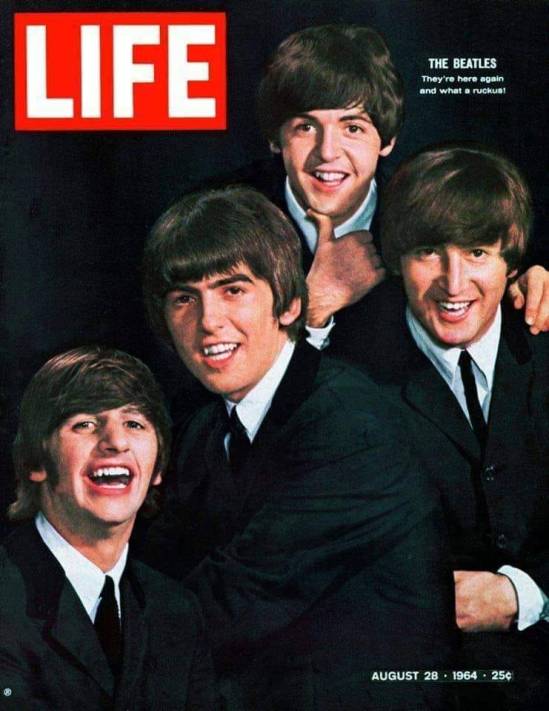
• 1964 ~ The Beatles appeared on the cover of LIFE magazine, only 6 months after they were first on the Ed Sullivan Show.
• 1965 ~ Shania Twain (Eilleen Regina Edwards), Grammy Award-winning singer
• 1984 ~ The Jacksons’ Victory Tour broke the record for concert ticket sales. The group surpassed the 1.1 million mark in only two months.
• 2002 ~ Kay Gardner, whose last musical work with the Bangor Symphony Orchestra memorialized the Sept. 11 terrorist attacks, died of a heart attack. She was in her early 60s.
On hearing of her death, symphony officials scheduled Gardner’s work, “Lament for Thousand,” for the orchestra’s season-opening concert Oct. 13 at the Maine Center for the Arts in Orono.
Gardner was a pianist, flutist and conductor who performed in 46 states and several countries.
More than 20 years ago, she sued the Bangor Symphony, unsuccessfully, for sex discrimination after she had applied for a conducting position and learned that orchestra members had been asked how they felt about working with a female conductor.
In 2000, she was the guest conductor for a 40-member orchestra of women from the Bangor Symphony, playing a repertoire written by women.
Gardner studied music at the University of Michigan and at the State University of New York at Stony Brook. In 1972, she helped found a feminist and openly lesbian women’s band, Lavender Jane.
Picture a seven-foot grand piano in a studio. The lid’s missing, so you can see all the strings. Researchers suspend a rod embedded with 32 microphones over the piano’s body.
“We played this middle C at a very soft level, a medium level, and a very loud level,” says Agnieszka Roginska, a professor in NYU’s music technology program. She says using a pianist to play middle C over and over wouldn’t be scientific. So they’re using a disklavier, a fancy player piano triggered by electronics. “So we could hit the same note, with the same velocity, thousands of times,” she says.
They’d record the piano in one spot. Then move the microphones eight inches. Record the note. Move the mics again. Record the note. Over and over and over, until they reach the back of the piano. At the end, they get “what is basically a very dense acoustical scan of the radiation pattern of the grand piano,” Roginska says.
Read the entire article here: http://www.pri.org/stories/2014-08-10/science-tries-understand-what-gives-piano-its-voice

Life very often throws some curious coincidences my way. Just as I was preparing a presentation for architecture students at the Goa College of Architecture on ‘Architecture and Music’ and looking at the relationship of the Fibonacci sequence to music, what should appear in my newsfeed but the announcement of the famed piano firm Steinway and Sons unveiling its 600,000th piano, incorporating the iconic Fibonacci spiral in its design.
The veneer of the “Fibonacci” piano features the eponymous spiral made from six individual logs of Macassar Ebony, “creating a fluid design that represents the geometric harmony found in nature.”
In the words of designer Frank Pollaro, who spent over 6000 work-hours over four years in its creation: “Designing Steinway & Sons’ 600,000th piano was an honour and a challenge. To me, knowing that this piano would become part of history meant that it had to be more than just a beautiful design, but also needed to visually convey a deeper message…as I considered the number 600,000, the Fibonacci spiral came to mind. The way in which it continues to grow but stay true to its form is very much like Steinway and Sons over these many years. Combining the universal languages of music and mathematics suddenly made perfect sense.”
Mind you, 600,000 is not a number in the Fibonacci sequence; I checked. 600,000 is between the 29th and 30th numbers in the Fibonacci series, which are 514,229 and 832,040 respectively. But Pollaro was nevertheless highlighting an interesting relationship between music and mathematics.
Named after the Italian mathematician Leonardo Fibonacci (c. 1170- c. 1250) who brought the Indian-Arabic numeral system to Europe, the Fibonacci series appear in nature and in music, and finds application in architecture and in instrument design, much before the Fibonacci Steinway.
The basic ideas of the Fibonacci progression are contained in the writings of Indian scholar Pingala (300-200 BC) in his treatise on Sanskrit prosody.
The Fibonacci numbers have the following integer sequence: 0, 1, 1, 2, 3, 5, 8, 13, 21, 34, 55, 89, 144, 233, 377, 610, 987 and onward. Each added number is the sum of two previous numbers before it.
In nature, the Fibonacci sequence underpins phyllotaxis (arrangement of leaves on a stem), branching in trees, fruit sprouts of a pineapple among many other examples, and even the shape of the human external ear, and the cochlear apparatus of the inner ear.
It can be applied to the western musical scale as well, with the caveat that the starting note one makes the measurement from (or the ‘root’ note) is designated as 1 and not 0. By this token, there are 13 notes in a scale through its octave. There are 8 notes in a diatonic scale (hence the top note is called an ‘oct’ave). The 5th and 3rd notes create the basic foundation of musical chords. All these are Fibonacci numbers.
The very notes in the scale are based on natural harmonics created by ratios of frequencies. Ratios found in the first seven numbers of the Fibonacci series (0, 1, 1, 2, 3, 5, 8) are related to key frequencies of musical notes. Thus if we take an arbitrary frequency of 440 Hz, the root note has a ratio of 1/1, but the octave above it has a frequency of 880 Hz (2/1 of 440); a fifth above has a frequency of 660 Hz (3/2 of 440), and so on for other notes in the scale.
In last Sunday’s article, I had mentioned the ‘golden proportion’ or phi, which underpins the proportions of the Parthenon temple in the Acropolis in Athens, Greece. This ‘golden ratio’ (also called the ‘golden section’, ‘golden mean’ or the ‘divine proportion’) of 1:1618 or 0.618 has influenced composition in painting and photography, prompting the notion of dividing a canvas into thirds vertically and horizontally, and to position a subject of interest ‘about one-third’ of the way across instead of in the centre.
This ‘golden ratio’ can be obtained by dividing a Fibonacci number (in the higher reaches, not the first few) by its immediate predecessor. The quotient approximates phi (φ). Thus 987/610= 1.61803, and its inverse is 0.618.
The climax or high point of many songs and other compositions is often found at the ‘phi’ (φ) point (61.8 per cent) of the work. We have seen this to be true in the first movement of
S. Bach’s G minor sonata for solo violin.
In many compositions in sonata form, the addition of a coda causes the recapitulation (the return of the original idea that started the work) to begin at the 61.8 per cent point.
The legendary violin maker Antonio Stradivari seemed to be aware of the ‘golden section’ and used it in the placement of the f-holes on his violins. The proportions of the violin conform to the ratios of ‘phi’ (φ). The spiral of a violin scroll also obeys the Fibonacci progression.
Isn’t it amazing, how the visual and aural world, indeed nature itself can all be unified by the same mathematical sequence?[NT]
From http://www.goacom.com/entertainment/28277-music-and-mathematics-the-fibonacci-sequence

• 1661 ~ Louis Couperin, composer, died
• 1813 ~ Daniel Gottlob Turk, composer, died at the age of 63
• 1873 ~ Lee DeForest, Inventor of the triode vacuum tube, possibly the most significant invention that made radio possible.
• 1894 ~ Arthur Loesser, American pianist and writer
• 1915 ~ Humphrey Searle, British composer and writer
• 1919 ~ Ronny Graham (Ronald Montcrief Stringer), Singer, actor
• 1928 ~ Peter Appleyard, British jazz vibraphonist and drummer
• 1939 ~ The radio program Arch Oboler’s Plays presented the NBC Symphony, for the first time, as the musical backdrop for the drama, This Lonely Heart.
• 1942 ~ Vic Dana, Singer
• 1949 ~ Bob Cowsill, Singer with The Cowsills
• 1957 ~ John O’Neill, Musician, guitar with That Petrol Emotion
• 1958 ~ Ralph Vaughan Williams, Composer, passed away.
• 1960 ~ Branford Marsalis, Musician, saxophone, bandleader with The Tonight Show, toured with Sting
More information about the Marsalis family
• 1967 ~ Brian Epstein passed away
• 1970 ~ Jimi Hendrix opened his recording studio in New York City. Because of its state-of-the-art 36-track recording capability, it attracted many top rock groups.
• 2000 ~ George Edmund Sandell, a noted violin and viola player, teacher and inventor died at the age of 88.
Sandell studied in New York under the viola virtuoso William Primrose and on scholarship at the Royal Swedish Conservatory in Stockholm.
Sandell moved to Los Angeles in 1938, where he played with the Los Angeles Philharmonic and the Pasadena and Santa Monica Symphonies.
Along with classical music, he performed pop, swing and Latin music, and played with the string sections of big band luminaries Harry James, Jimmy Dorsey and Xavier Cugat.
Sandell also played on some of Frank Sinatra’s recordings and worked for most of the big Hollywood studios on orchestral soundtracks, including the soundtrack for the movie Citizen Kane.
In 1947, he invented the Gee-Bee, a kitchen sponge with a plastic handle for washing dishes. He sold the company to DuPont in 1953.
• 2001 ~ Alix Williamson, the classical music publicist who suggested to Baroness Maria von Trapp that she write a book about her family’s experiences, died at the age of 85.
Williamson’s suggestion resulted in the Rodgers and Hammerstein musical “The Sound of Music.”
She represented artists such as André Watts and Frederica von Stade and helped the New York Grand Opera get a citation in the Guinness Book of World Records for its performances of a complete cycle of Verdi’s operas in Central Park. Williamson also ghostwrote books.
• 2018 ~ Neil Simon died at the age of 91. He was an American playwright, screenwriter and author. He wrote more than 30 plays and nearly the same number of movie screenplays, mostly adaptations of his plays. He received more combined Oscar and Tony nominations than any other writer.

• 1879 ~ New York’s Madison Square Garden displayed a real floating ship in a gigantic water tank as Gilbert and Sullivan’s operetta, H.M.S. Pinafore, was performed.
• 1902 ~ Stefan Wolpe, German-born American composer
• 1909 ~ Ruby (Ethel Hilda) Keeler, Dancer, actress
• 1913 ~ Bob Crosby, Bandleader with The Bob Cats, brother of Bing Crosby
• 1918 ~ Leonard Bernstein, American conductor, composer and pianist
Read quotes by and about Bernstein
Links to more information about Bernstein
 Grammy winner
• 1939 ~ Dorothy embarked on a journey down the yellow brick road with a lion, a tin man and a scarecrow in the classic film “The Wizard of Oz.”
• 1941 ~ Skinnay Ennis and his orchestra recorded the tune Don’t Let Julia Fool Ya.
• 1942 ~ Walter Williams, Singer with The O’Jays
• 1955 ~ Elvis Costello (Declan McManus), Musician, songwriter
• 1961 ~ Billy Ray Cyrus, Singer
• 1964 ~ The Beatles received a gold record for their hit single A Hard Day’s Night. It was the third gold record for the Fab Four. They would collect 18 more through 1970.
• 1971 ~ Ted Lewis passed away. He was an American entertainer, bandleader, singer, and musician.
• 1982 ~ The group, Fleetwood Mac, received a gold record for the album Mirage.
• 2001 ~ Aaliyah died at the age of 22. She was a R&B singer and budding actress who made her film debut in “Romeo Must Die” and was killed in a plane crash in the Bahamas.
• 2001 ~ Jazz musician John Nelson, the father of pop star Prince, died at the age of 85. Nelson was the model for a character in the 1984 Prince movie “Purple Rain.” He also co-wrote songs on several of his son’s hit albums.
In the 1950s, Nelson was a pianist in the jazz group Prince Rogers Trio featuring singer Mattie Shaw. Shaw and Nelson married, and they named their son Prince Roger Nelson.
Nelson left the household when Prince was about 10 and his sister Tyka was 8. The father and son reconciled after Prince began his climb to fame.
Nelson co-wrote Computer Blue on the Purple Rain album, The Ladder on Around the World in a Day; Christopher Tracy’s Parade and Under the Cherry Moon on Parade and Scandalous on the Batman soundtrack.
• 2008 ~ Josef Tal, Israel composer (Israeli art music), died at the age of 97
• 1837 ~ Théodore Dubois, French organist and composer
• 1856 ~ Felix Mottl, Austrian conductor, composer and arranger
• 1919 ~ Neils Viggo Bentzon, Danish composer
• 1924 ~ Louis Teicher, Pianist with the duo, Ferrante and Teicher
• 1938 ~ David Freiberg, Bass guitar with Jefferson Starship
• 1938 ~ Mason Williams, Guitarist, Emmy Award-winning writer
• 1941 ~ Ernest Wright, Singer with Little Anthony and the Imperials
• 1943 ~ John Cipollina, Guitarist with Quicksilver Messenger Service
• 1944 ~ Jim Brady, Singer with The Sandpipers
• 1945 ~ Ken Hensley, Musician, guitar, keyboard, composer, with Uriah Heep
• 1955 ~ Jeffrey Daniel, Singer with Shalamar
• 1969 ~ Arlo Guthrie’s Alice’s Restaurant premiered in both New York and Los Angeles.
• 1979 ~ B.B. King celebrated his 30th year in show business at a special celebration held at the Roxy Theatre in Los Angeles, CA.
• 1985 ~ Huey Lewis and The News reached the top. The Power of Love was #1 on the Billboard Hot 100 for two weeks.
• 1862 ~ Claude Debussy, French composer. Along with Maurice Ravel, he was one of the most prominent figures associated with Impressionist music, though he himself disliked the term when applied to his compositions.
• 1906 ~ The Victor Talking Machine Company of Camden, New Jersey began to manufacture the Victrola (record player). The hand-cranked unit, with horn cabinet, sold for $200. Records sold separately.
• 1917 ~ John Lee Hooker, American blues guitarist and singer, born in Clarksdale, Miss. He began his career in Detroit in 1948 with the release of Boogie Chillun, the biggest of his several hit records and a staple of both the blues and rock repertoires. He toured continually, and among “deep blues” artists, enjoyed an unusually successful career, appearing in concerts and on recordings with many of the leading figures in rock. He was inducted into the Rock ‘n’ Roll Hall of Fame in 1991.
• 1928 ~ Karlheinz Stockhausen, German composer
More information about Stockhausen
Read quotes by and about Stockhausen
• 1926 ~ Bob Flanigan, Singer with The Four Freshmen
• 1932 ~ The British Broadcasting Corporation (BBC) began its first experimental TV broadcast in England.
• 1938 ~ Fred Astaire and Ginger Rogers appeared, dancing, on the cover of LIFE magazine, published on this day.
• 1938 ~ Count Basie recorded the classic swing tune, Jumpin’ at the Woodside, for Decca Records.
• 1942 ~ Joe Chambers, Musician: guitar, singer with The Chambers Brothers
• 1950 ~ Sam Neely, Singer
• 1960 ~ Debbi Peterson, Drummer, singer with Bangles
• 1961 ~ Roland Orzabal, Singer, guitarist
• 2002 ~ Frederick Selch, an advertising executive and magazine publisher who collected hundreds of antique musical instruments, died at the age of 72.
Selch began collecting almost 50 years ago and owned more than 300 musical instruments by 1977.
In that year, he founded the Federal Music Society, an organization dedicated to performing music from the Colonial-Federal period. The group’s 26 players used instruments in Selch’s collection to perform in more than 70 concerts.
Selch was also the owner, editor and publisher of Ovation, a monthly magazine about classical music, from 1983 to 1989. He produced the Broadway musical “Play Me a Country Song” in 1982, and in the past 10 years was involved in a series of American Music Festivals at Illinois Wesleyan University.
Selch, who received a master’s degree in radio-television production from Syracuse University, worked at the J. Walter Thompson advertising agency from 1955 to 1974.
He is to be awarded a posthumous doctorate from the American Studies program at New York University.
• 2002 ~ Richard Lippold, a sculptor whose abstract works are featured at New York’s Avery Fisher Hall and at Harvard University, died. He was 87. Lippold created giant metal abstractions, many of which are suspended by wires so they appear to be hovering or moving through space.
His piece World Tree, a 27-foot structure of straight and circular metal tubes that resembles a radio antenna, stands on the Harvard University campus.
He is also known for Ad Astra, a double spire that rises 115 feet in front of the National Air and Space Museum in Washington, and Orpheous and Apollo, a constellation of bronze bars connected by wires in the lobby of Avery Fisher Hall in Lincoln Center.
Lippold studied industrial design, piano and dance at the Art Institute of Chicago and the University of Chicago. He worked as a freelance industrial designer for several years before teaching art at the University of Michigan.
He later taught at Goddard College in Plainfield, Vt., and Hunter College in New York.
• 2018 ~ Ed King, former guitarist for Lynyrd Skynyrd who co-wrote ‘Sweet Home Alabama,’ died at the age of 68
• 1904 ~ (William Allen) Count Basie, Bandleader, pianist
More information about Count Basie
• 1928 ~ Art Farmer, Trumpeter, flugelhorn, worked with Horace Henderson, Johnny Otis, Lionel Hampton Band; recorded be-bop classic Farmer’s Market; developed musical instrument called ‘flumpet’
• 1933 ~ Dame Janet Baker, British mezzo-soprano Read quotes by and about Baker
More information about Baker
• 1938 ~ Kenny (Kenneth Donald) Rogers, Grammy and CMA Award-winning singer; groups: The Kirby Stone Four, The New Christy Minstrels, The First Edition
• 1938 ~ A classic recording was made this day when Fats Waller performed Ain’t Misbehavin.
• 1939 ~ Harold Reid, Singer with The Statler Brothers
• 1944 ~ Jackie DeShannon (Sharon Myers), Singer, songwriter
• 1947 ~ Carl Giammarese, Guitarist with The Buckinghams
• 1952 ~ Joe Strummer (John Mellors), Guitarist and singer
• 1957 ~ Kim Sledge, Singer with Sister Sledge
• 1976 ~ RCA Victor Records announced that sales of Elvis Presley records had passed the 400 million mark.
• 1980 ~ Linda Ronstadt debuted on Broadway in the production of Gilbert and Sullivan’s, The Pirates of Penzance.
• 2005 ~ Robert Moog, American engineer (Moog synthesizer, Moog Music), died of a brain tumor at 71

Let’s face it. Most kids don’t want to practice the piano. And if they do find the time to practice, it’s usually because their parent kept nagging them. How frustrating!
Piano teachers are frustrated too. It’s nearly impossible to teach students new concepts when they don’t understand the old ones–all because of a lack of practice.
If you’re a parent in this situation, I have just the solution you’re looking for.
In this upbeat book, I share all the tips I’ve discovered in my 14 years of teaching piano. You’ll learn fun, practical ways to get your kids to the keyboard.
But this easy-to-read guide goes one step further. I’ll show you simple ways to encourage better quality practice. Even if you’ve never had a music lesson in your life!
I wrote this book for kids of all ages. There are creative ideas for elementary students and also a section for teens.
There’s even a section for what to do if your child wants to stop taking piano lessons. That’s right, there is hope and my book will show you exactly how to get them interested in piano again.
Don’t be the kind of parent who sits on the sidelines waiting until their child wants to practice. Piano lessons are too expensive for you to let another “no-practice” day go by.
This book is your answer to get your child to the keyboard, have good quality practice and develop a life-long love of music.
Get it on Amazon
 MaryO'Studio