August 14 ~ Today in Music History

today


1778 ~ Augustus Toplady, English hymn-writer who wrote Rock of Ages, died.

• 1868 ~ Leone Sinigaglia, Italian composer

• 1926 ~ Buddy (Armando) Greco, Singer and pianist

• 1937 ~ Brian Fennelly, American composer, pianist and conductor

• 1940 ~ Dash Crofts, Drums, mandolin and keyboard with Champs; singer is a duo with Seals and Crofts

• 1941 ~ David Crosby (Van Cortland), American rock singer, guitarist and songwriter. Performed with The Byrds as well as Crosby, Stills, Nash and Young

• 1941 ~ Connie Smith (Meadows), Singer

• 1946 ~ Larry Graham, Bassist and singer with Sly and the Family Stone as well as Graham Central Station

• 1971 ~ Elton John put the finishing touches to his Madman Across the Water LP at Trident Studios, London. Since the album’s release on Feb 2, 1972, it has sold over two million copies in the U.S. alone.

• 1981 ~ The BBC recording of the Royal Wedding of Prince Charles and Lady Diana reached number one on the album charts in Britain.

• 2000 ~ Leonard Kwan, a master of slack key guitar whose composition Opihi Moemoe is considered a classic of the genre, died at the age of 69.
Kwan began recording in 1957 and most recently recorded two albums for George Winston’s Dancing Cat Records. The second will be released in September.
Kwan also was the first slack key guitarist to publicly share his instrument tunings in an instruction book.
Hawaiian slack key, or ki ho`alu, is a unique musical style dating to the 1830s, when Spanish and Mexican cowboys arrived in the islands. Some of the guitar strings are slacked from the standard tuning and songs are played in a finger-picking style, with the thumb playing bass.
In 1960, he recorded, Slack Key, the world’s first all-instrumental slack key album.

• 2001 ~ Nicholas Orloff, a dancer and ballet teacher, died at the age of 86.
Orloff was known for his performance of the Drummer, a character he originated in David Lichine’s 1940 “Graduation Ball.”
He was a popular teacher with the Ballet Theater and other schools. He continued to teach in Manhattan schools even after suffering from a stroke three years ago.
Orloff appeared in the 1950 French film “Dream Ballerina” and on Broadway in the musical “Pipe Dream.”
He also was the ballet master of the Denver Civic Ballet in the mid- 1970s.
Born in Moscow, Orloff trained in Paris. He performed with the Ballet Russe de Monte Carlo, the Original Ballet Russe, Ballet Theater, as the American Ballet Theater was known, and the Grand Ballet du Marquis de Ceuvas.

• 2001 ~ Daniel Adrian Carlin, an Emmy-winning music editor who worked with soundtrack composers Lalo Schifrin and Ennio Morricone, died of complications from lung cancer and pulmonary fibrosis. He was 73.
Carlin edited the music for “Scorpio,” “The Outlaw Josey Wales,” “Ghost,” “Gorillas in  the Mist,” “Dead Poets Society” and “Cliffhanger.” He won a music-editing Emmy in 1987 for his work on the miniseries “Unnatural Causes.”
He was founder in 1972 of La Da Music. Now known as Segue Music, it is considered the leading film and television editing company.

This infographic of composers’ hands is painfully (and hilariously) accurate

pianist-hands


Redditor NeokratosRed  had an idea: depict the hands of great composers and pianists, according to the characteristics of their music. He shared it on the social media site, and also punted for suggestions of more. It has since received over 300,000 images views, and lots of further suggestions from fellow Redditors and piano geeks.

Whisks for Chopin’s elegant pianistic souffles, feather dusters for the gentle impressionism of Debussy, instruments of trade for the composer of the thunderous Hammerklavier sonata.

Piano, and the internet – top marks to the both of you.

via This infographic of composers’ hands is painfully (and hilariously) accurate | Classic FM.

August 13 ~ Today in Music History

today


• 1820 ~ Sir George Grove, British musicographer and educator.  Grove was editor of the Dictionary of Music and Musicians, the latest revised editions of which still carry his name

• 1860 ~ Annie Oakley born as Phoebe Anne Oakley Moses. She was a markswoman and member of Buffalo Bill Cody’s “Wild West Show” which toured America. The Irving Berlin musical, Annie Get Your Gun, was based on her life.

• 1912 ~ Jules Massenet, French composer of the operas Werther and Manon died.
More information about Massenet

• 1919 ~ George Shearing, British-born American jazz pianist and composer

• 1924 ~ The first country music record to sell one million copies reached that point on this day. It was The Prisoner’s Song, recorded by Vernon Dalhart. He became a Country Music Hall of Famer in 1981.

• 1930 ~ Don Ho, Singer

• 1930 ~ Guy Lombardo and his orchestra recorded Go Home and Tell Your Mother, on Columbia Records.

• 1948 ~ Kathleen Battle, American soprano, Metropolitan Opera diva, performed with the NY Philharmonic, Chicago Symphony, Boston Symphony, Berlin Philharmonic, Vienna Philharmonic, Orchestre de Paris

• 1949 ~ Cliff Fish, Musician, bassist with Paper Lace

• 1951 ~ Dan Fogelberg, Singer

• 1958 ~ Feargal Sharkey, Singer with The Undertones

• 2001 ~ Neil Cooper, the founder of the ROIR rock and reggae record label, died of cancer. He was 71.
Cooper started Reach Out International Records in 1979 and put out his first release – on cassette only – in 1981 by James Chance and the Contortions.
He then produced a catalog of cassettes by rock groups such as Bad Brains, Glenn Branca, Television, MC5, G.G. Allin, Johnny Thunders, and New York Dolls. ROIR’s reggae releases included Lee “Scratch” Perry, the Skatalites, Prince Far I, and Big Youth among others.
The cassette releases were a way to sidestep the artists’ exclusive contracts with other record labels. Vinyl album and compact disc versions were later issued.
Cooper also worked as an agent for MCA and Famous Artists before starting his label.

• 2003 ~ Ed Townsend, who wrote hit songs including 1958’s “For Your Love” and Marvin Gaye’s controversial “Let’s Get It On,” died at the age of 74.   Townsend had written more than 200 songs.    Nat King Cole and Etta James were among the stars who recorded Townsend’s songs. One of his first hits was “For Your Love” – which Townsend recorded himself.
Townsend also wrote and produced the Impressions’ 1974 No. 1 R&B hit “Finally Got Myself Together (I’m A Changed Man).”

Play Corvallis, Play


Play Corvallis, Play pianos are about to hit the streets, but first a giant gift to the community must be unwrapped at 6 p.m. Friday by the riverfront downtown.

“On Friday, we want to celebrate Corvallis and the citizens for being involved in music,” said Lee Eckroth, who came up with the street piano program last year. “Our reveal that day is a gift to the community and it’s pretty special.”

After the gift is opened, theme-painted pianos will start being available for free playing in various locations around town.

Eckroth was inspired to start the event after a family vacation in Boston a few years ago. He said the city had a street pianos program and his daughter, Morgan, thought it would be cool to bring that idea to Corvallis.

A mutual friend introduced Eckroth to Dave Lundahl, organizer of the Corvallis Imagination Music and Arts Festival, and the two decided to collaborate. The idea was to use both events to generate money for art and music programs in area K-12 public schools.

Eckroth said, “I put out a message to the community in February of 2014 that there was a guy looking to collect pianos. All of sudden I had 10 pianos in my garage.”

From June until the beginning of last August, Eckroth invited local residents and volunteers to use his driveway as a studio to paint whatever theme they wanted on the pianos. Themes included an all-orange piano called the Beaver Believer, or fruits and veggies, and more. One, called Happy Hands, featured a painted handprint of every volunteer. The pianos appeared outside locations such as the public library, the Oregon State University Valley Library and the downtown American Dream Pizza on Second Street.

“Last year we were amazed with what happened with the pianos,” Lundahl says. People were planning parties around the pianos, and impromptu concerts emerged from players of all different ages.

“We were giving people the opportunity to come out of their shells and express themselves,” Eckroth says.

The pianos, each with its own sponsor, will be re-released one by one between 7 a.m. and 10 p.m. every day in various locations until August 16. And like last year, when the pianos go away for the winter, they will be sent to different families to enjoy in their homes until next summer.

From http://www.gazettetimes.com/news/local/play-corvallis-play/article_694381ef-4c10-5570-9fab-490469eb4c2b.html

Finding The Right Teacher

NOT Mrs. O'Connor!

NOT Mrs. O’Connor!

See if a prospective teacher allows a trial lesson to test how the personalities mesh. And be sure to ask lots of questions. What’s the teacher’s background as a musician and as an instructor? What kinds of teaching materials and music does she use? How much practice time is expected for students, and does that vary by the student’s age? Does the teacher have access to student ensembles? What kinds of performance opportunities will he provide? Will the teacher allow the student to record the lesson? This can be a terrific practice aid, especially when it comes to remembering how something is supposed to sound. Does she teach any music theory or composition? What are the expectations for students and for their parents?

A good teacher can be a friendly, encouraging and inspiring presence — even when a student hits rough patches. He will point out the student’s weaknesses without being harsh or dismissive, suggest innovative ways to overcome challenges, and create engaging ways to tackle even rote activities like playing scales or honing fine motor skills. The instructor’s age and experience might or might not be a deciding factor; for example, I’m consistently impressed by the range of tricks my own child’s very youthful private teacher has up her sleeve to turn what could easily be drudgery into fun. Not to mention the huge helpings of good humor and patience she brings to her tiny charges!

Read more at Finding The Right Teacher For Your Music-Loving Kid : Deceptive Cadence : NPR.

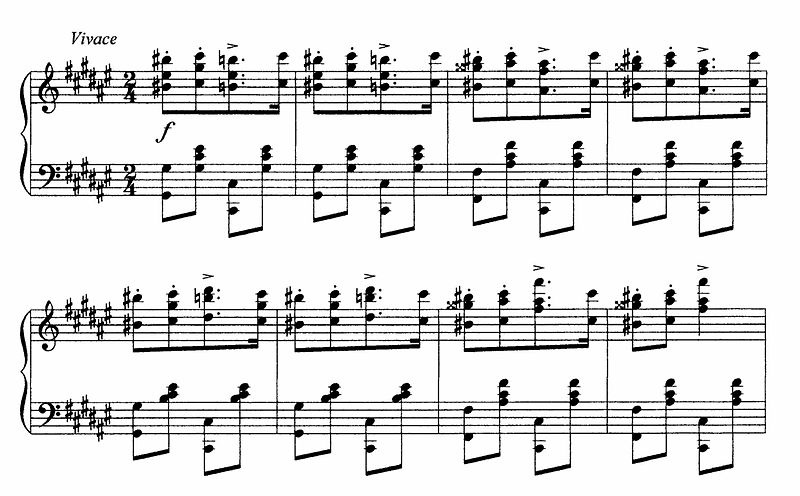
Franz Liszt’s “Hungarian Rhapsody no. 2 in c-sharp minor”

liszt

Hungarian Rhapsody No. 2, S.244/2, is the second in a set of 19 Hungarian Rhapsodies by composer Franz Liszt, and is by far the most famous of the set. Few other piano solos have achieved such widespread popularity, offering the pianist the opportunity to reveal exceptional skill as a virtuoso, while providing the listener with an immediate and irresistible musical appeal.

In both the original piano solo form and in the orchestrated version this composition has enjoyed widespread use in animated cartoons. Its themes have also served as the basis of several popular songs.

It is probable that you have heard this piece of music somewhere at one time or another because it is perhaps the most prominent piece of classical (romantic, actually) music featured in animated cartoons across the years.

Now, let the anvils fall and dynamite explode!

And, in real life, Valentina Lisitsa plays Liszt’s Hungarian Rhapsody No. 2

August 9 ~ Today in Music History

today


• 1874 ~ Reynaldo Hahn, Venezuelan-born French composer, conductor and music critic

• 1902 ~ Solomon Cutner, Classical pianist. A virtuoso performer, he played Tchaikovsky’s First Concerto at the age of 10. His career was stopped after a stroke in 1965.

https://youtu.be/4Vi0DwX6MEg

• 1902 ~ Zino (Rene) Francescatti, French concert violinist; passed away in 1991

• 1910 ~ A.J. Fisher of Chicago, IL received a patent for an invention that moms, grandmas and single guys certainly came to appreciate: the electric washing machine. Previous to Mr. Fisher’s invention, washing machines were cranked by hand (not easily done) – or you used a washboard (also sometimes used as a musical instrument).

• 1919 ~ Ruggiero Leoncavallo, Italian composer and librettist, died. He is famous for the single opera “Pagliacci” but never repeated the success with his other works.
More information about Leoncavallo

• 1932 ~ Helen Morgan joined the Victor Young orchestra to record Bill, a popular tune from Broadway’s Showboat.

• 1934 ~ Merle Kilgore, Songwriter Hall of Famer

• 1939 ~ Billy Henderson, Singer with Spinners

• 1955 ~ Benjamin Orr (Orzechowski), Musician, bass guitar, singer with The Cars

• 1963 ~ Whitney Houston, Grammy Award-winning singer

https://youtu.be/N_lCmBvYMRs

• 1963 ~ The TV program Ready, Set, Go! premiered on the BBC in London, England. The show gave exposure to such music luminaries as Bob Dylan and The Rolling Stones.

• 1964 ~ Joan Baez and Bob Dylan shared the stage for the first time when the singers performed in a concert in Forest Hills, NY.

• 1969 ~ Hot Fun in The Summertime, by Sly and the Family Stone, and Easy to Be Hard, from the Broadway production Hair, were released on this day. Hot Fun made it to number two on the music charts and Easy to Be Hard climbed to number four.

• 1975 ~ Dmitri Shostakovitch, Russian composer, died. He wrote 15 symphonies as well as operas, ballets and film and theater scores.
More information about Shostakovitch

https://youtu.be/tAL50lkWI8g

• 1995 ~ Jerry Garcia passed away

• 2003 ~ Chester Ludgin, a baritone in the New York City Opera for more than 30 years, died at the age of 78.
Ludgin sang a host of lead baritone parts, but was most recognizable in operas including “The Ballad of Baby Doe,” “The Devil and Daniel Webster” and “Susannah.” He debuted at the City Opera in 1957 in Johann Strauss II’s “Fledermaus.”
He also portrayed the part of Sam for Leonard Bernstein’s “A Quiet Place” at the Houston Grand Opera in 1983. He also sang for the San Francisco Opera and other North American companies.
His last appearance at City Opera was in 1991, but he remained on the stage, singing in musical comedies. His most recent lead was in “The Most Happy Fella.”

• 2005 ~ News Item:  New Vivaldi work heard for first time in 250 years.

August 7 ~ Today in Music History

today


• 1818 ~ Henry Charles Litolff, French pianist, composer and music publisher

• 1921 ~ Karel Husa, Czech-born American composer and conductor

• 1921 ~ Warren Covington, Bandleader, trombone, played with Horace Heidt and His Musical Knights

• 1925 ~ Felice Bryant, Songwriter with husband Boudleaux

• 1931 ~ Bix Beiderbecke, U.S. Jazz musician and composer, died. The first white musician to make an impact on jazz, he died from pneumonia aged 28.

• 1936 ~ Rahsaan Roland Kirk, American jazz musician

• 1937 ~ Bunny Berigan and his orchestra recorded I Can’t Get Started for Victor Records. The song became Berigan’s longtime theme song.

• 1939 ~ Ron Holden, Singer

• 1942 ~ B.J. (Billy Joe) Thomas, Singer

• 1943 ~ Lana Cantrell, Entertainer and singer

• 1952 ~ Andy Fraser, Musician: bass with Free

• 1958 ~ Bruce Dickenson, Singer with Iron Maiden

• 1970 ~ Christine McVie joined Fleetwood Mac as the group’s first female member. McVie was married to bass player John McVie. She quit touring with the group in 1991.

• 1971 ~ Homer (Henry D. Haynes) passed away

• 1975 ~ The Rolling Stones received a gold album for Made in the Shade.

• 1987 ~ Back to the Beach opened at theatres around the country. The film reunited Frankie Avalon and Annette Funicello, who played middle-aged parents with rebellious kids — kids like Frankie and Annette had played in their Bikini Beach movies in the 1960s.

• 2001 ~ Larry Adler, acknowledged as the king of the harmonica, died at the age of 87 at a London hospital after a long illness.
Adler, born in Baltimore in February 1914, was a musical prodigy whose career covered seven decades during which he worked with a veritable who’s who of the 20th century’s entertainment industry.

From George Gershwin to Elton John, the classically trained Adler had worked with and inspired generations of musicians, touring as late as 1994 and even planning an update of his 1985 biography “It Ain’t Necessarily So.”
“He was without doubt one of the greatest musicians of the 20th century” said musical agent Jonathan Shalit.
“Larry was a man who believed the show must always go on, even to the point of playing from his wheelchair,” he added.
Adler learned to play the piano and mouth organ by ear from listening to records and could not actually read music until 1941.
He won the Maryland Harmonica Championship in 1927 after being expelled from a music conservatory and promptly ran away to New York and got a job playing in film theaters between features.

In 1936 he played harmonica on George Gershwin’s Rhapsody in Blue, prompting the composer to exclaim that it sounded as though he had written the haunting melody specially for Adler.

During World War Two Adler toured extensively in Africa and the Middle East, entertaining troops, and insisting on a non-segregation policy between whites and blacks at concerts.

He also entertained in the South Pacific with artists including comedian Jack Benny, and worked consistently for the war effort and the Allied forces.

In 1945 he went to Berlin where he played The Battle Hymn of the Republic on harmonica on the balcony of Adolf Hitler’s ruined chancellery after Germany capitulated.

He left the U.S. for Britain in the early 1950s after being blacklisted during the McCarthy communist witch hunt.
Adler’s most familiar composition is the music for the film comedy “Genevieve,” but he composed the music for other films.
In 1967 and 1973, gave his services to Israel in aid of those affected by the Six Day and Yom Kippur wars.
After Adler guested on Sting’s 1993 album “Ten Summoner’s Tales,” the rock singer returned the compliment and appeared on Adler’s 80th birthday celebration,The Glory Of Gershwin.
They were joined by other stars from the rock world such as Meat Loaf, Kate Bush, Peter Gabriel and Sinead O’Connor.
A tennis fanatic, Adler once played in a doubles match with Charlie Chaplin, Greta Garbo and Salvador Dali.

• 2001 ~ Billy Byrd, who once played lead guitar for Ernest Tubb’s Texas Troubadours, died at the age of 81.
William Lewis Byrd was born in Nashville, and taught himself guitar by copying the records of Charlie Christian and Django Reinhardt.
In the 1940s, Byrd backed the Oak Ridge Quartet (predecessor of the Oak Ridge Boys), Little Jimmy Dickens, George Morgan and others.
In 1949, Byrd succeeded Tommy “Butterball” Paige as lead guitarist in Ernest Tubb’s Texas Troubadours.
On many of Tubb’s hit records, Tubb would introduce Byrd’s tight melodic solos by exclaiming, “Aw, Billy Byrd now,” or “Play it pretty, Billy Byrd.” Byrd played on scores of Tubb hits, including Jealous Loving Heart, Two Glasses Joe and Answer the Phone.
Byrd also drove Tubb’s bus during his first tenure with the Texas Troubadours, which lasted a decade. He returned twice to the band, from 1969-70 and 1973-74.
Byrd released three solo instrumental albums, and during a brief stint in California backed Tab Hunter and Tex Ritter. In 1950, Byrd and guitarist Hank Garland designed the popular Byrdland guitar for Gibson Guitars.

August 6 ~ Today in Music History

today


• 1834 ~ Hermann Mendel, German music lexicographer

• 1909 ~ Karl Ulrich Schnabel, German pianist and composer

• 1912 ~ Marina Koshetz, who followed her famous Russian diva mother Nina to the opera and concert stage and into the movies, was born.  Koshetz was born in Moscow, trained in France and came to the United States as a teen-ager. She made her debut substituting for her mother Nina Koshetz on radio’s “Kraft Music Hall.”  Using her father’s surname, she began appearing in films in the early 1930s as Marina Schubert. Among her early films were “Little Women,” “All the King’s Horses” and “British Agent.”
Marina concentrated more on her voice in the 1940s. Adopting the professional name Marina Koshetz, she went on to sing with the New York Metropolitan Opera and the Boston Symphony Orchestra.
Koshetz made her Los Angeles recital debut at the old Philharmonic Auditorium in 1947.

• 1921 ~ Buddy (William) Collette, Musician. reeds, piano and composer

• 1939 ~ After becoming a success with Ben Bernie on network radio, Dinah Shore started her own show on the NBC Blue radio network. Dinah sang every Sunday evening. Dinah also had a successful TV career spanning over two decades.

• 1940 ~ Columbia Records cut the prices of its 12-inch classical records. The records were priced to sell at $1. Within two weeks, RCA Victor did the same and ended a record-buying slump brought on by disinterested consumers.

• 1958 ~ Randy DeBarge, Musician, bass, vocals with DeBarge

• 1966 ~ The Beatles’ “Revolver” LP was released.

• 1973 ~ Stevie Wonder came close to losing his life, following a freak auto accident. Wonder, one of Motown’s most popular recording artists, was in a coma for 10 days. Miraculously, he recovered and was back in the recording studio in less than eight weeks.

• 1976 ~ Gregor Piatigorsky, Russian-born cellist, died
More information about Piatigorsky

• 1981 ~ Stevie Nicks’ first solo album, Bella Donna, was released. The lead singer for Fleetwood Mac scored a top-three hit with Stop Draggin’ My Heart Around from the album. Tom Petty and The Heartbreakers were featured on the track. Nicks went on to record a total of 11 hits for the pop-rock charts through 1988.