Philippe Entremont, conductor and piano
Pepe Romero, guitar
November 7, 2015 at 8:00 pm
Concert Hall
Bizet: Excerpts from Carmen Suites No. 1 and No. 2
Joaquin Rodrigo: Concierto Andaluz
Joaquin Rodrigo: Concierto de Aranjuez
Massenet: Ballet Music
Two of Europe’s most esteemed ensembles share the stage for a sublime evening of Spanish and French classical music. The Munich Symphony Orchestra is one of Germany’s most venerated musical institutions, held in high esteem by audiences, critics, and experts alike. This important orchestra has enriched the cultural life of Bavaria with its unparalleled performances of symphonic concert pieces, opera and operettas, musicals, ballets, oratorios, and church music. The pairing of this orchestra with conductor Philippe Entremont, who is renowned for his outstanding interpretive abilities on the podium, creates a stunning collaboration. The orchestra is joined by Spanish classical guitar virtuoso Pepe Romero for a solo work. Mr. Romero is then joined by the other members of his quartet, an ensemble that has a sterling reputation in the world of classical music. As New York Times said, “the only classical guitar quartet of real stature in the world today; in fact, they virtually invented the format.” The Washington Post praised the Munich Symphony Orchestra for “conjuring up a joyous whirlwind of sound that ultimately launched the music blazing into the ether.”
Pre-Performance Discussion: Member of the Company (Nov 7, 2015)
.1944 ~ Keith Emerson, Keyboards with Emerson, Lake & Powell as well as Emerson, Lake & Palmer
.1944 ~ Chris Morris, Guitarist with Paper Lace
.1945 ~ Rick Grech, Bassist, violinist
.1950 ~ Dan Peek, Guitarist, singer with America
.1951 ~ Ronald Bell, Saxophone with Kool & The Gang
.1957 ~ Lyle Lovett, Grammy Award-winning singer, Best Male Country Vocal in 1989
.1959 ~ Eddie MacDonald, Bass with The Alarm
.1962 ~ Rick Allen, Drummer with Def Leppard
.1962 ~ Mags Furuholmen, Keyboards, singer with a-ha
.1968 ~ George Harrison’s soundtrack LP, “Wonderwall”, was released. It was the first solo album by one of The Beatles. The album was also the first on the new Apple label.
.1969 ~ Warner Brothers Records added Faces, to its roster. They fared OK, but even better when lead singer Rod Stewart stepped out to become a superstar on his own. The group’s former label, Mercury, capitalized on the fact by releasing Maggie Mae and three other Faces tunes before Stewart went solo for Warner exclusively.
.1969 ~ The last album of The Beatles reached #1 on the album chart. “Abbey Road” was the top LP for eleven nonconsecutive weeks. The final studio recordings from the group featured two songs; ‘Something’ & ‘Here Comes The Sun’. The cover supposedly contained clues adding to the ‘Paul Is Dead’ phenomenon: Paul is barefoot and the car number plate ‘LMW 281F’ supposedly referred to the fact that McCartney would be 28 if he was still alive. ‘LMW’ was said to stand for ‘Linda McCartney Weeps.’
1975 ~ Elton John’sIsland Girl hit number one on the Billboard Hot 100 chart. The song parked itself at the top of the hit heap for 3 weeks.
Halloween (All Hallow’s Eve) is an ancient celebration dating back to the sixth or seventh centuries. This holiday combines the Druid autumn festival and the Christian celebration of Hallowtide, long associated with witches, ghosts, devils, spirits, magic … and all scary things that go bump in the night.
• 1896 ~ Ethel Waters, American blues and jazz singer
• 1906 ~ Louise Talma, American composer
• 1912 ~ Dale Evans (Frances Butts), Singer, songwriter of Happy Trails to You, actress, wife of ‘King of the Cowboys’ Roy Rogers
• 1927 ~ Anita Kerr, Pianist, singer, record producer, The Anita Kerr Singers, composer
• 1930 ~ In a rare recording, William ‘Count’ Basie sang with Bennie Moten’s orchestra, Somebody Stole My Gal, on Victor.
• 1934 ~ Tom Paxton, American folk singer, guitarist and songwriter
• 1947 ~ Russ Ballard, Singer, songwriter, guitar with Argent
• 1952 ~ Bernard Edwards, Bass with Chic
• 1953 ~ NBC televised “Carmen” on Opera Theatre in living color. It was the first major opera televised in anything other than black and white.
• 1956 ~ Tony Bowers, Bass with Simply Red
• 1961 ~ Larry Mullen, Grammy Award-winning drummer, with U2
• 1963 ~ Johnny Marr, Guitarist with The Smiths
• 1972 ~ Curtis Mayfield received a gold record for Freddie’s Dead from the movie, Superfly.
• 1984 ~ Caribbean Queen became a gold record for Billy Ocean. It was Ocean’s second hit song and the only one of his 11 hits to become a million-seller. He would have two other #1 songs and a pair of #2 hits, but none as big as Caribbean Queen (No More Love on the Run). Billy’s from Trinidad, and his real name is Leslie Sebastian Charles.
Johann Sebastian Bach’s towering monument of organ music, with its deep sense of foreboding, will forever be associated with Halloween.
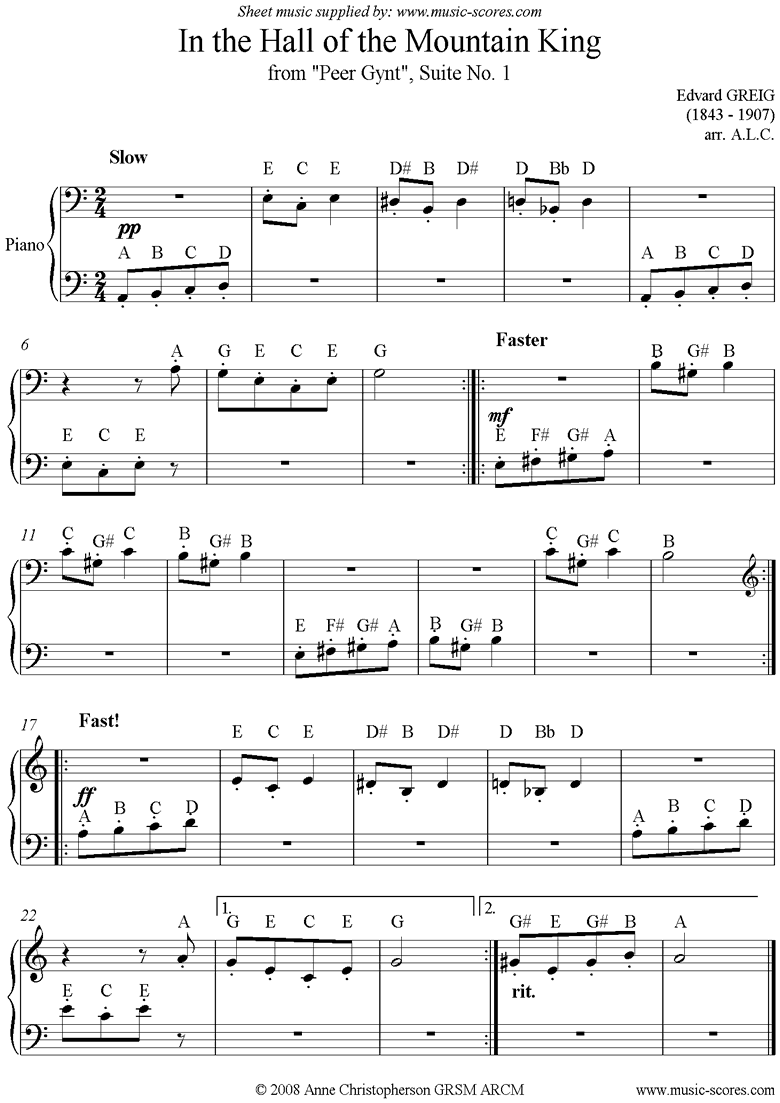
Get a free copy of the sheet music at IMSLP or borrow a copy from the O’Connor Music Studio. I have this arranged for organ, piano, duet, 2-piano, simplified…
“In the Hall of the Mountain King” is a piece of orchestral music composed for the sixth scene of act 2 in Henrik Ibsen’s 1867 play Peer Gynt. It was originally part of Opus 23 but was later extracted as the final piece of Peer Gynt, Suite No. 1, Op. 46. Its easily recognizable theme has helped it attain iconic status in popular culture, where it has been arranged by many artists, including for the piano.
Borrow a copy of the sheet music from the O’Connor Music Studio. I have this arranged for piano, duet, 2-piano, simplified…
8 part vocal orchestra (plus a tiny pair of cymbals)
Night on Bald Mountain refers to a series of compositions by Modest Mussorgsky (1839–1881). Inspired by Russian literary works and legend, Mussorgsky composed a “musical picture”, St. John’s Eve on Bald Mountain on the theme of a witches’ sabbath occurring on St. John’s Eve, which he completed on that very night, June 23, in 1867.
Get a free copy of the sheet music at IMSLP or buy it on amazon.com.
From Disney’s Fantasia
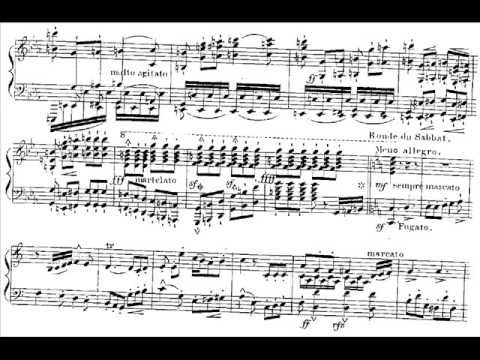
Piano version transcribed for solo piano by Konstantin Chernov (1865-1937).
The Ludwig Symphony Orchestra, conducted by Maestro Thomas Ludwig
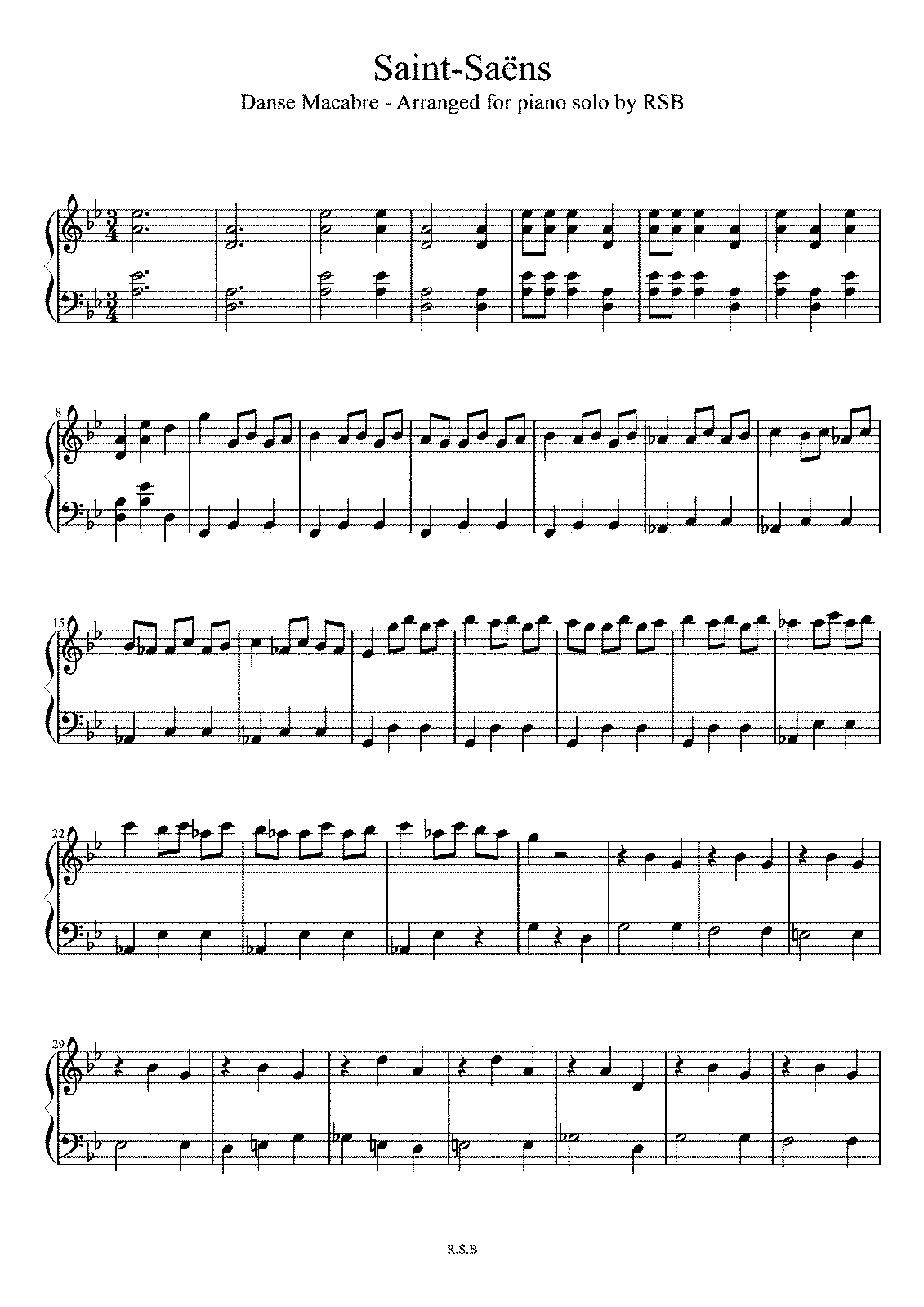
Danse macabre, Op. 40, is a tone poem for orchestra, written in 1874 by French composer Camille Saint-Saëns. It started out in 1872 as an art song for voice and piano with a French text by the poet Henri Cazalis, which is based on an old French superstition. In 1874, the composer expanded and reworked the piece into a tone poem, replacing the vocal line with a solo violin.
Get a free copy of the sheet music at IMSLP (Look for Arrangements and Transcriptions) or borrow a copy from the O’Connor Music Studio. I have this arranged for organ, piano, duet, simplified…
Amazon has a great Dover edition for solo piano. This splendid compilation features a variety of the composer’s best piano works, all reproduced from authoritative sources. Taking its title from the popular orchestral work “Danse Macabre” (presented here in the brilliant arrangement by Liszt), this collection also includes “Allegro appassionato,” “Album” (consisting of six pieces), “Rhapsodie d’Auvergne,” “Theme and Variations,” plus six etudes, three waltzes, and six etudes for left hand alone.
• 1941 ~ Everything I Love, by Buddy Clark, was recorded this day, number 6469 on the Okeh label.
• 1943 ~ Lee (Melvin) Greenwood, CMA Male Vocalist of the Year, 1983 and 1984, sax, piano, band leader
• 1957 ~ The Crickets started a three-week run at No.1 on the UK singles chart with ‘That’ll Be The Day’. It was also a No.3 hit in the US where it went on to sell over a million. The song was inspired by a trip to the movies by Holly, Jerry Allison and Sonny Curtis in June 1956. The John Wayne film The Searchers was playing and Wayne’s frequently-used, world-weary catchphrase, “that’ll be the day” inspired the young musicians.
• 1958 ~ Simon LeBon, Singer with Duran Duran
• 1975 ~ Rocker Bruce Springsteen appeared on the cover of both TIME and Newsweek. Things were certainly going well for ‘The Boss’ that week.
• 2000 ~ Walter Berry, a bass baritone who won acclaim for his interpretations of Mozart and Strauss and was beloved by Austrians for his renditions of Schubert, died of a heart attack at the age of 71. Known for the powerful timbre of his voice, Berry was a prolific performer who sang 100 different roles in more than 1,280 appearances at the Vienna State Opera. His U.S. debut was a 1963 performance with the Metropolitan Opera in New York. His interpretations of classical lieder by fellow Austrian Franz Schubert won him his most loyal following. Austrians who rarely went to the opera loved Berry for his renditions of popular Viennese songs performed as they believed only a native- born son could. In 1989, he became a professor at the Vienna University for Music and Performing Arts.
• 2001 ~ John Roberts, a promoter of the Woodstock Music and Art Fair in 1969, died of cancer. He was 56. Roberts produced the festival concert with three others, almost by accident. The idea originally was a pitch for a television comedy show about two young venture capitalists with money but no business plans. Roberts and his partners funded the festival with Roberts’ inheritance and ticket sales. They lost $2.3 million but recovered their loss with royalties from film and album spinoffs, and held on to the profitable name and trademark symbol of a dove on the neck of a guitar. A graduate of the University of Pennsylvania, Roberts later invested in other companies, avoiding the music business. Roberts also was a championship bridge player.
• 2006 ~ Amy Winehouse released her second and final studio album Back to Black. The album spawned five singles: ‘Rehab’, ‘You Know I’m No Good’, ‘Back to Black’, ‘Tears Dry on Their Own’ and ‘Love Is a Losing Game’ and won Best Pop Vocal Album at the 50th Annual Grammy Awards. Back to Black sold 3.58 million copies in the UK alone, becoming the UK’s second best-selling album of the 21st century. Worldwide, the album has sold over 20 million copies.
The final movement is the best known part of the symphony, thanks to its use in the Julia Roberts movie, Sleeping With The Enemy. It features a four-part structure, which Berlioz described in his own program notes from 1845 as follows:
“He sees himself at a witches’ Sabbath, in the midst of a hideous gathering of shades, sorcerers and monsters of every kind who have come together for his funeral. Strange sounds, groans, outbursts of laughter; distant shouts which seem to be answered by more shouts. The beloved melody appears once more, but has now lost its noble and shy character; it is now no more than a vulgar dance tune, trivial and grotesque: it is she who is coming to the Sabbath… Roar of delight at her arrival… She joins the diabolical orgy… The funeral knell tolls, burlesque parody of the Dies irae, the dance of the witches. The dance of the witches combined with the Dies irae.”
The Dies irae melody is one of the most-quoted in musical literature, appearing in the works of many diverse composers.
The traditional Gregorian melody has also been used as a theme or musical quotation in a number of classical compositions, notable among them:


 1830 ~
  Happy Halloween