Piano Maestro A Parent’s Guide

Piano Mania


It will be fun watching your child improve their piano skills all while having fun using Piano Maestro in lessons each week!

As your child’s teacher (or YOUR teacher!), I’m looking forward to seeing the progress they will make when they start using it at home each day. This guide will help you understand how this app will benefit your child and how to get it set up on your own iPad.


Overview
What is Piano Maestro?

Piano Maestro is the ultimate piano practice tool that will have students quickly playing their favorite classical, pop, rock, TV and video game songs and themes. It is available in the App Store and works on the iPad.


What skills does it improve?
• Note reading
• Sight reading
• Rhythm
• Inner pulse
• Confidence


What makes it so fun?
• Upbeat background tracks
• Stunning graphics
• Instant rewards and feed back
• Satisfaction of playing REAL music


It works with an acoustic piano?

Yes! Your child practices on your real acoustic or digital piano. Piano Maestro listens from the iPad’s built in microphone. No wires needed.


I’m already paying for lessons and books. What value does this add?

Sometimes I wish I could be there with your child to encourage them to keep practicing daily. I’m sure it’s not always easy, as unforeseen challenges will arise.

Since our time each week is just too short, this app will give me eyes on the ground and it will keep them practicing longer and improving more quickly.


How will it be used in lessons?

I will spend a few minutes of each lesson helping your child master a couple of new songs all while having fun! I will also teach them how to use the practice options at home.

At the end of the lesson, we will choose Home Challenge assignments within the app that will show up in your account at home. I’ll get updates when progress is made.


Getting Started
Wow, this sounds awesome. Now, how do I get started?

1) Download Piano Maestro on your iPad from the AppStore
2) Create a JoyTunes account with a parent’s email, under which, you can have multiple profiles for each member of the family.
3) Create a profile for each family member (that means you too Mom and Dad!) inside the Parent/Teacher zone (top right hand corner of main screen)
4) Connect to your teacher, me! After creating a profile in the “profiles” tab of the parent/teacher zone, select the student’s profile and click “connect to teacher.” Once I approve connection to your child, they will receive full access to all content for FREE! I will then also begin receiving weekly progress reports.
5) Start Playing – I will now start assigning you homework, meanwhile get started on Journey Mode.


There is one change in the video below – when you connect to the O’Connor Music Studio, Piano Maestro is free forever.

How do we know if children are ready to begin music lessons? « Piano Pedagogy @ The New School for Music Study

child-piano

These days, there is much pressure for parents to begin their children in activities from an early age.  We know that children tend to pick up new skills easily and we want for them to have an opportunity to become experts at these new skills.  We also see curiosity, desire and eagerness to learn in our children and want to capitalize on that.

Music lessons are no exception.  We often get calls asking the question, “When is the best time to enroll my child in piano lessons?”  The answer to that is a tricky one, and varies for each child.  The right age for one may not be the right age for another.  Here are a few questions to ask yourself if you are considering enrolling your child in music lessons:

1.   Does my child have an attention span to sit still for chunks of time and listen to instruction?

Many teachers today are very creative in using off-bench activities during lessons and have a plethora of activities to make lessons fun and engaging.  However, the fact remains that your child will need to sit at the piano for some periods of time during the lesson.  It is important that your child have the attention span to do this.

Read more at  How do we know if children are ready to begin music lessons? « Piano Pedagogy @ The New School for Music Study.


JoyTunes, Now Free For Music Teachers And Students, On Its Big Strategy Shift | Fast Company | Business + Innovation

Piano Mania


Yuval Kaminka was faced with a difficult choice. The Israeli entrepreneur had built a successful music learning app called JoyTunes, and he found that it was particularly beloved by professional music teachers. In the span of months, “we saw a vibrant community of teachers revolving around the apps,” he says. All the metrics were growing: retention, engagement, number of student profiles per teacher, and so on. “All these figures really blew up. We saw it was really making a difference.”

The accounts teachers were setting up for students–who use the app to gamify music learning–comprised a very significant part of JoyTunes’s revenue. Every time a teacher set up an account, either for themselves or their students, they paid either $10 a month or $60 per year. Power users wound up paying as much as $1,000 a month. Kaminka says that about 40% of his profits came from music teachers.

Read more at JoyTunes, Now Free For Music Teachers And Students, On Its Big Strategy Shift | Fast Company | Business + Innovation.

Finding The Right Teacher For Your Music-Loving Kid: Deceptive Cadence

NOT Mrs. O'Connor!

NOT Mrs. O’Connor!

See if a prospective teacher allows a trial lesson to test how the personalities mesh. And be sure to ask lots of questions. What’s the teacher’s background as a musician and as an instructor? What kinds of teaching materials and music does she use? How much practice time is expected for students, and does that vary by the student’s age? Does the teacher have access to student ensembles? What kinds of performance opportunities will he provide? Will the teacher allow the student to record the lesson? This can be a terrific practice aid, especially when it comes to remembering how something is supposed to sound. Does she teach any music theory or composition? What are the expectations for students and for their parents?

A good teacher can be a friendly, encouraging and inspiring presence — even when a student hits rough patches. He will point out the student’s weaknesses without being harsh or dismissive, suggest innovative ways to overcome challenges, and create engaging ways to tackle even rote activities like playing scales or honing fine motor skills. The instructor’s age and experience might or might not be a deciding factor; for example, I’m consistently impressed by the range of tricks my own child’s very youthful private teacher has up her sleeve to turn what could easily be drudgery into fun. Not to mention the huge helpings of good humor and patience she brings to her tiny charges!

Read more at Finding The Right Teacher For Your Music-Loving Kid : Deceptive Cadence : NPR.

Are You Moving this Summer?

Many homeowners don’t realize that there are movers available to them who specialize in the transportation and storage of pianos. A piano is a delicate instrument and not something you want to take risks with. By trusting this major job to a piano mover, you can rest easy knowing that one of the most valuable items in your home is being transported with the care it deserves.

But It Weighs 1500 Pounds. How Delicate Can It Be? 

pianomovingThis is exactly where many homeowners go wrong. Sure, that piano in your living room is heavy enough to throw out the backs of four or five of your best buddies as you wrestle it out the door and up into the truck, but don’t let that fool you. Despite its bulky appearance, it is also a precision musical instrument with over 1000 moving parts and 200 finely-tuned strings, any number of which can be damaged and require repair if your piano isn’t handled properly in a move.

Your Piano Mover Understands Pianos

These intricate inner workings of a piano are exactly why hiring an expert in piano moving is so important. These professionals understand pianos and moving them, from the safest way to lift and twist a standard upright piano to get it out the door, to how to properly disassemble a grand piano and transport it without causing any damage. And even more importantly, a piano mover understands that when your piano is delivered to your new home, you expect to be able to sit down and play it right away. It’s why many piano movers keep tuners and repairmen on staff, and why the rest will have a trusted list of professionals available on request if you need it.


From: http://www.homeadvisor.com/article.show.Don-t-Take-Risks-Moving-Your-Piano-Hire-an-Expert.14222.html#ixzz39Gny25qc

The Studio Painting is Done!

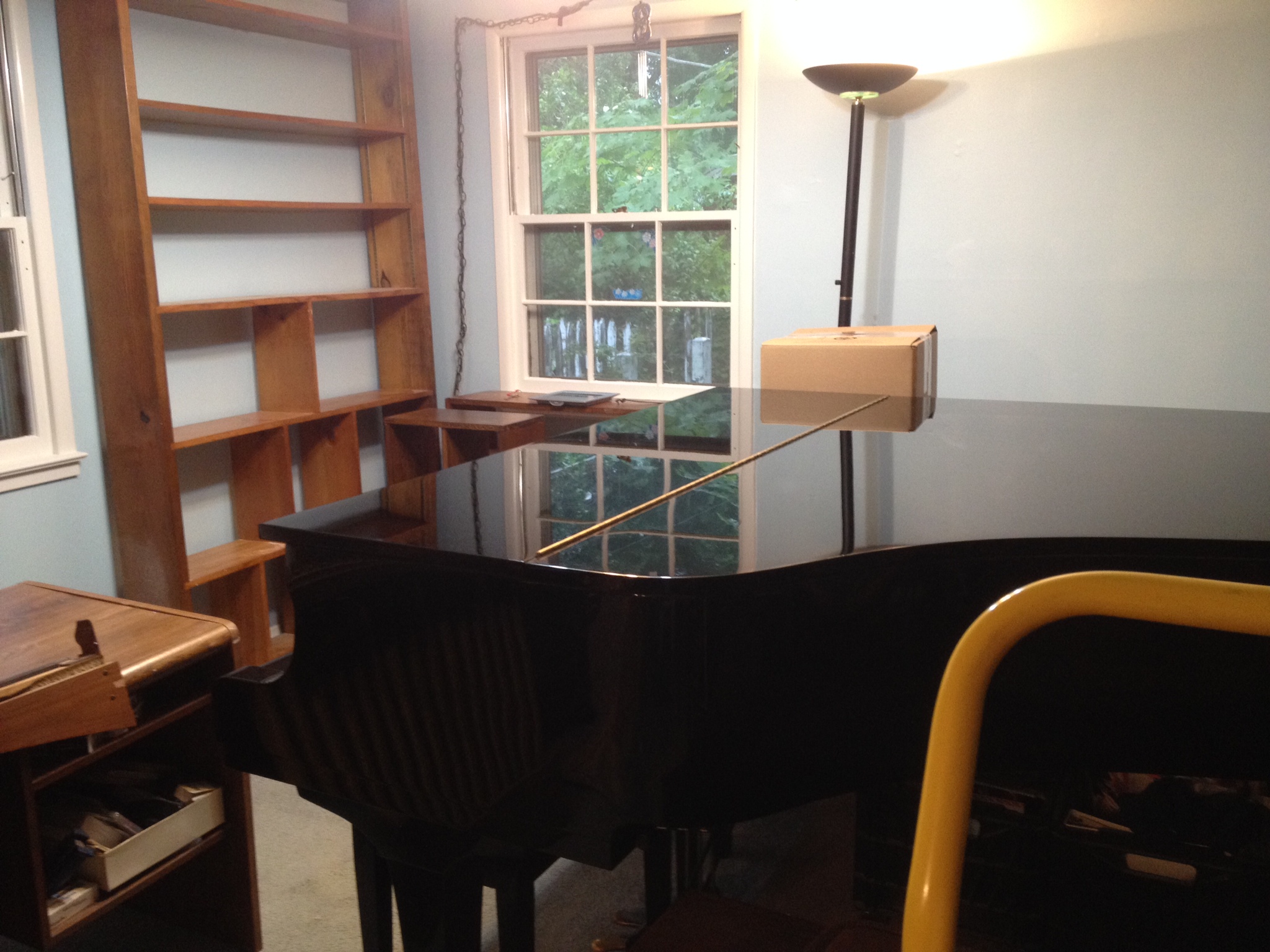
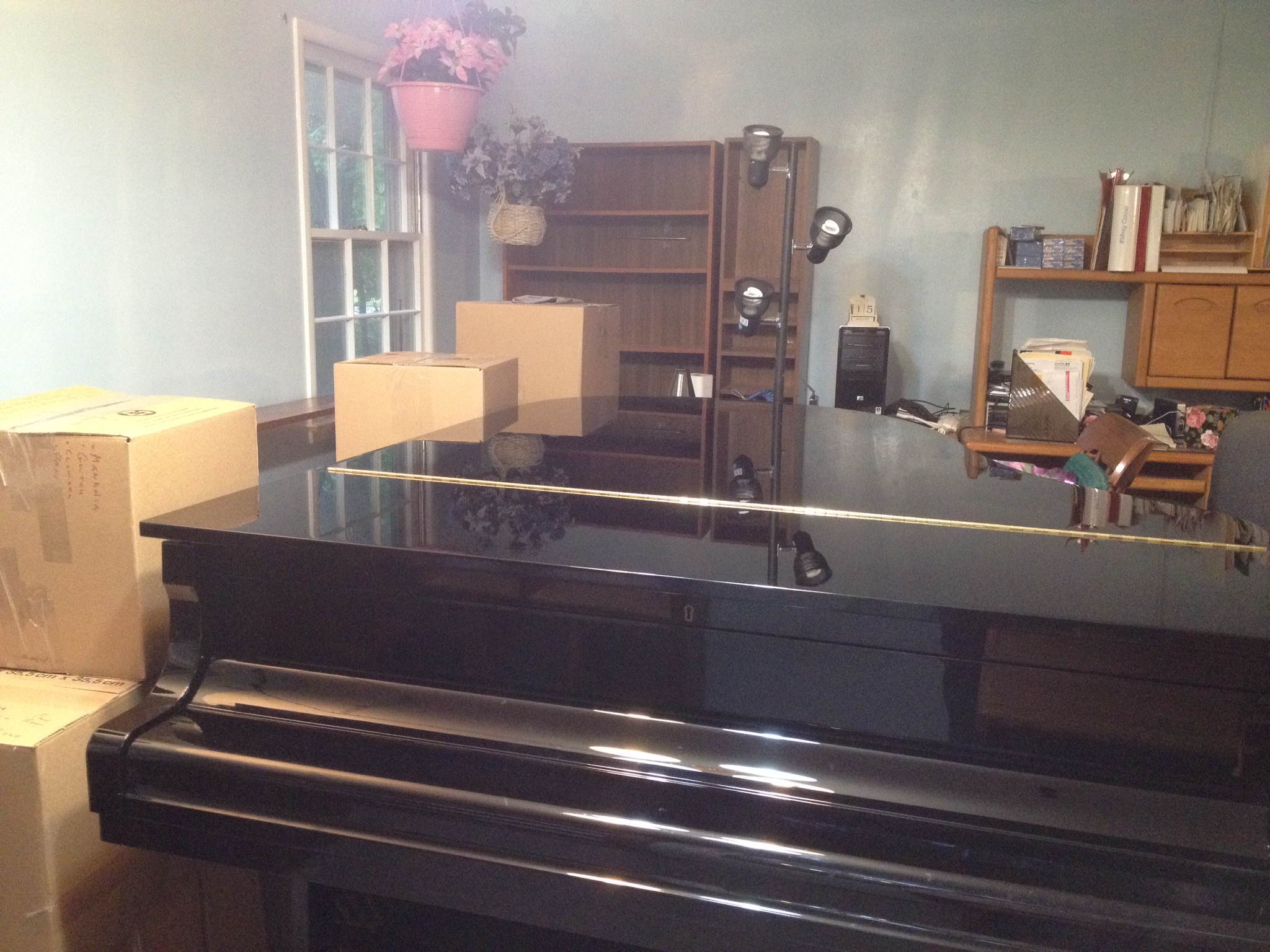
photo 1photo 2


Now, it’s time to start putting the furniture back where it goes, although I think I’m leaving the piano more in the center of the room for now.  It shows the piano off better and I’ll have a place to put the digital keyboard against the wall and closer to the piano.

After a lot of thought, the organs will stay in their respective places next to each other but the music for them will be moving nearer to them.

Then putting all the other books away.  I have an iPad app which is a database that adds items by taking pictures of their barcodes.  Hopefully, this will help organize some of my books.

It won’t be done by Monday but it will be done enough for teaching purposes!


Practising the Piano – The Myth of the Instant Fix

When they make a mistake they hack away at it until it finally yields, and simply move on. What they have actually practised is getting it wrong three or four times in a row and right on the fifth attempt. What, then, are the chances of getting it right the first time in the context of the flow of the piece?

via Practising the Piano – The Myth of the Instant Fix.

NO Piano Lessons Monday July 14!

The studio is just about cleared out and most things moved to the center of the room so that the painters can start painting Tuesday morning.

I had planned on teaching Monday, but with everything moved, it is far too difficult (but not impossible!) to get to the piano.

Painting is supposed to take only two days so it should be done on Wednesday (or Thursday!) and completely dry before the next lessons.

Thanks for your understanding and keep practicing! Next lesson, the studio will be a pretty blue color 🙂

Thanks,


maryOivoryandroses

Summer Schedules!

It’s hard to believe but summer is nearly upon us.  FCPS students are getting out later this year due to snow days, so the regular school year piano lessons are going a bit longer, as well.

Here’s the basic schedule from now through the start of fall lessons.  Please remember that students must take at least 6 summer lessons to hold a current school year lesson time for the fall.

The last day of school is  June 25, so there are no lessons week of June 23 (school age students only.  Adults continue, as always)

No lessons 4th of July weekend – July 3-5

No lessons after noon the week of July 7-11 (Pender UMC Music Camp)

No lessons August 15-Sept 2


Lessons (11 adult lessons, 10 school age students offered):

June 2 9, 16, 23 (except FCPS students – last week of school), 30
July 7 (mornings only), 14, 21, 28
Aug 4, 11

Sept 8, the fall semester begins


If you need to reschedule, please call, email or FaceBook me and with at least 24-hours notice. There are some open spots available on the schedule.  You can view them here: https://ocms.youcanbook.me/.   Those times are “more like guidelines.  I will contact you to confirm any changes.  As always, the PW is “piano”.


happy_summer